eBook - ePub
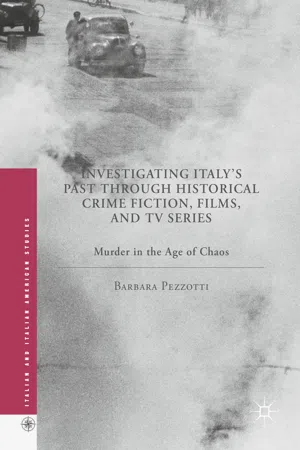
Investigating Italy's Past through Historical Crime Fiction, Films, and TV Series
Murder in the Age of Chaos
- English
- ePUB (mobile friendly)
- Available on iOS & Android
eBook - ePub
Investigating Italy's Past through Historical Crime Fiction, Films, and TV Series
Murder in the Age of Chaos
About this book
This book is the first monograph in English that comprehensively examines the ways in which Italian historical crime novels, TV series, and films have become a means to intervene in the social and political changes of the country. This study explores the ways in which fictional representations of the past mirror contemporaneous anxieties within Italian society in the work of writers such as Leonardo Sciascia, Andrea Camilleri, Carlo Lucarelli, Francesco Guccini, Loriano Macchiavelli, Marcello Fois, Maurizio De Giovanni, and Giancarlo De Cataldo; film directors such as Elio Petri, Pietro Germi, Michele Placido, and Damiano Damiani; and TV series such as the "Commissario De Luca" series, the "Commissario Nardone" series, and "Romanzo criminale–The series." Providing the most wide-ranging examination of this sub-genre in Italy, Barbara Pezzotti places works set in the Risorgimento, WWII, and the Years of Lead in the larger social and political context of contemporary Italy.
Information
Topic
LetteraturaSubtopic
Film e video© The Author(s) 2016
Barbara PezzottiInvestigating Italy's Past through Historical Crime Fiction, Films, and TV SeriesItalian and Italian American Studies10.1057/978-1-349-94908-3_11. Introduction
Barbara Pezzotti1
(1)
Victoria University of Wellington, Wellington, New Zealand
This book is an investigation into the Italian past and present through crime fiction. 1 It is not a history volume, but a study of how the experiences of war, dictatorship, political violence, and terrorism have been refracted and constructed through the prism of crime literature and cinema. By taking as its point of departure the privileged relationship between the crime genre and history, the book intends to examine the ways in which historical giallo novels, television series, and films have become a means to comment on and intervene in the social and political changes of the country. 2
Literature is a powerful instrument to investigate the past. History volumes are necessarily influenced by the contemporary socio-political and cultural framework of a historian and are subordinate to an epoch-specific topical paradigm of scientific reflection. 3 By contrast being free from the constraints of historiography, fiction writers are able to penetrate “the interstices of history” 4 and interpret obscure events, “recreating the missing pieces.” 5 Indeed, historical fiction recovers “memory from silence” often uncovering “the lies of official history” by filling the gaps historiography cannot fill. 6 Ultimately in Lukács’s words, historical fiction “offers a truer, more complete, more vivid, and more dynamic reflection of reality than the receptant otherwise possesses.” 7
On its part, cinema is a powerful mediator among history, memory, and politics. Rosenstone has celebrated the ability of cinema to enact a connection between past and present through its narrative and visual prerogatives. 8 As O’Leary points out, cinema provides “effective frames for understanding historical events” and a film is “symptomatic both of its time and of the code of representation of the medium itself—in terms of its elisions, omissions and evasions as well as of its emphasis.” 9 A film as a commercial product to be marketed and consumed can also provide a further insight into acceptable and inacceptable aspects of a given past. 10 Finally, it carries a political function as it is “subtextually linked to contemporary national issues.” 11 In other words, historical cinema challenges the perception that memory is primarily about the remembrance of the past and demonstrates that they also pertain to the present.
For Halbwachs, memory and recollection are intrinsically social phenomena. 12 A society can have a “collective memory,” and this memory is dependent upon the framework within which a group is situated in a society. Thus, there is not only an individual memory but also a group memory that exists outside of and lives beyond the individual. Consequently, an individual’s understanding of the past is strongly linked to this group consciousness. As Straub explains, collective recollections as communicative constructions of a shared past may serve two different purposes. First, they can be regenerative inasmuch as they serve the purpose of stabilizing the already existing traditional cultural-specific components of the social or individual life, such as norms, values, and rules. Second, they can be innovative. In this case, they create a break with the continuities of an established socio-cultural life. Therefore, they can generate a new understanding of the historical process and its disruption, a new version of the past, a new outlook on the present, and a new group-shared expectations for the future. 13 According to Ricoeur, continental memories of wars are reconstructed through both remembrance and amnesia. 14 This is particularly true for Italy. As Rusconi points out, for a long time national history has not been a principal moment of the democratic public discourse, and the incapacity to narrate the collective past in a convincing manner remains the main destabilizing factor in contemporary culture. 15 Indeed, in Italy, diametrically opposed memories of the past intended as recollection of basic historical facts (and not only of their significance) still coexist. As Foot shows, the Italian anomaly rests not as much as in the plurality of its narrative but, rather, in their pursuit of institutional legitimacy. 16 This attempt at manipulating history for propaganda purposes is evidence of the politicized nature of memory in Italy. 17
Writer Vincenzo Consolo stated that “the writing of historical fiction as a genre has nothing to do with escapism or nostalgia, nor does it defer to utopia.” 18 According to Della Colletta, following Alessandro Manzoni’s example, contemporary Italian writers, such as Giuseppe Tomasi di Lampedusa, Elsa Morante, and Umberto Eco, wrote historical novels that “imply a revisionist attitude with respect to the historical records. Invention, therefore, becomes a way to fill in the gaps in the archives and tell the stories of those who did not have a voice in the historical world.” 19 Analyzing literary novels set in ancient Rome, in the Middle Ages, the Renaissance, and the eighteenth century, Rebane argues that the new wave of historical fiction of the 1980s and 1990s in Italy “is characterised by the innovative ways of depicting, exploring and questioning the collective past.” 20 According to Rebane, the historical novel in particular unfolds its “powerful potential for a critical diagnosis of contemporary society” by representing “a search for new collective identities endangered by major socio-political transformations within and without Italy” 21 such as the increasing economic and political power of the European Union. Equally interestingly, Ganeri associates the recent revival of historical narratives with the fear produced by the information-technology revolution and by the impact of multimedia languages on the selection processes of historical memory. 22 In other words, working on the past would represent a natural form of resistance, because of its capacity to exalt that which the techno-communicative transitions tend to undermine from within: the value of the present and its root with the past.
What about crime fiction, specifically? Hampered by prejudices, this genre has been ignored by scholars for a long time, and only in the last few decades has become object of a lively scholarship. 23 The crime genre has engaged extensively with history, in Italy and abroad. Historical crime fiction has in fact developed into the fastest growing type of crime fiction. 24 Browne explains this impressive growth with the fact that “the reader gets the same kind of thrill at a safe distance that he or she gets from more contemporary and directly threatening true crime literature” and in the context of a new and revitalized general interest in history worldwide. 25 This may be true for crime narrative set in the distant past, but it may be argued that the success of crime narrative set in the near past speaks rather of the interest in making sense of the present by returning to its roots. In some cases, as Said acutely puts it, “[w]hat animates such appeals [to the past] is not only disagreement about what happened in the past and what the past was, but uncertainty about whether the past is really past, over and done with, or whether it continues, albeit in different forms.” 26
Spurred by the international success of Umberto Eco’s Il nome della rosa, 27 several Italian writers of the 1990s and 2000s employed the form of the historical novel, mostly concentrating on more recent—and particularly troubled—periods of Italian history, such as the Risorgimento (1815–1870) and Fascism (1922–1943). The focus of crime narrative is especially on justice and the law and relates to the hot topic of personal and collective responsibilities in the past and in the present. This is not surprising as the crime genre lends itself to exposing, denouncing, and addressing social and political injustice, often as a response to specific political and social climates experienced by the authors.
In spite of recurring prejudices, today there is a growing recognition in the social sciences of “popular” criminological texts, such as film, television drama, crime fiction, and true crime, as valid social documents, which shape both public and academic understanding of crime, justice, and victimization and offer alternative means of engaging with criminal events and “knowing” about crime. 28 This volume builds on recent scholarship on international historical crime fiction that highlights the importance of the genre for dealing with the past and the present. For its special relationship with topics such as legality, culpability, and responsibility, a crime novel is also a mostly suitable medium for recounting history. 29 The formula of the investigation allows tackling history from a hypocaliptic prospective: that is, a micro-story—the investigation itself—tha...
Table of contents
- Cover
- Frontmatter
- 1. Introduction
- 2. The Foundation of the State: Giallo and the Risorgimento
- 3. The Giallo and the Black: The Representation of Fascism and WWII Between Revisionism and Criticism
- 4. The Giallo and Terrorism: The Years of Lead and the Conspiracy Theory
- 5. Conclusions
- Backmatter
Trusted by 375,005 students
Access to over 1.5 million titles for a fair monthly price.
Study more efficiently using our study tools.
Frequently asked questions
Yes, you can cancel anytime from the Subscription tab in your account settings on the Perlego website. Your subscription will stay active until the end of your current billing period. Learn how to cancel your subscription
No, books cannot be downloaded as external files, such as PDFs, for use outside of Perlego. However, you can download books within the Perlego app for offline reading on mobile or tablet. Learn how to download books offline
Perlego offers two plans: Essential and Complete
- Essential is ideal for learners and professionals who enjoy exploring a wide range of subjects. Access the Essential Library with 800,000+ trusted titles and best-sellers across business, personal growth, and the humanities. Includes unlimited reading time and Standard Read Aloud voice.
- Complete: Perfect for advanced learners and researchers needing full, unrestricted access. Unlock 1.5M+ books across hundreds of subjects, including academic and specialized titles. The Complete Plan also includes advanced features like Premium Read Aloud and Research Assistant.
We are an online textbook subscription service, where you can get access to an entire online library for less than the price of a single book per month. With over 1.5 million books across 990+ topics, we’ve got you covered! Learn about our mission
Look out for the read-aloud symbol on your next book to see if you can listen to it. The read-aloud tool reads text aloud for you, highlighting the text as it is being read. You can pause it, speed it up and slow it down. Learn more about Read Aloud
Yes! You can use the Perlego app on both iOS and Android devices to read anytime, anywhere — even offline. Perfect for commutes or when you’re on the go.
Please note we cannot support devices running on iOS 13 and Android 7 or earlier. Learn more about using the app
Please note we cannot support devices running on iOS 13 and Android 7 or earlier. Learn more about using the app
Yes, you can access Investigating Italy's Past through Historical Crime Fiction, Films, and TV Series by Barbara Pezzotti in PDF and/or ePUB format, as well as other popular books in Letteratura & Film e video. We have over 1.5 million books available in our catalogue for you to explore.