The Fundamentals of Architecture, 2nd Edition is an introduction to the basic ideas that inform architecture. It is intended to unravel the complexity of architecture to explain its process and make it more accessible. It guides students through the rich history of the discipline, and introduces aspects of contemporary theory and practice. The book explores the process of architecture starting from the initial ideas and concepts, and how these ideas are informed by understanding site and context. It examines the impact of the physical environment and the historical ideas that have informed and influenced the architectural solution. The second edition has been redesigned and updated with new material, including six case studies, exercise sections and contemporary visuals from students and leading architects.
- 200 pages
- English
- ePUB (mobile friendly)
- Available on iOS & Android
eBook - ePub
The Fundamentals of Architecture
About this book
Information
Chapter 1
Placing Architecture
In architectural terms, ‘context’ generally refers to the place in which architecture or buildings are located. Context is specific and significantly affects how an architectural idea is generated. Many architects use context to provide a clear connection with their architectural concept, so the resultant building is integrated and almost becomes indistinguishable from the surrounding environment. Other responses may react against the environment, and the resultant buildings will be distinct and separate from their surroundings. Either way, the critical issue is that the context has been studied, analysed and responded to deliberately and clearly.
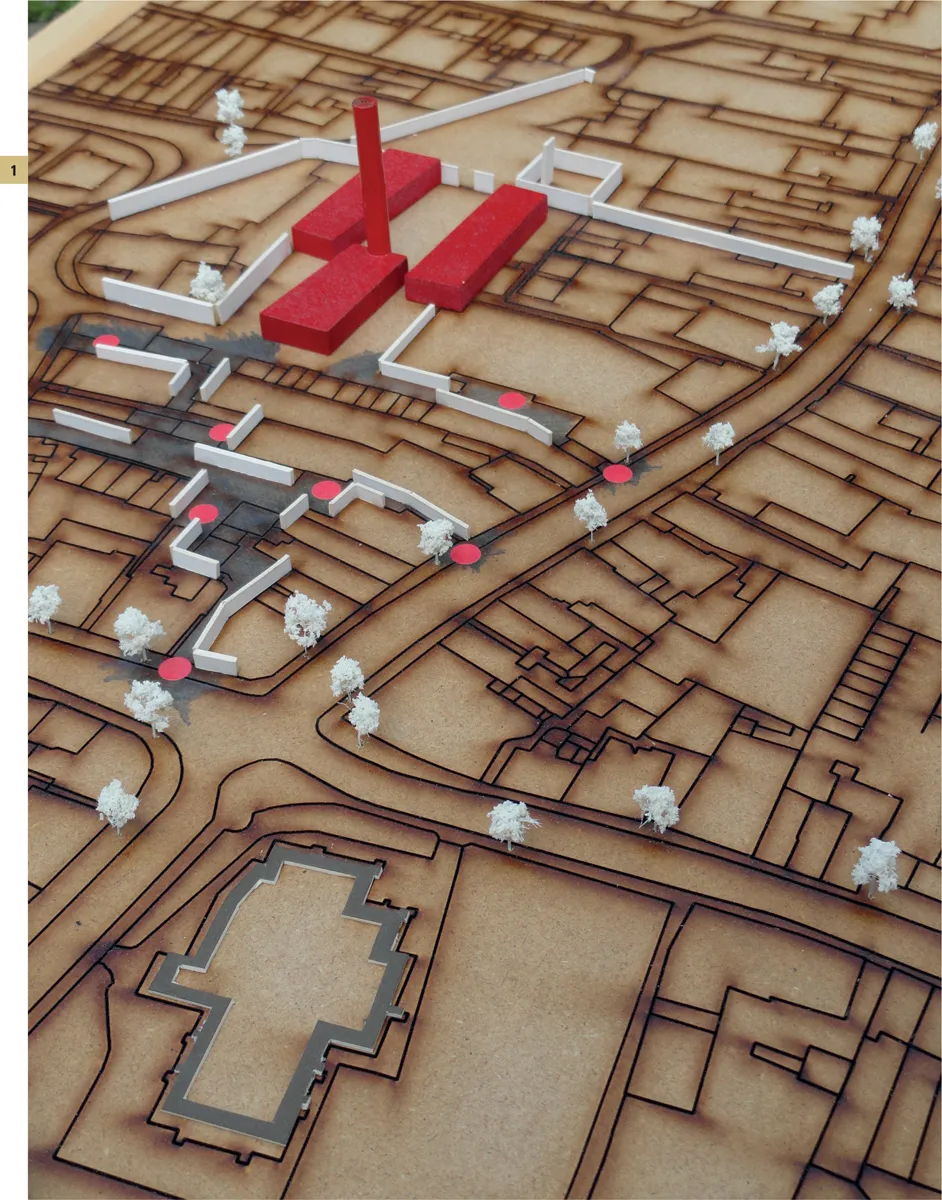
1. Townscape model
This model of a laser-cut map highlights aspects of a townscape: a project site is identified as a series of red blocks to distinguish it from the surrounding city site.
Site
Architecture belongs somewhere, it will rest on a particular place: a site. The site will have distinguishing characteristics in terms of topography, location and historical definitions.
UNDERSTANDING SITE
An urban site will have a physical history that will inform the architectural concept. There will be memories and traces of other buildings on the site, and surrounding buildings that have their own important characteristics; from use of materials, or their form and height, to the type of details and physical characteristics that the user will engage with. A landscape site may have a less obvious history. However, its physical qualities, its topography, geology and plant life for example, will serve as indicators for architectural design.
There is a fundamental need for an architect to understand the site that a building sits on. The site will suggest a series of parameters that will affect the architectural design. For example, broad considerations might include orientation (how the sun moves around the site) and access (how do you arrive at the site? What is the journey from and to the building?).
The location of a building relates not only to its site, but also to the area around it. This presents a further range of issues to be considered, such as the scale of surrounding buildings and the materials of the area that have been previously used to construct buildings.
On site it is important to imagine ideas of form, mass, materials, entrance and view. The site is both a limitation to design and a provider of incredible opportunities. It is what makes the architecture specific and unique as no two sites are exactly the same. Every site has its own life cycle, which creates yet more variables in terms of its interpretation and understanding. Site analysis is critical for architecture, as it provides criteria for the architect to work with.

1. Casa Malaparte (Villa Malaparte), Capri, Italy Adalberto Libera, 1937–1943
Adalberto Libera provides us with a clear example of a building responding to its landscape. The Casa Malaparte sits on top of a rocky outcrop on the eastern side of the Island of Capri in Italy. It is constructed from masonry, and is so intrinsically connected to its site that it actually appears to be part of the landscape.

2. A city skyline, London, UK
In an urban environment, a mixture of historical and contemporary buildings can work well together. The London skyline, viewed here from the South Bank, shows a city that has evolved over hundreds of years, each element connecting to the other in terms of material, form and scale.
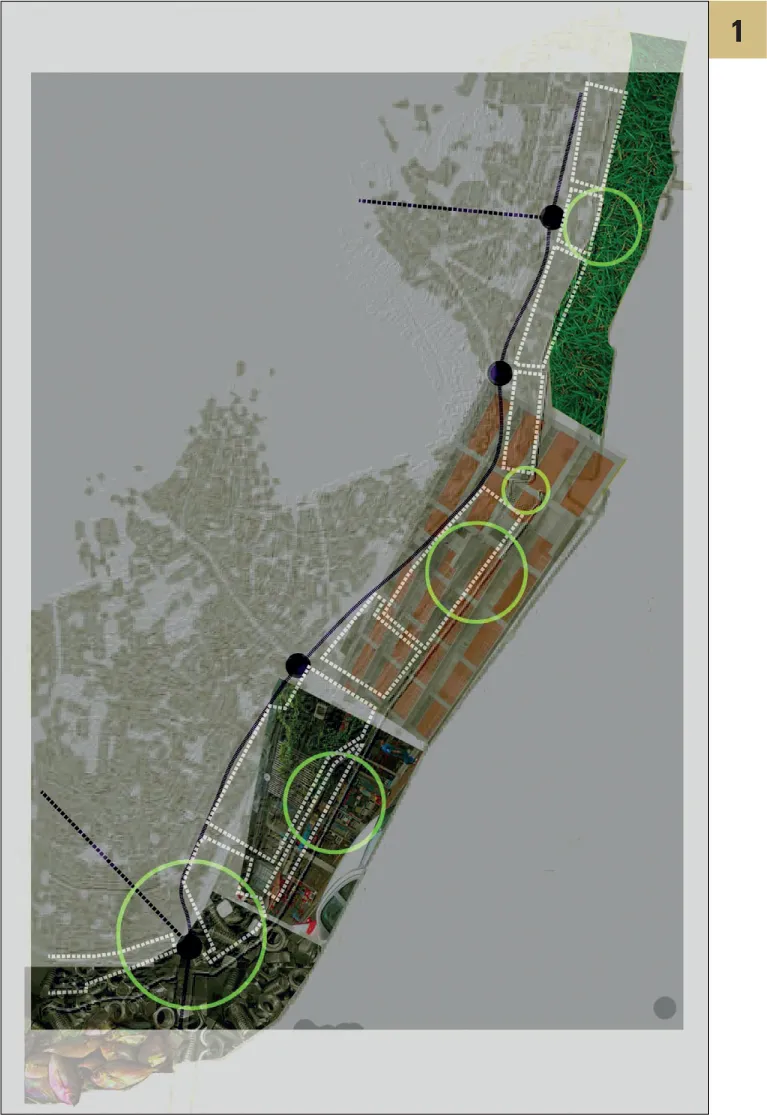
1. Istanbul: Karaköy analysis
This is a map of an area of Istanbul, alongside the water edge, the study identifies the key centres of activity along the map and also describes the various intended ‘character areas‘ through use of colour.
SITE ANALYSIS AND MAPPING
Techniques to record and understand a site are varied, from physical surveys (measuring quantitatively what is there) to qualitatively interpreting aspects of light, sound and experience. Most simply, just visiting a site to watch and record its life cycle can provide clues about how to produce a suitable design response.
Contextual site responses respect the known parameters of the site. Acontextual responses deliberately work against the same parameters to create contrast and reaction. For either approach it is necessary for the architect to have read the site, and properly understood it via various forms of site analysis.
To properly analyse a site it must be mapped, which means recording the many forms of information that exist on it. The mapping needs to include physical aspects of the site, but also more qualitative aspects of the experience and personal interpretations of the place.
There are a range of tools that can be used to map a site, investigate it and produce a design from its indicators. These are analytical tools that allow the site to be measured in a range of different ways.

2. Personal interpretations of a site
A collage image of London comprises a set of sketches of a journey, overlaid on a train map; a personal interpretation of a visit to London.
TOOL ONE: PERSONAL INTERPRETATION OF A SITE
The first impression we have of a place is critical. Our personal interpretations of the overall character of a site will inform subsequent design decisions, and it is important to record these honestly and immediately.
The idea of a personal journey around a site and the interpretation of it is something that Gordon Cullen focuses upon when he describes the concept of ‘serial vision’ in his book The Concise Townscape (1961). This concept suggests that the area under study is...
Table of contents
- Cover
- Title Page
- Contents
- Introduction
- Chapter 1 Placing Architecture
- Chapter 2 History and Precedent
- Chapter 3 Construction
- Chapter 4 Representation
- Chapter 5 Contemporary Ideas
- Chapter 6 Realization
- Conclusion
- Bibliography & Webography
- Glossary
- Picture Credits
- Index
- Acknowledgements
- Working With Ethics
- eCopyright
Trusted by 375,005 students
Access to over 1.5 million titles for a fair monthly price.
Study more efficiently using our study tools.
Frequently asked questions
Yes, you can cancel anytime from the Subscription tab in your account settings on the Perlego website. Your subscription will stay active until the end of your current billing period. Learn how to cancel your subscription
No, books cannot be downloaded as external files, such as PDFs, for use outside of Perlego. However, you can download books within the Perlego app for offline reading on mobile or tablet. Learn how to download books offline
Perlego offers two plans: Essential and Complete
- Essential is ideal for learners and professionals who enjoy exploring a wide range of subjects. Access the Essential Library with 800,000+ trusted titles and best-sellers across business, personal growth, and the humanities. Includes unlimited reading time and Standard Read Aloud voice.
- Complete: Perfect for advanced learners and researchers needing full, unrestricted access. Unlock 1.5M+ books across hundreds of subjects, including academic and specialized titles. The Complete Plan also includes advanced features like Premium Read Aloud and Research Assistant.
We are an online textbook subscription service, where you can get access to an entire online library for less than the price of a single book per month. With over 1.5 million books across 990+ topics, we’ve got you covered! Learn about our mission
Look out for the read-aloud symbol on your next book to see if you can listen to it. The read-aloud tool reads text aloud for you, highlighting the text as it is being read. You can pause it, speed it up and slow it down. Learn more about Read Aloud
Yes! You can use the Perlego app on both iOS and Android devices to read anytime, anywhere — even offline. Perfect for commutes or when you’re on the go.
Please note we cannot support devices running on iOS 13 and Android 7 or earlier. Learn more about using the app
Please note we cannot support devices running on iOS 13 and Android 7 or earlier. Learn more about using the app
Yes, you can access The Fundamentals of Architecture by Lorraine Farrelly in PDF and/or ePUB format, as well as other popular books in Architecture & Architecture General. We have over 1.5 million books available in our catalogue for you to explore.