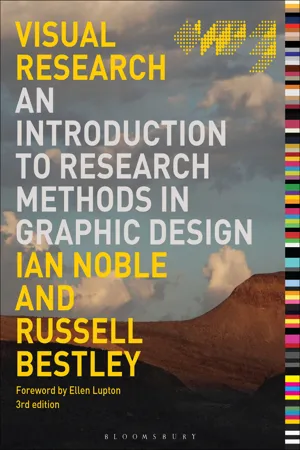
Packed with more than 200 colour illustrations, Visual Research explores a range of research methods that can be used by graphic designers and visual communicators in the development of clear and purposeful design solutions. The book introduces key terms and theories that underlie design research; examining the importance of visual grammar and design literacy, audience, communication theory and semiotics. Each chapter features case studies that demonstrate how the use of research methods can form the basis of effective visual communication and design problem solving, eschewing end product analysis for a discussion of the way research feeds into the design process. The third edition features new case studies in each chapter, updated design exercises and a new chapter on design-led tools and information design methods, in relation to both print and on-screen design.
eBook - ePub
Visual Research
An Introduction to Research Methods in Graphic Design
- 224 pages
- English
- ePUB (mobile friendly)
- Available on iOS & Android
eBook - ePub
About this book
Information


Receiving End
Building on the communication theory precepts outlined in Chapter 3: Analysis and Proposition, this chapter further investigates the relationship between designer, audience, and message, and considers alternative strategies for communicating through both direct and indirect means. The production of design within a social, cultural, and political context is further explored, placing both the designer and the audience as co-participants within predefined frameworks.
In this instance, the term social relates to human society and its members, describing the context within which humans live together in communities or organized groups. In relation to public forms of visual communication and graphic design aimed at a broad audience demographic, social space is the realm in which interaction and communication generally takes place between individuals. The term cultural is more complex, however. In Keywords, Raymond Williams’ seminal dictionary of terms used in philosophy and cultural studies, he noted that “culture is one of the two or three most complicated words in the English language.”1 The noun culture is often used to describe a particular society at a particular time and place, together with the attitudes and behavior that are characteristic of a particular social group or organization (often within a contemporaneous context). However, the term is extremely broad and can refer to a wide number of parallel and distinct themes, often interrelated with a range of social values and conventions. The adjective cultural refers to the tastes in art and manners that are favored by a social group, often the social elite within a wider society. As such, the term can be interpreted as pejorative, describing a hierarchical position within a value system.
Any general definition of graphic design and its intentions cannot fail to make reference to communication and audience. In this regard, graphic designers could develop a vocabulary for describing and understanding their working methods through the language and theory of communication studies. Although a separate discipline with a much broader remit than graphic design, communication studies incorporates a series of useful analytical and descriptive methodologies, which relate strongly to graphic and visual communication.
Defining Audience
The term audience commonly refers to a group of spectators or listeners at a concert or a play, or the people reached by a book, film, radio, or television program, for instance. Within the field of graphic design, they are the recipients of a piece of communication. The audience for a visual communication outcome or product is usually clearly defined by the client in advance of the brief or, following a period of primary research, by the designer in consultation with the client. The designer obviously needs to build a clear picture of who they are attempting to communicate with, the language codes, tastes, hierarchies, sensitivities, likes, and dislikes of that group, and the reaction that the client of the message is seeking to elicit from them. That will then determine the form and the tone of the designed message.
In communication theory, the term audiencing refers to the ways in which readers interpret and understand texts. Research conducted into audience reading is often based on methods adopted from qualitative social science, such as interviews and ethnographic studies, together with quantitative methods based on the statistical analysis of data banks. Such studies are often centered on the interpretation of written text or the spoken word, rather than the reception of visual information. Even academic texts describing tools of visual analysis seldom focus closely on the graphic form itself, rather than the semiotic interpretation of the already constructed visual message.2 As such, a further model for graphic designers to consider is the critical interpretation of images, with particular attention paid to the tools, materials, graphic and/or typographic elements, and formal properties of the work. Within the design process, this can often include a deconstruction of existing material (e.g., the designer evaluating the effectiveness of existing forms of communication within the same field as the brief) and a step-by-step critical reflection on the work being undertaken at each stage of the design process. Through this analysis of design methods, the designer can become more expert in the range of forms and approaches suitable for a particular context or audience.
Are You Receiving Me?
Two schools of thought exist within communication theory, the first of which might be described as the process school—an approach to the subject that is concerned with the actual processes of communication. This school highlights the channels and media through which messages are transmitted and by which senders and receivers encode and decode, in particular setting up a model of analysis that is concerned with matters of efficiency and accuracy. If the process of communication creates a different effect from that which is intended by the transmitter, and this in turn leads to a misreading or aberrant interpretation, then that reveals a breakdown in transmission, a flawed system or channel. This school of thought envisages a message as that which is transmitted by the communication process (and maintains that intention is a crucial factor in deciding what constitutes a message).
By contrast, the semiotic school is concerned with the message as a construction of signs that, through interaction with receivers, produces meaning. This school of thought views communication as an agent in the construction and exchange of meaning: by using terms like signification (related to the constituent parts of a message), it does not consider misunderstandings to necessarily be evidence of communication failure. Advocates for this model argue that a differing interpretation within the process of communication would validate a position more concerned with the plurality and unstable nature of messages, and with their perception of an audience dependent on culture and context. In reality, many design approaches combine both viewpoints, because the brief would normally have a clearly stated intention (e.g., to bring an audience to an event, to direct customers to service points, etc.), while an appreciation of the range of potential interpretations and an understanding of the value of audience or reader engagement can aid the creation of purposeful and interesting outcomes.
Design is not an abstract theoretical discipline—it produces tangible artefacts, expresses social priorities and carries cultural values. Exactly whose priorities and values is at the core of the debate.
Andrew Howard, “A New Kind of Dialogue,” in Adbusters: Design Anarchy issue (2001).

Post/Modernity
The approaches of these two schools of thought could also be applied to what are often described as the modernist and postmodernist positions within current graphic design practice and theory. The process school of graphic design—modernity and its legacy—is motivated by notions of universality, rationality, the clarity of communication through legibility, neutrality, and the grid. This arguably utopian worldview, based on form and functionality and a homogeneous process, could be characterized as dealing with absolutes within communication.
By contrast, what might be called postmodern approaches to graphic design embrace and promulgate the view of design and visual communication as an important component in the plurality of contemporary culture, and seek to emphasize its role in constructing a matrix of interpretation. Less concerned with broad bands of communication, this approach to the construction and reading of visual communication addresses specific and focused, and often smaller, communities and groups, which might be described in social, economic, or geographic terms.
The recognition that designed objects exist within a social structure, and are read by their receivers from a particular cultural perspective and subjective worldview, is central to an understanding of audience-specific graphic design. Although certain forms of graphic design may offer some claim to the modernist objectives of universality and mass communication, much contemporary design work operates within more limited and specific boundaries. As such, a sense of familiarity with the graphic languages already understood by the target audience is crucial to the development of effective design solutions. Both qualitative and quantitative approaches are useful here, in the collection and analysis of a range of visual material operating within the same space as the intended message.
A qualitative analysis of existing artifacts and visual solutions, through the semiotic principles of connotation and denotation discussed in Chapter 2: Design Literacy, can help the designer to interrogate the underlying principles within effective visual messages targeting the same audience. Meanwhile, quantitative methods for reviewing and analyzing a broad range of objects in the same space, and gathering feedback from focus or survey groups, can help create a bigger picture of the range of cultural readings and messages already in place. Knowledge of existing material with which the proposed message will compete is crucial to the development of a successful design solution.
Distant Relatives
It is also important to consider the relationship between designer and client, and between client and audience, as well as that between designer, designed object, and audience. It should be noted that the designer may play only one part within the creative team involved in a project, whose members may range from marketing consultants to copywriters, programmers, and manufacturers. This area is sometimes overlooked, but the relationship and process of negotiation between client and designer is a key development in the definition of the brief. Sometimes, the client may be unsure of the best way to target a particular audience, or may be unclear as to the specific intentions of the message, which may be necessary to achieve a desired goal. In this case, the designer can play a central role in revising and defining the brief in order to address specific needs and provide a practical solution for the client.

Within commercial practice, the need for this kind of negotiation may mark the distinction between the context-definition and context-experiment areas of research mentioned earlier (see here). Context-definition may be appropriate where the client has a good knowledge of their market or audience, and the brief might reflect this by being strongly prescriptive in the range of activities expected of the designer. Where the client is unsure of the specific problem to be addressed, the context-experiment model could help refine the project. In this case, the designer’s initial research can help inform the direction that the project will take, and the process of negotiation between client and designer is foregrounded. Contextual research conducted by the graphic designer can both inform th...
Table of contents
- Cover
- Title Page
- Table of Contents
- Foreword
- Introduction
- Chapter 01. Why and How?
- Chapter 02. Design Literacy
- Chapter 03. Analysis and Proposition
- Chapter 04. Visual Research Analytical Tools
- Chapter 05. Theory in Practice
- Chapter 06. Audience and Message
- Chapter 07. Process and Materials
- Chapter 08. Synthesis
- Appendices
- eCopyright
Trusted by 375,005 students
Access to over 1.5 million titles for a fair monthly price.
Study more efficiently using our study tools.
Frequently asked questions
Yes, you can cancel anytime from the Subscription tab in your account settings on the Perlego website. Your subscription will stay active until the end of your current billing period. Learn how to cancel your subscription
No, books cannot be downloaded as external files, such as PDFs, for use outside of Perlego. However, you can download books within the Perlego app for offline reading on mobile or tablet. Learn how to download books offline
Perlego offers two plans: Essential and Complete
- Essential is ideal for learners and professionals who enjoy exploring a wide range of subjects. Access the Essential Library with 800,000+ trusted titles and best-sellers across business, personal growth, and the humanities. Includes unlimited reading time and Standard Read Aloud voice.
- Complete: Perfect for advanced learners and researchers needing full, unrestricted access. Unlock 1.5M+ books across hundreds of subjects, including academic and specialized titles. The Complete Plan also includes advanced features like Premium Read Aloud and Research Assistant.
We are an online textbook subscription service, where you can get access to an entire online library for less than the price of a single book per month. With over 1.5 million books across 990+ topics, we’ve got you covered! Learn about our mission
Look out for the read-aloud symbol on your next book to see if you can listen to it. The read-aloud tool reads text aloud for you, highlighting the text as it is being read. You can pause it, speed it up and slow it down. Learn more about Read Aloud
Yes! You can use the Perlego app on both iOS and Android devices to read anytime, anywhere — even offline. Perfect for commutes or when you’re on the go.
Please note we cannot support devices running on iOS 13 and Android 7 or earlier. Learn more about using the app
Please note we cannot support devices running on iOS 13 and Android 7 or earlier. Learn more about using the app
Yes, you can access Visual Research by Russell Bestley,Ian Noble in PDF and/or ePUB format, as well as other popular books in Conception & Conception graphique. We have over 1.5 million books available in our catalogue for you to explore.