Over the past twenty years, elite colleges and universities enacted policies that reshaped the racial and class composition of their campuses, and over the past decade, Latinos' college attendance notably increased. While discussions on educational mobility often focus on its perceived benefits – that it will ultimately lead to social and economic mobility – less attention is paid to the process of "making it" and the challenges low-income youth experience when navigating these elite spaces. In Meanings of Mobility, sociologist Leah C. Schmalzbauer explores the experiences of low-income Latino youth attending highly selective, elite colleges.
To better understand these experiences, Schmalzbauer draws on interviews with 60 low-income Latino youth who graduated or were set to graduate from Amherst College, one of the most selective private colleges in the United States. The vast majority of these students were the first in their immigrant families to go to college in the U.S. She finds that while most of the students believed attending Amherst provided them with previously unimaginable opportunities, adjusting to life on campus came with significant challenges. Many of the students Schmalzbauer spoke with had difficulties adapting to the cultural norms at Amherst as well as with relating to their non-Latino, non-low-income peers. The challenges these students faced were not limited to life on campus. As they attempted to adapt to Amherst, many felt distanced from the family and friends they left behind who could not understand the new challenges they faced.
The students credit their elite education for access to extraordinary educational and employment opportunities. However, their experiences while in college and afterward reveal that the relationship between educational and social mobility is much more complicated and less secure than popular conversations about the "American Dream" suggest. Many students found that their educational attainment was not enough to erase the core challenges of growing up in a marginalized immigrant family: many were still poor, faced racism, and those who were undocumented or had undocumented family members still feared deportation.
Schmalzbeauer suggests ways elite colleges can better support low-income Latino students and lower the emotional price of educational mobility, including the creation of immigration offices on campus to provide programming and support for undocumented students and their families. She recommends educating staff to better understand the centrality of family for these students and the challenges they face, as well as educating more privileged students about inequality and the life experiences of their marginalized peers.
Meanings of Mobility provides compelling insights into the difficulties faced by low-income Latinos pursuing educational and social mobility in America's elite institutions.
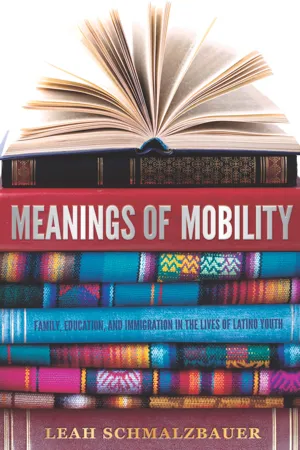
eBook - ePub
Meanings of Mobility
Family, Education, and Immigration in the Lives of Latino Youth
- 243 pages
- English
- ePUB (mobile friendly)
- Available on iOS & Android
eBook - ePub
Meanings of Mobility
Family, Education, and Immigration in the Lives of Latino Youth
About this book
Information
Table of contents
- Cover Page
- Title Page
- Copyright Page
- Dedication
- Contents
- About the Author
- Acknowledgments
- Introduction
- Chapter 1. Pathways to Amherst
- Chapter 2. A New World
- Chapter 3. The Price of Mobility
- Chapter 4. Siblings
- Chapter 5. COVID-19 Ruptures
- Chapter 6. Redefining Success
- Chapter 7. Moving Forward
- Appendix A. Demographics of Study Participants
- Appendix B. A Methodological Roadmap
- Notes
- References
- Index
Trusted by 375,005 students
Access to over 1.5 million titles for a fair monthly price.
Study more efficiently using our study tools.
Frequently asked questions
Yes, you can cancel anytime from the Subscription tab in your account settings on the Perlego website. Your subscription will stay active until the end of your current billing period. Learn how to cancel your subscription
No, books cannot be downloaded as external files, such as PDFs, for use outside of Perlego. However, you can download books within the Perlego app for offline reading on mobile or tablet. Learn how to download books offline
We are an online textbook subscription service, where you can get access to an entire online library for less than the price of a single book per month. With over 1.5 million books across 990+ topics, we’ve got you covered! Learn about our mission
Look out for the read-aloud symbol on your next book to see if you can listen to it. The read-aloud tool reads text aloud for you, highlighting the text as it is being read. You can pause it, speed it up and slow it down. Learn more about Read Aloud
Yes! You can use the Perlego app on both iOS and Android devices to read anytime, anywhere — even offline. Perfect for commutes or when you’re on the go.
Please note we cannot support devices running on iOS 13 and Android 7 or earlier. Learn more about using the app
Please note we cannot support devices running on iOS 13 and Android 7 or earlier. Learn more about using the app
Yes, you can access Meanings of Mobility by Leah Schmalzbauer in PDF and/or ePUB format, as well as other popular books in Social Sciences & Emigration & Immigration. We have over 1.5 million books available in our catalogue for you to explore.