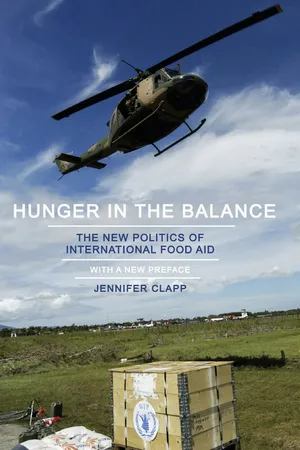
Food aid has become a contentious issue in recent decades, with sharp disagreements over genetically modified crops, agricultural subsidies, and ways of guaranteeing food security in the face of successive global food crises. In Hunger in the Balance, Jennifer Clapp provides a timely and comprehensive account of the contemporary politics of food aid, explaining the origins and outcomes of recent clashes between donor nations—and between donors and recipients.She identifies fundamental disputes between donors over "tied" food aid, which requires that food be sourced in the donor country, versus "untied" aid, which provides cash to purchase food closer to the source of hunger. These debates have been especially intense between the major food aid donors, particularly the European Union and the United States. Similarly, the EU's rejection of GMO agricultural imports has raised concerns among recipients about accepting GMO foodstuffs from the United States. For the several hundred million people who at present have little choice but to rely on food aid for their daily survival, Clapp concludes, the consequences of these political differences are profound.
- 224 pages
- English
- ePUB (mobile friendly)
- Available on iOS & Android
eBook - ePub
About this book
Information
1
FOOD AID POLITICS
The Old and the New
More than 900 million people on the planet are undernourished. Food aid has long been one of many responses to global hunger. It is by no means the primary response or the best approach to ensuring food security. Nevertheless, some 150–200 million people depend on food aid every year. In situations of acute food shortages, particularly when crises hit people who are already suffering from chronic undernourishment, such aid can mean the difference between life and death. And food intervention in the first two years of a child’s life can make enormous improvements in both long-term health and quality of life.
Food aid as a response to global hunger has been controversial ever since institutionalized food-aid programs began in donor countries in the 1950s and 1960s. In the early years, debates over food aid centered largely on the geopolitics of the Cold War and the trade and development impacts of surplus disposal of donor grains in poor countries. By the 1980s and 1990s, many felt that donors had moved beyond dumping unwanted grain and seeking political favors and had begun to use food aid as a development tool geared more toward recipient needs than those of the donor. In political terms, food aid moved to the back pages, and was assumed to have taken on a largely uncontroversial role. But in the last decade, it once again began to make front-page headlines, though not in the ways it had in the past. Although the debates and contexts were different, the level of passion about the issue ran just as high.
This book seeks to explain why food aid politics have become so heated in recent years. I argue that the renewed politicization of food aid is linked to two major developments. The first is the emergence of different, but strongly held, viewpoints among donors regarding the appropriateness of providing aid in its tied, commodity form—that is, food aid given in kind to the recipient country as a direct transfer of food sourced in the donor country. The second is that food aid has become increasingly linked to other international debates—over agricultural biotechnology, over international agricultural trade rules, and over the reorganization of global food security governance in the face of a new global food crisis. These debates have been particularly intense between the major food aid donors: the European Union (EU) and the United States. The fact that these two donors follow different policies with respect to tied food aid has only made these debates more heated.
What is the significance of these new debates? Although food aid as a development resource has shrunk significantly since its early days by comparison with other forms of assistance, the stakes are very high. The political controversies over food aid are important in determining whether it can play a helpful role in addressing world hunger. It is by no means clear that food aid will continue to play the role it has in the past. Its future will depend on the outcomes of debates over the most appropriate mode of delivery of food assistance and over the relationship of food aid to the other international debates noted above. And for the several hundred million people who at present have little choice but to rely on food aid for their daily survival, the outcome of these debates is crucial.
Past Understandings of Food Aid Politics
A great deal of scholarly literature has looked at various aspects of food aid since it became a major component of international aid programs in the 1950s and 1960s. Since that time, food aid policies and practices have evolved. Economic studies have kept pace with these changes and provide a good picture of their economic implications, for both donor and recipient countries.1 But there have been relatively few explicitly political analyses of food aid in recent decades, particularly with respect to the dynamics of donor country policymaking and its ramifications for international-level debates over food aid. At a time of intense debate over food aid, both at the international level and within certain donor countries, it is important to uncover the reasons that food aid has become so politicized.
Early studies on the politics of international food aid focused primarily on the interests of donor states. Realist approaches within the field of international relations focused on states’ self-interest—both economic and political—as a key driver of policy. Realist scholars saw food aid as a classic example of donor self-interest. Food aid served both the domestic interest of donor states in supporting their farm sectors and their foreign policy interests. The former included a desire to remove surplus grain from markets in order to bolster farmers’ incomes. The latter included the development of international markets for their surplus agricultural products and the use of food as a tool to influence policies of recipient states as part of their diplomatic and strategic efforts to gain political leverage during the Cold War.2 Food aid was often used as both a carrot and a stick, particularly by the U.S. government, in the 1950s and 1960s with respect to these aims. These factors were widely recognized as the primary driving forces of food aid policy in its early years.
More radical scholars of international relations and development studies also emphasized the material self-interests within donor countries that drove policy decisions. Not unlike the realists, this literature focused on the ways in which donor states used food aid as a mercantilist tool to establish new commercial market outlets for their surplus.3 For radicals, this practice transformed countries that were once self-sufficient into highly dependent recipients of food aid and commercial food imports.4 Radical scholars also saw food aid as a means by which to bolster capitalist agribusiness interests within donor states, especially agricultural producer groups and the grain trading and processing firms that often supplied the food. Their critique, not unlike early economic critiques of food aid, also pointed to the potential distortions to farmer incentives in poor countries that surplus disposal by donor countries could create.5
Partially in response to a growing popular critique of the self-interested nature of donor food-aid policies, and partially as a product of changing circumstances, some changes in food aid policies were ushered in during the 1970s and 1980s.6 The 1970s food crisis in particular brought attention to the donor-oriented and geopolitical nature of food aid, prompting increased allocation to more needy recipient countries. This shift occurred in the context of overall lower food aid donations in the 1970s and the unwinding of the Cold War by the late 1980s.
These modifications in the context and practice of food aid prompted some scholars to reinterpret donor motives in food-aid politics and policymaking.7 Drawing on liberal institutionalist approaches to international relations, these thinkers argued that the interest-based approaches of the realists and the radicals were no longer as relevant as they had been previously. They contended that food aid was increasingly shaped by norms of international development cooperation promoted by international institutions such as the World Food Programme (WFP), the UN agency that provides a multilateral channel for food aid, rather than by donors seeking to dispose of donor surplus grain. Peter Uvin, for example, argued that after the mid-1970s a development-oriented international “regime” for food aid began to emerge that was geared toward recipient needs rather than donor self-interest.8 As Uvin notes, “Food aid donation is increasingly governed by multilateral institutions, norms and procedures.”9
This institutionalist interpretation of food aid policies was complemented by constructivist analyses that focused on norms and ideas as key factors in shaping donor policies. Raymond Hopkins, for example, highlighted the emergence and influence of an “epistemic community” of like-minded development experts who held shared notions of what constitutes appropriate food aid policies.10 These food aid experts, Hopkins argued, identified improvements to make food aid policies more development-based and needs-oriented. They championed their ideas to improve the development effectiveness of food aid through international institutions such as the WFP, which subsequently filtered down to influence donor-state policies. Hopkins noted that the WFP had increased its role significantly by the late 1980s, and had “become the major arena in which new norms for all food aid were being articulated.” The result, he argued, was incremental reform of food aid policies away from those that primarily serve donor self-interest and toward policies that better serve the poor.11
These new interpretations of food aid politics in the 1990s were important in opening up our understanding of the range of forces that influence donor policies. Beyond material interests, norms and ideas were increasingly seen to affect at least some aspects of donor policies that were in need of change. Most donors have reformed their food aid policies since the mid-1970s to reduce practices such as the allocation of aid to geopolitically important countries, rather than those most in need, and large-scale disposal of donor surpluses that result in gross distortions in agricultural trade and on local markets in recipient countries. Norms against these practices are now widely accepted.12 Similarly, the WFP, as the key institution for multilateral food aid, has taken a far greater role in the provision of food aid and has been important in shaping the food aid regime in practical terms.
The liberal institutionalist and constructivist contributions to the debate suggested that incremental reforms to food aid were well under way by the early 1990s and that donor self-interest had diminished significantly. Food aid was, as a result, largely considered by scholars in the field to be no longer driven by political and economic interests. Instead, it played a more functional role in fostering international development, shaped by an international regime that established the rules and norms for food aid and upheld by international institutions. But far from becoming depoliticized as these analyses suggested, food aid became highly political again by the early 2000s. Yet surprisingly, few studies have been published since the 1990s that address broad debates on the politics of food aid in the international context. It is again time to update our understandings of the politics of food aid.
A New Politics of Food Aid
The international political clashes over food aid since the early 2000s have differed in some important ways from earlier politics surrounding this form of assistance. At the same time, some aspects of today’s food aid politics are linked to long-standing issues, especially with respect to donors’ economic interests. Old debates about the use of food aid to further foreign policy goals or dispose of grain surpluses have given way to debates over how food aid is given. In particular, the question of whether food aid is tied to food sourced in the donor country has generated heated exchanges between donors. As some donors began to untie their food aid, divisions among donors emerged. At the same time, an...
Table of contents
- List of Illustrations
- Preface to the Paperback Edition
- Acknowledgments
- List of Abbreviations
- 1. Food Aid Politics
- 2. Past and Present Food Assistance Trends
- 3. Donor Policies on the Question of Tying
- 4. U.S. Debates on Tied Food Aid
- 5. The GMO Controversy
- 6. Food Aid at the WTO
- 7. The 2007–2008 Food Crisis and the Global Governance of Food Aid
- 8. Conclusion
- References
- Index
Trusted by 375,005 students
Access to over 1.5 million titles for a fair monthly price.
Study more efficiently using our study tools.
Frequently asked questions
Yes, you can cancel anytime from the Subscription tab in your account settings on the Perlego website. Your subscription will stay active until the end of your current billing period. Learn how to cancel your subscription
No, books cannot be downloaded as external files, such as PDFs, for use outside of Perlego. However, you can download books within the Perlego app for offline reading on mobile or tablet. Learn how to download books offline
Perlego offers two plans: Essential and Complete
- Essential is ideal for learners and professionals who enjoy exploring a wide range of subjects. Access the Essential Library with 800,000+ trusted titles and best-sellers across business, personal growth, and the humanities. Includes unlimited reading time and Standard Read Aloud voice.
- Complete: Perfect for advanced learners and researchers needing full, unrestricted access. Unlock 1.5M+ books across hundreds of subjects, including academic and specialized titles. The Complete Plan also includes advanced features like Premium Read Aloud and Research Assistant.
We are an online textbook subscription service, where you can get access to an entire online library for less than the price of a single book per month. With over 1.5 million books across 990+ topics, we’ve got you covered! Learn about our mission
Look out for the read-aloud symbol on your next book to see if you can listen to it. The read-aloud tool reads text aloud for you, highlighting the text as it is being read. You can pause it, speed it up and slow it down. Learn more about Read Aloud
Yes! You can use the Perlego app on both iOS and Android devices to read anytime, anywhere — even offline. Perfect for commutes or when you’re on the go.
Please note we cannot support devices running on iOS 13 and Android 7 or earlier. Learn more about using the app
Please note we cannot support devices running on iOS 13 and Android 7 or earlier. Learn more about using the app
Yes, you can access Hunger in the Balance by Jennifer Clapp in PDF and/or ePUB format, as well as other popular books in Politics & International Relations & Agricultural Public Policy. We have over 1.5 million books available in our catalogue for you to explore.