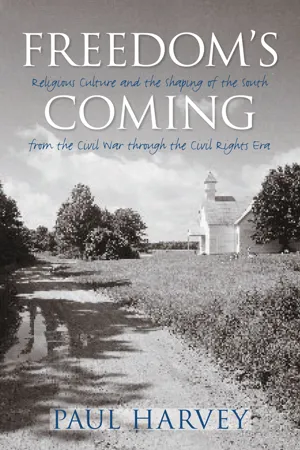
In a sweeping analysis of religion in the post–Civil War and twentieth-century South, Freedom’s Coming puts race and culture at the center, describing southern Protestant cultures as both priestly and prophetic: as southern formal theology sanctified dominant political and social hierarchies, evangelical belief and practice subtly undermined them. The seeds of subversion, Paul Harvey argues, were embedded in the passionate individualism, exuberant expressive forms, and profound faith of believers in the region.
Harvey explains how black and white religious folk within and outside of mainstream religious groups formed a southern “evangelical counterculture” of Christian interracialism that challenged the theologically grounded racism pervasive among white southerners and ultimately helped to end Jim Crow in the South. Moving from the folk theology of segregation to the women who organized the Montgomery bus boycott, from the hymn-inspired freedom songs of the 1960s to the influence of black Pentecostal preachers on Elvis Presley, Harvey deploys cultural history in fresh and innovative ways and fills a decades-old need for a comprehensive history of Protestant religion and its relationship to the central question of race in the South for the postbellum and twentieth-century period.
eBook - ePub
Freedom's Coming
Religious Culture and the Shaping of the South from the Civil War through the Civil Rights Era
- 360 pages
- English
- ePUB (mobile friendly)
- Available on iOS & Android
eBook - ePub
Freedom's Coming
Religious Culture and the Shaping of the South from the Civil War through the Civil Rights Era
About this book
Information
Chapter One
Redemption
Religion, Race, and Reconstruction in the South, 1861–1900
Prayer is best ’ting, for it got us out of slavery.—ex-slave from Oklahoma
We act toward them as brethren, but never shall we again let them rule us as masters.—Arthur Waddell, black missionary in South Carolina
Let Negroes and Chinamen and Indians suffer the superior race of white men to whom Providence has given this country, to control it.—New Orleans Advocate, 1879
The granddaughter of an enslaved woman recounted the stories she heard about the last days of the Confederacy, when the overseer said to her grandmother’s family, “Now you must pray because the South is losing. They always had family prayers and then prayed aloud and she said they knew what was going on. They knew if the North won they would have a little more freedom.... But she said her mother and father said now we must pray out loud for the South to win but in our hearts we must pray that the North will win.” The familiar subversive delight of “puttin’ on Ole Massa” was rehearsed one last time. Late in the Civil War, as freedom’s coming drew nigh, enslaved Christians more openly and frequently sent up their prayers for deliverance from bondage.1
Shortly after the Civil War, Prince Murrell, a black Baptist minister from Tuscaloosa, Alabama, attended a freedmen’s convention in the Gulf Coast city of Mobile. As a slave, Murrell had been mentored by his owner, Basil Manly Sr., who helped to found the Southern Baptist Convention (SBC) in 1845 and served as president of the University of Alabama. While in Mobile, Murrell received a ministerial ordination from some white northern clergymen who were in attendance. Afterward, Basil Manly’s son Charles protested the “uncandid and unfair proceeding as well as unscriptural and disorderly way of pronouncing a sort of quasi ordination” for the freedman Murrell. Black Tuscaloosans, in turn, organized their own congregation and called Murrell as their pastor. His congregants held no “hard feelings against [their] former owners,” Murrell reported, but they also recognized that white southern churches would not “have anything to do with any northern churches. They say that religion is the same as it was before the war. They will have nothing to do with any colored churches that think they ought to have the same rights to serve God in their own way.” Similarly, in South Carolina white believers still demanded the old “slavish custom” of black worshippers sitting in the balcony or standing outdoors during services. Christian freedpeople could not abide such gestures of submission. “We act toward them as brethren,” the black missionary Arthur Waddell pronounced, “but never shall we again let them rule us as masters.” For Murrell, Waddell, and the nearly four million recently enslaved people in the South, freedom’s coming in 1865 was at once legal, psychological, and spiritual.2
White fears of black religious independence waxed along with conflict over the relative political and economic power of former masters and the freedpeople. Basil Manly Sr. had pastored biracial churches in South Carolina in the 1830s. Within the severely circumscribed limits available to him, he attempted to deal fairly with slave members of his church. For example, he licensed black men to preach and allowed black members to conduct disciplinary actions in church courts. During the war, he wondered if God was “chastizing our guilty people” because of their failure to evangelize the servants with sufficient vigor. After Appomattox, the Manly patriarch impressed on former slaves the “dignity of labor,” evidently oblivious to the painful irony such messages held for the former bonds-people. Manly’s black congregants “seemed to enjoy and be affected” by his preaching, he ruminated, yet “the idea seems never to have entered them, that all which they see of power or attainment is the result of labor—labor such as they themselves can perform.” Meanwhile, Basil Manly Jr. adopted a far less paternalistic posture than his father in July of 1866 as he armed himself to protect his property against any marauding freedmen: “I loaded all my shooting irons—be ready, if that was necessary: which I did not really anticipate any difficulty: but I had determined to shoot without delay, if there was any violence attempted about my place.” Basil Manly Jr.’s bitterness toward the freedpeople left him shaken. “I should be satisfied—to live and raise my child in a ‘white man’s country’—and if I get a chance to do so, I may accept it,” he wrote to his brother Charles in 1868. White southern believers like the Manlys recognized that they were “unexpectedly in the midst of one of the greatest social changes which the history of the world presents.”3
For white southern Christians, the term “redemption” infused deeply religious meanings into often deadly political struggles. Redemption was simultaneously freedom’s coming for the body’s soul and for the body politic. The region’s sins and impurities, signified by the staining presence of “Black Republican” rule, had been washed by the blood. The image took on even more tangible power by the sheer amount of blood that was shed in reimposing white supremacist rule. White clergymen such as the Methodist Simon Peter Richardson were perfectly capable of taking the business of Redemption in their own hands. When asked what to do about black soldiers foraging in the countryside, he told a group of whites to “bushwhack them.” He learned later that the group “made a few shots at the negroes, and that kept them at close quarters.” There was nothing wrong in what white southerners had done, he wrote in 1900, and there was “no justifiable reason why they ought not to do it again.” The Ku Klux Klan “seemed to be the only remedy to keep the negroes in check, and to enable the farmers to make a living for themselves and the negroes.” Suspicious of democracy in politics and ecclesiology, he decried the “constant tendency” in Methodist congregations “to throw off the governmental restraints of the Church.”4
For northern missionaries in the South such as John Emory Bryant, a white Methodist and Republican Party activist, freedom’s coming beckoned as an opportunity to bring the light of Christian civilization to a benighted land. Intending to educate the freedpeople and defend their rights in the new southern regime, the Maine native moved to Georgia after the war. Despite years of disappointment and difficulty, he remained certain in 1878 that God had called him to the “work of political evangelization in the South, and also in the North.” Explaining this to his long-suffering wife, from whom he was frequently parted, he said, “The evidence is so strong that I can not doubt it. As I have often said, if He has called me to this work, He will take care of me, if I obey Him.” His endeavors for Republicanism and education, moreover, had shed “much light upon the subject of holiness,” and, he said, “[I] think I understand where I am spiritually.”5
White and black Christians in the post-Civil War South struggled over what constituted the terms of freedom’s coming. The work of figures such as ex-slaves Prince Murrell and Arthur Waddell, white ex-masters and ministers such as Basil Manly Sr. and his sons, and northern missionaries, including the Methodist John Emory Bryant, shaped southern religious institutions for a century to come. In the end, none of their visions triumphed completely or failed totally. Yet some of their prayers apparently were more equal than others. Northern hopes very nearly failed, for white southern denominations resisted ecclesiastical re-incorporation while newfound black southern religious institutions steered free of white control, northern or southern. African Americans established independent religious institutions yet were painfully aware that the Promised Land was nowhere in sight. Ultimately, a white southern conservative vision prevailed, and it provided a powerful theological imprimatur for American apartheid.6
African American Religious Organizing in the Post-Civil War South
Black believers saw in the war the fulfillment of prayers for emancipation, education, and the right to worship freely in churches of their own directing. Quasi-independent African American churches existed in the antebellum era, but white authorities monitored them closely. In black communities after the war, independent churches and denominational organizations sprung up quickly, including thousands of small local congregations and major national organizations such as the African Methodist Episcopal Church (AME) and the National Baptist Convention (NBC). Only a decade after the war, hardly any black parishioners still worshipped in the historically white southern churches.
Through the last part of the nineteenth century, black church membership grew rapidly. By the 1906 religious census, the National Baptist Convention claimed more than two million communicants, or over 61 percent of black churchgoers. The African Methodist Episcopal Church numbered some 500,000, the African Methodist Episcopal Zion Church (AMEZ) about 185,000, the Colored Methodist Episcopal (CME) sect approximately 173,000, and the Methodist Episcopal Church (MEC) about 60,000 black adherents. Catholics claimed around 38,000 African American worshippers, while the Presbyterians and Congregationalists together counted some 30,000. Altogether, church membership among African Americans rose from 2.6 million to 3.6 million from 1890 to 1906.7
More important than tallying up these rather uncertain (likely inflated) and self-reported numbers, however, is understanding the critical role church life and key clergymen played for the freedpeople in the first generation after emancipation. Independent African American churches organized in part as a response to the refusal of whites to grant black Christians equality in church. But most important, African American churches and denominations represented the initiative of freedpeople in carving out separate cultural spaces. “The emancipation of the colored people made the colored churches and ministry a necessity, both by virtue of the prejudice existing against us and of our essential manhood before the laws of the land,” explained one black Baptist clergyman.8
Black and white missionaries in the post-Civil War South, including the white Republican activist John Emory Bryant and the black Methodist stalwart Henry McNeal Turner, pursued the work of “political evangelization,” the securing of religious and political rights for the former bondspeople. Turner was a legendary evangelist for the venerable African Methodist Episcopal Church. Officially organized in 1816, the AME anchored the embattled free black community in the North. White southern authorities banned the black denomination from the South in 1822 following its suspected role in the abortive Denmark Vesey slave revolt. Thereafter, the church could make no headway in the South until the providential turn in human history in 1861.
Remembered later for his caustic editorials advocating black American emigration to Africa and denouncing the American flag (which in the 1880s he castigated as a “rag of contempt” and the Constitution a “cheat, a libel,... to be spit upon by every negro in the land”), Turner helped to establish the African Methodist Episcopal Church in the South. Born free in 1834 in South Carolina (which he later dubbed “that pestiferous state of my nativity”), raised by an extended family of women, and by 1848 an avid Methodist, Turner learned early on the importance of black self-reliance and respectability. In the 1850s, Turner moved to Georgia, the state where he would make his name and career. There, biracial crowds eagerly gathered to hear his powerful preaching, although some incredulous whites pronounced him a “white man galvanized”9
Following service as a Union army chaplain, Turner established himself as a prominent AME churchman, missionary, legislator, newspaper editor, and rhetorical firebrand. The AME and its sister competitor, the African Methodist Episcopal Zion Church, sent missionaries to evangelize what they perceived to be waiting masses of freedpeople who needed the leadership of the venerable black ecclesiastical bodies. Turner and his fellows envisioned their religious work as essential to securing full citizenship rights for the freedpeople. Civil rights, church organization, and racial uplift would go hand in hand. Turner expressed this sentiment when defending the continued use of the word “African” in the AME denominational title. “The curse of the colored race in this country, where white is God and black is the devil,” he insisted, was in “the disposition to run away” from blackness. “In trying to be something beside themselves,” he said, black Americans would “never amount to anything.” Turner advocated a different course: “honor black, dignify it with virtues, and pay as much respect to it as nature and nature’s God does.” Or more succinctly: “respect black.”10
Turner also served as a delegate to the postwar constitutional convention in Georgia. In his brief term in the reconstructed state legislature, he placated whites by taking conciliatory positions on key symbolic issues. “‘Anything to please the white folks,’ has been my motto,” was his own sardonic self-assessment. But his efforts at winning over potential adversaries failed. White opponents forcibly and illegally removed Turner (and other black lawmakers) from the 1868 legislative session. By 1871, the Peach State had been redeemed from Black Republican rule, one that whites perceived as contrary to the will of God. The derogatory terms “Radical” and “Black Republican” stuck in spite of the fact that Reconstruction governments, including the Georgia legislature from which Turner was removed, were largely made up of white officeholders.11
With his political career forcibly terminated, Turner settled into three more decades of ceaseless work for the AME in the South and, later, South Africa. He traveled constantly, edited the official denominational hymnal, and eventually was elected bishop. He fought internecine battles with northern bishops over the degree of education necessary for ministerial ordination and the place of women in the church; in both cases, Turner argued for democratizing church polity by extending opportunities to those historically excluded from leadership positions. When southern-style racism swept the country in the 1890s, Turner blasted American hypocrisy. As editor of the Voice of Missions in the last two decades of his life, Turner articulated what later would be called black theology. He organized African conferences of the AME while struggling to overcome the cultural gulf separating American and African AME leaders. Turner died in 1915, memorably eulogized by his fellow Georgian W. E. B. Du Bois as “a man of tremendous force and indomitable courage.... In a sense Turner was the last of his clan: mighty men, physically and mentally, men who started at the bottom and hammered their way to the top by sheer brute strength.”12
Turner’s career was indeed remarkable; yet throughout the South dozens of black ministers and missionaries forged equally significant lives in political evangelization, including the Georgia Baptist William Jefferson White. The son of a white planter and a mother who was probably of mixed Native American and African American ancestry, the ambitious young Georgian could pass as white but self-identified as black. In the 1850s, he worked as a carpenter and cabinetmaker, thus securing the artisanal economic base that underwrote his independence into the era of black freedom. As a stalwart of Augusta’s free black community, an educational leader, newspaper editor, and political spokesman, White labored for freed African Americans. At the first meeting of the Georgia Equal Rights and Education Association (held at Augusta’s historic black Springfield Baptist Church in early 1866), White’s eloquent address drew the attention of General Oliver O. Howard, director of the federal Freedmen’s Bureau.
White also helped to found schools for freedpeople in the growing southeastern Georgia town, including Augusta Baptist Institute. Upon taking over the institute in 1867, Charles H. Corey, a white Canadian-born Baptist missionary, confronted bitterness, prejudice, and poor facilities. The KKK dispatched unmistakable “warnings” against his efforts to establish a black theological institution. “Bad passions” were “still rampant” then, he recalled; it was a time “when hate prevailed, and not love.” White Christians would “almost turn pale with fear when I asked them to sell me a piece of land”; few locals would sell or lease a building if it would be used as a black school. “Times were critical,” White remembered, “and in some respects, dangerous, for whites engaged in teaching colored people.” Seeking political cover and surer sources of funding, black Augustans cultivated local white benefactors. During these years, the institute trained some talented students who would leave a significant mark on black Georgia, including Emmanuel K. Love (later pastor of Georgia’s largest black Baptist church and a founder of the National Baptist Convention). But the school languished in Augusta, compelling its 1879 move to the rapidly growing and more centrally located city of Atlanta. Atlanta Baptist Institute eventually took the permanent name of Morehouse College, honoring the white northern Baptist educator Henry Morehouse. The college served as a base for the twentieth-century educator John Hope and trained Martin Luther King Jr., Julian Bond, and other civil rights leaders. Like so many other stories from this era, William Jefferson’s White’s efforts created key institutions for the future of black America.13
In 1880, White began publishing the Georgia Baptist. With its masthead reading “Great Elevator, Educator, and...
Table of contents
- Cover Page
- Freedom’s Coming
- Copyright Page
- Dedication
- Contents
- Illustrations
- Acknowledgments
- Abbreviations
- Introduction Freedom and Its Coming
- Chapter One Redemption
- Chapter Two Freedom’s Struggles
- Chapter Three The Color of Skin Was Almost Forgotten for the Time Being
- Chapter Four Religion, Race, and Rights
- Chapter Five Religion, Race, and the Right
- Epilogue The Evangelical Belt in the Contemporary South
- Notes
- Bibliography
- Index
Trusted by 375,005 students
Access to over 1.5 million titles for a fair monthly price.
Study more efficiently using our study tools.
Frequently asked questions
Yes, you can cancel anytime from the Subscription tab in your account settings on the Perlego website. Your subscription will stay active until the end of your current billing period. Learn how to cancel your subscription
No, books cannot be downloaded as external files, such as PDFs, for use outside of Perlego. However, you can download books within the Perlego app for offline reading on mobile or tablet. Learn how to download books offline
Perlego offers two plans: Essential and Complete
- Essential is ideal for learners and professionals who enjoy exploring a wide range of subjects. Access the Essential Library with 800,000+ trusted titles and best-sellers across business, personal growth, and the humanities. Includes unlimited reading time and Standard Read Aloud voice.
- Complete: Perfect for advanced learners and researchers needing full, unrestricted access. Unlock 1.5M+ books across hundreds of subjects, including academic and specialized titles. The Complete Plan also includes advanced features like Premium Read Aloud and Research Assistant.
We are an online textbook subscription service, where you can get access to an entire online library for less than the price of a single book per month. With over 1.5 million books across 990+ topics, we’ve got you covered! Learn about our mission
Look out for the read-aloud symbol on your next book to see if you can listen to it. The read-aloud tool reads text aloud for you, highlighting the text as it is being read. You can pause it, speed it up and slow it down. Learn more about Read Aloud
Yes! You can use the Perlego app on both iOS and Android devices to read anytime, anywhere — even offline. Perfect for commutes or when you’re on the go.
Please note we cannot support devices running on iOS 13 and Android 7 or earlier. Learn more about using the app
Please note we cannot support devices running on iOS 13 and Android 7 or earlier. Learn more about using the app
Yes, you can access Freedom's Coming by Paul Harvey in PDF and/or ePUB format, as well as other popular books in History & North American History. We have over 1.5 million books available in our catalogue for you to explore.