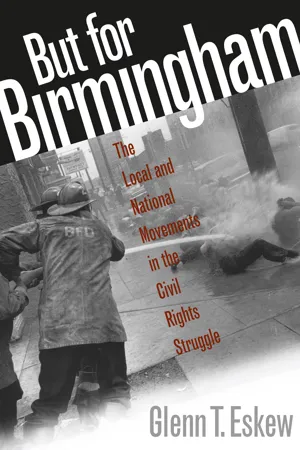
Birmingham served as the stage for some of the most dramatic and important moments in the history of the civil rights struggle. In this vivid narrative account, Glenn Eskew traces the evolution of nonviolent protest in the city, focusing particularly on the sometimes problematic intersection of the local and national movements.
Eskew describes the changing face of Birmingham’s civil rights campaign, from the politics of accommodation practiced by the city’s black bourgeoisie in the 1950s to local pastor Fred L. Shuttlesworth’s groundbreaking use of nonviolent direct action to challenge segregation during the late 1950s and early 1960s.
In 1963, the national movement, in the person of Martin Luther King Jr., turned to Birmingham. The national uproar that followed on Police Commissioner Bull Connor’s use of dogs and fire hoses against the demonstrators provided the impetus behind passage of the watershed Civil Rights Act of 1964.
Paradoxically, though, the larger victory won in the streets of Birmingham did little for many of the city’s black citizens, argues Eskew. The cancellation of protest marches before any clear-cut gains had been made left Shuttlesworth feeling betrayed even as King claimed a personal victory. While African Americans were admitted to the leadership of the city, the way power was exercised — and for whom — remained fundamentally unchanged.
eBook - ePub
But for Birmingham
The Local and National Movements in the Civil Rights Struggle
- 456 pages
- English
- ePUB (mobile friendly)
- Available on iOS & Android
eBook - ePub
About this book
Information
CHAPTER ONE The National Movement
Birmingham transformed the Southern Christian Leadership Conference. Civil rights activists had organized the SCLC in the aftermath of the Montgomery bus boycott as a national movement to coordinate the efforts of local protest groups. They selected the charismatic spokesman of the Montgomery Improvement Association (MIA), the Reverend Dr. Martin Luther King Jr., as president. From 1957 until 1961 the SCLC drifted without much purpose, proposing voter registration drives and offering belated assistance to student activists following the sit-ins and the Freedom Rides. With corporate foundation grants that funded the Citizenship Education Program (CEP) and the Voter Education Project (VEP), the SCLC conducted workshops to register black voters. The NAACP viewed the fledgling civil rights organization as a threat to its interests. Radical black youths thought the SCLC lacked initiative. In 1961 the Albany Movement offered the SCLC an opportunity to return to the direct action strategy that had succeeded in Montgomery. Yet, unlike the simplicity of the bus boycott, the SCLC found the movement in southwestern Georgia more complex for a variety of reasons. With the inability of the SCLC to make substantial gains in Albany, critics questioned the effectiveness of the organization. Thus on the eve of the Spring 1963 demonstrations in Birmingham, the SCLC had little to show for six years of protest work. The success of the Birmingham campaign changed all that.
Although many people date the beginning of the civil rights movement with the Montgomery bus boycott of 1955–56, a similar boycott had occurred just two years before in Baton Rouge, Louisiana. The Reverend T. J. Jemison, a charismatic minister and newcomer to the city, headed an indigenous protest effort centered in the black church. He combined activist congregations with middle-class civic groups to form an umbrella organization that coordinated a boycott of city buses. During June 1953 Baton Rouge's black community stayed off the buses until the city agreed to provide black patrons with better—yet still segregated—seating arrangements. The conservative nature of the demands reflected the transitional period in postwar black protest when black leaders advocated increased public services within the confines of Jim Crow. Jemison scheduled mass meetings to mobilize the black community behind the boycott. Modeled on church services, the meetings unified the participants, reinforced the community's resolve, kept African Americans abreast of the boycott, and raised revenues for the protest. Indeed, Baton Rouge—with its charismatic leadership style, organizational structure, and moral tenor—reflected an evolving movement culture in the South centered in the black church.1
Events in Montgomery, Alabama, brought the emerging reform movement to the nation's attention. For months, black civic groups headed by Jo Ann Robinson and E. D. Nixon had planned a boycott of city buses in order to achieve more equitable seating and courteous treatment on public transportation. When Rosa Parks refused to surrender her bus seat to a white patron on December 1,1955, and was arrested for violating the city's segregation ordinance, Robinson and Nixon asked her to serve as a focal point for the protest. As Robinson printed leaflets announcing a one-day boycott of the buses, Nixon contacted the Reverend Ralph Abernathy and other ministers to enlist the black church in the December 5 event. Most African Americans stayed off the buses that morning, and that afternoon the civic leaders and ministers organized the MIA as an umbrella group and named the Reverend Dr. Martin Luther King Jr. as president.2
Black Montgomery embraced the boycott. Packed mass meetings demonstrated the new movement culture as charismatic leaders led the congregation of civil rights activists in singing, praying, and planning. The umbrella organizational structure of the MIA successfully brought otherwise divided elements of the black community together in common cause. Black middle-class groups such as the Women's Political Council, the Progressive Democratic Association, and the Citizens’ Steering Committee joined with the Interdenominational Ministerial Alliance in coordinating the boycott. The black masses of maids and laborers participated by attending mass meetings, staying off the buses, and walking to work or riding in car pools created by the MIA and operated by black professionals and their wives who owned cars. Even some white women assisted the bus boycott by driving their employees to and from domestic duties.3
The African American unity surprised Montgomery's white power structure, which tried to sow dissent in the movement by emphasizing class divisions within the black community. Yet when given the opportunity, the white officials failed to exploit divisions among the black leaders of the boycott. Feeling upstaged by King, E. D. Nixon began to distance himself from the protest. The Reverend U. J. Fields, the secretary of the MIA, resigned in June 1956, claiming that King and others in the organization's leadership had “misused” funds for personal gain. A week passed in which MIA officials ultimately resolved the conflict by having King return from a vacation in California and appear with Fields at a mass meeting. The criticism from within the MIA actually strengthened the determination of the members, who increasingly articulated a rhetoric of nonviolence.4
The MIA borrowed strategy from the Baton Rouge bus boycott and received assistance from the national movement. King and Abernathy remembered the previous protest and contacted Jemison for advice. Consequently, during the Montgomery bus boycott the MIA adopted the car pool strategy used in Baton Rouge. Likewise, when word of the Montgomery boycott reached national civil rights groups, professional activists departed for Alabama. The FOR sent the white Reverend Glenn Smiley and the War Resister's League sent the black Bayard Rustin to Montgomery. Both organizations advocated nonviolence and Christian pacifism. Both Rustin and Smiley hoped King would become a black Gandhi who could lead a nonviolent movement for race reform in the South. To achieve this end, they and others from the national movement systematically coached King and trained local volunteers in the techniques of nonviolence as the indigenous movement adapted the protest philosophy to suit its needs. Many white people attributed the organized racial conflict to the involvement of these external advisers and the NAACP.5
In response to the bus boycott and the simultaneous effort by Autherine Lucy to desegregate the University of Alabama, state authorities targeted the NAACP in a campaign of massive resistance. For three years NAACP attorney Arthur Shores and Autherine Lucy, a Birmingham resident and graduate of Miles College, had waged a legal fight to gain admission to the state's flagship institution. In January 1956 the board of trustees bowed to the authority of federal court rulings and admitted the first African American to the university. Lucy attended classes the first week in February, but mob violence by white students and Ku Klux Klansmen provided the pretext with which the board expelled her. Alabama governor James E. Folsom attributed her actions to the NAACP and “professional outside agitators.” Alabama attorney general John Patterson also blamed the desegregation attempt as well as the Montgomery bus boycott on the NAACP. He requested a temporary restraining order against the NAACP for failing to register under state law as a foreign corporation. The state circuit court issued the injunction, and rather than surrender membership lists and other information, the NAACP obeyed the court order. The legal attack effectively banned the NAACP from Alabama for eight years. Yet the defiance of state authorities and the white people who joined the ever popular citizens councils actually stiffened the resolve of the black activists.6
As in Baton Rouge, the Montgomery movement initially sought to ameliorate racial customs within the Jim Crow social structure. At the initial mass meeting, black Montgomery opted to stay off the buses until the city met the MIA's demands of first come, first seated within segregated sections on the bus, the hiring of black bus drivers for the routes through black sections of town, and the courteous treatment of black patrons by white bus drivers. Unlike Baton Rouge, however, the intransigence of Montgomery's white officials and the violence of white vigilantes led the MIA to alter its moderate demands and challenge the color line directly. The Montgomery bus boycott thus reflected the evolution of postwar black protest from a request for improved but segregated public services to a demand for equal access to the system.
White vigilante violence convinced the MIA to seek redress through the federal courts while the state courts assisted the white power structure in its efforts to suppress the boycott. In response to the dynamite bombing of King's house on January 30, 1956, the MIA approved attorney Fred Gray's plan to challenge the constitutionality of Montgomery's segregated seating ordinance. Filed in federal court on February 1, Browder v. Gayle ultimately shifted MIA strategy away from a reliance on negotiations with white city officials to an anticipated favorable ruling from the federal courts. Using the grand jury, however, Montgomery's white power structure indicted the black leaders of the movement under Alabama's antiboycott law. Officials arrested, tried, and convicted King, but the MIA appealed the verdict. The city petitioned the state court for a temporary injunction that halted the MIA's car pool. Yet in light of Brown and other recent decisions, the federal district court found Montgomery's segregated seating ordinance unconstitutional. City officials appealed the ruling to the U.S. Supreme Court, which upheld the lower court decision in Browder v. Gayle on November 13, 1956. Once official notification of the ruling reached Montgomery on December 21 and the buses were desegregated, the MIA called off the boycott. King, Abernathy, and Smiley boarded a bus for the first time in a year and sat up front in the formerly white section. Three weeks later, six bombs targeted movement leaders as white vigilantes resisted the court-ordered racial change.7
A national media increasingly interested in southern race relations identified King as a new leader in black America. The January 7,1957, issue of Time magazine featured King on the cover and included a glowing account of his activities in Montgomery. Earlier white media coverage of the bus boycott had been limited, although black newspapers had devoted a great deal of attention to the protest. Nonetheless, the mainstream media increasingly played a central role in the movement by broadcasting nationally what previously had been ignored as a local story. No longer did white violence against civil rights activists escape unnoticed. The growth of television in the late 1950s and early 1960s expanded the coverage of the movement. The more sensational an event, the more likely the national coverage. The inverse was also true. Thus the media enabled the movement to present its demands for racial equality to a national audience through sound bites and film clips. In time, the movement developed a postmodern appearance as activists staged protests for the journalists and television crews, proving “the medium is the message,” as argued by Marshall McLuhan. Not only did Americans feel outrage when witnessing simulated racial brutality via the television, but so did an international audience. In an age of consensus politics and Cold War braggadocio, abuses of American democracy made hot film footage and front-page reading at home and abroad. With American markets expanding throughout the world, Washington was becoming more sensitive to southern race relations.8
Coverage of the Montgomery bus boycott in the black press encouraged the formation of local movements in other southern cities as black ministers led an indigenous protest for civil rights reform. The lengthy struggle against bus segregation in New Orleans was typical. The first protest occurred in January 1956, and demonstrations periodically resumed until complete desegregation resulted in 1958. The Reverend A. L. Davis headed the New Orleans movement, which derived strength from students. In May 1956 students provoked a bus boycott in Tallahassee, Florida, that evolved into a mass movement led by the Reverend C. K. Steele. The next month the Reverend Fred L. Shuttlesworth formed the Alabama Christian Movement for Human Rights in Birmingham. Davis, Steele, and Shuttlesworth had watched Jemison's earlier protest in Baton Rouge and had witnessed the organizational meetings of the MIA. They borrowed strategy from these earlier boycotts. Yet as “movement centers,” the protests in New Orleans, Tallahassee, and Birmingham remained locally inspired and controlled.9
To capitalize on the Montgomery bus boycott, northern activists assisted southern black preachers in organizing a new national movement that could unite the emerging local movement and counterbalance a passive NAACP in the South. Rustin and Smiley separately proposed to King the creation of a regional umbrella organization to assist indigenous groups in a nonviolent direct action struggle for civil rights. The two pacifists competed over strategy, with Smiley suggesting an integrated approach that would appeal to black and white activists in the South and Rustin recommending an all-black approach that would emphasize the organic nature of the protest. During 1956 and 1957 the Fellowship of Reconciliation held several meetings in Atlanta at which it conducted seminars on nonviolence. Despite the efforts of Smiley and the FOR, the black preachers followed Rustin's plans for a new national movement.10
The impetus behind the SCLC came from In Friendship, a group of northern activists formed in early 1956 by Rustin, Ella Baker, and Stanley Levison. Rustin was raised by Quaker grandparents in Pennsylvania, a heritage that encouraged his activism in the Young Communist League, the March on Washington movement, the FOR, and the War Resister's League. He supplemented his abilities as a teacher of nonviolence by using his enormous skills as a writer to compose position papers and to ghost essays for King and the movement. Baker was a black native of North Carolina who had lived in New York City for many years before returning to the postwar South as the NAACP director of branches. Through this position she developed valuable contacts among the traditional Negro leadership class in the region, and she learned organizational skills while conducting NAACP membership drives. Levison was a white Jewish businessman from the city whose background as an activist and lawyer put him in touch with powerful people in New York's left-wing community. While his alleged communist sympathies fueled federal criticism of the movement, his dedication to social change, his legal expertise, and his abilities as a fund-raiser contributed greatly to the cause. These three individuals directed the SCLC as advisers and staff members during the organization's early years. Baker ultimately quit over the chauvinism of the black ministers, but Levison and Rustin continued to influence the SCLC throughout King's life. The talents of the three members of In Friendship complemented one another and the charismatic leadership of King.11
To make the initiative appear indigenous, Rustin consulted King on how best to organize the black preachers. When forming In Friendship, Rustin, Baker, and Levison had asked A. Philip Randolph to chair the group because of his reputation within the national movement. As the head of the Brotherhood of Sleeping Car Porters and the March on Washington movement, Randolph had demonstrated a deep concern over the well-being of black workers. Although he took a less-than-active role in organizing the 25 SCLC, he stressed the need for the organization to appear spontaneous and independent. One evening in December 1956 Rustin, Baker, and Levison gathered in New York City and debated strategy late into the night, drafting lists of activist black leaders in the South who could issue the call for a conference on civil rights and nonviolent protest. Rustin telephoned the Reverend C. K. Steele of Tallahassee to see if he would make an announcement for such a meeting, but Steele declined to act without King's assistance. In the end, Rustin convinced King, Steele, Jemison, and Shuttlesworth to issue the call jointly on January 3,1957. The night before the meeting convened, Rustin and Baker completed seven “working papers” that set the agenda for the gathering.12
About sixty black leaders attended the Atlanta conference on January 10–11,1957, as Rustin, Baker, and Shuttlesworth led the discussions on the “working papers.” Church bombings in Montgomery had forced King, Abernathy, and several other participants to return briefly to Alabama, although they made it back to Atlanta in time to endorse the meeting's resolutions. Rustin believed it imperative that the momentum from Montgomery be maintained, so he promoted the new organization as a vehicle that could generate and sustain protests elsewhere in the South. The working papers proposed various forms of direct action that the black masses could undertake. Although more militant than any previous NAACP strategy in the South, the papers focused on bus boycotts and voting rights campaigns that would stress nonviolence. Reflecting this strategy, the group adopted the cumbersome name, the Southern Negro Leaders’ Conference on Transportation and Nonviolent Integration, chose King as acting chairman, and sent telegrams to Washington demanding that the Eisenhower administration meet with black leaders to discuss southern compliance with the Brown decision. The meeting adjourned with the understanding that the temporary group would reconvene during the next month.13
Nearly one hundred black activists gathered in New Orleans on February 14, 1957, to formally elect King president of the new organization that they renamed the Southern Leadership Conference. Not until the August 1957 meeting would the word Christian be added, making the permanent title, the Southern Christian Leadership Conference. The constitution of the SCLC stated its purpose as “achieving full citizenship rights, equality, and the integration of the Negro in all aspects of American life.” As an umbrella organization, the SCLC recognized the importance of cultivating associations with “other bodies whose aims and methods are closely akin to the aims and the methods of the SCLC,” although it declined individual memberships in order to prevent unwanted comparisons to the NAACP. In New Orleans, King reported to the conference that the Eisenhower administration had refused the Atlanta entreaties to meet with representatives of the national movement. In response, the SCLC announced a pilgrimage whereby the ministers would go to Washington anyway and pray for a change of heart among those in the federal government. The Prayer Pilgrimage for Freedom to be held in the spring of 1957 would signify the arrival of the SCLC on the scene of the national movement.14
In March 1957 King joined Rustin, Randolph, and Roy Wilkins of the NAACP in a planning session for the pilgrimage to Was...
Table of contents
- Cover Page
- But for Birmingham
- Copyright Page
- Dedication
- CONTENTS
- ILLUSTRATIONS
- ACKNOWLEDGMENTS
- INTRODUCTION: Stalemate
- CHAPTER ONE The National Movement
- CHAPTER TWO Bombingham
- CHAPTER THREE Bull's Birmingham
- CHAPTER FOUR The Local Movement
- CHAPTER FIVE Businessmen's Reform
- CHAPTER SIX Momentum
- CHAPTER SEVEN Another Albany?
- CHAPTER EIGHT The Children's Crusade
- CHAPTER NINE But for Birmingham
- EPILOGUE Ambiguous Resolution
- NOTES
- BIBLIOGRAPHY
- INDEX
Trusted by 375,005 students
Access to over 1.5 million titles for a fair monthly price.
Study more efficiently using our study tools.
Frequently asked questions
Yes, you can cancel anytime from the Subscription tab in your account settings on the Perlego website. Your subscription will stay active until the end of your current billing period. Learn how to cancel your subscription
No, books cannot be downloaded as external files, such as PDFs, for use outside of Perlego. However, you can download books within the Perlego app for offline reading on mobile or tablet. Learn how to download books offline
Perlego offers two plans: Essential and Complete
- Essential is ideal for learners and professionals who enjoy exploring a wide range of subjects. Access the Essential Library with 800,000+ trusted titles and best-sellers across business, personal growth, and the humanities. Includes unlimited reading time and Standard Read Aloud voice.
- Complete: Perfect for advanced learners and researchers needing full, unrestricted access. Unlock 1.5M+ books across hundreds of subjects, including academic and specialized titles. The Complete Plan also includes advanced features like Premium Read Aloud and Research Assistant.
We are an online textbook subscription service, where you can get access to an entire online library for less than the price of a single book per month. With over 1.5 million books across 990+ topics, we’ve got you covered! Learn about our mission
Look out for the read-aloud symbol on your next book to see if you can listen to it. The read-aloud tool reads text aloud for you, highlighting the text as it is being read. You can pause it, speed it up and slow it down. Learn more about Read Aloud
Yes! You can use the Perlego app on both iOS and Android devices to read anytime, anywhere — even offline. Perfect for commutes or when you’re on the go.
Please note we cannot support devices running on iOS 13 and Android 7 or earlier. Learn more about using the app
Please note we cannot support devices running on iOS 13 and Android 7 or earlier. Learn more about using the app
Yes, you can access But for Birmingham by Glenn T. Eskew in PDF and/or ePUB format, as well as other popular books in History & North American History. We have over 1.5 million books available in our catalogue for you to explore.