In this study of the encounter between Vietnam and the United States from 1919 to 1950, Mark Bradley fundamentally reconceptualizes the origins of the Cold War in Vietnam and the place of postcolonial Vietnam in the history of the twentieth century. Among the first Americans granted a visa to undertake research in Vietnam since the war, Bradley draws on newly available Vietnamese-language primary sources and interviews as well as archival materials from France, Great Britain, and the United States.
Bradley uses these sources to reveal an imagined America that occupied a central place in Vietnamese political discourse, symbolizing the qualities that revolutionaries believed were critical for reshaping their society. American policymakers, he argues, articulated their own imagined Vietnam, a deprecating vision informed by the conviction that the country should be remade in America’s image.
Contrary to other historians, who focus on the Soviet-American rivalry and ignore the policies and perceptions of Vietnamese actors, Bradley contends that the global discourse and practices of colonialism, race, modernism, and postcolonial state-making were profoundly implicated in — and ultimately transcended — the dynamics of the Cold War in shaping Vietnamese-American relations.
eBook - ePub
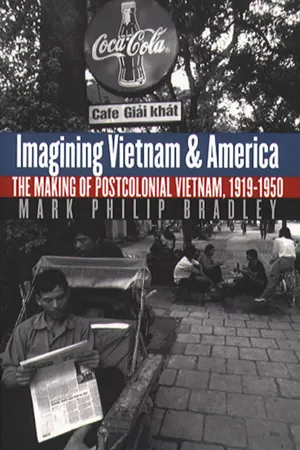
Imagining Vietnam and America
The Making of Postcolonial Vietnam, 1919-1950
- 344 pages
- English
- ePUB (mobile friendly)
- Available on iOS & Android
eBook - ePub
About this book
Information
Topic
HistoriaSubtopic
Historia asiáticaChapter 1: European Wind, American Rain: The United States in Vietnamese Anticolonial Discourse
In the winter and spring of 1919, as the Paris Peace Conference deliberated over the postwar peace settlement for Europe, members of the Vietnamese expatriate association known as the Groupe des Patriotes Annamites often gathered in a small Parisian apartment in the thirteenth arrondissement. Inspired by the Wilsonian rhetoric of self-determination, the focus of their meetings was to draft a proposal for the gradual emancipation of Vietnam from French colonial rule to present to the leaders of the Great Powers in Paris. The final document, titled “Revendications du Peuple Annamite,” set forth an eight-point program that included calls for a general amnesty for political prisoners, equality of legal rights between French and Vietnamese, freedom of the press, the right to form political associations, and permanent Vietnamese representation in the French parliament.
Although the drafting of the proposal had been a collective effort that included the participation of Phan Chu Trinh, among the most famous and influential of Vietnamese anticolonial leaders, the “Revendications” bore the signature of a relative unknown, Nguyen Ai Quoc, or Nguyen the Patriot. Shortly before the deliberations in Paris came to a close, the Groupe des Patriotes Annamites submitted its “Revendications” to the heads of various national delegations, including President Woodrow Wilson, asking that their proposals be added to the conference agenda. Their request was ignored.1
Some twenty-five years later, Nguyen Ai Quoc, who reemerged on the Vietnamese political stage as Ho Chi Minh, would again pursue American support, this time as the leader of the communist-led Viet Minh movement that sought independence from the French during World War II. The passage of a quarter-century, however, fundamentally transformed the nature and aims of Vietnamese anticolonialism. The refusal of the Paris conference to consider the relatively modest demands of the Groupe des Patriotes Annamites marked the eclipse of a generation of scholar-gentry patriots, such as Phan Chu Trinh, who had embraced Social Darwinism and new currents of neo-Confucian thought to apprehend the humiliation of French conquest and chart a path of indigenous societal reform and anticolonial resistance. In their place arose a younger generation of anticolonial activists in the 1920s who conceived a more radical critique of Vietnamese society and French colonialism. By the 1930s, Marxist-Leninist internationalism had become the driving force in Vietnamese anticolonialism.
Just as the spirit of Wilsonianism hovered over the drafting of the “Revendications” by the Groupe des Patriotes Annamites in 1919, the United States occupied a persistent though often elliptical role in the transformation and radicalization of Vietnamese anticolonial thought and politics. Although Ho Chi Minh visited New York City in 1912, rarely, if ever, did most Vietnamese political elites encounter America or Americans directly.2 Reflecting the importance of East Asia and Europe as the primary source of foreign influence on Vietnam under French colonial rule, Vietnamese perceptions of the United States were refracted through Chinese, Japanese, French, and Russian commentaries on American history and society. Viewed at such a distance, an imagined America came to represent the shifting currents and tensions in Vietnamese anticolonial thought. As Ho Chi Minh and the leaders of the Viet Minh embarked on their path to power and Vietnamese independence in the 1940s, the legacies of the anticolonial political discourse under French colonial rule, and the place of America in it, would frame their vision of national liberation and the nature of their diplomacy with the United States.
Between Neo-Confucianism and Social Darwinism
Vietnamese images of the United States first emerged through the Reform Movement, which dominated anticolonialism in Vietnam during the early decades of the twentieth century. Members of the generation of elites that led the Reform Movement were born in the 1860s and early 1870s into scholar-gentry families often from north and north-central Vietnam. Like their fathers and grandfathers before them, they had studied Chinese classical texts in preparation for the imperial examinations that would enable them to enter government service and symbolically mark their right to rule as virtuous Confucian “superior men” (quantu). The examination system, reflecting centuries of cultural borrowing from the Chinese, inculcated Confucian values into the political culture of Vietnamese elites and served as the foundation of the administrative structure through which the Nguyen emperors had ruled Vietnam since 1802.3 Prizing stability over change and viewing the wider non-Confucian world beyond East Asia with suspicion and derision, it was a profoundly conservative political and social order that proved unable to withstand the French colonial challenge in the late nineteenth century.
Members of the reform generation, who came of age in the 1880s at the time of the French conquest of northern Vietnam, watched as the slow French enervation of Vietnamese political, economic, and social life undermined the neo-Confucian premises that had shaped their view of the world. For these young men, the failure of scholar-gentry resistance to French conquest, like the Aid the King (Can Vuong) Movement in which many of their fathers had played a leading role, demonstrated that Confucian principles alone provided an inadequate response to French rule and heightened the urgency of reversing what they termed “the loss of country” or “national extinction” (mat nuoc; vong quoc). As the author of one reform poem asked of the situation Vietnam faced under the onslaught of French colonialism,
Why is the roof over the Western universe the broad lands and skies,
While we cower and confine ourselves to a cranny in our house?
Why can they run straight, leap far,
While we shrink back and cling to each other?
Why do they rule the world,
While we bow our heads as slaves?4
To explain Vietnam’s predicament and formulate a new vision for the reconstruction and transformation of Vietnamese society, the reform generation increasingly looked outside their own tradition. For the first time, the European and American historical experience became a major part of Vietnamese political discourse. Reformers were captivated by the philosophical writings of Jean-Jacques Rousseau and Montesquieu; the nation-building efforts of Peter the Great, Giuseppe Garibaldi, and Otto von Bismarck; and the inventiveness of James Watt. Americans, including figures such as George Washington, Patrick Henry, and Thomas Edison, were also widely celebrated as deserving emulation by the Vietnamese. Among the most compelling Western thinkers for the Reform Movement was Herbert Spencer. To Vietnamese reformers, Social Darwinism offered a powerful explanation for the weaknesses in traditional society that had led to Vietnam’s domination by the French. It also pointed to the strengths of the West that offered a potential path for Vietnam’s future.5
Significantly, Social Darwinism, or what reformers more broadly termed the “European wind and American rain” (gio Au mua My), entered Vietnam indirectly. Unable to read European or American texts themselves, Vietnamese reformers encountered Western thought and experiences in the writings of Liang Ch’i-ch’ao and K’ang Yu-wei, the leading intellectual advocates of self-strengthening reforms in China, and through what they came to know about the reform of Japanese society under the Meiji restoration.6 Discussions of the West in works by Chinese self-strengtheners in particular were a revelation to Vietnamese reformers whose training in the Chinese classics was bounded by the conservative curriculum of the Nguyen imperial examinations that favored the study of Sung neo-Confucianism and ignored contemporary intellectual innovations in the Sinic tradition.7
But viewed within the interpretative veil of Chinese and Japanese informants, the revolutionary new currents of Western thought that animated the discourse of reform in early twentieth-century Vietnam were refracted through the persisting neo-Confucian sensibilities of the East Asian classical world. While the reformers in Vietnam were remarkably open to European and American ideas, they continued to see themselves as Confucian superior men and mediated Western thought through Confucian norms and values. As one reform text argued, “Among these European winds and American rains, who knows but what there may be men who on behalf of their country will sweep away the fog, lift up the clouds, and create a radiant and expansive horizon for us all.”8 By emulating the achievements of the West, the leaders of the Reform Movement believed they could transcend French colonialism and regain their rightful place as the leaders of a newly strengthened Vietnam. Poised between neo-Confucianism and Social Darwinism, the articulation of this reformist vision would produce the earliest enduring Vietnamese images of America.
The Reform Movement was launched in 1904 with the publication of an anonymous tract titled The Civilization of New Learning [Van Minh Tan Hoc Sach]. Infused with the Social Darwinian themes that had characterized the writings of Chinese reformers, the manifesto offered a wide-ranging critique of Vietnamese society and a prescription for the future. It argued that Vietnamese civilization was “static” (tinh) and Western civilization was “dynamic” (dong). Using Spencerian rhetoric, the manifesto suggested that ceaseless change produced a strong civil society: “The more ideas, the more competition; the more competition, the more ideas.” Appreciation for the importance of Darwinian intellectual competition in Europe and America, it continued, produced innovations in political thought, education, commerce, and industry. In Vietnam, by contrast, the rigid adherence to classical Chinese learning and suspicion of foreign ideas had foreclosed dynamic change.
Despite this grim Spencerian critique of traditional society, Vietnamese reformers were not without hope for the future. Because Chinese interpretations of Spencer’s thought downplayed its relentless determinism in favor of a more optimistic voluntarism, Social Darwinism as it was received by the Vietnamese also presented a path to national revival. Much of The Civilization of New Learning was devoted to outlining a program of Vietnamese self-strengthening patterned on Western models that included plans for educational reform and the development of indigenous industry and commerce. Sharing the neo-Confucian perspective of Chinese interpreters of Social Darwinism, the manifesto insisted these projects were to be led by and directed to Vietnamese elites, arguing one could not “open up” the intellects of the masses until elite attitudes had been changed.9
The critique of Vietnamese society and reform proposals contained in The Civilization of New Learning, aimed at bringing the dynamism of the West to Vietnam, would underlie much of the Reform Movement’s activities.10 An Eastern Study (Dong Du) movement brought Vietnamese students to Japan, where they not only came in closer contact with the works of Chinese reformers such as Liang Ch’i-ch’ao, who was living in Yokohama, but also with the ideas of Japanese thinkers who had guided the country’s rapid economic modernization and bid for Great Power status under the Meiji restoration. In Vietnam itself, reformers organized the Dong Kinh Free School (Dong Kinh Nghia Thuc) and the publication of a newspaper, Old Lantern Miscellany [Dang Co Tung Bao], which served as critical forums for the introduction of new currents of thought. They also worked to establish indigenous commercial enterprises and agricultural societies to reverse the traditional scholar-gentry disdain for commerce and to emulate what reformers perceived as the sources of Western wealth and power. Reinforcing their optimism that these projects could successfully bring about the transformation of Vietnamese society was the Japanese victory in the Russo-Japanese war of 1905. As the Asia ballad [A-te-a] that was popularized by the Dong Kinh Free School suggested, the Japanese experience confirmed that Asian peoples could match and even exceed the achievements of the West.11
Within the broader consensus of the need to reform Vietnamese society along Western lines, substantial differences existed on the ultimate aims of the Reform Movement, illustrated by the careers of the two leading reformers, Phan Boi Chau and Phan Chu Trinh. Like others in the movement’s leadership, both men were classically educated sons of scholar-gentry families who embraced reform after the failure of the Aid the King Movement. Phan Boi Chau, born in 1867 in Nghe An province in north central Vietnam, passed the regional imperial examination with the highest honors in 1900. Phan Chu Trinh, born in 1872 in Quang Nam province, passed both the regional and metropolitan imperial exams by 1900. Coming to reformist ideas through the medium of Chinese writers and short sojourns in Japan after 1900, both men played critical roles in establishing the Vietnamese movement for reform. Phan Boi Chau organized the Eastern Study Movement in Japan, and his writings were among the most important and influential reform works, forming the basis for much of the curriculum at the Dong Kinh Free School.12 Phan Chu Trinh, second only to Phan Boi Chau in the Reform Movement, became a widely read essayist, a particularly influential figure in the Dong Kinh Free School, and a strong advocate of scholar-gentry involvement in commerce and industry. But while Phan Boi Chau saw reform as part of a larger effort to organize effective anticolonial opposition against the French, Phan Chu Trinh believed political change should come to Vietnam only after a long process of social and cultural transformation.
Phan Boi Chau’s calls for reform in Vietnam were accompanied by sustained efforts at political organization, including the development of the Reformation Society (Duy Tan Hoi) and the League for the Restoration of Vietnam (Viet-Nam Quang Phuc Hoi). The Reformation Society, active in the first decade of the twentieth century, aimed at Vietnamese independence under a constitutional monarch. The league, inspired by the Chinese revolution of 1911, sought to put into place a democratic republic. Little came of these ambitious goals, but both organizations reflected Phan Boi Chau’s willingness to use political violence to bring about anticolonial ends. Members of the Reformation Society were instrumental in the wave of anticolonial demonstrations that erupted in 1908, including tax protests in central Vietnam and a plot to poison the food of the French colonial garrison in Hanoi. The league, too, was involved in a series of terrorist incidents that eventually brought Phan Boi Chau’s imprisonment in 1914.
For Phan Chu Trinh, a lifelong opponent of violence whose father had been assassinated when Phan Chu Trinh was in his late teens, the educational and cultural projects of the Reform Movement were ends in themselves. Phan Chu Trinh uncompromisingly opposed the old order in Vietnam. In his best-known work, a letter to French governor general Paul Beau in 1906 seeking French support for institutional reform in Vietnam,13 Phan Chu Trinh was intensely critical of French colonial rule. But he reserved his harshest scorn for the traditional mandarinate whose obscurantism and petty jealousies, he believed, had prevented the emergence of reforms necessary for the transformation of Vietnam into a dynamic society. Because the indigenous barriers to reform were so great and the gap between Vietnam and the West was so vast, Phan Chu Trinh argued, independence could only follow an extended period of internal reform. Despite Phan’s gradualist tone and repeated denouncements of anticolonial violence, French colonial officials found his vision of reform radical enough that he was sentenced to life imprisonment on the penal island of Con Son in the wake of the anticolonial protests of 1908, a...
Table of contents
- Cover Page
- Imagining Vietnam and America: The Making of Postcolonial Vietnam, 1919–1950
- Copyright Page
- Dedication
- Contents
- Foreword
- Acknowledgments
- Abbreviations
- Introduction: Liberty and the Making of Postcolonial Order
- Chapter 1: European Wind, American Rain: The United States in Vietnamese Anticolonial Discourse
- Chapter 2: Representing Vietnam: The Interwar American Construction of French Indochina
- Chapter 3: Trusteeship and the American Vision of Postcolonial Vietnam
- Chapter 4: Self-Evident Truths?: Vietnam, America, and the August Revolution of 1945
- Chapter 5: Improbable Opportunities: Vietnamese and American Diplomacy in the Postcolonial Moment
- Conclusion: Becoming Postcolonial in a Cold War World
- Notes
- Bibliography
- Index
Trusted by 375,005 students
Access to over 1.5 million titles for a fair monthly price.
Study more efficiently using our study tools.
Frequently asked questions
Yes, you can cancel anytime from the Subscription tab in your account settings on the Perlego website. Your subscription will stay active until the end of your current billing period. Learn how to cancel your subscription
No, books cannot be downloaded as external files, such as PDFs, for use outside of Perlego. However, you can download books within the Perlego app for offline reading on mobile or tablet. Learn how to download books offline
Perlego offers two plans: Essential and Complete
- Essential is ideal for learners and professionals who enjoy exploring a wide range of subjects. Access the Essential Library with 800,000+ trusted titles and best-sellers across business, personal growth, and the humanities. Includes unlimited reading time and Standard Read Aloud voice.
- Complete: Perfect for advanced learners and researchers needing full, unrestricted access. Unlock 1.5M+ books across hundreds of subjects, including academic and specialized titles. The Complete Plan also includes advanced features like Premium Read Aloud and Research Assistant.
We are an online textbook subscription service, where you can get access to an entire online library for less than the price of a single book per month. With over 1.5 million books across 990+ topics, we’ve got you covered! Learn about our mission
Look out for the read-aloud symbol on your next book to see if you can listen to it. The read-aloud tool reads text aloud for you, highlighting the text as it is being read. You can pause it, speed it up and slow it down. Learn more about Read Aloud
Yes! You can use the Perlego app on both iOS and Android devices to read anytime, anywhere — even offline. Perfect for commutes or when you’re on the go.
Please note we cannot support devices running on iOS 13 and Android 7 or earlier. Learn more about using the app
Please note we cannot support devices running on iOS 13 and Android 7 or earlier. Learn more about using the app
Yes, you can access Imagining Vietnam and America by Mark Philip Bradley in PDF and/or ePUB format, as well as other popular books in Historia & Historia asiática. We have over 1.5 million books available in our catalogue for you to explore.