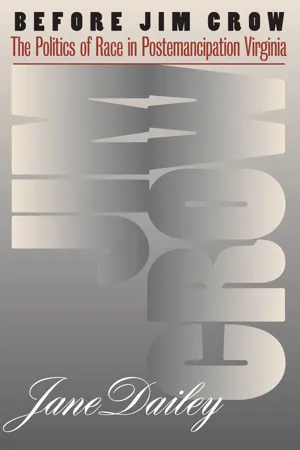
Long before the Montgomery bus boycott ushered in the modern civil rights movement, black and white southerners struggled to forge interracial democracy in America. This innovative book examines the most successful interracial coalition in the nineteenth-century South, Virginia’s Readjuster Party, and uncovers a surprising degree of fluidity in postemancipation southern politics.
Melding social, cultural, and political history, Jane Dailey chronicles the Readjusters' efforts to foster political cooperation across the color line. She demonstrates that the power of racial rhetoric, and the divisiveness of racial politics, derived from the everyday experiences of individual Virginians — from their local encounters on the sidewalk, before the magistrate’s bench, in the schoolroom. In the process, she reveals the power of black and white southerners to both create and resist new systems of racial discrimination. The story of the Readjusters shows how hard white southerners had to work to establish racial domination after emancipation, and how passionately black southerners fought each and every infringement of their rights as Americans.
- 292 pages
- English
- ePUB (mobile friendly)
- Available on iOS & Android
eBook - ePub
About this book
Information
Chapter 1: Origins of the Readjuster Movement
White southerners in the antebellum era liked to argue that racial slavery, far from being incompatible with democracy, was in fact the basis for equality among white men. “In this country alone does perfect equality of civil and social privilege exist among the white population, and it exists solely because we have black slaves,” lectured the Richmond Enquirer in 1856. “Freedom is not possible without slavery.”1 The constitutional history of the southern states reflected this view, although the “perfect equality” of whites trumpeted by the Enquirer was never attained. In the 1810s and 1820s slave states in the South produced the most democratic state constitutions in the country, granting free white manhood suffrage before most of the states that would make up the Union did.2 In a very real sense, this white political freedom was defined against black slavery. It should not be surprising, then, that the end of slavery shook white southern ideologies about hierarchy and equality to their very foundations. It was on the remnants of these foundations that the Readjusters later sought to build their own precarious edifice.
White Virginians had more reasons for anxiety than most other southern whites, for the civic status of nonpropertied white men there had shallow roots. These men gained the suffrage only in 1851, when the slavery crisis bore down on the nation. Even then the General Assembly insisted on retaining viva voce voting, which meant that patrons, landlords, and employers could monitor the electoral choices of their clients, renters, and workers.3 At the local level, Virginia politics was dominated by an archaic system of elite-controlled, self-perpetuating county courts.4 Statewide, the eastern planter elites of antebellum Virginia controlled the legislature through an electoral system that counted slaves for representational purposes. (The national electoral system, designed in good measure by Virginians, achieved much the same result through the three-fifths clause, whereby slaves were counted as three-fifths of a free person for the election of representatives to the house and the electoral college.) Throughout the South, many whites thought of their electoral privileges as dependent on black subordination, and emancipation put those privileges in doubt. Glancing back to antebellum Virginia reminds us that postwar political battles were fought in a world in which suffrage was highly unstable and recently exclusive. For many white Virginians, as for the freedpeople, the right to vote was a novelty not to be taken for granted.
But the freedpeople had the greatest cause to worry about representation. African Americans demanded civil and political rights even before they officially entered politics in Virginia during Reconstruction. Thousands of freed men and women assembled in Richmond only two months after Appomattox to demand citizenship rights and to protest their treatment at the hands of native whites and Union troops alike.5 In a series of meetings in Norfolk from April to June 1865, black Virginians called for the suffrage as the key to their future as workers, citizens, and families.6 That April, again in Norfolk, more than five thousand black men demonstrated their intention to assume the rights of citizenship when they tried to vote in a municipal election. A similar scene would be repeated in Alexandria in March 1866.7 Earlier in 1865 freedpeople had assembled at a convention in Alexandria and insisted, “As citizens of the Republic we claim the rights of citizens; we claim that we are by right entitled to respect.”8 Already in this demand we see many of the keywords that would prove so important in the political sensibilities of the next thirty years, a vocabulary in which civic rights and civility, equality and respect, politics and honor, were so intertwined as to be empirically inseparable.
The black citizens of Alexandria insisted on rights that few whites in Virginia were willing to grant. At the head of the “loyal government” of Virginia in 1865 was Governor Francis H. Pierpont, who had been elected at a convention in Wheeling in 1861 in opposition to the Virginia secessionists. When West Virginia was admitted to the Union on the last day of 1862, the Pierpont government moved to Alexandria to administer the Union-controlled areas of Virginia.9 After the Confederate surrender, the Pierpont administration oversaw the election of a new state legislature, which assembled in Richmond in December 1865. This legislature, like all that had preceded it in Virginia, was elected exclusively by white men. As William L. Royall, a prominent Richmond lawyer in the postbellum era, wrote without irony, “It was truly representative of the old State.”10
When the representatives of the “old state” convened in Richmond in December 1865, they ignored Governor Pierpont’s many suggestions, including the establishment of free schools, provision for widows and orphans, consolidation of the railroads, and, later, ratification of the Fourteenth Amendment. Pierpont’s opponents claimed to resist him for his boorish western ways. He was, after all, a manufacturer, not a planter, and he pastured his cow on the capitol lawn besides.11 We may be forgiven, however, for suspecting that Pierpont’s detractors were probably more concerned about his relative progressivism. Totally unreconstructed, the General Assembly denied the existence of West Virginia, enacted a draconian vagrancy law that was denounced by the Union military commander of Virginia as “slavery in all but its name,” rejected the Fourteenth Amendment, and suggested that the president replace Governor Pierpont with Robert E. Lee.12 The legislature also vowed to pay the state’s antebellum debt in full, including wartime interest. When West Virginia declined to “restore the ancient commonwealth” and, incidentally, assume responsibility for its share of the debt, Virginia’s leaders declared that the state would assume West Virginia’s share until it could be determined and apportioned.13
That debt, which would come to dominate postwar Virginia politics, originated in antebellum efforts to construct roads and canals. In this, Virginia was hardly alone. New York had led the way in 1817 with the Erie Canal. But Virginia’s economic and political ambitions, when married to its topography, produced a multitude of competing claims for state funding. Pressed to link its vast western hinterland to the more settled counties of the east, the commonwealth tried at the same time to carve out a north-south juncture. Because capital was scarce in the new nation, Virginia and the other states turned to Europe to finance their improvement projects. In return for cash, the states issued interest-bearing bonds.
After 1845 the growth of railroads, whose enormous capital needs were incapable of being satisfied by private stock subscriptions, made Virginia the nation’s largest borrower. To facilitate the construction of railroads, the state became the majority stockholder in the companies that built and operated them.14 In 1861, on the eve of secession, Virginia’s debt stood at $33.3 million, which translated into an annual interest payment to bondholders of about $2 million. With that money the state had constructed the James River and Kanawha Canal, which linked Richmond and the Shenandoah Valley, and 2,483 miles of rail that crisscrossed the commonwealth.15 Four years later Virginia’s transportation system, like the state itself, was undone by war. Nearly every rail line was wrecked.16 Northern war correspondent Whitelaw Reid traveled at a snail’s pace from Lynchburg to Bristol on straightened track whose gaps were plugged with stones.17 English journalist John Kennaway spent most of his time on trains in Virginia peering out the window to see if the car had derailed.18 About all that remained intact of Virginia’s extensive antebellum infrastructure was the debt that the state had incurred to finance its construction.
It was unclear, to say the least, how Virginia expected to settle this debt after the war. The state had lost a third of its territory in 1861, when the Union convention in Wheeling passed an ordinance for the formation of the new state of West Virginia. The dismemberment of the state represented a severe financial blow to Virginia, as a third of its population—and nearly half of its taxpaying free men and women—lived in the mineral-rich regions of the west. In 1865 emancipation erased the chief form of taxable property in Virginia, and war-related damage cut the value of farmland in half.19 Although northern visitors dismissed reports of mass starvation, even those least inclined to sympathize with the defeated Confederates noted the prevalence of scurvy and other nutritional deficiencies and remarked on Virginia’s overall devastation. Infectious diseases such as typhus and tuberculosis carried away thousands in the immediate postwar years. So many African Americans were infected by cholera in the summer of 1866 that some suspected whites of poisoning them.20 In this context of devastation, the “old state” legislature issued its declarations about honoring the debt and ignoring the political consequences of emancipation.
It was this kind of thing that convinced Congress that President Andrew Johnson’s lenient policy of southern readmission to the Union jeopardized the social and political fruits of Union military victory. The Reconstruction Act of 1867 divided the eleven Confederate states (except Tennessee, which had ratified the Fourteenth Amendment) into five military zones. The act left in place state governments dominated by former Confederates, but it required that the states allow black men to vote for representatives to conventions called to create new state constitutions that would provide for universal manhood suffrage. In addition, the states had to accept the Fourteenth Amendment, which declared African Americans to be citizens and reduced the congressional representation of states that refused to enfranchise black men. The combined intransigence of the president and the white southern ruling elite had accomplished what Radical Republicans could never have done alone: the recognition of black suffrage as the cornerstone of Reconstruction.21
The 1867 Reconstruction Act nullified both the Virginia General Assembly and its fiscal intentions and reorganized the state as Military District Number One. While the other southern states elected new Republican legislatures and set about the process of congressional readmission, Virginia resisted and remained under military control until 1870. Most white Virginians preferred the indignity of military rule to the black-white coalition governments that ruled their neighbors. Referring to the declaration of martial law by Arkansas governor Powell Clayton and his use of black militias to suppress white terrorists, the Richmond Whig declared that U.S. troops were vastly preferable to “such characters as are now marauding Arkansas.”22
While Governor Pierpont tried to forge a moderate consensus of Republican loyalists led by former Whigs, white and black Radical Republicans founded the Union Republican Party of Virginia. In 1867 this wing of the Republican Party dominated the state convention in Richmond and wrote a platform that celebrated the passage of the federal Civil Rights Bill of 1866, championed the equal protection of all men before the courts, advocated universal suffrage and the right of all Union men to hold office “without distinction of race or color,” and called for a free school system.23 Led by abolitionist and federal judge John C. Underwood and the Reverend James W. Hunnicutt, who had both served in Pierpont’s Alexandria government, the Radicals spoke for the overwhelming majority of black Virginians and a significant minority of white voters as well. But they went too far for some white Republicans. Alienated by the Radicals’ demand for black suffrage, the more conservative Republicans would ally in 1869 with the Conservative (Democratic) Party, which was founded in November 1867 in opposition to the Union Republicans.24
But for the moment, at least, radicalism had the upper hand. Radical Republicans predominated among the delegates elected in the fall of 1867 to the constitutional convention called to bring Virginia’s laws into accordance with the federal Constitution prior to the state’s readmission to the Union. Three-quarters of the convention members were Radical Republicans. Among them were twenty-four African Americans and thirty-three white men born outside Virginia.25 The black delegates were hampered to a certain extent by a lack of formal education—as bricklayer George Teamoh recalled, “Agricultural degrees and brickyard diplomas, I found, passed for very little” in constitutional debate.26 Nevertheless, the black delegates participated spiritedly in discussion and used their votes when words failed them. Often they appealed to the galleries, which were filled with men and women from Richmond’s large black community.27 Despite the obstructions of the minority Conservatives, and against the best efforts of the decidedly non-Radical military commander of Virginia, General John M. Schofield, the convention produced a constitution that upheld the 1867 Union Republican platform.28 Denounced as the “Negro Constitution,” its most hotly contested provisions were one that provided for black male suffrage and another that disfranchised all who had held civil or military office under the Confederacy...
Table of contents
- Cover Page
- Before Jim Crow
- Copyright Page
- Contents
- Illustrations and Maps
- Acknowledgments
- Introduction
- Chapter 1: Origins of the Readjuster Movement
- Chapter 2: Expanding the Circle of Honor: The Politics of Patronage
- Chapter 3: Drawing the Line Between Public & Private: Sex, Schools, & Liberalism
- Chapter 4: Deference & Violence in Danville
- Chapter 5: Making Black White & White Black: The Politics of Racial Identity
- Epilogue: The Voice of the People
- Notes
- Bibliography
- Index
Trusted by 375,005 students
Access to over 1.5 million titles for a fair monthly price.
Study more efficiently using our study tools.
Frequently asked questions
Yes, you can cancel anytime from the Subscription tab in your account settings on the Perlego website. Your subscription will stay active until the end of your current billing period. Learn how to cancel your subscription
No, books cannot be downloaded as external files, such as PDFs, for use outside of Perlego. However, you can download books within the Perlego app for offline reading on mobile or tablet. Learn how to download books offline
Perlego offers two plans: Essential and Complete
- Essential is ideal for learners and professionals who enjoy exploring a wide range of subjects. Access the Essential Library with 800,000+ trusted titles and best-sellers across business, personal growth, and the humanities. Includes unlimited reading time and Standard Read Aloud voice.
- Complete: Perfect for advanced learners and researchers needing full, unrestricted access. Unlock 1.5M+ books across hundreds of subjects, including academic and specialized titles. The Complete Plan also includes advanced features like Premium Read Aloud and Research Assistant.
We are an online textbook subscription service, where you can get access to an entire online library for less than the price of a single book per month. With over 1.5 million books across 990+ topics, we’ve got you covered! Learn about our mission
Look out for the read-aloud symbol on your next book to see if you can listen to it. The read-aloud tool reads text aloud for you, highlighting the text as it is being read. You can pause it, speed it up and slow it down. Learn more about Read Aloud
Yes! You can use the Perlego app on both iOS and Android devices to read anytime, anywhere — even offline. Perfect for commutes or when you’re on the go.
Please note we cannot support devices running on iOS 13 and Android 7 or earlier. Learn more about using the app
Please note we cannot support devices running on iOS 13 and Android 7 or earlier. Learn more about using the app
Yes, you can access Before Jim Crow by Jane Dailey in PDF and/or ePUB format, as well as other popular books in History & American Civil War History. We have over 1.5 million books available in our catalogue for you to explore.