In the late 1960s, Brazilian artists forged a watershed cultural movement known as Tropicália. Music inspired by that movement is today enjoying considerable attention at home and abroad. Few new listeners, however, make the connection between this music and the circumstances surrounding its creation, the most violent and repressive days of the military regime that governed Brazil from 1964 to 1985. With key manifestations in theater, cinema, visual arts, literature, and especially popular music, Tropicália dynamically articulated the conflicts and aspirations of a generation of young, urban Brazilians.
Focusing on a group of musicians from Bahia, an impoverished state in northeastern Brazil noted for its vibrant Afro-Brazilian culture, Christopher Dunn reveals how artists including Caetano Veloso, Gilberto Gil, Gal Costa, and Tom Zé created this movement together with the musical and poetic vanguards of São Paulo, Brazil’s most modern and industrialized city. He shows how the tropicalists selectively appropriated and parodied cultural practices from Brazil and abroad in order to expose the fissure between their nation’s idealized image as a peaceful tropical “garden” and the daily brutality visited upon its citizens.
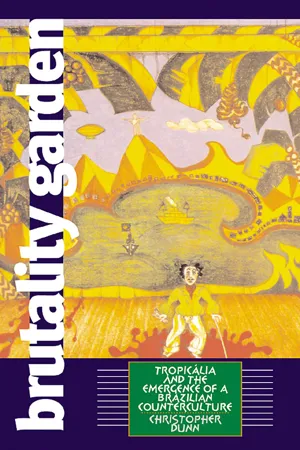
eBook - ePub
Brutality Garden
Tropicália and the Emergence of a Brazilian Counterculture
- 276 pages
- English
- ePUB (mobile friendly)
- Available on iOS & Android
eBook - ePub
About this book
Information
1
POETRY FOR EXPORT
MODERNITY, NATIONALITY, AND INTERNATIONALISM IN BRAZILIAN CULTURE
One of the most remarkable aspects of the tropicalist movement of the late 1960s was its sustained dialogue with several trends in Brazilian literary and cultural production of the twentieth century. The group of young singer-songwriters and their interlocutors in film, theater, visual arts, and literature responded to long-standing polemics over modernity and nationality, as well as to specific dilemmas of cultural production under military rule. Tropicália intervened in a constellation of debates surrounding popular culture and national identity that, as Renato Ortiz has argued, constitutes an evolving “modern tradition” in Brazil.1
The most salient point of reference for this modern tradition is modernismo, a heterogeneous literary and cultural movement that emerged in the 1920s. Modernismo brought together artists who were broadly committed to the aesthetic renovation of Brazilian arts and letters and the articulation of a national culture that was at once “original” (i.e., rooted in the popular cultures of Brazil) and “modern” (i.e., informed by contemporary literary trends in the international sphere). The synthesis of native originality and cosmopolitan technique would generate, as one modernist writer proposed, a “poetry for export” that could have international impact. Brazil would no longer simply import and passively consume metropolitan culture; it would be an exporter of culture. By the 1930s, the spirit of irreverent rebellion against literary conventions had subsided as modernismo was institutionalized under the aegis of an emergent nationalist and populist political regime. During this period, key artists and intellectuals sought to explain the originality of Brazilian civilization in terms of its racial and cultural hybridity, thereby establishing a paradigm for a mestiço national identity.
Throughout the twentieth century, Brazilian popular music has been the most important vehicle for the affirmation of this mestiço national identity both at home and abroad. As early as the mid-1920s, several modernist artists and intellectuals regarded popular music as a prime exemplar of authentic national expression and a source of inspiration for art music. Aided by the expansion of radio in urban centers, African-derived forms, most notably samba, were becoming popular among Brazilians of all races and classes. Samba would eventually be heralded as Brazil’s “national music” and play a key role in the projection of Brazilian culture abroad. In the 1950s, samba would also provide the foundation for bossa nova, a sophisticated new style that gave expression to the cosmopolitan aspirations of Brazil’s cultural elite during a phase of democratic modernization and industrial development. This period of national optimism and confidence was short-lived, but it produced lasting cultural achievements, such as bossa nova, that demonstrated to emerging artists that a poor and unevenly developed country could still produce a “poetry for export” and receive international acclaim.
BRAZILIAN MODERNISM
Launched formally in February 1922 during the Modern Art Week in São Paulo, Brazilian modernismo was a movement with important manifestations in several areas of cultural production.2 The so-called heroic phase of modernismo (1922–30) primarily involved a group of writers, visual artists, and composers from São Paulo and Rio de Janeiro. Although a heterogeneous group, both in terms of aesthetic values and political ideologies, the modernists were generally committed to the critique of belles lettres aesthetics, most identified with Parnassianism, a movement of French origin that had great influence on the previous generation of Brazilian literati. In their attack on literary and artistic conventions, the modernists appropriated avant-garde practices and techniques from European movements such as futurism, cubism, surrealism, and Dada. At the same time, they denounced the acritical imitation of metropolitan forms and the use of continental Portuguese as stylistically removed from Brazilian reality. Even more than other Latin American vanguard movements, Brazilian modernismo was concerned foremost with articulating a project of cultural nationalism. Modernismo signaled transformations in Brazilian cultural, political, and economic life that eventually culminated in the nationalist-populist Revolution of 1930, led by Getúlio Vargas.
The Modern Art Week of São Paulo coincided with the centennial of Brazil’s political independence from Portugal and was articulated as an event to herald the nation’s cultural independence. Although vanguardist literary and artistic activities had been going on for several years before the event, the Modern Art Week marked the moment in which diverse intellectuals coalesced to advance a national cultural project. Established and emergent figures of the literary and artistic milieus of São Paulo and Rio de Janeiro participated in the Modern Art Week, including writers Mário de Andrade, Oswald de Andrade, Menotti del Picchia, and Plínio Salgado; painters Anita Malfatti and Emilio Di Calvancanti; and composer Heitor Villa-Lobos. By the mid-1920s, modernismo had fragmented into separate, often antagonistic subgroups.
Alfredo Bosi identified two imperatives of European avant-garde movements that were manifest in Brazilian modernismo: a futurist imperative calling for formal experimentation, engagement with technology, and the representation of urbanity; and a primitivist imperative with its emphasis on the quotidian experience and cultural practices of the Brazilian people. The modernists were divided, according to Bosi, between a futurist imperative to keep pace with modernity and a primitivist imperative to express “Brazilian roots.”3 This binary may be understood, on one level, as a tension between the simultaneously local and cosmopolitan orientations of the Brazilian modernists. International vanguardism, urbanity, and industrialization were foregrounded in the futurist tendency. A renewed interest in the colonial experience, myths of national foundation, linguistic vernaculars, and the cultural practices of the povo (people or masses), especially Afro-Brazilians and indigenous peoples, oriented primitivist concerns. The modernists appropriated cultural materials of Brazil’s nonwhite population in order to advance the project of cultural nationalism. By interpreting the “primitive” within a framework of vanguardist poetics, the modernists sought to delineate both the specificity and the universality of Brazilian culture. Artistic production that was simultaneously autochthonous and cosmopolitan could be readily “exportable” as an original intervention in the international sphere.
In Brazil, as elsewhere in Latin America, local contexts and concerns mediated these two imperatives. Enthusiasm for Franco-Italian futurism, for example, had already subsided by 1922, when modernismo was formally articulated. Later in the decade, Brazilian modernists would also express ambivalence toward the primitivist vogue, in which they detected a metropolitan fascination with the exotic. Primitivism was often an expression of the West’s own fantasies and anxieties about racial others.4 These two vanguardist tendencies appeared as traces in aesthetic practice and not as programmatic directives. This binary was also not mutually exclusive in modernismo, nor did it necessarily inform for all writers and artists of the modernist generation. It did generate, however, a dominant tension in Brazilian artistic production and cultural debates throughout the twentieth century.
THE FOREST AND THE SCHOOL
Of all the modernists, the poet, novelist, dramatist, and literary provocateur Oswald de Andrade had the greatest impact on the tropicalist movement. He authored the most radical gestures of modernismo, including two of its most celebrated and cited manifestos. Published in 1924, his “Manifesto da Poesia Pau-Brasil” (Manifesto of Brazilwood Poetry) called for a “poetry for export” that would be informed by international literary vanguards but also grounded in the cultural context of Brazil. As the first extract product for international export during the early period of Portuguese colonial rule, Brazilwood was a suggestive metaphor for a “native” cultural project informed by contemporary international trends. Some critics have argued that the notion of a “poetry for export” based on the Brazilwood metaphor merely reaffirms Brazil’s historical role as an exporter of cheap raw materials to the metropolis.5 Yet there is a heavy dose of irony in the Brazilwood metaphor since the manifesto is ultimately about subverting the European colonial legacy while fomenting a modern, technologically informed Brazilian culture. Following a visit to Paris in 1912, Oswald de Andrade had returned to São Paulo with Felippo Tomaso Marinetti’s “Futurist Manifesto” (1909), a dramatic call for the violent destruction of art and institutions of the past and the elaboration of a new project exalting the velocity and technology. In the “Brazilwood Manifesto,” he proposed that futurism served to “reset the Imperial clock of national literature” and that it was time to be “regional and pure in our time.”6
Oswald de Andrade’s “Brazilwood Manifesto” is structured around a binary tension between “the forest and the school” in the genesis of Brazilian culture. In his formulation, the school connotes lettered society, with its formal institutions and technological resources, and the forest serves as a natural metaphor for that which was excluded or marginalized from the economic, political, and cultural centers of power and prestige. Oswald denounces the twin legacy of colonial exploitation and academic pretense represented in the figures of the profiteur, with his will to dominate nature for commercial ends, and the doutor, with his moralizing and phony erudition useful only for marking and reproducing social distinction. As an antidote to these historical types, Oswald calls for more inventors and engineers to produce and implement new forms of modern technology, as well as for new artists to create “agile and candid” poetry using Brazilian street vernacular “without archaisms, without erudition.” Against any programmatic imperatives for artistic production, he simply exhorts his audience to “see with free eyes.”
Oswald de Andrade located popular culture at the center of his poetry for export: “Carnival in Rio is the religious event of our race. Pau-Brasil. Wagner is submerged under the carnival groups of Botafogo. Barbarous and ours. Rich ethnic formation. Vegetal riches. Ore. Cuisine, Vatapá, gold, and dance.” Like precious commodities of the national patrimony, local cultural practices—cuisine and dance—are set alongside Brazil’s iron ore, gold, and botanic splendor. During the annual pre-Lenten festival, neighborhood carnival groups even overwhelm the operas of Wagner, the epitome of European high culture consumed by the local elite. These popular manifestations, which overwhelm imported metropolitan culture with insurgent glee, are claimed as emblems of nationality.
Implicit in this formulation was a celebration of racial and cultural diversity, which provided the necessary conditions for the emergence of a distinct and original culture in the tropics. Romantic writers, artists, and composers of the mid-nineteenth century exalted the Brazilian Indian as a symbol of nationality, a literary motif that was common to many new nations of the Americas. In most cases, the celebration of Indians was possible only after they had been exterminated in large numbers, geographically isolated, or socially marginalized. Oswald eschewed bucolic nostalgia for victims of colonialization, emphasizing instead their agency in the creation of modern Brazil. His reference to vatapá, a traditional Afro-Bahian dish, underscored the centrality of Afro-Brazilians in the formation of national culture. In a critique of Europhilia in Brazilian letters, he satirized Rui Barbosa, a famous white scholar-diplomat from Bahia, labeling him “a top hat in Senegambia.” For Oswald de Andrade, Barbosa’s buttoned-down formality seemed so out of place in this exuberant New World profoundly influenced by indigenous and African cultures.
In the “Brazilwood Manifesto,” the forest and the school, the primitivist and the futurist, the natural and the technological, the local and the cosmopolitan, and the past and the present exist simultaneously. Silviano Santiago has noted the ubiquitous presence of the conjunction “and” in which contradictory or opposing phenomena cited in the manifesto “contaminate” each other.7 On the horizon there is a suggestion of synthesis in which the affective qualities of the Brazilian people would be fused with modern rationality: “A mixture of ‘sleep little baby or the bogey-man will get you’ and equations.” The tension between the two poles never quite reaches dialectical resolution, generating a poetics of playful contradiction. The “Brazilwood Manifesto” invokes a multiplicity of cultural referents that hold promise for future synthesis that could serve as the foundation for an original “poetry for export.”
THE CANNIBALIST GESTURE
Oswald’s project was further radicalized with a second declaration of principles, “Manifesto Antropófago” (Cannibalist Manifesto), first published in the Revista de Antropofagia in 1928.8 A cohort of associates coalesced around the cannibalist group, including Oswald’s second wife, Tarsila de Amaral, who gave visual expression to antropofagia in her tropical surrealist paintings. By this time, modernismo had fractured into a field of competing projects and movements.
The most contentious exchange involved Oswald’s cannibalist group and the ultranationalist movement, Verdeamarelismo (Green-yellowism), later constituted as Anta (Tapir), led by Menotti del Picchia, Cassiano Ricardo, and Plínio Salgado. Originally articulated as a critical response to Oswald’s Pau-Brasil, their nationalist project was based on the mythic history of precolonial native Brazilians. In their 1929 manifesto, the Anta group exalted the Tupi Indians, who had been driven from the high plains to the coast by a rival group, the Tapuias, “in order to be absorbed” by the Portuguese colonists.9 This was a “historic fatality” in which the Tupi “disappeared objectively” in order “to live subjectively and be transformed into a prodigious force of goodness in the Brazilian.” They eulogized the Tupi as a “race that transformed the races” precisely for the...
Table of contents
- Cover Page
- TROPICÁLIA AND THE EMERGENCE OF A BRAZILIAN COUNTERCULTURE
- Copyright Page
- Dedication
- CONTENTS
- ILLUSTRATIONS
- ACKNOWLEDGMENTS
- ABBREVIATIONS
- INTRODUCTION
- 1 POETRY FOR EXPORT
- 2 PARTICIPATION, POP MUSIC, AND THE UNIVERSAL SOUND
- 3 THE TROPICALIST MOMENT
- 4 IN THE ADVERSE HOUR
- 5 TROPICÁLIA, COUNTERCULTURE, & AFRO-DIASPORIC CONNECTIONS
- 6 TRACES OF TROPICÁLIA
- NOTES
- BIBLIOGRAPHY
- DISCOGRAPHY
- INDEX
Trusted by 375,005 students
Access to over 1.5 million titles for a fair monthly price.
Study more efficiently using our study tools.
Frequently asked questions
Yes, you can cancel anytime from the Subscription tab in your account settings on the Perlego website. Your subscription will stay active until the end of your current billing period. Learn how to cancel your subscription
No, books cannot be downloaded as external files, such as PDFs, for use outside of Perlego. However, you can download books within the Perlego app for offline reading on mobile or tablet. Learn how to download books offline
Perlego offers two plans: Essential and Complete
- Essential is ideal for learners and professionals who enjoy exploring a wide range of subjects. Access the Essential Library with 800,000+ trusted titles and best-sellers across business, personal growth, and the humanities. Includes unlimited reading time and Standard Read Aloud voice.
- Complete: Perfect for advanced learners and researchers needing full, unrestricted access. Unlock 1.5M+ books across hundreds of subjects, including academic and specialized titles. The Complete Plan also includes advanced features like Premium Read Aloud and Research Assistant.
We are an online textbook subscription service, where you can get access to an entire online library for less than the price of a single book per month. With over 1.5 million books across 990+ topics, we’ve got you covered! Learn about our mission
Look out for the read-aloud symbol on your next book to see if you can listen to it. The read-aloud tool reads text aloud for you, highlighting the text as it is being read. You can pause it, speed it up and slow it down. Learn more about Read Aloud
Yes! You can use the Perlego app on both iOS and Android devices to read anytime, anywhere — even offline. Perfect for commutes or when you’re on the go.
Please note we cannot support devices running on iOS 13 and Android 7 or earlier. Learn more about using the app
Please note we cannot support devices running on iOS 13 and Android 7 or earlier. Learn more about using the app
Yes, you can access Brutality Garden by Christopher Dunn in PDF and/or ePUB format, as well as other popular books in Media & Performing Arts & Latin American & Caribbean History. We have over 1.5 million books available in our catalogue for you to explore.