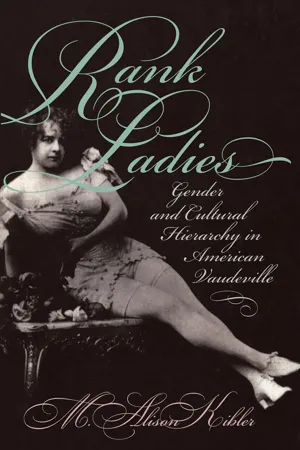
A disrobing acrobat, a female Hamlet, and a tuba-playing labor activist — all these women come to life in Rank Ladies. In this comprehensive study of women in vaudeville, Alison Kibler reveals how female performers, patrons, and workers shaped the rise and fall of the most popular live entertainment at the turn of the century.
Kibler focuses on the role of gender in struggles over whether high or low culture would reign in vaudeville, examining women’s performances and careers in vaudeville, their status in the expanding vaudeville audience, and their activity in the vaudevillians' labor union. Respectable women were a key to vaudeville’s success, she says, as entrepreneurs drew women into audiences that had previously been dominated by working-class men and recruited female artists as performers. But although theater managers publicly celebrated the cultural uplift of vaudeville and its popularity among women, in reality their houses were often hostile both to female performers and to female patrons and home to women who challenged conventional understandings of respectable behavior. Once a sign of vaudeville’s refinement, Kibler says, women became associated with the decay of vaudeville and were implicated in broader attacks on mass culture as well.
- 288 pages
- English
- ePUB (mobile friendly)
- Available on iOS & Android
eBook - ePub
About this book
Information
NOTES
Abbreviations
The following abbreviations are used throughout the notes.
- BRTC
- Billy Rose Theatre Collection, New York Public Library for the Performing Arts, New York, New York
- DBS
- Daniel Blum Scrapbooks, Wisconsin State Historical Society, Madison, Wisconsin
- ESVAP
- Elinore Sisters’ Vaudeville Act Papers, Department of Rare Books and Special Collections, University of Rochester Library, Rochester, New York
- FTC v. VMPA
- Federal Trade Commission v. Vaudeville Managers’ Protective Association et al., Docket 128, Record Group 122, National Records Center, Suitland, Maryland
- HC
- Harris Collection, Special Collections, John Hay Library, Brown University, Providence, Rhode Island
- HRHRC
- Harry Ransom Humanities Research Center, University of Texas, Austin, Texas
- HTC
- Harvard Theatre Collection, Houghton Library, Harvard University, Cambridge, Massachusetts
- JAC
- Julia Arthur Collection, Harvard Theatre Collection, Houghton Library, Harvard University, Cambridge, Massachusetts
- KAC
- Keith/Albee Collection, Special Collections Department, University of Iowa Library, Iowa City, Iowa
- LC
- Library of Congress, Washington, D.C.
- RBC
- Ruth Budd Collection, Allen County-Fort Wayne Historical Society, Fort Wayne, Indiana
- RLC
- Robinson Locke Collection, New York Public Library for the Performing Arts, New York, New York
Chapter One
1. The description of this entertainment is based on the theater manager’s account in Report Book 10, 28, KAC.
2. New York Dramatic Mirror, October 23, 1909, quoted in Slide, Selected Vaudeville Criticism, 91.
3. “Keith Bill Headed by Yvette Guilbert,” Philadelphia Inquirer, November 16, 1909, 6. Epes Sargent (Chicot) described her “personal charm” in Variety, April 28, 1906, quoted in Slide, Selected Vaudeville Criticism, 90.
4. Report Book 10, 28, KAC.
5. Guilbert was not simply a cardboard caricature of feminine snobbery. During her first vaudeville tour, she agreed to incorporate several “coon songs” (syncopated songs with African American characters usually sung in African American dialect) after her agent convinced her that the usual fare would not draw a broad enough crowd. Critics noted that as she progressed in vaudeville she abandoned some of her typical restraint; one reviewer was pleased to see that by 1906 Guilbert was no longer standing motionless onstage while she sang. See Gilbert, American Vaudeville, 142.
6. Report Book 10, 28, KAC.
7. New York Dramatic Mirror, October 23, 1909, quoted in Slide, Selected Vaudeville Criticism, 91.
8. “Yvette Guilbert Raps American Audiences,” New York Times, October 17, 1909, 13. For information on Guilbert’s appearances in Britain, see Géraldine Harris, “Yvette Guilbert.”
9. Report Book 2, 231, KAC.
10. “Mrs. Fiske’s Anger Aroused,” The Player, November 25, 1910, 37; “The Matinee Girl,” New York Dramatic Mirror, June 11, 1904, 2. Furthermore, the police reportedly became involved in maintaining cultural order when they forbade blackface, acrobatic, and animal acts to appear at the Actors Fund Benefit, a charity production that included many vaudeville as well as dramatic performers. See “Big Actors’ Fund Benefit Given by White Rats,” The Player, May 6, 1910, 17.
11. Frank Fogarty testimony, box 71, 1134–35, FTC v. VMPA.
12. DiMaggio, “Cultural Entrepreneurship in Nineteenth Century Boston, Part II,” 308–13. See also DiMaggio, “Cultural Entrepreneurship in Nineteenth Century Boston: The Creation of an Organizational Base for High Culture in America”; Bright and Bakewell, Looking High and Low; and Lamont and Fournier, Cultivating Differences.
13. Levine, Highbrow/Lowbrow, 101.
14. Neil Harris, “Four Stages of Cultural Growth,” 22. See also Levine, Highbrow/ Lowbrow.
15. Butsch, “Bowery B’hoys and Matinee Ladies,” 376.
16. Ann Douglas, Feminization of American Culture; Cott, Bonds of Womanhood; Ryan, Cradle of the Middle Class.
17. Butsch, “Bowery B’hoys and Matinee Ladies.” See also Claudia Johnson, “That Guilty Third Tier,” and Tracy C. Davis, Actresses as Working Women. Hansen notes that, by the end of the nineteenth century, middle-class leisure was usually family centered (catering to women and men), whereas popular entertainment (saloons and burlesque, for example) was still male dominated, a threat to women’s reputations (Babel and Babylon, 115).
18. Butsch, “Bowery B’hoys and Matinee Ladies,” 387.
19. McLean, “Genesis of Vaudeville,” 86.
20. Levine, Highbrow/Lowbrow, 197; Kasson, Rudeness and Civility, 250. Kasson also acknowledges some debate over refinement in American vaudeville, pointing to the activity of the “guerilla fighters of male working-class culture” (ibid.).
21. Oberdeck, “Contested Cultures of American Refinement,” 42. See also Oberdeck, “Religion, Culture, and the Politics of Class.” The manager of Keith’s theater in Providence noted a class difference between the patrons who came to see Ethel Barrymore one week and those who came to see the Edison talking pictures the next, but he admitted that “as they both pay the same price, I presume it is all right” (Report Book 14, 246, KAC).
22. Oberdeck, “Contested Cultures of American Refinement,” 53.
23. Rubin, Showstoppers, 14–18. William Taylor has described the aggregate amusements around the turn of the century as the “commercial culture of pastiche.” Such offerings, he argues, were a profitable combination of “plasticity and suggestiveness,” open to varied interpretations and broad markets (In Pursuit of Gotham, 74, 90). See also Snyder, Voice of the City, 3–12.
24. Ibid., 16. See also Toll, On with the Show, 86.
25. Mahar, “Ethiopian Skits and Sketches,” 269. See also Toll, Blacking Up.
26. Toll, Blacking Up, chap. 3.
27. Snyder, Voice of the City, 9.
28. Ibid., 10.
29. Nasaw, Going Out, 14.
30. Ibid., 18. Dennett notes that “typical late nineteenth century middle-of-the-road dime museums [catered] to a working-class and lower-middle-class clientele” (Weird and Wonderful, 56).
31. Nasaw, Going Out, 18. See also Dennett, Weird and Wonderful, 61.
32. Harlow, Old Bowery Days, quoted in Dennett, Weird and Wonderful, 61.
33. Nasaw has identified the late nineteenth century as the beginning of an “era of public amusements,” including the dramatic rise of world fairs, amusement parks, baseball parks, vaudeville, and motion picture houses (Going Out, l). And Ohmann has described the rise of mass culture in relation to magazine publishing and marketing around the turn of the century in Selling Culture.
34. Butsch, “Introduction: Leisure and Hegemony,” 14–15.
35. Snyder, Voice of the City, xv.
36. Gorn, “Sports through the Nineteenth Century,” 1639.
37. Leach, Land of Desire, 23.
38. Ibid., 25.
39. Nasaw, Going Out, 27. Sometimes, however, vaudeville theater managers noted that popular baseball games hurt vaudeville’s business. On the opening day of the baseball season in Cleveland, Keith’s manager there wrote, “The sun shone, and the theatre starved to death. At one time I thought of asking our audience if he would go out and have a cigar, bu...
Table of contents
- Cover Page
- RANK LADIES
- Copyright Page
- Dedication
- CONTENTS
- ILLUSTRATIONS
- ACKNOWLEDGMENTS
- ONE INTRODUCTION
- TWO LADIES AND NUTS
- THREE LADIES OF RANK
- FOUR A HAS BEEN OLD-LADY STAR
- FIVE THE CORKING GIRLS
- SIX THE UPSIDE-DOWN LADY
- SEVEN ARTISTS AND ARTISANS, RATS AND LAMBS
- EIGHT CONCLUSION
- NOTES
- BIBLIOGRAPHY
- INDEX
- Series
Trusted by 375,005 students
Access to over 1.5 million titles for a fair monthly price.
Study more efficiently using our study tools.
Frequently asked questions
Yes, you can cancel anytime from the Subscription tab in your account settings on the Perlego website. Your subscription will stay active until the end of your current billing period. Learn how to cancel your subscription
No, books cannot be downloaded as external files, such as PDFs, for use outside of Perlego. However, you can download books within the Perlego app for offline reading on mobile or tablet. Learn how to download books offline
Perlego offers two plans: Essential and Complete
- Essential is ideal for learners and professionals who enjoy exploring a wide range of subjects. Access the Essential Library with 800,000+ trusted titles and best-sellers across business, personal growth, and the humanities. Includes unlimited reading time and Standard Read Aloud voice.
- Complete: Perfect for advanced learners and researchers needing full, unrestricted access. Unlock 1.5M+ books across hundreds of subjects, including academic and specialized titles. The Complete Plan also includes advanced features like Premium Read Aloud and Research Assistant.
We are an online textbook subscription service, where you can get access to an entire online library for less than the price of a single book per month. With over 1.5 million books across 990+ topics, we’ve got you covered! Learn about our mission
Look out for the read-aloud symbol on your next book to see if you can listen to it. The read-aloud tool reads text aloud for you, highlighting the text as it is being read. You can pause it, speed it up and slow it down. Learn more about Read Aloud
Yes! You can use the Perlego app on both iOS and Android devices to read anytime, anywhere — even offline. Perfect for commutes or when you’re on the go.
Please note we cannot support devices running on iOS 13 and Android 7 or earlier. Learn more about using the app
Please note we cannot support devices running on iOS 13 and Android 7 or earlier. Learn more about using the app
Yes, you can access Rank Ladies by M. Alison Kibler in PDF and/or ePUB format, as well as other popular books in Social Sciences & Gender Studies. We have over 1.5 million books available in our catalogue for you to explore.