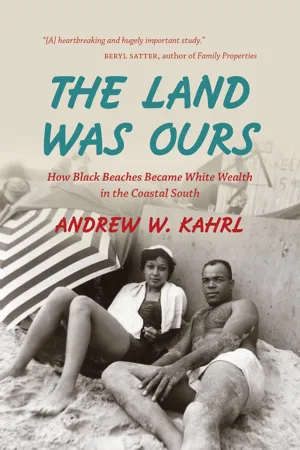
The coasts of today’s American South feature luxury condominiums, resorts, and gated communities, yet just a century ago, a surprising amount of beachfront property in the Chesapeake, along the Carolina shores, and around the Gulf of Mexico was owned and populated by African Americans. Blending social and environmental history, Andrew W. Kahrl tells the story of African American–owned beaches in the twentieth century. By reconstructing African American life along the coast, Kahrl demonstrates just how important these properties were for African American communities and leisure, as well as for economic empowerment, especially during the era of the Jim Crow South. However, in the wake of the civil rights movement and amid the growing prosperity of the Sunbelt, many African Americans fell victim to effective campaigns to dispossess black landowners of their properties and beaches.
Kahrl makes a signal contribution to our understanding of African American landowners and real-estate developers, as well as the development of coastal capitalism along the southern seaboard, tying the creation of overdeveloped, unsustainable coastlines to the unmaking of black communities and cultures along the shore. The result is a skillful appraisal of the ambiguous legacy of racial progress in the Sunbelt.
eBook - ePub
The Land Was Ours
How Black Beaches Became White Wealth in the Coastal South
- 374 pages
- English
- ePUB (mobile friendly)
- Available on iOS & Android
eBook - ePub
About this book
Information
Chapter 1: Corporate Ventures
He “made personal sacrifices to accommodate his people.” He stood “as a beacon light to his race,” a “man whose words [were] household aphorisms.” “His reputation is known by the entire community to be a man who gives the people of this city enjoyment when all others fail.” Following his incorporation, in 1902, of the Freedman’s Transportation, Land, and Improvement Company in Washington, D.C., and the opening of the city’s only “colored” riverside resort, the name Lewis Jefferson became, for some black Washingtonians, synonymous with “race enterprise,” a man whose sagacity and empathy saved fellow black Washingtonians from humiliation and indignation in their summertime pursuit of pleasure, and whose personal success exemplified a race on the rise. To others in a city where, as the writer and poet Paul Laurence Dunbar put it, “the big men of little towns come to be disillusioned,” Jefferson was another swindler masquerading as a leader, who promised riches to his investors but delivered only debt, and who preached race loyalty and race pride but only to the dollar remained true.1 Still to others, he was a black competitor in the lucrative, white-controlled “colored excursion” trade, whose message of race loyalty in consumer spending demanded and gave rise to new measures to enlist black class chauvinism and white racism as tools of profit and market control.
As a young black capitalist seeking to build wealth through real estate and turn fellow blacks’ thirst for modern amusements into profit, Jefferson was, if anything, a man of his times. His incorporation of a transportation company, acquisition of Potomac waterfront real estate along with an outdated and mechanically unsound steamboat, and development of the city’s first black-owned amusement park resort exemplified the structure and culture of black investment strategies and entrepreneurial activity from the late nineteenth through the early twentieth centuries, as did his appeals to potential investors, grounded in the often-incongruous promise of personal riches and economic empowerment of “the race.” To his supporters and detractors, it was no surprise that Jefferson channeled his energies toward real estate acquisitions and leisure and transportation industries, nor that he built his fortune through exploiting while skillfully appealing to the black masses. In his 1936 study, The Negro As Capitalist, Abram Harris wrote: “From the [18]80s on, the Negro masses, urged by their leaders, were led to place increasing faith in business and property as a means of escaping poverty and achieving economic independence. Although ostensibly sponsored as a means of self-help or racial cooperation . . . Negro business enterprise was motivated primarily by the desire for private profit and looked toward the establishment of a Negro capitalist employer class.” Lacking the capital, connections, or market to sustain large-scale commercial and industrial development, turn-of-the-century black capitalists, Harris found, turned to real estate speculation and amusement enterprises as two of the primary means through which to secure an economic foundation in urban settings.2 Perceiving possibilities arising from the segregation of public outdoor space and privately run amusements, Jefferson and others adhered to Booker T. Washington’s maxim “Every condition which creates a new want offers at the same time a new business opportunity.”3
It was no coincidence that black Washingtonians loaded the hopes and dreams of a rising race onto aging steamboats and unloaded them on the shores of the Potomac. Since man first secured sail to mast, fortunes have been squandered on the mythical allure of boat ownership, that most notorious of risky investments. The high risks involved, in turn, made water transportation vessels one of the few industries and commercial pursuits open to black investors, as sellers sought to unload often-frail and dilapidated vessels or excess or unprofitable real estate onto those desperate to secure a tangible investment in future success, or used the promise of riches from the amusement trade to lure black investors into fraudulent schemes. As urban waterfronts and nearby seashores connected by rail grew in popularity and profitability in the first decades of the twentieth century, African American corporate investments in pleasure resorts increasingly fell victim to arson and other forms of racial terrorism by those who saw in such visible symbols of black economic initiative an affront to relations of power being inscribed onto these new land and waterscapes. By the turn of the twentieth century, countless numbers of ambitious young men and women had staked their future in volatile industries and notoriously unprofitable assets, their rare instances of success-against-all-odds overshadowed by equally epic (and far more common) failures. For many, their savings and investments sank, quite literally, to the bottom of the river or sea, along with their faith in the power of the marketplace to deliver freedom from racial oppression and exploitation.
In an 1886 editorial in the New York Globe, T. Thomas Fortune told his readers that, rather than spend precious dollars at white-owned resorts and picnic grounds, they should build and support a black-owned public resort.4 A glimpse of leisure and enterprise on Washington’s Potomac River seemed to testify to the wisdom and urgency of Fortune’s advice. In the preceding decades, the city’s African American population had grown exponentially.5 Many arrived at the wharves of the city’s Southwest district aboard one of the steamboats that plied the Potomac and Chesapeake, after a voyage spent confined to the lower decks, forced to withstand the heat and breathe in the soot from the engine, while white passengers danced and dined on the decks above.6 By the late nineteenth century, steamboats had long ceased to be the quickest and most reliable form of transportation for persons or freight in the mid-Atlantic region, but remained popular as a form of leisurely transportation. With each passing season, steamboat owners and operators refitted freight boats as excursion steamers offering day and overnight trips.7 Among burgeoning communities of freed-people in Washington and other cities, summertime steamboat excursions emerged as both a popular activity and a fund-raising source for churches, social clubs, secret orders, lodges, and other mutual aid societies.8 By the 1880s, African American organizations routinely rented out excursion steamboats for private events and ventured to riverside resorts, often taking advantage of lower rates on weekdays or during the off-season months of April and September. The riverside landings where excursion parties disembarked remained, into the 1880s, little more than a cleared field suitable for picnics, hiking, and flower picking, and offered travelers a chance to “get away from the heat of the city and enjoy the fresh air of the river . . . [and] a few pleasant hours in the woods.”9
Like other bodies of water located in or near urban centers, the Potomac had, throughout the nineteenth century, attracted a wide and varied assemblage of persons and activities. Alongside stately and decorated steamboats floated gambling and prostitution dens, known as arks; on the shore, sporting crowds gathered for illicit boxing matches within earshot of Mount Vernon, the home of the “father of the nation.” Prostitution flourished in coves and shoal waters that were inaccessible to harbor patrol boats. Located on the border of Prince George’s and Charles counties in Maryland and surrounded by steep hills, dense forest, and thick underbrush, Bull Town Cove housed a floating village of gambling, drinking, and prostitution dens and became a favorite rendezvous for sailing crews headed to and from the capital city. In the city, prizefight promoters sold tickets and accepted wagers at the wharfs in Washington or Alexandria, loaded interested parties onto steamboats, and traveled down the river in search of an open landing or a sheriff or night watchman they could bribe to allow them to come ashore and commence the affair. Along the city’s waterfront, small-business owners set up shops, with legitimate services up front disguising faro rooms in back.
It was no coincidence that illegal activities flourished along the water. Maryland’s boundary extended to the Virginia shoreline, thus giving it nominal authority over the Potomac’s waters south of the District. Following the retrocession of Arlington and Alexandria to Virginia in 1848, the waters north of the District’s southern boundary became a subject of legal debate, with neither the District nor the state of Virginia willing to claim jurisdiction. Thus, at the convergence of Maryland, Virginia, and the District, illicit pleasures flourished with virtual impunity, as offenders could easily move into another jurisdiction at the sight of an approaching patrol boat. Gambling proprietors such as Alexandria’s Jack Heath anchored riverboat casinos at the intersection of these boundaries of authority, “flirt[ing] around the law with the dexterity of a swallow.” Heath’s Ark, one reporter noted, “is always cunningly anchored within close proximity to the channel and boundary intersection.”10
While Heath floated in the river, growing numbers of riverboat owners sought out the shore. Excursion boats marketed to city dwellers the chance to travel down the river, breathe fresh air, and watch the rolling countryside of Maryland and Virginia as they passed by. But ultimately, an excursion needs a destination, and its passengers expected to reach a place along the sandy shores of the Potomac where they could disembark and picnic. As they became increasingly engaged in the business of pleasure, riverboat owners acquired riverfront properties with the intent of developing pleasure resorts. Picnic groves that previously consisted of little more than cut grass were transformed into modern amusement parks, while formerly common lands were landscaped, fenced, and privatized. Excursion steamboat companies bought up waterfront property and streamlined operations by running a set, daily schedule of trips open to the public to a single location, in place of a series of trips for different groups to various locations. In 1895, L. L. Blake and Joseph C. McKibben, owners and operators of the Charles Macalester and the River Queen, purchased the grounds of the venerable Marshall Hall, a colonial mansion and the former home of one of Maryland’s oldest and wealthiest families, located across the river from Mount Vernon. They equipped the 412-acre tract with rides, lights, and concessions and began running a daily schedule of excursions from Washington to Mount Vernon and Marshall Hall. In the shadow of the old plantation house, excursion parties enjoyed “planked shad, hot from the fire and washed down with foamy extract of malt or fragrant mint juleps, and afterward the various amusements of bowling alleys, rifle ranges, merry-go-rounds, strolling under the trees or loafing quietly in the shade.” The composition of and atmosphere aboard riverboat excursions and at new modern pleasure resorts both reflected and shaped a broader redefinition of “respectability” in the age of public amusements, one set in contrast to the mixed, sporting crowds that characterized past summers on the Potomac. At places like Marshall Hall, guests were expected to adhere to standards of conduct. “Positively no improper characters,” one excursion boat publicized, “will be allowed aboard.”11
In this and other public places of amusement, persons of color were, without exception, defined as improper. Part and parcel of becoming a “respectable” riverboat or riverside resort was the drawing of the color line.12 If blacks were lucky, they could enjoy these new facilities on certain days of the week, or during the off-season. More often, though, owners simply barred blacks from entry altogether. In July 1887, the Excelsiors, a social club composed of “aristocrats of color,” enjoyed another annual excursion aboard the Mary Washington to River View, a small resort on the Virginia side of the river. There they marveled at the resort’s “spacious and elegant booths, its young tress and its roller coaster.” The following summer, however, the resort’s managers, having established the park as a “public” resort, “swor[e] against colored organizations of every description.” In June 1891, “three colored men called at one of [the riverboat] ticket offices . . . to inquire what boat they could take to some point down the river, when an insignificant jack commenced braying. He told them to get away from the window; that colored people were not allowed at Marshall Hall, and he refused to sell them tickets.”13
Many of these same ticket offices would soon come to welcome black excursionists’ money, but only aboard one of their Negro excursion boats. L. T. Woolen, a young white captain and owner of the steamer Pilot Boy, was among the first to perceive the profits to be drawn from black Washingtonians’ yearning for an afternoon or evening on the Potomac. In 1888 he designated the Pilot Boy as a “colored excursion boat” and began accepting reservations from the city’s black churches, social clubs, and mutual aid societies. He leased the Virginia resort Collingwood Beach to host “colored” excursion parties throughout the summer (see Map 3, p. 35). Woolen outfitted Collingwood Beach with ample attractions, including “a splendid Pavilion, a Gravity Railroad, Flying Horses, Swings, Boats, Bath Houses, etc.” Other proprietors turned to “colored excursion” parties after finding themselves crowded out of the whites-only market. Across the river from Collingwood Beach, in Prince George’s County, Maryland, white businessman J. Harrison Johnson opened in 1890 a riverside resort catering to white Washingtonians on the fifty acres of woodland surrounding the old plantation home Notley Hall. He spared “no expense . . . in fitting out the grounds in a manner which places it far in the lead as a field for picnicking parties,” including, “An elegant two-story café . . . mammoth pavilion . . . bowling alleys, a steam carousel, chariots, and horses, and other pleasing forms of amusement.” Despite its advantageous location nine miles south of the Seventh Street wharf, which afforded guests a “grand view of Washington,” Notley Hall was unable to compete with larger, more fanciful resorts downriver. After three unprofitable seasons catering to whites, in 1894 Harrison began soliciting black excursion parties.14
Like any good business, “colored excursion” companies evolved in relation to the structure of work and the culture of play among their customer base. Many boats specialized in offering moonlight excursions, which began in the evening and often lasted through the night and into the following morning. These proved an especially popular draw for persons who worked long hours. Domestic servants often carried “freedom bags” with them to work containing the outfit they planned to wear once the workday was done.15 Young black men, likewise, donned their finest threads before boarding an excursion steamer.16 For many, these moonlight excursions were one of the few stages on which they could figuratively (and literally) try on and wear identities that the long hours and humiliating racial conventions their jobs in the city’s service trades denied. The moonlight excursion became, as one white reporter put it, an “institution the existence of which is not suspected by the white people.” On board, young couples danced the “cake walk” to the sounds of ragtime, while groups of singers and musicians formed on the decks. As opposed to the select few who had “the time or money to go off an enjoy . . . a country retreat,” the “river crowd” became, as one writer for the Colored American put it, “a faithful type of true democracy.” The boats they boarded and the beaches where they landed, likewise, became formative spaces in the making of a modern, urban black public.17
The companies that owned these boats and resorts had little interest in supporting black social and institutional life. They wanted to make money, and entered into the “colored excursion” trade with a set of assumptions and strategies. White proprietors internalized and worked to prove stereotypes of African Americans as spendthrifts who were willing to part with their last cent on an ephemeral amusement. Most reported to prefer the “colored excursion” business since it was, as one operator described, virtually recession proof. Their business practices, in turn, reinforced the very prejudices about black leisure that justified segregation. Woolen and other white operators of “colored excursions” earned a reputation for their callous disregard for the desires and sensibilities of their clientele. They often purposely oversold tickets for black excursion parties (sometimes as many as twice the legal capacity), leading to disturbances that were often described as “riots.” On several occasions, those holding worthless tickets attempted to storm the boat, resulting in the swift arrival of baton-swinging police squads. On board “colored excursions,” parents, children, and preachers were crowded alongside hustlers and brawlers. One exasperated black clergyman reported that his church had tried to reserve a boat for an excursion, “with the express understanding that no tickets were to be sold to rough characters, that no gambling should be allowed, and that there should be no bar on the boat.” The white manager instead sold tickets to all comers, dispensed alcohol on board, and looked the other way when gambling rings formed on deck. After the minister requested that he honor the wishes of the excursion party, the manager simply set up a “speakeasy and gambling joint in a less con...
Table of contents
- Cover Page
- Halftitle Page
- Title Page
- Copyright Page
- Dedication
- Contents
- Maps
- Introduction: “Bring Back My Yesterday”
- Chapter 1: Corporate Ventures
- Chapter 2: A Sanctuary by the Sea
- Chapter 3: Building Black Privatopias
- Chapter 4: Surviving the Summer
- Chapter 5: Family Ties
- Chapter 6: Spinning Sand into Gold
- Chapter 7: The Price We Pay for Progress
- Epilogue
- Notes
- Primary Sources
- Acknowledgments
- Index
- A section of photographs follows page 154
Trusted by 375,005 students
Access to over 1.5 million titles for a fair monthly price.
Study more efficiently using our study tools.
Frequently asked questions
Yes, you can cancel anytime from the Subscription tab in your account settings on the Perlego website. Your subscription will stay active until the end of your current billing period. Learn how to cancel your subscription
No, books cannot be downloaded as external files, such as PDFs, for use outside of Perlego. However, you can download books within the Perlego app for offline reading on mobile or tablet. Learn how to download books offline
Perlego offers two plans: Essential and Complete
- Essential is ideal for learners and professionals who enjoy exploring a wide range of subjects. Access the Essential Library with 800,000+ trusted titles and best-sellers across business, personal growth, and the humanities. Includes unlimited reading time and Standard Read Aloud voice.
- Complete: Perfect for advanced learners and researchers needing full, unrestricted access. Unlock 1.5M+ books across hundreds of subjects, including academic and specialized titles. The Complete Plan also includes advanced features like Premium Read Aloud and Research Assistant.
We are an online textbook subscription service, where you can get access to an entire online library for less than the price of a single book per month. With over 1.5 million books across 990+ topics, we’ve got you covered! Learn about our mission
Look out for the read-aloud symbol on your next book to see if you can listen to it. The read-aloud tool reads text aloud for you, highlighting the text as it is being read. You can pause it, speed it up and slow it down. Learn more about Read Aloud
Yes! You can use the Perlego app on both iOS and Android devices to read anytime, anywhere — even offline. Perfect for commutes or when you’re on the go.
Please note we cannot support devices running on iOS 13 and Android 7 or earlier. Learn more about using the app
Please note we cannot support devices running on iOS 13 and Android 7 or earlier. Learn more about using the app
Yes, you can access The Land Was Ours by Andrew W. Kahrl in PDF and/or ePUB format, as well as other popular books in Social Sciences & North American History. We have over 1.5 million books available in our catalogue for you to explore.