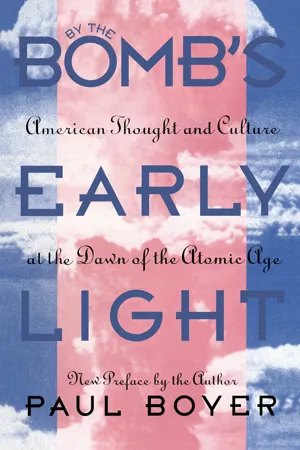
Originally published in 1985, By the Bomb’s Early Light is the first book to explore the cultural 'fallout' in America during the early years of the atomic age. Paul Boyer argues that the major aspects of the long-running debates about nuclear armament and disarmament developed and took shape soon after the bombing of Hiroshima.
The book is based on a wide range of sources, including cartoons, opinion polls, radio programs, movies, literature, song lyrics, slang, and interviews with leading opinion-makers of the time. Through these materials, Boyer shows the surprising and profoundly disturbing ways in which the bomb quickly and totally penetrated the fabric of American life, from the chillingly prophetic forecasts of observers like Lewis Mumford to the Hollywood starlet who launched her career as the 'anatomic bomb.'
In a new preface, Boyer discusses recent changes in nuclear politics and attitudes toward the nuclear age.
eBook - ePub
By the Bomb's Early Light
American Thought and Culture At the Dawn of the Atomic Age
- 464 pages
- English
- ePUB (mobile friendly)
- Available on iOS & Android
eBook - ePub
About this book
Information
First Reactions
1
“The Whole World Gasped”
Just as people recall the circumstances under which they first heard the news of the attack on Pearl Harbor, so they will remember how the atomic bomb first burst upon their consciousness.
August 6, 1945. President Truman was aboard the U.S.S. Augusta, steaming across the Atlantic on his way home from the Postdam conference, when he received the word: an American atomic bomb had been successfully detonated over Hiroshima, Japan. Excitedly Truman rushed to the officers’ wardroom and told them the news. The navy men burst into cheers.
At the White House, it was a slow news day and only a few reporters were on duty. In mid-morning, assistant press secretary Eben Ayres strolled into the press room and told the reporters something might be coming later. At 10:45 AM., Eastern War Time, Ayres released the story. At first the reporters seemed to hesitate, then they rushed for the telephones. The first bulletin went out over the Associated Press wire at 11:03.
John Haynes Holmes, minister of the Community Church of New York City, was vacationing at his summer cottage in Kennebunk, Maine, that day. Soon after, he described his feelings on hearing the news: ‘Everything else seemed suddenly to become insignificant. I seemed to grow cold, as though I had been transported to the waste spaces of the moon. The summer beauty seemed to vanish, and the waves of the sea to be pounding upon the shores of an empty world. …For I knew that the final crisis in human history had come. What that atomic bomb had done to Japan, it could do to us.”1
How does a people react when the entire basis of its existence is fundamentally altered? Most such changes occur gradually; they are more discernible to historians than to the individuals living through them. The nuclear era was different. It burst upon the world with terrifying suddenness. From the earliest moments, the American people recognized that things would never be the same again.
Perhaps the best way to convey a sense of the earliest days of what almost immediately began to be called the “Atomic Age” is not to impose too much order or coherence on them retrospectively. Out of the initial confusion of emotions and welter of voices, certain cultural themes would quickly emerge. But first, the Event.
The first to hear the news that distant Monday were those who happened to be near a radio at midday—housewives, children, the elderly, war workers enjoying a vacation day at home:
This is Don Goddard with your news at noon. A little less than an hour ago, newsmen were called to the White House down in Washington, and there they were read a special announcement written by President Truman. … This was the story of a new bomb, so powerful that only the imagination of a trained scientist could dream of its existence. Without qualification, the President said that Allied scientists have now harnessed the basic power of the universe. They have harnessed the atom.2
As the sultry August afternoon wore on, the news spread by word of mouth. The evening papers reported it in screaming headlines:
ATOMIC BOMB LOOSED ON JAPAN
ONE EQUALS 20,000 TONS OF TNT
FIRST TARGET IS ARMY BASE OF HIROSHIMA
DUST AND SMOKE OBSCURE RESULT.
On his six O’clock newscast, Lowell Thomas of CBS radio, already assuming that everyone had heard the story, began in his folksy, avuncular voice:
That news about the atomic bomb overshadows everything else today; and the story of the dropping of the first one on Japan. The way the Japanese describe last night’s raid on Hiroshima indicates that this one bomb was so destructive that the Japs thought they had been blasted by squadrons of B-29s.3
Meanwhile, over at NBC, the dean of radio news commentators, H. V. Kaltenborn, was preparing the script of his 7:45 P.M. broadcast. The first draft began by describing the atomic bomb as “one of the greatest scientific developments in the history of man.” Hastily, Kaltenborn penciled in a punchier opening: “Anglo-Saxon science has developed a new explosive 2,000 times as destructive as any known before.”4
Continuing in his stern, professorial voice, Kaltenborn struck a somber note: “For all we know, we have created a Frankenstein! We must assume that with the passage of only a little time, an improved form of the new weapon we use today can be turned against us.”.
Kaltenborn was far from alone in perceiving the nightmarish possiblities. Science may have “signed the mammalian world’s death warrant,” warned the St. Louis Post-Dispatch on August 7, “and deeded an earth in ruins to the ants.” A Milwaukee Journal editorial on the same day speculated about “a self-perpetuating chain of atomic destruction” that, like “a forest fire sweeping before high winds,” could obliterate the entire planet.
In a broadcast that evening, Don Goddard added a chilling concreteness to these ominous forebodings:
There is reason to believe tonight that our new atomic bomb destroyed the entire Japanese city of Hiroshima in a single blast. … It would be the same as Denver, Colorado, with a population of 350,000 persons being there one moment, and wiped out the next.5
Thus in the earliest moments of the nuclear era, the fear that would be the constant companion of Americans for the rest of their lives, and of millions not yet born in 1945, had already found urgent expression.
The carefully orchestrated government press releases, illustrated with a set of officially approved photographs, only partially allayed the gathering fear and uncertainty. Hiroshima itself was enveloped in an eerie silence that the outside world only gradually penetrated. “As for the actual havoc wrought by that first atomic bomb,” said Lowell Thomas on August 7, “one earlier report was that the photographic observation planes on the job shortly after the cataclysmic blast at Hiroshima had been unable to penetrate the cloud of smoke and dust that hung over that devastated area.” An air force spokesman on Okinawa said Hiroshima “seemed to have been ground into dust by a giant foot.”
At a hectic news conference on Guam, Col. Paul Tibbets, Jr., pilot of the Enola Gay, the atomic-bomb plane, compared the cloud over the city to “boiling dust.” Navy captain William S. Parsons, the scientist responsible for the final bomb assembly aboard the plane, extended an open palm to represent Hiroshima and said that only the fingers—the docks jutting into Hiroshima Bay—had been visible after the blast. The news conference was continually interrupted by a cigar-chomping Gen. Curtis LeMay with a terse, “No, you better not say that.”6
Speculation and “human interest” stories supplemented the tightly controlled official releases. Newsmen compared the atomic bomb to the 1917 explosion of a munitions ship in the harbor of Halifax, Nova Scotia, that had killed eighteen hundred people. They interviewed the wife of Gen. Leslie R. Groves, military chief of the Manhattan Project (“I didn’t know anything about it until this morning, the same as everyone else”). They sought out Eleanor Roosevelt, who gave FDR’s posthumous benediction to the atomic bomb: “The President would have been much relieved had he known we had it.”
Journalists strove for a local angle: “DEADLIEST WEAPONS IN WORLD’S HISTORY MADE IN SANTA FE VICINITY” was the headline carried by the Santa Fe New Mexican over its story about tiny Los Alamos, nerve center of the Manhattan Project. Tennessee papers played up what the New York Times dramatically called the “secret empire” at Oak Ridge, where work on the atomic bomb had been conducted in a vast “labryinthine concrete fortress.” In Hanford, Washington, reporters found the local residents surprised to learn that the vast secret facility nearby had been making plutonium; they had assumed poison gas. The Albany newspapers noted that General Groves was the son of a Presbyterian minister who had once had a church in that city.7
The secret atomic-bomb test conducted at Alamogordo, New Mexico, on July 16, 1945, was now revealed. Lowell Thomas quoted a railway engineer who had been in the cab of the Santa Fe over 100 miles away at the moment of the predawn test: “All at once, it seemed as if the sun suddenly appeared out of the darkness. … The glare lasted about three minutes, then all was dark again.” Newspaper stories told of Georgia Green, a blind girl in Albuquerque, 120 miles from Alamogordo, who at the moment of detonation had cried out, “What was that?”8
On August 9, with Hiroshima still dominating the nation’s consciousness, came a further shock: a second atomic bomb had been dropped on the Japanese city of Nagasaki. “It is an awful responsibility which has come to us,” intoned President Truman on nationwide radio the next day. “We thank God that it has come to us instead of to our enemies; and we pray that He may guide us to use it in His ways and for His purposes.”9
Amid the stupefying rush of events, people could only assure each other that something momentous, almost unfathomable, had occurred. “[One] forgets the effect on Japan . . . ,” said the New York Herald Tribune, “as one senses the foundations of one’s own universe trembling.” The papers were full of such observations. The bomb, commented Christian Century magazine, had “cast a spell of dark foreboding over the spirit of humanity.” In the New York Times’s first letter-to-the-editor about the atomic bomb (forerunner of thousands that would appear in the years to follow), A. Garcia Diaz of New York City spoke of the “creeping feeling of apprehension” pervading the nation. (With characteristic understatement, the Times captioned this letter: “Atomic Bomb Poses Problem.”) In the New York Sun, correspondent Phelps Adams described the mood in Washington: “For forty-eight hours now, the new bomb has been virtually the only topic of conversation and discussion. … For two days it has been an unusual thing to see a smile among the throngs that crowd the streets. The entire city is pervaded by a kind of sense of oppression.” Political cartoonist D. R. Fitzpatrick of the St. Louis Post-Dispatch pictured a tiny human figure desperately clinging to a pair of reins attached to an awesome lightning bolt streaking across the skies. The caption was: “Little Man, Where To?”10
On August 10, a day after the Nagasaki bombing, the Japanese offered to surrender if Emperor Hirohito could keep his throne. The Allies agreed, and on August 14, World War II ended. The nation’s cities erupted in frenzied celebration, but the underlying mood remained sober and apprehensive. In Washington, the New Republic reported, the war’s end did nothing to mitigate the post-Hiroshima gloom or the “curious new sense of insecurity, rather incongruous in the face of military victory.” Thanks to the atomic bomb, wrote an official of the Rockefeller Foundation a few weeks later, the nation’s mood at the moment of victory was bleaker than in December 1941 when much of the Pacific Fleet had lain in ruins at Pearl Harbor.11 “Seldom, if ever,” agreed CBS radio commentator Edward R. Murrow on August 12, “has a war ended leaving the victors with such a sense of uncertainty and fear, with such a realization that the future is obscure and that survival is not assured.”12
On August 17, amid stories of the surrender ceremonies in Tokyo Bay, H. V. Kaltenborn reported a sobering assessment by air force general H. H. (“Hap”) Arnold of what an atomic war would be like. “As we listen to the newscast tonight, as we read our newspapers tomorrow,” said Kaltenborn, “let us think of the mass murder which will come with World War III.” A few days later he added, “We are like children playing with a concentrated instrument of death whose destructive potential our little minds cannot grasp.”
“The knowledge of victory was as charged with sorrow and doubt as with joy and gratitude,” observed Time in its first postwar issue.
In what they said and did, men are still, as in the aftershock of a great wound, bemused and only semi-articulate. … But in the dark depths of their minds and hearts, huge forms moved and silently arrayed themselves: Titans, arranging out of the chaos an age in which victory was already only the shout of a child in the street.
The war itself had shrunk to “minor significance,” Time added, and its outcome seemed the “most grimly Pyrrhic of victories.”13
The best known of these early postwar editorials, Norman Cousins’s “Modern Man Is Obsolete,” which appeared in the Saturday Review four days after the Japanese surrender, exuded this spirit of apprehension. “Whatever elation there is in the world today,” wrote Cousins,
is severely tempered by . . . a primitive fear, the fear of the unknown, the fear of forces man can neither channel nor comprehend. This fear is not new; in its classical form it is the fear of irrational death. But overnight it has become intensified, magnified. It has burst out of the subconscious and into the conscious, filling the mind with primordial apprehensions.14
Am...
Table of contents
- Cover Page
- By the Bomb’s Early Light
- Copyright Page
- Dedication
- Contents
- Preface
- Acknowledgments
- Introduction
- Part 1 First Reactions
- Part 2 Overture: The World-Government Movement
- Part 3 The Atomic Scientists: From Bomb-Makers to Political Sages
- Part 4 Anodyne to Terror: Fantasies of a Techno-Atomic Utopia
- Part 5 The Social Implications of Atomic Energy: Prophecies and Prescriptions
- Part 6 The Crisis of Morals and Values
- Part 7 Culture and Consciousness in the Early Atomic Era
- Part 8 The End of the Beginning: Settling in for the Long Haul
- Epilogue
- Notes
- Index
Trusted by 375,005 students
Access to over 1.5 million titles for a fair monthly price.
Study more efficiently using our study tools.
Frequently asked questions
Yes, you can cancel anytime from the Subscription tab in your account settings on the Perlego website. Your subscription will stay active until the end of your current billing period. Learn how to cancel your subscription
No, books cannot be downloaded as external files, such as PDFs, for use outside of Perlego. However, you can download books within the Perlego app for offline reading on mobile or tablet. Learn how to download books offline
Perlego offers two plans: Essential and Complete
- Essential is ideal for learners and professionals who enjoy exploring a wide range of subjects. Access the Essential Library with 800,000+ trusted titles and best-sellers across business, personal growth, and the humanities. Includes unlimited reading time and Standard Read Aloud voice.
- Complete: Perfect for advanced learners and researchers needing full, unrestricted access. Unlock 1.5M+ books across hundreds of subjects, including academic and specialized titles. The Complete Plan also includes advanced features like Premium Read Aloud and Research Assistant.
We are an online textbook subscription service, where you can get access to an entire online library for less than the price of a single book per month. With over 1.5 million books across 990+ topics, we’ve got you covered! Learn about our mission
Look out for the read-aloud symbol on your next book to see if you can listen to it. The read-aloud tool reads text aloud for you, highlighting the text as it is being read. You can pause it, speed it up and slow it down. Learn more about Read Aloud
Yes! You can use the Perlego app on both iOS and Android devices to read anytime, anywhere — even offline. Perfect for commutes or when you’re on the go.
Please note we cannot support devices running on iOS 13 and Android 7 or earlier. Learn more about using the app
Please note we cannot support devices running on iOS 13 and Android 7 or earlier. Learn more about using the app
Yes, you can access By the Bomb's Early Light by Paul Boyer in PDF and/or ePUB format, as well as other popular books in Histoire & Histoire de l'Amérique du Nord. We have over 1.5 million books available in our catalogue for you to explore.