- 464 pages
- English
- ePUB (mobile friendly)
- Available on iOS & Android
eBook - ePub
About this book
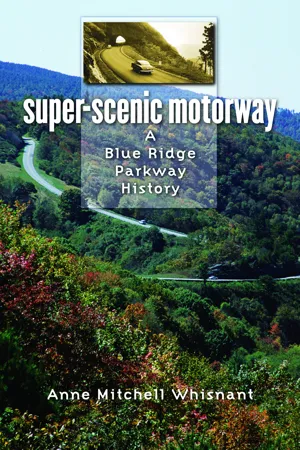
The most visited site in the National Park system, the 469-mile Blue Ridge Parkway winds along the ridges of the Appalachian mountains in Virginia and North Carolina. According to most accounts, the Parkway was a New Deal "Godsend for the needy," built without conflict or opposition by landscape architects and planners who traced their vision along a scenic, isolated southern landscape. The historical archives relating to this massive public project, however, tell a different and much more complicated story, which Anne Mitchell Whisnant relates in this revealing history of the beloved roadway.
Information
1 ROADS, PARKS, AND TOURISM
A SOUTHERN SCENIC PARKWAY IN A NATIONAL CONTEXT
In 1919, North Carolina attorney, resort developer, and Democratic Party activist Heriot Clarkson gave a speech, probably at a meeting of the newly organized Wilmington-Charlotte-Asheville Highway Association, which he served as a legal adviser.1 “This is an age of progress,” he exhorted. Quoting a South Carolina governor advocating the state's-rightist nullification law of the 1830s, Clarkson continued, “‘He who dallies is a dastard and he who doubts is damned.’” What people want, he ventured “are results. Beneficial results, those that serve mankind, churches, schools, good roads — these are the great civilizers of the ages.” The Wilmington-Charlotte-Asheville Road project, an effort to build “a hard-surface road from the mountains to the sea,” he named “the greatest movement started in years.” This road, he hoped, could be linked with roads to be built through federally owned lands in North Carolina's mountains. “The National Government,” he reminded his listeners, “has spent millions of dollars on roads in Yellowstone Park, White Mountains and elsewhere.” Given that fact, “What is the matter with our Congressmen, are they sleeping at the switch? We have the most beautiful scenic mountains in the world. Our government has acquired hundreds of thousands of acres — why not great hard-surface roads built approaching and through them?”2
With characteristic hyperbole, Clarkson previewed the boosterish spirit and identified several of the national and regional trends that fifteen years later would bring the Blue Ridge Parkway to the southern Appalachian mountains of North Carolina and Virginia. As a tourism developer (he had started his Little Switzerland resort getaway in the North Carolina mountains in 1909), a prominent state political figure, and a crusader for good roads, Clarkson was well placed to appreciate the possibilities offered by the emerging tourism–roads–national parks link that lay at the center of the accelerating development of the new national park system.
Nationwide, Good Roads advocacy, park building, and surging automotive tourism in the 1910s and 1920s heralded a new era of national park–oriented travel to which local boosters such as Clarkson hoped to hitch their economic wagons.3 Throughout America, the phenomenal growth of the national park system between 1916 and World War II (greatly fostered by the New Deal) was inextricably tied to the spread of cars and the growth of tourism. Perhaps no project of this era exemplifies the national tourism–automobiles–national parks interconnection (and the many tensions within it) as fully as the New Deal's Blue Ridge Parkway — precisely the kind of “hard-surfaced road approaching and through” the scenic North Carolina mountains for which Clarkson had called. In North Carolina especially, the Blue Ridge Parkway appeared to offer tourism boosters, business promoters, road and park builders, and state government officials a not-to-be missed opportunity to realize long-term goals having as much to do with regional development as with national currents.
Both national trends and regional dynamics gave birth to the Parkway, and the roads-autos-tourism connection shaped the road in crucial ways. It was not (as it has generally been understood to be) a wholly new and imaginative idea for a road to be “laid gently on the land.” How did this particular road came to lie on this particular land, and what can it can tell us about the cultural, social, economic, and political history and values of our or any other times?
EARLY PARK BUILDING IN THE UNITED STATES
The Blue Ridge Parkway emerged at the end of a century-long process of developing an American aesthetic and style for public parks, first in nineteenth-century cities and later in the huge expanses of national parklands. When they began to think about the Parkway in 1933, planners could draw on landscape architecture and park-planning experience that originated in Frederick Law Olmsted's nineteenth-century work on municipal and regional parks, more than thirty years of state park development, more than twenty years of parkway-building experience in other parts of the United States, more than a decade of road building in the national parks, and an evolving Park Service “rustic” design aesthetic. Thus, the Parkway — though longer and more ambitious in scope than any earlier parkway or park road — represented the fruition of long-term trends rather than a new model of park and road development.4
The ideas about scenery, parks, and presentation of landscapes that had been evolving in the United States since the early nineteenth century borrowed in turn from an earlier tradition of English landscape gardening. In nineteenth-century America, civic enthusiasm for carefully planned public parks designed by landscape architects, especially Olmsted and the many influenced or taught by him, produced numerous urban, suburban, and wilderness spaces with roads, paths, and plantings that harmonized with the surrounding natural landscape and highlighted its scenic qualities. From New York's Central Park (1858) to the many other municipal parks it inspired to the federal donation of Yosemite to the state of California in 1864 to the establishment of Yellowstone as a federal park in 1872, park development in the nineteenth century sprang from a growing sense of “seeing land as landscape.” This aesthetic, according to historian Ethan Carr and others, celebrated scenic beauty as a core cultural value and landscape as an art form. Out of this sensibility grew what Carr calls the “landscape park concept” that would govern national park development from 1910 through the 1930s.5
Related to municipal park development were Olmsted's and others’ plans in several cities beginning in the 1870s for integrated systems of controlled parkways to connect neighborhoods and parks. The system created by Olmsted's student, Charles Eliot, on the outskirts of Boston after 1893 exemplified the possibilities. Olmsted's sons’ Denver Mountain Park system (initiated in 1912) also connected a series of outlying areas by scenic roadways, a plan that according to Carr became characteristic of park development in many western cities in the early twentieth century. Foreshadowing the later Blue Ridge Parkway, many early-twentieth-century park systems “featured curvilinear drives and paths that conformed to topography and offered constantly shifting views in a considered sequence.”6
Eliot's park system around Boston also heralded a widening of the concept through the creation of municipal, county, and state park commissions that had the power to condemn and manage larger and larger areas of parklands (sometimes outside of municipal boundaries) for public health and aesthetic enjoyment. The movement for state parks in particular strengthened in the 1880s and 1890s, with New York's protection of Niagara Falls (1885), the creation of Minnesota's Itasca State Park (1891), and designation of the Palisades Interstate Park in New York and New Jersey (1895). Park commissions and systems soon emerged in Connecticut, Minnesota, Wisconsin, Ohio, Idaho, North Carolina, Indiana, and several other states. By 1920, the parks movement had spread nationwide and stood poised for exponential growth in the decade to follow.7
As the twentieth century proceeded, physical modifications of the landscape in the larger new state and regional parks were downplayed in favor of increasing emphasis on highlighting the scenery nature provided. Even the roads and paths needed for visitors, Eliot wrote in the 1890s, should be “mere slender threads of graded surface winding over and among the huge natural forms of the ground.” Other physical improvements to these parks — such as Eliot's Boston system, Bear Mountain in Palisades Park, and Lake Itasca — were also designed seamlessly to foreground the natural scenery. Buildings and other facilities were carefully placed, and all construction was designed so that it blended into the landscape picture. Designers requested that grading follow the land's natural contours, gardeners emphasized woodlands management and planting of indigenous rather than exotic plants, and masons used native stone and wood to build visitor shelters, lodges, guardrails, and signs. The larger, more remote parks offered visitors a wider range of vigorous recreational options, including mountain climbing and hiking, fishing, camping, boating, and swimming. With these developments, Carr notes, the “American landscape park,” born in the city, “moved to the country.”8
In 1917, just in time for the advent of the national park system, Harvard landscape architect Henry Hubbard and librarian Theodora Kimball summarized much of what had been learned by two generations of landscape architects in their seminal textbook, An Introduction to the Study of Landscape Design. According to one historian of the Park Service, this book, which still dominated schools of landscape architecture as late as the 1950s, was likely “the single most influential source that inspired national and state park designers in the 1920s and 1930s.” Hubbard and Kimball advocated an informal style they called “modern American landscape” that highlighted the use of indigenous plants, “natural” landscape scenes that were usually “partly the results of man's activity,” and the development of “vistas” that included a “single central focal point . . . enframed by trees or other masses that screened all other objects” and created a “window that could be manipulated by the designer who could arrange one scene after another in a sequence.” They pushed park builders to imitate natural forms in their buildings by using weathered local stone, rough posts, and thatched roofs to blend shelters and other structures into the landscape.9
Nearly as influential as Hubbard and Kimball was landscape gardening professor Frank Waugh of the Massachusetts Agricultural College, whose The Natural Style in Landscape Gardening (1917) was also widely read. Waugh promoted an approach to park planning that involved asymmetry, mass plantings, an emphasis on imitating natural forms, an attempt to create areas whose boundaries were nearly invisible, and the careful sequencing of scenes and views. All of these elements of design work, he claimed, concerned “intelligently letting alone a natural landscape.”10
This expansion of the park concept received a major impetus from the growth of automobile-based tourism. As automobile ownership expanded and the national park system came into being, Carr argues, “automotive technology pervaded almost every aspect of how [national] parks were developed, managed, and used. Automobiles — and the crowds of tourists they conveyed — made the national park system as we know it possible.”11
THE GOOD ROADS MOVEMENT IN THE NATION AND THE SOUTH
Auto tourism depended on the development of good roads. When the Blue Ridge Parkway idea was first whispered in North Carolina in the summer of 1933, the state, like the nation, was only barely into its second decade of serious road construction. Late-nineteenth-century calls for better roads had finally begun to bring some change in first two decades of the twentieth century, as a network of improved roads spread across the northeast and as the federal government passed legislation in 1916 and 1921 providing funds to help states with road building. With the growing popularity and affordability of the automobile, a national (albeit disunified) Good Roads movement emerged, and by the 1920s highway construction across the country was booming.12
Within and beyond North Carolina, awful southern roads needed attention. In 1904, for example, only slightly over 4 percent of them qualified as “improved” in any way, and most of those were in urban areas. State and federal governments were slow to respond, and as of 1910 (when “improved” mileage had climbed to 7 percent), neither the federal government nor most southern state governments (Virginia's and Alabama's being the exceptions) allocated any money to help local governments with road construction.13
First to set about to change this situation were farmers’ organizations, which advocated better roads to connect farms to nearby markets or to railroad hubs. The farmers’ lobbies resisted levying additional taxes on their members to finance road building, however, and the early Good Roads organizations did not envision a state-controlled highway system. Domination of the Good Roads movement by farmers also limited broad public support by casting road improvement as primarily a farmers’ problem. Not until business and industrial leaders joined the campaign did the Good Roads movement gain the momentum it needed to transform the southern landscape. Financially strapped local or county governments continued to manage road construction, which remained a decentralized and erratic process until the 1916 federal legislation.14
The automobile-induced transportation revolution arrived in earnest in 1910 (with more than thirty-two thousand Model Ts sold), and by the mid-1910s, momentum was building for road improvements. By 1912 North Carolina alone had at least sixty-five Good Roads associations. Car registrations soared to more than 25 million by the late 1920s as the American middle class took to the roads in droves. As people struggled to dig their new vehicles out of the muddy ruts of the old wagon roads, however, the clamor for better highways increased. Professional engineering training was becoming more widely available, and public relations campaigns for better roads galvanized citizens across the South.15
As the automobile-owning population and the automobile industry grew, the rationale for road improvements altered dramatically. Auto owners and industry leaders wanting to sell more cars began to see the auto as a replacement for the railroad, issuing calls for roads to serve interstate tourists and industries, not local farmers. Reform-oriented professionals who had always favored good roads as a means to southern progress and economic development had little difficulty switching to the new rationale, and they were soon joined by business leaders who previously had paid little attention to the Good Roads movement. One historian terms these people “highway progressives” who “paid only lip service to rural development issues and mentioned the concerns of farmers only as a means of getting them on the bandwagon to construct tourist highways. To highway progressives, good roads in the South clearly meant increased tourism, and that translated into economic well-being.” The Good Roads movement thus turned in a new direction by 1915, and this change mirrored trends nationwide as interstate tourism and advocates of a federally funded, nationally connected system of roads came to dominate the enterprise.16
State leaders, however, had no clear idea of how to plan, build, or pay for the roads everyone now seemed to agree were needed. The old decentralized, county-controlled, locally financed, convict-labor road-building system seemed inadequate, but what could or should replace it? What role should federal and state governments play?17
As North Carolina's political leaders edged haltingly into the new age, Heriot Clarkson became central in spurring road building in the state. In his 1919 speech, he spoke for many prominent North Carolinians who had been trying to dig the “Rip Van Winkle state,” left behind by progress, out of both the mud and legendary backwardness. Clarkson and other North Carolina 1920s highway progressives subscribed to a broader development creed that has been termed “business progressivism.” This point of view translated into a willingness to throw the state's money and support behind social and infrastructure improvements that would make North Carolina more attractive to business and industry and, they hoped, help modernize the state.18
Deep-seated resistance to tax hikes to finance road building and a long-entrenched commitment to county control of highway construction restrained the state from creating a unified and professionally designed state road system until 1921. That year, after much publicity by the North Carolina Good Roads Association (by then...
Table of contents
- Cover Page
- Super-Scenic Motorway
- Copyright Page
- Dedication
- CONTENTS
- ILLUSTRATIONS
- ACKNOWLEDGMENTS
- INTRODUCTION A NEW TRIP ALONG A BELOVED ROAD
- 1 ROADS, PARKS, AND TOURISM
- 2 THE SCENIC IS POLITICAL
- 3 WE AIN'T PICKED NONE ON THE SCENIC
- 4 BY THE GRACE OF GOD AND A MITCHELL COUNTY JURY
- 5 THE CROWNING TOUCH OF INTEREST
- 6 REMEMBERING THE PEAKS OF OTTER
- 7 FROM STUMP TOWN TO CAROLINA'S TOP SCENIC ATTRACTION
- EPILOGUE THE PARKWAY'S PAST, ITS PRESENT, AND THE ONGOING SEARCH FOR THE PUBLIC GOOD
- NOTES
- BIBLIOGRAPHY
- INDEX
Trusted by 375,005 students
Access to over 1.5 million titles for a fair monthly price.
Study more efficiently using our study tools.
Frequently asked questions
Yes, you can cancel anytime from the Subscription tab in your account settings on the Perlego website. Your subscription will stay active until the end of your current billing period. Learn how to cancel your subscription
No, books cannot be downloaded as external files, such as PDFs, for use outside of Perlego. However, you can download books within the Perlego app for offline reading on mobile or tablet. Learn how to download books offline
Perlego offers two plans: Essential and Complete
- Essential is ideal for learners and professionals who enjoy exploring a wide range of subjects. Access the Essential Library with 800,000+ trusted titles and best-sellers across business, personal growth, and the humanities. Includes unlimited reading time and Standard Read Aloud voice.
- Complete: Perfect for advanced learners and researchers needing full, unrestricted access. Unlock 1.5M+ books across hundreds of subjects, including academic and specialized titles. The Complete Plan also includes advanced features like Premium Read Aloud and Research Assistant.
We are an online textbook subscription service, where you can get access to an entire online library for less than the price of a single book per month. With over 1.5 million books across 990+ topics, we’ve got you covered! Learn about our mission
Look out for the read-aloud symbol on your next book to see if you can listen to it. The read-aloud tool reads text aloud for you, highlighting the text as it is being read. You can pause it, speed it up and slow it down. Learn more about Read Aloud
Yes! You can use the Perlego app on both iOS and Android devices to read anytime, anywhere — even offline. Perfect for commutes or when you’re on the go.
Please note we cannot support devices running on iOS 13 and Android 7 or earlier. Learn more about using the app
Please note we cannot support devices running on iOS 13 and Android 7 or earlier. Learn more about using the app
Yes, you can access Super-Scenic Motorway by Anne Mitchell Whisnant in PDF and/or ePUB format, as well as other popular books in History & North American History. We have over 1.5 million books available in our catalogue for you to explore.