Cities were the core of a changing economy and culture that penetrated the rural hinterland and remade the South in the decades following the Civil War. In New Men, New Cities, New South, Don Doyle argues that if the plantation was the world the slaveholders made, the urban centers of the New South formed the world made by merchants, manufacturers, and financiers. The book’s title evokes the exuberant rhetoric of New South boosterism, which continually extolled the “new men” who dominated the city-building process, but Doyle also explores the key role of women in defining the urban upper class.
Doyle uses four cities as case studies to represent the diversity of the region and to illuminate the responses businessmen made to the challenges and opportunities of the postbellum South. Two interior railroad centers, Atlanta and Nashville, displayed the most vibrant commercial and industrial energy of the region, and both cities fostered a dynamic class of entrepreneurs. These business leaders' collective efforts to develop their cities and to establish formal associations that served their common interests forged them into a coherent and durable urban upper class by the late nineteenth century. The rising business class also helped establish a new pattern of race relations shaped by a commitment to economic progress through the development of the South’s human resources, including the black labor force. But the “new men” of the cities then used legal segregation to control competition between the races.
Charleston and Mobile, old seaports that had served the antebellum plantation economy with great success, stagnated when their status as trade centers declined after the war. Although individual entrepreneurs thrived in both cities, their efforts at community enterprise were unsuccessful, and in many instances they remained outside the social elite. As a result, conservative ways became more firmly entrenched, including a system of race relations based on the antebellum combination of paternalism and neglect rather than segregation. Talent, energy, and investment capital tended to drain away to more vital cities.
In many respects, as Doyle shows, the business class of the New South failed in its quest for economic development and social reform. Nevertheless, its legacy of railroads, factories, urban growth, and changes in the character of race relations shaped the world most southerners live in today.
eBook - ePub
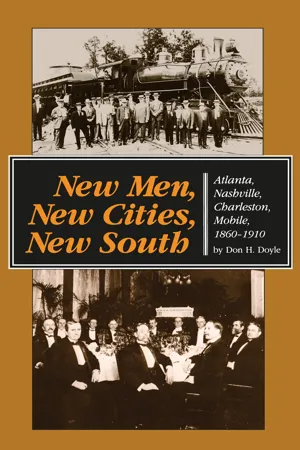
New Men, New Cities, New South
Atlanta, Nashville, Charleston, Mobile, 1860-1910
- 391 pages
- English
- ePUB (mobile friendly)
- Available on iOS & Android
eBook - ePub
About this book
Information
Table of contents
- Cover Page
- Title Page
- Copyright Page
- Dedication
- Contents
- Preface
- Acknowledgments
- Chapter 1: The Urbanization of Dixie
- Chapter 2: The New Order of Things
- Chapter 3: Ebb Tide
- Chapter 4: New Men
- Chapter 5: Patrician and Parvenu
- Chapter 6: The Atlanta Spirit
- Chapter 7: The Charleston Style
- Chapter 8: New Class
- Chapter 9: Gentility and Mirth
- Chapter 10: The New Paternalism
- Chapter 11: Paternalism and Pessimism
- Epilogue
- Notes
- Index
Trusted by 375,005 students
Access to over 1.5 million titles for a fair monthly price.
Study more efficiently using our study tools.
Frequently asked questions
Yes, you can cancel anytime from the Subscription tab in your account settings on the Perlego website. Your subscription will stay active until the end of your current billing period. Learn how to cancel your subscription
No, books cannot be downloaded as external files, such as PDFs, for use outside of Perlego. However, you can download books within the Perlego app for offline reading on mobile or tablet. Learn how to download books offline
Perlego offers two plans: Essential and Complete
- Essential is ideal for learners and professionals who enjoy exploring a wide range of subjects. Access the Essential Library with 800,000+ trusted titles and best-sellers across business, personal growth, and the humanities. Includes unlimited reading time and Standard Read Aloud voice.
- Complete: Perfect for advanced learners and researchers needing full, unrestricted access. Unlock 1.5M+ books across hundreds of subjects, including academic and specialized titles. The Complete Plan also includes advanced features like Premium Read Aloud and Research Assistant.
We are an online textbook subscription service, where you can get access to an entire online library for less than the price of a single book per month. With over 1.5 million books across 990+ topics, we’ve got you covered! Learn about our mission
Look out for the read-aloud symbol on your next book to see if you can listen to it. The read-aloud tool reads text aloud for you, highlighting the text as it is being read. You can pause it, speed it up and slow it down. Learn more about Read Aloud
Yes! You can use the Perlego app on both iOS and Android devices to read anytime, anywhere — even offline. Perfect for commutes or when you’re on the go.
Please note we cannot support devices running on iOS 13 and Android 7 or earlier. Learn more about using the app
Please note we cannot support devices running on iOS 13 and Android 7 or earlier. Learn more about using the app
Yes, you can access New Men, New Cities, New South by Don H. Doyle in PDF and/or ePUB format, as well as other popular books in History & North American History. We have over 1.5 million books available in our catalogue for you to explore.