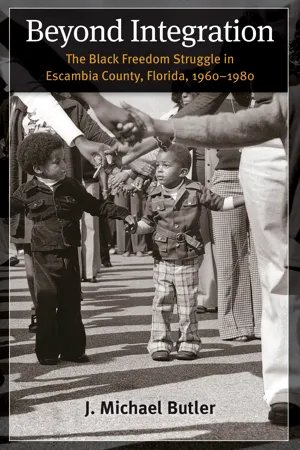
In 1975, Florida’s Escambia County and the city of Pensacola experienced a pernicious chain of events. A sheriff’s deputy killed a young black man at point-blank range. Months of protests against police brutality followed, culminating in the arrest and conviction of the Reverend H. K. Matthews, the leading civil rights organizer in the county. Viewing the events of Escambia County within the context of the broader civil rights movement, J. Michael Butler demonstrates that while activism of the previous decade destroyed most visible and dramatic signs of racial segregation, institutionalized forms of cultural racism still persisted. In Florida, white leaders insisted that because blacks obtained legislative victories in the 1960s, African Americans could no longer claim that racism existed, even while public schools displayed Confederate imagery and allegations of police brutality against black citizens multiplied.
Offering a new perspective on the literature of the black freedom struggle, Beyond Integration reveals how with each legal step taken toward racial equality, notions of black inferiority became more entrenched, reminding us just how deeply racism remained — and still remains — in our society.
eBook - ePub
Beyond Integration
The Black Freedom Struggle in Escambia County, Florida, 1960-1980
- 346 pages
- English
- ePUB (mobile friendly)
- Available on iOS & Android
eBook - ePub
Beyond Integration
The Black Freedom Struggle in Escambia County, Florida, 1960-1980
About this book
Information
Chapter One: Patterns of Protest in Escambia County
The colonial history and location of Florida had a tremendous impact on the development of race relations in the Panhandle, as it possessed a degree of religious pluralism, economic prosperity, and ethnic diversity absent in much of the South. Bountiful employment opportunities, in particular, attracted large numbers of freedmen to the area during the postbellum era and contributed to the rise of a confident black middle class in Pensacola. African American economic and political assertion continued into the twentieth century, and a chapter of the NAACP came to the city in 1919. Yet the activism did not occur without resistance, and white hostility to black advancement increased in the years following World War II. The uneasy coexistence that characterized race relations in Florida’s Panhandle threatened to unravel as the 1960s progressed.
The area that became Escambia County experienced one of the earliest European attempts to colonize North America when Spanish explorer Tristan de Luna established a settlement at Pensacola Bay in 1550. The colony collapsed within two years because of many factors, but Andres de Pez claimed the area again for Spain in 1686 and named it “Panzacola” after the long hair common to native men and women. Twelve years later, Don de Arriola established Pensacola as the Gulf of Mexico’s first permanent European settlement. Competing European kingdoms exchanged Pensacola thirteen times before the twentieth century due to its desirable location, including a one month period when the colony’s possession changed four times between warring nations. Spain ceded Pensacola to the United States on July 17, 1821, and Andrew Jackson served as West Florida’s governor until 1828. Except for its brief Confederate period, Pensacola remained a U.S. possession from 1821. As Jane Landers and other scholars have demonstrated, African American resistance to racial oppression became a primary theme of Florida history during its colonial era.1 The quest for black freedom continued into and beyond the U.S. Civil War.
The Civil War devastated Pensacola industries but, as it did throughout Florida, the Reconstruction years initiated unprecedented growth in the Panhandle. The historian Paul Ortiz argued that the postwar “economic expansion of Florida depended on the subjugation of black labor,” and Pensacola was no exception. The lumber trade, naval stores, railroad construction, and fishing industry created employment opportunities, but they were “the most dangerous jobs that paid the lowest wages.”2 Yet the prospect of employment attracted white migrants to an area that remained attached to southern cultural traditions. In 1870, only 40 percent of white Escambia County residents claimed Florida as their birth state, while another 47 percent were born in another southern state. The trend continued into the twentieth century, as 60 percent of the area’s white parents and 83 percent of black parents migrated to Pensacola from elsewhere in the region between 1900 and 1910. By the beginning of the twentieth century, Pensacola was the state’s largest port, the primary commercial center for northwestern Florida and southwestern Alabama, and the region’s only connection to national markets.3 It was also an area where African Americans initiated an open struggle to secure greater freedoms in Northwest Florida.
Historians have recently highlighted Florida’s role as a bastion of white supremacy in the Reconstruction and Jim Crow South. Irvin D. S. Winsboro and Abel Bartley maintained, for instance, that “a racial climate of separate-but-unequal was the norm in Florida long before the Plessy v. Ferguson decision provided the legal basis for this in 1896,” while Michael Newton labeled the state “one of the Klan’s strongest and most violent realms.” Tallahassee legislators made Florida the first southern state to adopt the convict lease system and poll tax, and revoked the Pensacola city charter in 1885 due to the impact blacks had in electing their civil leaders. In Emancipation Betrayed, Paul Ortiz argued that while segregation and white supremacy in the proverbial Sunshine State was “as brutal as anywhere in the cotton south,” African Americans in Florida initiated “the first statewide social movement against Jim Crow.” Panhandle blacks joined separate militia units, organized public Emancipation Day celebrations, initiated a successful boycott against segregated city streetcars, and formed their own trade unions and fraternal organizations, groups that Ortiz deemed “the backbone of the Florida movement.”4 Yet in 1909, city officials prohibited miscegenation and interracial cohabitation and segregated multiple public accommodations.5 Unsurprisingly, the county experienced its first recorded lynching during the transitional era. On July 29, 1908, a mob of 1,000 whites dragged Leander Shaw, a black male accused of raping and attempting to murder a white woman who lived six miles north of Pensacola, through the city’s downtown streets to his public execution. The mob hung Shaw at Plaza Ferdinand, riddled his body with bullets, and mutilated the corpse. Photographers took pictures of the scene and sold them as souvenirs throughout the city. Local African Americans avoided the plaza for over a year to protest the death.6 In 1914, federal intervention stabilized Northwest Florida’s struggling economy, became the most important element in Escambia County’s financial rejuvenation, and escalated area racial tensions.
On January 20, 1914, thirty-two men, seven aircraft, and two surveillance balloons established the Pensacola Naval Air Station (NAS). Due to the outbreak of World War I, the promise of employment opportunities sparked another wave of rural migration to Pensacola. White newcomers outnumbered African Americans and accepted jobs considered undesirable a few years earlier. Only menial labor or domestic positions remained open to blacks, and 60 percent of Escambia County African Americans had no job at the decade’s end. Many simply left the area during the Great Migration in search of employment in the North, and white supremacy continued to permeate Northwest Florida.7 Throughout the decade, the Pensacola News Journal glorified the Confederacy, justified white supremacy, published cartoons and editorials that negatively stereotyped blacks, supported the Ku Klux Klan, and sensationalized crimes that blacks allegedly committed.8 Some African Americans responded to the increased anxiety by joining the Pensacola chapter of the NAACP, which formed on June 15, 1919. It was Florida’s second local branch and it enrolled seventy-three members in its first year of existence. The organization identified the white primary, a crucial element in the preservation of white supremacy locally and regionally, as its immediate concern, and it sponsored voter registration and membership drives into the 1940s.9 Escambia County whites, though, provided little overt brutality to black mobilization efforts from the 1920s through the Second World War due in part to the economic stability that the federal government provided.
The Naval Air Station brought large federal appropriations to the area during the depression through World War II, provided jobs for many workers, and saved several local businesses from financial ruin. In 1923, the federal government dispersed $2.3 million to military and civic personnel in the county. By 1930, the government distributed $4 million to the area as 25 percent of Pensacola residents derived their salaries directly from the federal government. The situation continued through the New Deal, as federal work relief and national defense funds provided Pensacola with government allotments unmatched in most southern locales. From 1933 through 1936, Escambia County received $23 million in New Deal appropriations for navy-related projects alone. Federal support created jobs and Pensacola’s population increased from 31,000 in 1920 to 60,000 by 1940.10 The Second World War created more work in Escambia County due to increased activity at the NAS. By war’s end, the federal government employed 30 percent of Pensacola’s labor force, contributed over $180 million to the local economy, and created a labor shortage that again drew thousands of migrants to the area. Federal intervention also sparked growth in other local industries such as shipbuilding, construction, retail, and naval supplies. As a result, Pensacola’s population grew by 61 percent between 1940 and 1950, while the county experienced a 51 percent increase during the same period.11 Yet the conclusion of World War II ended many employment opportunities the conflict had created four years earlier. The Pensacola Shipyard and Engineering Company, for example, employed 7,000 workers in 1942 but closed when the war ended. “The Navy,” Pensacola city manager George Roark complained, “had drawn a red ring around the city of Pensacola which prohibited not only the building of ships but anything else due to the fact that it might interfere with the NAS activities.” In short, the conclusion of war meant the liquidation of thousands of jobs in the Pensacola area. The local economy depended heavily upon federal spending, and it decreased when World War II ended.12 Racial animosity in Escambia County intensified during the postwar period as black and white workers competed for the remaining employment opportunities and white politicians at the local and states levels tightened their control of the ballot box.
The chances of black victory in a general election remained slim in 1945, but the end of the poll tax and white primary weakened majority control of the voting process. In fact, the Pensacola Journal speculated that blacks could claim up to nine elected positions in Escambia County if the NAACP mobilized the full postwar voting potential of African Americans. To head off black electoral success, in 1945 the Florida legislature changed the election process for all state county offices from single-member districts to at-large positions. Over thirty years later, a federal judge concluded that “racial motivations were a main force” behind a transition to at-large elections because the single-member district system gave African American candidates their only chance of winning a local election in Florida. The at-large elections, a $1,000 filing fee for public office candidates, and the geographical and population size of Escambia County essentially barred African Americans from winning spots on its commission and school board, the two most important and influential political bodies at the county level.13 The city council, however, retained its district-based election process, a fact that captured widespread local attention in the months following one of the twentieth century’s most important Supreme Court rulings.
On May 17, 1954, the Supreme Court ruled segregated schools “inherently unequal” in its Brown v. Board of Education decision. Political scientist Michael Klarman’s “backlash thesis” contends the verdict made race the focus of regional politics and catapulted into public office the white politicians willing to use any necessary means to preserve Jim Crow. The ruling, Klarman maintained, “produced a southern political atmosphere in which racial extremism flourished.” Florida state senator and Escambia County resident John Rawls, for instance, decried the decision because it encouraged “the reprehensible, unnatural, abominable, abhorrent, execrable, and revolting practice of miscegenation which is recognized, both in conscience and the law of the state of Florida, as a criminal offense.” On May 31, 1955, the Brown II decision required local school systems to make only a “prompt and reasonable start toward full compliance” with their original verdict and that integration proceed “with all deliberate speed.” The two rulings did not unleash a torrent of hatred upon blacks, as politicians at the local and state level believed it to be easy to circumvent both orders. The historian Richard Kluger declared that Florida legislators, in fact, submitted the “most extensive and spirited brief” the Supreme Court received to “slow the desegregation process” in their state. Still, Pensacola city councilmen openly discussed whether the case would increase federal intervention in their affairs or embolden blacks to disrupt the local political structure.14 The 1955 city council election justified their anxieties.
Although the Brown decisions did not directly encourage Charlie Taite to run for the city council’s Ward Two position, the sensitive racial atmosphere that existed in the verdict’s aftermath exacerbated the white response to his candidacy and near victory. Since 1931, a council-manager structure governed Pensacola. The system divided the city into five wards that each placed two citizens on the city council. Ward residents determined one representative, while a citywide vote selected its other. Council members appointed a mayor from their ranks, but the title possessed no executive authority. The council seats, then, represented the most important positions of political authority in Pensacola, and no African American ran for a council spot in its first twenty-four years. Charlie Taite, a minister and member of the Pensacola NAACP, decided to buck local tradition and campaign for a seat in his residency district, Ward Two, after a white employee at the Kress department store in downtown Pensacola refused to serve a hamburger to him and his daughter at the establishment’s lunch counter. The only way to change the discriminatory practice, Taite believed, was as a city councilman. The close ratio of white to black residents in his ward gave the forty-one-year-old hope that he could win the election. In the spring of 1955, Charlie Taite became the first African American to run for a spot on the Pensacola City Council.15
Taite’s candidacy and subsequent campaign alarmed city politicians. A representative for Congressman Robert Sikes, the district’s state house member, offered Taite a job at the Naval Air Station and $10,000 to withdraw from the race. He refused the proposal. On election day, Pensacola radio stations broadcast multiple announcements that asked listeners to contact anyone they knew who lived in Ward Two and urge them to vote before the polls closed “or we will wake up the next morning with a black city councilman.” After the voting ended, Taite and a small group of supporters went to observe the ballot count at City Hall. Much to their surprise, they learned that the votes had already been counted and Admiral C. P. Mason had won the election. The city registrar submitted an official result of 929 to 765 votes in Mason’s favor. Taite filed a complaint concerning the vote count with the State Attorney’s office, but was told that his grievance was a private matter for which he needed to hire an attorney. Taite decided not to waste any of his additional time, energy, and limited funds on the election and conceded the seat to Admiral Mason. The city council ultimately appointed Mason the mayor of Pensacola and took steps to prevent similar future black campaigns.16
Events occurred outside of Pensacola weeks later which further exacerbated racial concerns in the city and throughout the region. On December 1, 1955, police in Montgomery, Alabama, arrested Rosa Parks for not surrendering her city bus seat to a white passenger. Four days later, local blacks refused to use city buses as part of a greater protest against discrimination. The Montgomery bus boycott lasted 381 days and ended with the court-ordered integration of city buses. The historian Samuel Hyde argues that while Montgomery lies one hundred and twenty miles northwest of Escambia County, the city is an integral part of the Gulf South because of its shared cultural and social characteristics.17 In May 1956, another bus boycott began in Florida’s capital city. The Tallahassee protest lasted until the city commission rescinded their segregated seating ordinance on public transportation in 1957. Events that occurred on the regional and state levels had local consequences, as each Gulf South boycott captured white attention in Northwest Florida. Both protests occurred in state capitals less than two hundred miles from Pensacola and potentially threatened white supremacy in Florida’s Panhandle, particularly in the aftermath of the Taite-Mason election.18 In the midst of such growing African American assertiveness, the Pensacola City Council took steps to dilute local black voting power.
On July 24, 1956, the council changed the boundaries of Ward Two, the district where Charlie Taite lived, to incorporate more white voters. The board gerrymandered the district to render blacks a nonthreatening voting minority in all of Pensacola’s single-member districts for future city elections. Councilmen unanimously endorsed the change, according to one member, to specifically prevent “a recurrence of what had happened in 1955.” Approximately two years later, the Pensacola City Council changed the selection process of its members from the single-member ward to the at-large election system. City voters, regardless of the district where they lived, elected all ten council members as a result of the procedural change, much as county voters selected school board and county commission members. The city council held no public meetings or public forums, passed no resolutions, nor voted to recommend the significant change to the state legislature for its approval. Instead, councilmen discussed the idea at informal gatherings and dinners that they attended with influential local citizens, legislators, and newspaper editors to keep the plan out of the official record.19
The at-large election process, Councilman Julian Banfell explained, would save future members the trouble “of reapportioning to keep so many blacks in this ward and so many whites in that ward,” while fellow representative Red McCullough warned of “a salt and pepper council” if the election process remained unaltered. A popular vote, though, had to approve the measure before it became policy. In the weeks leading to the October 6, 1959, referendum election, the News Journal repeatedly endorsed the proposal because it “would create extensive changes in the operation of the city government.” Editor Paul Jasper declared the at-large method “advantageous” because under the current system “small groups which might dominate one ward could not choose a councilman. Thus one ward might conceivably elect a Negro councilman although the city as a whole would not. This,” Jasper wrote, “is the prime reason behind the proposed change.” One thousand seven hundred and twenty-two voters approved the measure while only 307 cast ballots to retain the ward-based system. The Journal praised the result and Jasper found “no interest on the part of Negro voters who might have felt discriminated against” due to the procedural change, which indicates th...
Table of contents
- Cover Page
- Halftitle Page
- Title Page
- Copyright Page
- Dedication
- Contents
- Illustrations
- Acknowledgments
- Abbreviations and Acronyms
- Introduction
- Chapter One: Patterns of Protest in Escambia County
- Chapter Two: The Movement Evolves
- Chapter Three: Cultural Imagery, School Integration, and the Lost Cause
- Chapter Four: Racial Irritants
- Chapter Five: Who Shall We Incarcerate?
- Chapter Six: Opposition Familiar and Unanticipated
- Chapter Seven: The State of Florida v. B. J. Brooks and H. K. Matthews
- Chapter Eight: Clouds of Interracial Revolution
- Chapter Nine: The Consequences of Powerlessness
- Chapter Ten: Legacy of a Struggle
- Appendix: Demographic, Economic, and Educational Data Referenced in Chapter 10
- Notes
- Bibliography
- Index
Trusted by 375,005 students
Access to over 1.5 million titles for a fair monthly price.
Study more efficiently using our study tools.
Frequently asked questions
Yes, you can cancel anytime from the Subscription tab in your account settings on the Perlego website. Your subscription will stay active until the end of your current billing period. Learn how to cancel your subscription
No, books cannot be downloaded as external files, such as PDFs, for use outside of Perlego. However, you can download books within the Perlego app for offline reading on mobile or tablet. Learn how to download books offline
We are an online textbook subscription service, where you can get access to an entire online library for less than the price of a single book per month. With over 1.5 million books across 990+ topics, we’ve got you covered! Learn about our mission
Look out for the read-aloud symbol on your next book to see if you can listen to it. The read-aloud tool reads text aloud for you, highlighting the text as it is being read. You can pause it, speed it up and slow it down. Learn more about Read Aloud
Yes! You can use the Perlego app on both iOS and Android devices to read anytime, anywhere — even offline. Perfect for commutes or when you’re on the go.
Please note we cannot support devices running on iOS 13 and Android 7 or earlier. Learn more about using the app
Please note we cannot support devices running on iOS 13 and Android 7 or earlier. Learn more about using the app
Yes, you can access Beyond Integration by J. Michael Butler in PDF and/or ePUB format, as well as other popular books in Social Sciences & North American History. We have over 1.5 million books available in our catalogue for you to explore.