In Creek Paths and Federal Roads, Angela Pulley Hudson offers a new understanding of the development of the American South by examining travel within and between southeastern Indian nations and the southern states, from the founding of the United States until the forced removal of southeastern Indians in the 1830s.
During the early national period, Hudson explains, settlers and slaves made their way along Indian trading paths and federal post roads, deep into the heart of the Creek Indians' world. Hudson focuses particularly on the creation and mapping of boundaries between Creek Indian lands and the states that grew up around them; the development of roads, canals, and other internal improvements within these territories; and the ways that Indians, settlers, and slaves understood, contested, and collaborated on these boundaries and transit networks.
While she chronicles the experiences of these travelers — Native, newcomer, free, and enslaved — who encountered one another on the roads of Creek country, Hudson also places indigenous perspectives squarely at the center of southern history, shedding new light on the contingent emergence of the American South.
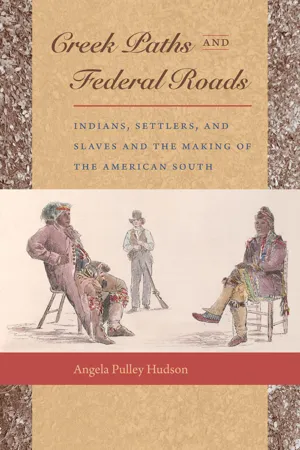
eBook - ePub
Creek Paths and Federal Roads
Indians, Settlers, and Slaves and the Making of the American South
- 272 pages
- English
- ePUB (mobile friendly)
- Available on iOS & Android
eBook - ePub
Creek Paths and Federal Roads
Indians, Settlers, and Slaves and the Making of the American South
About this book
Information
Chapter One
TERRITORIALITY AND MOBILITY IN EIGHTEENTH-CENTURY CREEK COUNTRY
On a bright sunny day in early November 1779, a Creek leader known to outsiders as the Tallassee King rose to speak to an assembly of Indians, traders, and American officials at the Savannah River plantation of trader and de facto Indian agent George Galphin. He took a white eagle feather in one hand and a string of white beads in the other and said these items signified “that the path may be kept perfect Clain and white from heare to the Nation.”1 In Creek cosmology, the color red is associated with action, aggression, and/or defense and often signifies affairs of war or retribution, while white signifies peace, negotiation, and calm reflection. Using white feathers and beads thus assured the Americans of the Creeks’ determination to avoid hostilities.2
The Tallassee King, likely known to his own people as Tallassee Micco, had traveled eastward to the edge of Carolina to reaffirm Creek friendship with the Americans and show an earnest desire to continue to engage in trade along the east-west trading paths that led through the Upper and Lower Creek towns. He situated his talk within the terms of Creek metaphysics, invoking whiteness and cleanliness as a way of professing peace and friendly intentions and using the string of beads to symbolize both the literal path that passed from Charleston to the Upper Creek towns on the Coosa River and the Creek concept of right behavior known as “the sacred path.”3 Like the “bright chain of friendship” that connected the Iroquois and the British, the path that linked the Creeks and the Americans functioned on multiple levels and had to be carefully maintained.4
Among the Creeks, the practice of peaceful diplomacy was frequently referred to as keeping the paths “straight” and “clean” or “white,” a responsibility with important cultural resonance.5 In a similar talk a year earlier, the Tallassee King had asserted, “We have but one white path and that path I stand by.”6 By using the terms “white and clean,” he thus indicated both a general disposition toward peaceful diplomatic relations and spiritual calm, but also an uninterrupted and pacific trade. The “straight”-ness of the path between Creeks and Americans similarly reflected the importance of order and clarity in Creek political and spiritual thought. Thus the word “straight” was often heard in diplomatic settings to indicate the propriety or acceptability of an agreement.7 Crookedness, its opposite, signifies an association with snakes, whose dangerous reputation and sinuous shapes mirrored the invisible wave-like forces that sometimes shook the ground beneath the feet of Creek people.8
The overland trails that connected talwas and talofas to each other as well as to the outside world were vital links not only for the political well-being of the Creek Nation, but also for maintaining social and spiritual health of the confederacy. Such paths made it possible for Creek men and women to travel to visit clan members in distant communities and attend important annual gatherings, like the Green Corn ceremony (or Busk/Boskita/Poskita) typically held in early autumn, as well as frequent inter-town ball plays.9 They also allowed townspeople to stay informed of the political goings-on in neighboring towns and to form coalitions to promote discrete agendas. When eighteenth-century Coweta headman Brims sought support for an uprising against abusive traders from Carolina, he sent runners bearing strands of deer hide seeking the pledges of each town to join the revolt. As each town promised allegiance, the strand was knotted, resulting in three six-foot-long cords.10 Similarly, the towns of Tuckabatchee and Coweta maintained an important path between them for nearly a century, cementing both trade relations and kinship ties between the talwas that would continue to function for generations to come.11
Despite a growing consolidation of Creek political interests toward the end of the eighteenth century, individual talwas conducted trade and diplomatic negotiations independently according to both their external alliances and internal politics.12 For instance, in 1778, the Tallassee King professed the friendship of his town to the Americans and also assured them of the peaceful intentions of the Apalachicolas, the Hitchitis, the Killigees, and the Tallushatchees. He cautioned, however, “I give no Towns but what I am sure of, there are many more Towns that their Talks, are not good, but by any Talk you will know who are your friends Towns.”13 Colonial (and later state) officials were not entirely ignorant of the town configuration, but they tended to acknowledge distinctions between talwas only when it was in their best interest to do so. They sometimes chose to deal with the Creeks as a nation, while other times entering agreements with a single town. When a boundary line was to be run or a peace talk held, headmen of specific talwas might be asked to attend. But if colonists sought repayment or retribution for real or imagined wrongs, one Creek town might be expected to pay the price for the misdeeds of another even if the two towns were largely unrelated.
In addition, towns might shift position as a result of changing political fortunes. Given the vast network of paths that connected the various talwas in both the Upper and Lower sections, it was unlikely that any given settlement would move completely out of contact with others in its province. On the contrary, townspeople sometimes removed themselves from one farflung locale to a more centrally located place, where they might benefit more directly from the intersection of numerous paths. Similarly, townspeople from one talwa might launch a daughter town that enabled them to live closer to trade paths that brought much-desired goods. In 1775, for instance, Adair noted that since the 1760s, “the Muskoghe have settled several towns, seventy miles eastward from Okwhuske, on the Chatahooche river, near to the old trading path.”14 But such out-settled villages typically remained associated with and committed to their mother towns, a relationship enabled (if not required) not only by their kin and clan network but also by the network of trails that bound them together.15
The various paths that crisscrossed Creek country were not roads as we might picture them. By the eighteenth century, they were usually only wide enough for a single horse and rider, typically 18–24 inches in width, especially in close, hilly terrain.16 The course of most paths was determined by the local topography. Some trails, particularly above the fall line, followed the course of rivers and streams when the ground was not too wet for travel.17 Others passed along upland ridges. Of particular importance were places where paths crossed the region's many streams and rivers.18 Precipitous bluffs or rocky descents often characterized the river banks of the interior Southeast, so finding fordable places on the rivers was essential, particularly for east-west travel.19 Although Native peoples invested time in clearing paths (both literally and metaphorically), travelers sometimes had to choose between pausing to remove obstacles or finding a way around them.20 But generations of use had made many of these routes unmistakable. Pathways were frequently defined by a series of notches and hatches in the bark of trees. The height of the hatch mark and the use of symbols indicated the age of the path and its destination.21
Surveyor and naturalist Bernard Romans, who traveled among the southeastern Indians in the 1770s, asserted that they always knew the “kind of people” that had made a certain path, “by the strokes of the hatchets in the trees and branches as they go along.” He explained that each group marked the trees differently and thus left an identifiable reminder of their trail.22 In addition, Creeks and other southern Indians sometimes inscribed messages or narratives on the timber alongside the trails they used. British traveler Philip Thicknesse observed a piece of cedar bark tied to a tree on which “in a very uncouth Manner several Figures were delineated.” He interpreted this drawing to represent Upper Creek warriors who had been traveling the path and stopped to record the loss of two companions.23 James Adair described a similar process used by war parties that would “strip the bark off several large trees in conspicuous places, and paint them with red and black hieroglyphics, thereby threatening the enemy with more blood and death.”24 For Native inhabitants who relied on oral rather than written traditions, landmarks such as these were part of a mental map that combined geography and history and coded the landscape according to their experiences within it.25
European explorers and surveyors imported their own techniques for making the landscape legible.26 They cut marks—chops, blazes, or notches—on the trees that indicated the course of the trail; some enterprising explorers even carved their initials into trees or hurled bottles at them in unique ceremonies of possession.27 To be a trailblazer denoted not only that one had passed along a certain route, but also had traced a decipherable remainder that would guide others along the way.
Hurricanes and tornadoes were often the culprits of the worst damage to these thoroughfares, generating impassable obstacles and obliterating notches and blazes that designated the trails. But because the ravage of such storms could sometimes be seen for decades, the shredded earth and mangled trees might also become nature's route markers.28 The forces of weather and wear, combined with indigenous and imported techniques of land marking, produced a graphic landscape.
The land could also be read through Creek stories. In addition to creation myths such as those described in the Introduction, the larger body of Creek mythology also contains important references to travel and mobility. A series of stories concern the Tie Snake or Horned Serpent; although they vary in detail, each narrates a dangerous transformation that occurs when a person consumes a taboo food while traveling. As a result, the transgressor is transformed into a serpent and takes up residence in a nearby body of water.29 Other stories concerning the Tie Snake or Strong Snake describe the creature's power and presence within rumbling or thundering waters, a salient ecological feature of parts of Creek country.30 While the core of these myths inscribes concepts of purity and reciprocity, we can distill another element that applies to our discussion of Creek territory and mobility.
In many of the Tie Snake stories, as well as other Creek myths, a person commits a taboo act or is otherwise endangered while traveling.31 This may seem unremarkable since Creek hunting methods often required long periods of time spent away from one's hometown. But taken together, these stories suggest that while travel was a necessity, it was also a time of increased risk—a time when a person might have to be especially on guard against danger and deception.
Water crossings represented a particular peril. A number of stories describe situations in which travelers must cross over a precarious bridge or otherwise pass bodies of water.32 These themes reflect the natural world of Creek country, where frequent river crossings were a dangerous fact of life. But they also incorporate southeastern Indian beliefs regarding the separation of basic categories like earth and water, as well as a concern with bodies of water as portals to the chaotic underworld.33 It is important here to recognize that bodies of water and the hidden realm they concealed were not always associated with evil. In fact, daily immersion or “going to water” was considered an important mode of assuring good health and spiritual purity.34
In addition, at least one story, associated with Tuckabatchee, described the Tie Snake as a friendly being that accepts underwater visitors and renders aid to villages under attack.35 Rivers, streams, and ponds could be frightening and awesome, not because they were innately malevolent, but because they represented a sort of threshold—a meeting place between this world and the world below. At such a place, cosmic power is concentrated and could be harnessed for good or ill purposes.
In addition to travel, paths themselves are of great importance in Creek stories. Consider, for example, the Cusseta migration legend told to Governor James Oglethorpe by Tchikilli in 1735. An eastward-traveling party of Muskogeans, including a group known as the Cussetas, arrived at a white foot-path. According to Tchikilli, “the grass and everything around were white,” and they understood this to mean that people had been there. They crossed the path and camped nearby, later turning back to try to determine what sort of people had made the white path. The traveling Muskogeans continued going eastward, searching for the people who made the white path. Over a series of years they followed the path, crossing numerous rivers and encountering many other groups of people. They finally arrived at the town of the Apalachicolas, where these peace-loving people convinced the “bloody-minded” Cussetas to abandon their aggression, telling them, “Our hearts are white, and yours must be white.” Tchikilli, descended from the Apalachicolas, explained that the Cussetas joined with them but kept their “red hearts,” although they “now know that the white path was the best for them.”36
Part of the reason Tchikilli told this particular story to Oglethorpe (in the presence of other Creek headmen) was to establish himself and his town of origin as important and endowed with the diplomatic skill associated with the color white. In addition, this story both reiterated the tradition of Muskogee emergence and migration from a point in the west and also contained numerous other references to travel. Perhaps more significant here, however, is that the path, specifically the white path, figured as both a literal trail followed by the Muskogeans and a philosophical orientation or way of being. The concept of the white path existed in both realms simultaneously, both in the myths themselves and in political discourse invoking such concepts.37
The combined effect of these Creek stories is an understanding that travel was fundamentally necessary but frequently dangerous. A Creek person crossing a strong spring freshet would undoubtedly find fording the stream perilous, but he or she might also fear the Tie Snake that lived beneath the surface of the water. Creek men and women of the late eighteenth century inhabited a world that was simultaneously home to rivers, streams, grass, rocks, trees, horned serpents, giant eagles, wandering souls, red paths, and white paths. Humans were merely one of many kinds of living beings and not necessarily the most important or the smartest ones.38 Thus, it would be a misrepresentation of Creek ethnogeography to assert that they maintained a strict intellectual distinction between a person and a tree, a path and a snake. All these concepts are relevant in a discussion of how Creek people made sense of their homelands and how these concepts emerged and functioned within their diplomacy.
These stories and the lessons they impart were not m...
Table of contents
- Cover Page
- Creek Paths and Federal Roads
- Copyright Page
- Dedication
- Contents
- Figures and Maps
- Acknowledgments
- Introduction OLD PATHS, NEW PATHS
- Chapter One TERRITORIALITY AND MOBILITY IN EIGHTEENTH-CENTURY CREEK COUNTRY
- Chapter Two SETTLING BOUNDARIES AND NEGOTIATING ACCESS
- Chapter Three OPENING ROADS THROUGH CREEK COUNTRY
- Chapter Four WAR COMES TO THE CREEKS
- Chapter Five A NEW WAVE OF EMIGRATION
- Chapter Six REMAPPING CREEK COUNTRY
- Epilogue
- Notes
- Bibliography
- Index
Trusted by 375,005 students
Access to over 1.5 million titles for a fair monthly price.
Study more efficiently using our study tools.
Frequently asked questions
Yes, you can cancel anytime from the Subscription tab in your account settings on the Perlego website. Your subscription will stay active until the end of your current billing period. Learn how to cancel your subscription
No, books cannot be downloaded as external files, such as PDFs, for use outside of Perlego. However, you can download books within the Perlego app for offline reading on mobile or tablet. Learn how to download books offline
Perlego offers two plans: Essential and Complete
- Essential is ideal for learners and professionals who enjoy exploring a wide range of subjects. Access the Essential Library with 800,000+ trusted titles and best-sellers across business, personal growth, and the humanities. Includes unlimited reading time and Standard Read Aloud voice.
- Complete: Perfect for advanced learners and researchers needing full, unrestricted access. Unlock 1.5M+ books across hundreds of subjects, including academic and specialized titles. The Complete Plan also includes advanced features like Premium Read Aloud and Research Assistant.
We are an online textbook subscription service, where you can get access to an entire online library for less than the price of a single book per month. With over 1.5 million books across 990+ topics, we’ve got you covered! Learn about our mission
Look out for the read-aloud symbol on your next book to see if you can listen to it. The read-aloud tool reads text aloud for you, highlighting the text as it is being read. You can pause it, speed it up and slow it down. Learn more about Read Aloud
Yes! You can use the Perlego app on both iOS and Android devices to read anytime, anywhere — even offline. Perfect for commutes or when you’re on the go.
Please note we cannot support devices running on iOS 13 and Android 7 or earlier. Learn more about using the app
Please note we cannot support devices running on iOS 13 and Android 7 or earlier. Learn more about using the app
Yes, you can access Creek Paths and Federal Roads by Angela Pulley Hudson in PDF and/or ePUB format, as well as other popular books in History & North American History. We have over 1.5 million books available in our catalogue for you to explore.