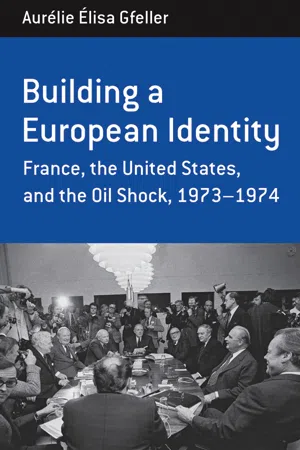
The Arab-Israeli war of 1973, the first oil price shock, and France's transition from Gaullist to centrist rule in 1974 coincided with the United States' attempt to redefine transatlantic relations. As the author argues, this was an important moment in which the French political elite responded with an unprecedented effort to construct an internationally influential and internally cohesive European entity. Based on extensive multi-archival research, this study combines analysis of French policy making with an inquiry into the evolution of political language, highlighting the significance of the new concept of a political European identity.
eBook - ePub
Building a European Identity
France, the United States, and the Oil Shock, 1973-74
- 242 pages
- English
- ePUB (mobile friendly)
- Available on iOS & Android
eBook - ePub
Building a European Identity
France, the United States, and the Oil Shock, 1973-74
About this book
Trusted by 375,005 students
Access to over 1.5 million titles for a fair monthly price.
Study more efficiently using our study tools.
Information
Chapter 1
MEETING THE AMERICAN CHALLENGE
France and the Year of Europe

An American initiative provided the original impetus for France’s reassessment of the value of collective European action. The Year of Europe was officially designed to revitalize the Atlantic Alliance in a context of growing transatlantic economic rivalry and rising U.S. protectionism. It was also, and perhaps primarily, intended to adjust the set of economic, political, and security interrelations between Western Europe and the United States. The U.S. goal was to persuade its allies to be more accommodating in economic matters and to assume a greater share of the security load within a U.S.-led Western order. As such, the plan was likely to arouse suspicion in Western Europe, particularly in France. Contrary to Kissinger’s later assertions, senior U.S. officials anticipated such resistance. What they did not expect, however, was that Kissinger’s plea for a new “Atlantic charter” would spur EC states to assert their distinctiveness in the international arena. In September 1973, the nine EC countries presented a draft declaration of principles between the EC and the United States which proclaimed the “distinctiveness” of a united Europe and its rightful place in world affairs.1 To French Foreign Minister Michel Jobert, this was a remarkable turnaround: “only a good loser could have accepted this outcome; Europe was now laying claims to existence!” (“Il eût fallu, certes, être très beau joueur pour voir sans frémir les cartes être ainsi retournées. Voilà que l’Europe, néant docile, prétendait exister!”)2 Kissinger clearly did not accept this ending. In his memoirs, he accuses Jobert of having “ruthlessly used our effort to conciliate France as a device to isolate us” by putting together a “coalition of negation.”3
The real story was more complex. French political actors and the press were mostly hostile to the proposed charter because they regarded it as a covert attempt to reassert U.S. leadership in Europe in the context of superpower détente. Despite their ambivalent feelings, their EC counterparts wished to respond positively to the U.S. overture and pressed for elaborating a draft declaration within the framework of EPC. French officials initially resorted to delay tactics, but under increased EC pressure they wound up accepting Britain’s proposal for two declarations, an EC-U.S. statement and a NATO declaration.4 While taking this step during the second half of August, they shifted the thrust of the British draft away from Atlantic unity and toward European distinctiveness. This move was broadly congruent with de Gaulle’s early 1960s vision of a “European Europe” that would be independent from the United States. Nonetheless, this was a policy shift—one that went beyond acceptance or non-acceptance of a joint EC Nine response to Kissinger’s overture. The French government had agreed to what it had always opposed: EPC discussions on U.S.-European relations. Because it fueled fears of a U.S.-Soviet condominium, the U.S.-Soviet Agreement on the Prevention of Nuclear War was an influential factor. But so too were the deterioration of Franco-American relations after 1971 and growing French concerns about U.S. unilateral impulses.
Linking Economics and Security: A New U.S. Initiative on Europe
Several factors coalesced at the end of Nixon’s first term to persuade the White House of the need to reappraise U.S.-European relations.5 The imminent end of the Vietnam War was expected to free up resources for new policy designs. It also called for moves that would restore American prestige. Strains in U.S.-European economic relations and a budding mood of isolationism in Congress encouraged a reassessment of U.S. policy toward Western Europe. Calls for troop redeployment had not subsided since the early 1970s. Détente with the Soviet Union, moreover, had not spared the necessity of a solid transatlantic alliance. Quite the opposite, U.S. officials felt that transatlantic cohesion was crucial to the success of this policy, and that it could not be taken for granted given Brandt’s Ostpolitik.6
The story of the origins of the Year of Europe deserves to be told, as it is still partially clouded in mystery.7 Some years later, Kissinger asserted that the Year of Europe was “born in the office of the President of the French Republic.”8 Largely untapped archives belie this claim. Planning began several weeks before Kissinger’s December 1972 meeting with Pompidou. As head of the National Security Council (NSC), Kissinger played a critical role in this process. He set the stage for an initiative on Europe as early as September 1972. On 16 September, he declared that Nixon hoped soon to resume consultation with his allies.9 Less than two weeks later, he told French Foreign Minister Maurice Schumann that the U.S. government planned to “create a little task force” on U.S. relations with Western Europe. The goal was to establish an overarching political framework in order to prevent future clashes on trade and monetary issues.10 The NSC staff was immediately set to work, but progress was initially slow. After Nixon’s November reelection, Kissinger complained about the approach of his trusted NSC adviser on Europe, Helmut Sonnenfeldt, who had like him emigrated from Nazi Germany to the United States:11 “the one trouble I have with Sonnenfeldt is that son of a bitch turns everything into a Federal case. Now for the last two months I wanted a study on Europe and he’s still negotiating it.”12 A week later, Kissinger commissioned a trans-departmental study of all current and future issues in transatlantic relations.13 At the same time, U.S. officials began to refer to the “Year of Europe.”14
The notion of linkage was central to the study the NSC issued in December 1972.15 The gist of National Security Study Memorandum (NSSM) 164 was that “political, security, military, economic, scientific and technological issues” were interdependent. Its central claim was that the U.S.-European security and economic interrelationships must be “brought into a balance more satisfactory to the U.S.” NSSM 164 outlined three possible strategies: seek more integrated relations with Western Europe through enhanced cooperation; attenuate these ties, allowing them to “deteriorate if necessary”; and maintain existing security arrangements while improving the U.S. economic position. The first option was meant to strengthen “transatlantic cohesion.” NSSM 164, however, warned against restrictions on U.S. freedom of action and potential European opposition. The other two alternatives implied an explicit strategy of linkage—one that the Nixon administration had applied in its dealings with the Soviet Union, making progress in one area conditional upon progress in another.16 The second option assumed a confrontational stance. The United States would “vigorously” pursue its own interests, taking advantage of its strategic and economic preeminence “to extract economic concessions from Europe.” The third option was designed to square the circle: the United States should seek to reform the world economic system and the Western security structure, but without risking “ruptures … or even a deterioration in the general climate of transatlantic relations.” NSSM 164 portrayed this last option as “a balanced approach” that met “pressure in the U.S. and Western Europe for ‘setting the transatlantic house in order.’”
In seeking to strike equilibrium between competing views, the NSC’s memorandum inevitably aroused criticism. Acting Assistant Secretary of Commerce Lawrence Fox wrote that the study failed fully to address the trade and monetary objectives of the United States.17 Fox encouraged the White House to pursue a more aggressive linkage approach. Another commentary stated that NSSM 164 gave insufficient weight to U.S. financial and economic interests, and urged the administration to reassert its claim for burden-sharing.18
NSSM 164 stopped short of advocating a hard bargaining strategy but implied a cross-issue linkage approach that was bound to arouse resistance in Western Europe. U.S. officials were fully aware of it. Vernon A. Walters, deputy director for central intelligence, cautioned that “European resistance to being engulfed by their American friends may be at an all-time high.”19 With incredible prescience, the NSC warned that France would play “a leading role in asserting a European identity.”20 A special assistant—presumably to the State Department—even anticipated the French line of argument. The two alternatives, he maintained, should be more clearly stated: a closer relationship with Europe involved “more Atlanticism”; looser ties implied “more European integration and independence.”21
Convergent Ideas, Diverging Aims: Monnet and the Nixon White House
While preparing for the Year of Europe, the U.S. government consulted with one of the prime promoters of a united Europe: the Frenchman Jean Monnet. Monnet’s U.S. contacts from World War II to the 1960s have been studied extensively.22 What scholars have yet to acknowledge is his influence in shaping the Year of Europe and...
Table of contents
- Cover Page
- Title Page
- Copyright Page
- Contents
- Acknowledgments
- Acronyms and Abbreviations
- Introduction
- Chapter One Meeting the American Challenge: France and the Year of Europe
- Chapter Two Constructing a European Identity
- Chapter Three War in the Middle East: The Europeanization of France’s Arab Policy
- Chapter Four Kissinger, Jobert, and the Oil Shock
- Chapter Five From a European Common Voice toward Atlanticism?
- Chapter Six Building a Political Europe in a Changed International Context: Giscard and the Twin Summits of Paris and Martinique
- Conclusions
- Bibliography
- Index
Frequently asked questions
Yes, you can cancel anytime from the Subscription tab in your account settings on the Perlego website. Your subscription will stay active until the end of your current billing period. Learn how to cancel your subscription
No, books cannot be downloaded as external files, such as PDFs, for use outside of Perlego. However, you can download books within the Perlego app for offline reading on mobile or tablet. Learn how to download books offline
We are an online textbook subscription service, where you can get access to an entire online library for less than the price of a single book per month. With over 1.5 million books across 990+ topics, we’ve got you covered! Learn about our mission
Look out for the read-aloud symbol on your next book to see if you can listen to it. The read-aloud tool reads text aloud for you, highlighting the text as it is being read. You can pause it, speed it up and slow it down. Learn more about Read Aloud
Yes! You can use the Perlego app on both iOS and Android devices to read anytime, anywhere — even offline. Perfect for commutes or when you’re on the go.
Please note we cannot support devices running on iOS 13 and Android 7 or earlier. Learn more about using the app
Please note we cannot support devices running on iOS 13 and Android 7 or earlier. Learn more about using the app
Yes, you can access Building a European Identity by Aurélie Élisa Gfeller in PDF and/or ePUB format, as well as other popular books in History & European History. We have over 1.5 million books available in our catalogue for you to explore.