The Earlier Iron Age (c. 800-400 BC) has often eluded attention in British Iron Age studies. Traditionally, we have been enticed by the wealth of material from the later part of the millennium and by developments in southern England in particular, culminating in the arrival of the Romans. The result has been a chronological and geographical imbalance, with the Earlier Iron Age often characterised more by what it lacks than what it comprises: for Bronze Age studies it lacks large quantities of bronze, whilst from the perspective of the Later Iron Age it lacks elaborate enclosure. In contrast, the same period on mainland Europe yields a wealth of burial evidence with links to Mediterranean communities and so has not suffered in quite the same way. Gradual acceptance of this problem over the past decade, along with the corpus of new discoveries produced by developer-funded archaeology, now provides us with an opportunity to create a more balanced picture of the Iron Age in Britain as a whole.
The twenty-six papers in the book seek to establish what we now know (and do not know) about Earlier Iron Age communities in Britain and their neighbours on the Continent. The authors engage with a variety of current research themes, seeking to characterise the Earlier Iron Age via the topics of landscape, environment, and agriculture; material culture and everyday life; architecture, settlement, and social organisation; and with the issue of transition - looking at how communities of the Late Bronze Age transform into those of the Earlier Iron Age, and how we understand the social changes of the later first millennium BC. Geographically, the book brings together recent research from regional studies covering the full length of Britain, as well as taking us over to Ireland, across the Channel to France, and then over the North Sea to Denmark, the Low Countries, and beyond.
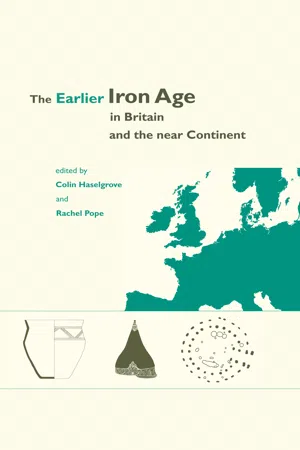
- 416 pages
- English
- ePUB (mobile friendly)
- Available on iOS & Android
eBook - ePub
The Earlier Iron Age in Britain and the Near Continent
About this book
Information
Subtopic
ArchaeologyIndex
Social SciencesTable of contents
- Cover
- Title
- Copyright
- Contents
- 1. Characterising the Earlier Iron Age: Colin Haselgrove and Rachel Pope
- 2. The character of Late Bronze Age settlement in southern Britain: Joanna Brück
- 3. 800 BC, The Great Divide: Stuart Needham
- 4. Llyn Fawr metalwork in Britain: a review: Brendan O’Connor
- 5. Intensification of animal husbandry in the Late Bronze Age? The contribution of sheep and pigs: Dale Serjeantson
- 6. After ‘Celtic’ fields: the social organisation of Iron Age agriculture: Richard Bradley and David Yates
- 7. Refiguring rights in the Early Iron Age landscapes of East Yorkshire: Melanie Giles
- 8. Pitted histories: early first millennium BC pit alignments in the central Welsh Marches: Andy Wigley
- 9. Environmental evidence from the Iron Age in north central Britain: putting archaeology in its place: Jacqueline P. Huntley
- 10. Simple tools for tough tasks or tough tools for simple tasks? Analysis and experiment in Iron Age flint utilisation: Jodie Humphrey
- 11. A bloodless past: the pacification of Early Iron Age Britain: Simon James
- 12. Building communities and creating identities in the first millennium BC: Niall Sharples
- 13. Deposits and doorways: patterns within the Iron Age settlement at Crick Covert Farm, Northamptonshire: Ann Woodward and Gwilym Hughes
- 14. Ritual and the roundhouse: a critique of recent ideas on the use of domestic space in later British prehistory: Rachel Pope
- 15. The character of Earlier Iron Age societies in Scotland: Ian Ralston and Patrick Ashmore
- 16. The Early Iron Age of the Peak District: re-reading the evidence: Bill Bevan
- 17. The Early to Later Iron Age transition in the Severn–Cotswolds: enclosing the household?: Tom Moore
- 18. The aesthetics of landscape on the Berkshire Downs: Chris Gosden and Gary Lock
- 19. Settlement in Kent from 1500 to 300 BC: Timothy Champion
- 20. The Atlantic West in the Early Iron Age: Jon C. Henderson
- 21. English and Danish Iron Ages – a comparison through houses, burials and hoards: M. L. S. Sørensen
- 22. Familar landscapes with unfamiliar pasts? Bronze Age barrows and Iron Age communities in the southern Netherlands: Fokke Gerritsen
- 23. The emergence of early Iron Age ‘chieftains’ graves’ in the southern Netherlands: reconsidering transformations in burial and depositional practices: David Fontijn and Harry Fokkens
- 24. Early La Tène burial practices and social (re)constructions in the Marne–Moselle region: Marian Diepeveen-Jansen
- 25. Boundaries and identity in Early Iron Age Europe: Peter S. Wells
- 26. Rethinking Earlier Iron Age settlement in the eastern Paris Basin: Colin Haselgrove
- List of contributors
Trusted by 375,005 students
Access to over 1.5 million titles for a fair monthly price.
Study more efficiently using our study tools.
Frequently asked questions
Yes, you can cancel anytime from the Subscription tab in your account settings on the Perlego website. Your subscription will stay active until the end of your current billing period. Learn how to cancel your subscription
No, books cannot be downloaded as external files, such as PDFs, for use outside of Perlego. However, you can download books within the Perlego app for offline reading on mobile or tablet. Learn how to download books offline
Perlego offers two plans: Essential and Complete
- Essential is ideal for learners and professionals who enjoy exploring a wide range of subjects. Access the Essential Library with 800,000+ trusted titles and best-sellers across business, personal growth, and the humanities. Includes unlimited reading time and Standard Read Aloud voice.
- Complete: Perfect for advanced learners and researchers needing full, unrestricted access. Unlock 1.5M+ books across hundreds of subjects, including academic and specialized titles. The Complete Plan also includes advanced features like Premium Read Aloud and Research Assistant.
We are an online textbook subscription service, where you can get access to an entire online library for less than the price of a single book per month. With over 1.5 million books across 990+ topics, we’ve got you covered! Learn about our mission
Look out for the read-aloud symbol on your next book to see if you can listen to it. The read-aloud tool reads text aloud for you, highlighting the text as it is being read. You can pause it, speed it up and slow it down. Learn more about Read Aloud
Yes! You can use the Perlego app on both iOS and Android devices to read anytime, anywhere — even offline. Perfect for commutes or when you’re on the go.
Please note we cannot support devices running on iOS 13 and Android 7 or earlier. Learn more about using the app
Please note we cannot support devices running on iOS 13 and Android 7 or earlier. Learn more about using the app
Yes, you can access The Earlier Iron Age in Britain and the Near Continent by Rachel Pope, Colin Haselgrove in PDF and/or ePUB format, as well as other popular books in Social Sciences & Archaeology. We have over 1.5 million books available in our catalogue for you to explore.