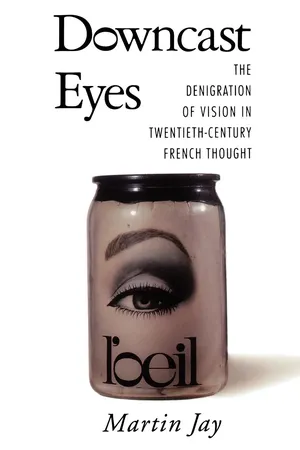
Long considered "the noblest of the senses," vision has increasingly come under critical scrutiny by a wide range of thinkers who question its dominance in Western culture. These critics of vision, especially prominent in twentieth-century France, have challenged its allegedly superior capacity to provide access to the world. They have also criticized its supposed complicity with political and social oppression through the promulgation of spectacle and surveillance.
Martin Jay turns to this discourse surrounding vision and explores its often contradictory implications in the work of such influential figures as Jean-Paul Sartre, Maurice Merleau-Ponty, Michel Foucault, Jacques Lacan, Louis Althusser, Guy Debord, Luce Irigaray, Emmanuel Levinas, and Jacques Derrida. Jay begins with a discussion of the theory of vision from Plato to Descartes, then considers its role in the French Enlightenment before turning to its status in the culture of modernity. From consideration of French Impressionism to analysis of Georges Bataille and the Surrealists, Roland Barthes's writings on photography, and the film theory of Christian Metz, Jay provides lucid and fair-minded accounts of thinkers and ideas widely known for their difficulty.
His book examines the myriad links between the interrogation of vision and the pervasive antihumanist, antimodernist, and counter-enlightenment tenor of much recent French thought. Refusing, however, to defend the dominant visual order, he calls instead for a plurality of "scopic regimes." Certain to generate controversy and discussion throughout the humanities and social sciences, Downcast Eyes will consolidate Jay's reputation as one of today's premier cultural and intellectual historians.
- 648 pages
- English
- PDF
- Available on iOS & Android
eBook - PDF
About this book
Information
sions
of
modern
ocularcentrism
into
question.
Included
among
these
was
the
typical
Cartesian
gesture
of
refusing
to
listen
to
the
voices
of
the
past
and
trusting
instead
only
to
what
one
could
"see
with
one's
eyes."
Insofar
as
the
Enlightenment
was
premised
largely
on
that
same
attitude,
the
antiocularcentric
discourse
often
took
on
a
self-consciously
Counter-
Enlightenment
tone.
Here,
however,
I
am
getting
ahead
of
myself,
for
it
will
be
necessary
before
analyzing
the
twentieth-century
turn
against
vi-
sion
to
see
more
clearly
what
its
target
actually
was.
To
do
so,
the
role
of
ocularcentrism
in
the
France
so
long
beholden
to
its
Cartesian
point
of
departure
must
first
be
exposed
to
view.
82
THE
NOBLEST
OF
THE
SENSES
Table of contents
- Cover
- Downcast Eyes: THE DENIGRATION OF VISION IN TWENTIETH-CENTURY FRENCH THOUGHT
- A CENTENNIAL BOOK
- Title
- Copyright
- Dedication
- Contents
- Acknowledgments
- Introduction
- CHAPTER ONE: The Noblest of the Senses: Vision from Plato to Descartes
- CHAPTER TWO: Dialectic of EnLIGHTenment
- CHAPTER THREE: The Crisis of the Ancien Scopic Régime: From the Impressionists to Bergson
- CHAPTER FOUR: The Disenchantment of the Eye: Bataille and the Surrealists
- CHAPTER FIVE: Sartre, Merleau-Ponty, and the Search for a New Ontology of Sight
- CHAPTER SIX: Lacan, Althusser, and the Specular Subject of Ideology
- CHAPTER SEVEN: From the Empire of the Gaze to the Society of the Spectacle: Foucault and Debord
- CHAPTER EIGHT: The Camera as Memento Mori: Barthes, Metz, and the Cahiers du Cinéma
- CHAPTER NINE: "Phallogocularcentrism": Derrida and lrigaray
- CHAPTER TEN: The Ethics of Blindness and the PostmodernSublime: Levinas and Lyotard
- Conclusion
- Index
Trusted by 375,005 students
Access to over 1.5 million titles for a fair monthly price.
Study more efficiently using our study tools.
Frequently asked questions
Yes, you can cancel anytime from the Subscription tab in your account settings on the Perlego website. Your subscription will stay active until the end of your current billing period. Learn how to cancel your subscription
No, books cannot be downloaded as external files, such as PDFs, for use outside of Perlego. However, you can download books within the Perlego app for offline reading on mobile or tablet. Learn how to download books offline
Perlego offers two plans: Essential and Complete
- Essential is ideal for learners and professionals who enjoy exploring a wide range of subjects. Access the Essential Library with 800,000+ trusted titles and best-sellers across business, personal growth, and the humanities. Includes unlimited reading time and Standard Read Aloud voice.
- Complete: Perfect for advanced learners and researchers needing full, unrestricted access. Unlock 1.5M+ books across hundreds of subjects, including academic and specialized titles. The Complete Plan also includes advanced features like Premium Read Aloud and Research Assistant.
We are an online textbook subscription service, where you can get access to an entire online library for less than the price of a single book per month. With over 1.5 million books across 990+ topics, we’ve got you covered! Learn about our mission
Look out for the read-aloud symbol on your next book to see if you can listen to it. The read-aloud tool reads text aloud for you, highlighting the text as it is being read. You can pause it, speed it up and slow it down. Learn more about Read Aloud
Yes! You can use the Perlego app on both iOS and Android devices to read anytime, anywhere — even offline. Perfect for commutes or when you’re on the go.
Please note we cannot support devices running on iOS 13 and Android 7 or earlier. Learn more about using the app
Please note we cannot support devices running on iOS 13 and Android 7 or earlier. Learn more about using the app
Yes, you can access Downcast Eyes by Martin Jay in PDF and/or ePUB format, as well as other popular books in Filosofia & Filosofia politica. We have over 1.5 million books available in our catalogue for you to explore.