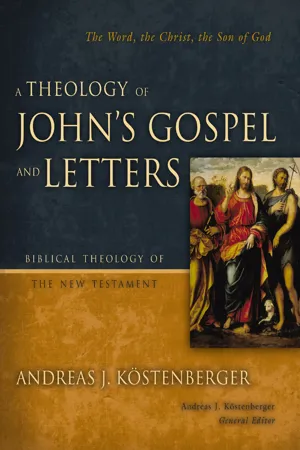
A Theology of John’s Gospel and Letters introduces the first volume in the BTNT series. Building on many years of research and study in Johannine literature, Andreas Köstenberger not only furnishes an exhaustive theology of John’s Gospel and letters, but also provides a detailed study of major themes and relates them to the Synoptic Gospels and other New Testament books. Readers will gain an in-depth and holistic grasp of Johannine theology in the larger context of the Bible. D. A. Carson (Trinity Evangelical Divinity School) says about Köstenberger’s volume that “for the comprehensiveness of its coverage in the field of Johannine theology (Gospel and Letters), there is nothing to compare to this work.” I. Howard Marshall (University of Aberdeen) writes, “This book is a ‘first’ in many ways: the first volume that sets the pattern for the quality and style of the new Biblical Theology of the New Testament series published by Zondervan; the first major volume to be devoted specifically to the theology of John’s Gospel and Letters at a high academic level; and the first volume to do so on the basis that here we have an interpretation of John’s theology composed by an eyewitness of the life and passion of Jesus.” The Biblical Theology of the New Testament Series The Biblical Theology of the New Testament (BTNT) series provides upper college and seminary-level textbooks for students of New Testament theology, interpretation, and exegesis. Pastors and discerning theology readers alike will also benefit from this series. Written at the highest level of academic excellence by recognized experts in the field, the BTNT series not only offers a comprehensive exploration of the theology of every book of the New Testament, including introductory issues and major themes, but also shows how each book relates to the broad picture of New Testament theology.
eBook - ePub
A Theology of John's Gospel and Letters
The Word, the Christ, the Son of God
- 656 pages
- English
- ePUB (mobile friendly)
- Available on iOS & Android
eBook - ePub
About this book
Information
Topic
Theology & ReligionSubtopic
Biblical StudiesPart 1
THE HISTORICAL FRAMEWORK FOR JOHANNINE THEOLOGY
Chapter 1
JOHANNINE THEOLOGY AND THE HISTORICAL SETTING OF JOHN’S GOSPEL AND LETTERS
BIBLIOGRAPHY
Bauckham, Richard, ed. The Gospels for All Christians: Rethinking the Gospel Audiences. Grand Rapids: Eerdmans, 1998. Idem. Jesus and the Eyewitnesses: The Gospels as Eyewitness Testimony. Grand Rapids: Eerdmans, 2006. Blomberg, Craig L. The Historical Reliability of John’s Gospel. Leicester, UK: Inter-Varsity Press, 2002. Bockmuehl, Markus N. A. Seeing the Word: Refocusing New Testament Study. Studies in Theological Interpretation. Grand Rapids: Baker, 2006. Warren Carter. John and Empire: Initial Explorations. London: T&T Clark, 2008. Cook, W. Robert. The Theology of John. Chicago: Moody Press, 1979. Hengel, Martin. Die johanneische Frage. WUNT 67. Tübingen: Mohr-Siebeck, 1993. Idem. “Das Johannesevangelium als Quelle für die Geschichte des antiken Judentums.” Pp. 293–334 in Judaica, Hellenistica et Christiana: Kleine Schriften II. WUNT 109. Tübingen: Mohr-Siebeck, 1999. Idem. “Eye-Witness Memory and the Writing of the Gospels.” Pp. 70–96 in The Written Gospel. Ed. Markus Bockmuehl and Donald A. Hagner. Cambridge: Cambridge University Press, 2001. Hill, Charles E. The Johannine Corpus in the Early Church. Oxford/New York: Oxford University Press, 2004. Hoehner, Harold W. Chronological Aspects of the Life of Christ. Grand Rapids: Zondervan, 1977. Idem. “Chronology.” Pp. 118–22 in Dictionary of Jesus and the Gospels. Ed. Joel B. Green, Scot McKnight, and I. Howard Marshall. Downers Grove, IL: InterVarsity Press, 1992. Jackson, Howard M. “Ancient Self-Referential Conventions and Their Implications for the Authorship and Integrity of the Gospel of John.” JTS 50 (1999): 1–34. Kealy, Seán P. John’s Gospel and the History of Biblical Interpretation. 2 vols. Mellen Biblical Press Series 60a–b. Lewiston, NY: Mellen, 2002. Keefer, Kyle. The Branches of the Gospel of John: The Reception of the Fourth Gospel in the Early Church. LNTS 332. London: T&T Clark, 2006. Keener, Craig S. The Gospel of John: A Commentary. 2 vols. Peabody, MA: Hendrickson, 2003. Klink, Edward W. III. The Sheep of the Fold: The Audience and Origin of the Gospel of John. SNTSMS 141. Cambridge: Cambridge University Press, 2007. Koester, Craig R. The Word of Life: A Theology of John’s Gospel. Grand Rapids: Eerdmans, 2008. Köstenberger, Andreas J. “John.” Pp. 1–216 in Zondervan Illustrated Bible Backgrounds Commentary. Ed. Clinton E. Arnold. Vol. 2: John–Acts. Grand Rapids: Zondervan, 2002. Idem. “Early Doubts of the Apostolic Authorship of the Fourth Gospel in the History of Modern Biblical Criticism.” Pp. 17–47 in Studies on John and Gender: A Decade of Scholarship. Studies in Biblical Literature 38. New York: Peter Lang, 2001. Malatesta, Edward. St. John’s Gospel 1920–1965. AnBib 32. Rome: Pontifical Biblical Institute, 1967. Morris, Leon. Studies in the Fourth Gospel. Grand Rapids: Eerdmans, 1969. Stevens, George B. The Johannine Theology: A Study of the Doctrinal Contents of the Gospel and Epistles of the Apostle John. New York: Scribner, 1894. Taylor, Michael J., ed. A Companion to John: Readings in Johannine Theology (John’s Gospel and Epistles). New York: Alba House, 1977. Thatcher, Tom, ed. What We Have Heard from the Beginning: The Past, Present, and Future of Johannine Studies. Waco, TX: Baylor University Press, 2007. Idem. Greater than Caesar: Christology and Empire in the Fourth Gospel. Minneapolis: Fortress, 2009. Van Belle, Gilbert. Johannine Bibliography 1966–1985: A Cumulative Bibliography on the Fourth Gospel. BETL 132. Leuven: Leuven University Press/Peeters, 1988.
1 JOHANNINE AND BIBLICAL THEOLOGY
1.1 Introduction
What a wonderful challenge and opportunity it is to write a Johannine theology! This is the body of Scripture anchored in the gospel Clement of Alexandria called a “spiritual Gospel” (pneumatikon euangelion),1 and this gospel, in turn, has moved countless hearts to recognize their need for Christ and nurtured many to greater heights in their spiritual pilgrimage. Markus Bockmuehl has recently made a case for the importance of Wirkungsgeschichte (a study of a work’s “history of effects” on later interpreters) in biblical studies,2 and John’s writings have indeed had a profound impact on Christian theology and spirituality that is second to few (if any) biblical or other works.3
1.2 The “Spiritual Gospel”
1.2.1 History of Scholarship
In the recent history of interpretation, Clement’s reference to John as a “spiritual gospel” has frequently been taken to imply that John is less interested in historical matters than the Synoptics, and a chasm began to open up between John as a “spiritual” (i.e., nonhistorical) gospel and the Synoptics as more reliable historical accounts.4 However, taking “spiritual” as “nonhistorical” is of doubtful merit.5 More likely, by observing that John was “conscious that the outward facts had been set forth in the [Synoptic?] Gospels” already, Clement sought to draw attention to the profound theological reflection present in John’s gospel without intending to disparage the historical nature of his account. Indeed, John deepens the reader’s understanding of the significance of Jesus’ life and work by focusing on a small number of pivotal items such as the identity of Jesus, the necessity of faith, and the universal scope of Christ’s redemptive work.
Understood this way, there is every reason to believe that John, as a “spiritual gospel”—in the sense of being an interpretive account that brings out more fully the spiritual significance of the events and teachings it features—is grounded firmly in actual historical events, for it is only on such that theological reflection can properly be based.6 Most likely, in his theological reflection John took his departure from the “outward facts” set forth in the Synoptics rather than disregarding or contradicting them. His account commences with the Baptist’s witness to Jesus (John 1:6–8, 15) and the incarnation (1:14). These events, in turn, are grounded in previous salvation history such as the tabernacle (1:14) or the giving of the law through Moses (1:17). What is more, in framing his narrative, the evangelist uses eyewitness language to testify to these events: “The Word became flesh and made his dwelling among us. We have seen his glory, the glory of the one and only Son, who came from the Father, full of grace and truth. . . . For the law was given through Moses; grace and truth came through Jesus Christ” (emphasis added).7
In this sense, then, John is a “spiritual gospel”: it is the product of profound theological reflection, which, in turn, is grounded in actual historical events through which God acted in salvation history.8 However, the last half millennium of human thought has bequeathed several unfortunate dichotomies on biblical scholarship. The separation between history and theology has led to a gradual disparagement of John’s historical reliability and moved the gospel’s genre closer to myth and legend.9
Another dichotomy passed on to the contemporary interpreter is that between religion and theology. If theology is understood as reflection on actual divine revelation, religion, by contrast, is conceived as the result of the human quest for meaning and as the evolution of human consciousness of a higher power. Thus Johann Salomo Semler sought to blend pietism with rationalism by separating theology as an historical, objective academic discipline from religion, which, he held, was subjective and based on personal experience.10
Friedrich Schleiermacher, likewise, building on Immanuel Kant’s distinction between metaphysics and practical morality, drew the same distinction between religion as a phenomenon of feeling and experience, “the sense of absolute dependence on God,” and theology as intellectual reflection about God. After him, Karl Bretschneider (who in 1820 threw down the gauntlet by challenging the historical reliability of John’s gospel),11 the Tübingen School (which favored a late, second-century date for John’s gospel), and others applied critical reason to the biblical documents, questioning their historical reliability, while others sought to retain the spiritual relevance of the Scriptures, including John’s gospel.12
However, salvaging John’s spiritual message appeared possible only by jettisoning his historical reliability, whether through Rudolf Bultmann’s demythologization program (on which see further below) or the setting aside of the gospel in historical Jesus research. Thus this gospel, which had exerted such powerful influence throughout the centuries, not least in the formation of the early Christian creeds, was increasingly marginalized. The gospel, the emerging consensus had it, was of great devotional and theological value, but lacked a proper historical foundation. It appeared that John had suffered irreparable damage at the hands of skeptical scholars, having been dissected by critics of all stripes whether by applying source, form, redaction, or some other form of “higher” criticism.
In the past several decades, however, some have come to view this approach to John’s gospel as misguid...
Table of contents
- Cover
- Title Page
- Copyright Page
- Dedication
- Contents
- List of Figures
- Series Preface
- Author’s Preface
- Abbreviations
- Part 1: The Historical Framework for Johannine Theology
- Part 2: Literary Foundations for Johannine Theology
- Part 3: Major Themes in Johannine Theology
- Part 4: Johannine Theology and the Canon of Scripture
- Conclusion
- Bibliography
- Scripture Index
- Index of Extrabiblical Literature
- Subject Index
- Author Index
Trusted by 375,005 students
Access to over 1.5 million titles for a fair monthly price.
Study more efficiently using our study tools.
Frequently asked questions
Yes, you can cancel anytime from the Subscription tab in your account settings on the Perlego website. Your subscription will stay active until the end of your current billing period. Learn how to cancel your subscription
No, books cannot be downloaded as external files, such as PDFs, for use outside of Perlego. However, you can download books within the Perlego app for offline reading on mobile or tablet. Learn how to download books offline
Perlego offers two plans: Essential and Complete
- Essential is ideal for learners and professionals who enjoy exploring a wide range of subjects. Access the Essential Library with 800,000+ trusted titles and best-sellers across business, personal growth, and the humanities. Includes unlimited reading time and Standard Read Aloud voice.
- Complete: Perfect for advanced learners and researchers needing full, unrestricted access. Unlock 1.5M+ books across hundreds of subjects, including academic and specialized titles. The Complete Plan also includes advanced features like Premium Read Aloud and Research Assistant.
We are an online textbook subscription service, where you can get access to an entire online library for less than the price of a single book per month. With over 1.5 million books across 990+ topics, we’ve got you covered! Learn about our mission
Look out for the read-aloud symbol on your next book to see if you can listen to it. The read-aloud tool reads text aloud for you, highlighting the text as it is being read. You can pause it, speed it up and slow it down. Learn more about Read Aloud
Yes! You can use the Perlego app on both iOS and Android devices to read anytime, anywhere — even offline. Perfect for commutes or when you’re on the go.
Please note we cannot support devices running on iOS 13 and Android 7 or earlier. Learn more about using the app
Please note we cannot support devices running on iOS 13 and Android 7 or earlier. Learn more about using the app
Yes, you can access A Theology of John's Gospel and Letters by Andreas J. Kostenberger in PDF and/or ePUB format, as well as other popular books in Theology & Religion & Biblical Studies. We have over 1.5 million books available in our catalogue for you to explore.