The link between residential segregation and racial inequality is well established, so it would seem that greater equality would prevail in integrated neighborhoods. But as Sarah Mayorga-Gallo argues, multiethnic and mixed-income neighborhoods still harbor the signs of continued, systemic racial inequalities. Drawing on deep ethnographic and other innovative research from “Creekridge Park,” a pseudonymous urban community in Durham, North Carolina, Mayorga-Gallo demonstrates that the proximity of white, African American, and Latino neighbors does not ensure equity; rather, proximity and equity are in fact subject to structural-level processes of stratification. Behind the White Picket Fence shows how contemporary understandings of diversity are not necessarily rooted in equity or justice but instead can reinforce white homeowners' race and class privilege; ultimately, good intentions and a desire for diversity alone do not challenge structural racial, social, and economic disparities. This book makes a compelling case for how power and privilege are reproduced in daily interactions and calls on readers to question commonsense understandings of space and inequality in order to better understand how race functions in multiethnic America.

eBook - ePub
Behind the White Picket Fence
Power and Privilege in a Multiethnic Neighborhood
- 208 pages
- English
- ePUB (mobile friendly)
- Available on iOS & Android
eBook - ePub
About this book
Information
Topic
Scienze socialiSubtopic
Studi afroamericaniChapter 1: Inside Creekridge Park
Creekridge Park is an urban, multiethnic, and mixed-income neighborhood in Durham, North Carolina (see map 1).1 During the fall of 2010, the Creekridge Park Neighborhood Association (CPNA) once again held its annual picnic at the home of Burt, a White homeowner and established resident, on Harris Street.2 Temperatures in the low seventies and clear skies made it a perfect day for a picnic. The main purpose of this gathering was holding the CPNA board elections. Burt has a covered garage with a long, wide driveway that served as the party area. The property seems uncharacteristically new and large for the neighborhood. I heard on several occasions from Creekridge Park residents that these happenings are “really well-attended.” In fact, Cynthia, an established resident and White homeowner in her sixties, stated, “We get amazing turnouts. . . . It’s just been phenomenal.” The attendance at the annual picnic was highlighted by some respondents and attributed to a location change from a neighborhood-adjacent park to Burt’s house. “It just felt friendly to have it there [at Burt’s],” said Stephanie, a thirty-something White homeowner and established resident.
Residents ranged in their familiarity with the neighborhood association and its events. For example, White longtime resident Matt told me that “these uh, [neighborhood events] are times of extremely, uh, valuable and informal conversations that do make you feel part of something that works in our country.” White established resident and homeowner Rhonda said that while she was familiar with the association and its events, she never attended. “Um, just ’cause I don’t have that many frien—you know what I mean? Like, true friends, we haven’t gone [to any neighborhood events]. And I also, like, we don’t have kids, I feel like if we had kids we might [attend].” Martín, a newcomer and Latino renter in his forties, also did not attend the annual picnic. During his interview he stated that he was familiar with neither the association nor its events: “Como viene todo en inglés, vemos, y como no nos importa, no sabemos qué es lo que dice, lo tiro.” (Since everything comes in English, we look at it, and since it doesn’t matter to us, we don’t know what it says, I toss it.)3 I specifically asked Martín during his interview whether he had seen any of the bilingual advertisements for the annual picnic; “No,” he responded.
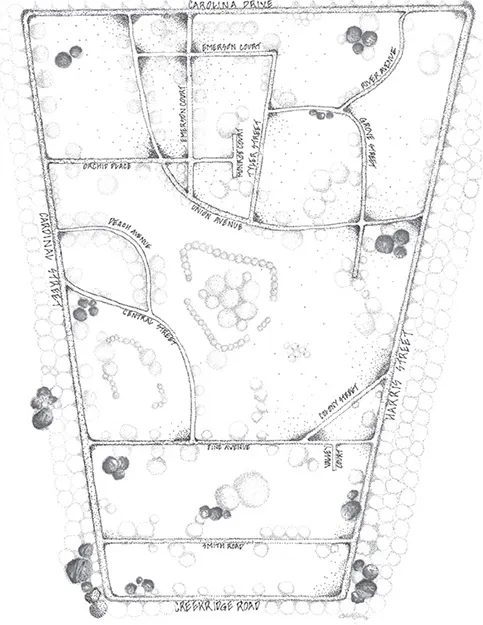
MAP 1 Creekridge Park Streets
As I chat with a few residents at the annual picnic (all White and most of whom I have met through neighborhood association events and interview referrals), Roberta walks up. Roberta is a short Black woman whom nobody seems to know; her arrival is met with silence. As she signs in, I see that she is carrying a plastic grocery bag. I think it includes a food item she has brought to share, as the picnic advertisements requested. She asks Tammy, who is running the registration table, how much a CPNA shirt costs. Roberta buys one, although she comments that the $12 price is “steep.” Another woman in attendance agrees, although she does not make eye contact with Roberta. Roberta proceeds to buy a $1 raffle ticket and is told by Tammy not to write on top of the book they are raffling off. I notice Tammy’s tone, which seems cold, but Roberta appears unfazed. Roberta then heads to the food table nearby, cuts herself a piece of cake, grabs a drink, and sits down in a chair away from the sun. Most other attendees are standing around, chatting. Although many of the other participants already know each other, some residents are being introduced to neighborhood folks they have not yet met. When Roberta sits down, I wrap up my conversation with Scott, a White homeowner and established resident; say hello to Deborah, a longtime Creekridge Park resident and a White homeowner; and then say hello to Roberta. She comes across as friendly and open, although she also seems content to be sitting down in the shade. She tells me that she is a North Carolina native who lives in an apartment off Cardinal Street and that she walked to the party. She said that she learned about the picnic from a flier and decided to step outside her “comfort zone” and attend.
Over the course of the next hour, I greet other residents that I know and introduce myself to some new faces, hoping to schedule a few more interviews. I also, however, keep track of Roberta throughout the evening. She never leaves her chair, and the other residents generally ignore her as they continue to chat and enjoy hotdogs, snacks, and iced tea. Deborah and Beth, both White CPNA board members, and Connie, a Black homeowner, are the only individuals I see speak to Roberta. Toward the end of the picnic, I go back and ask Roberta if she is having a good time and if she would like to speak with me about my project at a later date. She agrees without hesitation and gives me her phone number. She also tells me where she works as a medical records clerk. As we are chatting, we get called over to start the elections process. They need twenty neighborhood association members for a quorum, and they have twenty-one. Before I leave the picnic, I say goodbye to a few people, mostly board members, but also Roberta and Robin (a White homeowner), who agreed to be interviewed.
I share this story about the annual picnic because it exemplifies what this book is about: the interactions between Black, Latino/a,4 and White residents and how they shape the character of this multiethnic neighborhood. Using the events I observed, the interviews I conducted, and the analysis of survey data, I deconstruct the activities, codes of conduct, and ideologies of White, Black, and Latino/a residents in Creekridge Park. For example, how does a predominantly White neighborhood organization understand and justify their representation of a neighborhood that is almost 60 percent non-White? What does it mean when organizers of neighborhood association events characterize the annual picnic as well-attended when about 40 of 1,570 residents participate, most of whom are White homeowners? This book unpacks the meanings White and non-White residents attach to this multiethnic space and their experiences within it.
A central concern of this book is reorienting the conversation around residential segregation and integration. Over the last few decades, segregation research has focused on quantitative measurement. Indices of segregation, such as the dissimilarity index, dictate our national academic and policy conversations on segregation. The dissimilarity index is a number between 0 and 1 that indicates how evenly a racial group is represented across subregions in comparison to a larger, encompassing area. The dissimilarity index is commonly understood to represent the percentage of people from one racial-ethnic group that would have to move from one subarea to another to create 100 percent evenness within the larger area. Zero represents complete “integration” or evenness, and 1 represents complete “segregation” or unevenness. For example, a dissimilarity index of .3 would indicate that 30 percent of White residents in Creekridge Park would have to move to another block within Creekridge Park to create perfect neighborhood evenness—a 0 on the dissimilarity index. According to recent news publications, some analysts are even heralding a new era of reduced segregation based on city-level dissimilarity indices.5 In this book, I challenge the premise of these conversations. Rather than assume that segregation indices speak to the day-to-day interracial experiences of Americans, as many social scientists and policy makers do, I examine the social relationships, neighborhood norms, and ideological elements of life in multiethnic America.
Although Creekridge Park qualifies as “integrated” under the traditional statistical definitions, I argue that integration must be understood beyond spatial concerns. The measurement of residential integration should include the quality and the quantity of interracial interactions in a neighborhood. Instead of defining integration as the opposite of segregation or using proportionality and minority representation as markers of neighborhood integration, I use qualitative data to capture life in Creekridge Park. I argue that spatial proximity among Blacks, Latino/as, and Whites is not a guarantee of interracial interactions or relationships, let alone positive ones.6
In the following sections of this chapter, I discuss relevant research on segregation, integration, and multiethnic settings and specifically address the importance of Durham as a new Latino/a destination city. I also present background information on Creekridge Park, including demographic and historical data. Lastly, I reflect on my role in the field, discuss why I focus on White residents in Chapters 2 and 3, and outline the direction of the book.
WHY STUDY A MULTIETHNIC NEIGHBORHOOD IN DURHAM?
Clarifying Concepts
In the social science literature, integration has generally been measured using racial-ethnic population percentages and proportions, which I call statistical integration. The two dominant conceptualizations of statistical integration are not mutually exclusive but represent two distinct theoretical approaches to integration research. The first definition is the “proportional representation of all groups,” which concerns proportionality between neighborhood-level and city-level racial group percentages.7 Using this definition, one can argue that integration exists in Creekridge Park because the county and neighborhood percentages of Blacks, Latino/as, and Whites are comparable (see table 1.1). The other definition, used by those who argue for the importance of “sharing spaces on relatively equal grounds,” designates integrated neighborhoods as those with a Black population that comprises 10 to 50 percent of the total population.8 Creekridge Park also qualifies as integrated under this criterion, since according to 2010 census data, Black residents comprise 39 percent of the neighborhood population. Thankfully, social scientists have begun to challenge the flawed theoretical foundations of these numbers-based definitions.9 For instance, why is a predominantly White neighborhood with a 10 percent Black population designated as integrated, while a predominantly Black neighborhood with a 10, 20, or even 40 percent White population is not? These definitions of integration fail to challenge the normativity of whiteness and predominantly White neighborhoods as well as the tyranny of proportionality. If integration is intended to speak to issues of equity, then its definition must include measures of power, resource sharing, and reciprocity in relationships.10 Proportionality between neighborhood and city racial-ethnic percentages should not be the sole determining factor in naming a neighborhood as integrated. As I showcase throughout the following chapters, zeroing in on statistical integration lets social scientists and policy makers make arguments that are not reflected in sociological data but based on statistical assumptions.
TABLE 1.1 2010 census estimates for Creekridge Park and Durham County
Creekridge Park 2010 (%) | Durham County 2010 (%) | |
Male | 816 (52) | 127,656 (48) |
Female | 754 (48) | 139,931 (52) |
Under 18 | 377 (24) | 61,321 (23) |
18+ | 1,193 (76) | 206,266 (78) |
White, non-Hispanic | 533 (34) | 112,697 (42) |
Black, non-Hispanic | 612 (39) | 100, 260 (38) |
Hispanic | 408 (26) | 36,077 (14) |
N | 1,570 | 267,587 |
Throughout the book I generally use “multiethnic” to describe Creekridge Park, a more exact label than “integrated” or even “statistically integrated.” The term “multiethnic” highlights that there are more than two distinct racial-ethnic communities in Creekridge Park, moving the analysis beyond the traditional Black-White binary, a limitation of previous research. In addition, by using “multiethnic” rather than “integrated,” I do not presume that the experiences and interpretations of residents in this neigh...
Table of contents
- Cover Page
- Behind the White Picket Fence
- Copyright Page
- Dedication
- Contents
- Acknowledgments
- Chapter 1: Inside Creekridge Park
- Chapter 2: White Habitus and the Meanings of Diversity
- Chapter 3: Neighboring from a Distance
- Chapter 4: Creekridge Park in Black and Brown
- Chapter 5: Solving the Wrong Problem
- Appendix A: Researcher in the Field
- Appendix B: Guide for In-depth Interviews
- Appendix C: Interview Participant Demographics
- Notes
- Bibliography
- Index
Trusted by 375,005 students
Access to over 1.5 million titles for a fair monthly price.
Study more efficiently using our study tools.
Frequently asked questions
Yes, you can cancel anytime from the Subscription tab in your account settings on the Perlego website. Your subscription will stay active until the end of your current billing period. Learn how to cancel your subscription
No, books cannot be downloaded as external files, such as PDFs, for use outside of Perlego. However, you can download books within the Perlego app for offline reading on mobile or tablet. Learn how to download books offline
Perlego offers two plans: Essential and Complete
- Essential is ideal for learners and professionals who enjoy exploring a wide range of subjects. Access the Essential Library with 800,000+ trusted titles and best-sellers across business, personal growth, and the humanities. Includes unlimited reading time and Standard Read Aloud voice.
- Complete: Perfect for advanced learners and researchers needing full, unrestricted access. Unlock 1.5M+ books across hundreds of subjects, including academic and specialized titles. The Complete Plan also includes advanced features like Premium Read Aloud and Research Assistant.
We are an online textbook subscription service, where you can get access to an entire online library for less than the price of a single book per month. With over 1.5 million books across 990+ topics, we’ve got you covered! Learn about our mission
Look out for the read-aloud symbol on your next book to see if you can listen to it. The read-aloud tool reads text aloud for you, highlighting the text as it is being read. You can pause it, speed it up and slow it down. Learn more about Read Aloud
Yes! You can use the Perlego app on both iOS and Android devices to read anytime, anywhere — even offline. Perfect for commutes or when you’re on the go.
Please note we cannot support devices running on iOS 13 and Android 7 or earlier. Learn more about using the app
Please note we cannot support devices running on iOS 13 and Android 7 or earlier. Learn more about using the app
Yes, you can access Behind the White Picket Fence by Sarah Mayorga in PDF and/or ePUB format, as well as other popular books in Scienze sociali & Studi afroamericani. We have over 1.5 million books available in our catalogue for you to explore.