1
THE RAPTURE
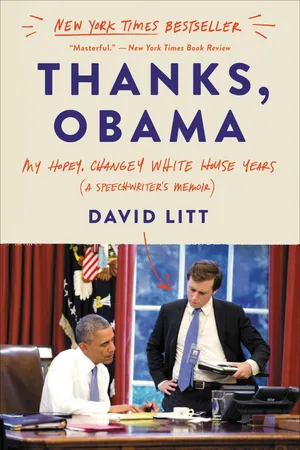
On January 3, 2008, I pledged my heart and soul to Barack Obama. There was no formal, lovesick declaration. No one tattooed a Hope poster across my chest. Still, my transformation was immediate and all-consuming. One moment I was a typical college senior, barely interested in politics. The next moment I would have done anything, literally anything, for a freshman senator from Illinois.
I was not a likely candidate for conversion. The summer before I began working for Obama I interned at the comedy newspaper The Onion, where my boss wore roller-skate sneakers and sold feminine hygiene products from a kiosk at his desk. It was a dream job. I fetched coffee and did busy work. In exchange, I got to sit in on a writers’ meeting and watch a senior editor come dangerously close to a psychotic break. “We’re a comedy paper, not a stupid paper!” he shouted, before storming out of the room. I had never been part of anything so meaningful.
There was just one problem: I didn’t fit in. As an intern, my biggest responsibilities were proofreading articles and writing jokes about the weather, but the second task kept getting in the way of the first. Each morning, I’d arrive at work and think, Cloudy with a chance of meatballs! I knew it wasn’t funny, but the phrase lodged itself in my head like a mantra, or a tumor. Typos went uncorrected. Run-on sentences ran on.
Cloudy with a chance of meatballs. Cloudy with a chance of meatballs. Cloudy with a chance of meatballs.
This wasn’t just another job. I worshipped The Onion. I grew up in Manhattan, and I’ll never forget the headlines from the issue released a few weeks after 9/11, when I still thought al Qaeda would kill me before I finished tenth grade.
HIJACKERS SURPRISED TO FIND SELVES IN HELL
NOT KNOWING WHAT TO DO, WOMAN BAKES AMERICAN-FLAG CAKE
In that awful moment, a small, satirical newspaper was everything I loved about my country. Defiant. Proud. Optimistic in spite of everything. The Onion gave me hope I might not die a virgin. What could be more uplifting than that?
But if satire represented the best of America, politics was the worst. My family is a classic American-dream story. My great-grandparents fled Russia to avoid being murdered for their religion. Just two generations later, my parents fled New York City weekends for their country house. I never felt guilty about this. I was raised to believe America rewards hard work. But I was also raised to understand that luck plays a role in even the bootstrappiest success story. The cost of living the dream, I was taught, is the responsibility to expand it for others. It’s a more than fair price.
Yet the people running the country didn’t see it that way. With George W. Bush in the White House, millionaires and billionaires were showered with tax cuts. Meanwhile, schools went underfunded. Roads and bridges deteriorated. Household incomes languished. Deficits ballooned.
And America went to war. President Bush invaded Iraq to destroy weapons of mass destruction, a campaign which hit a snag when it turned out those weapons didn’t exist. But by then it was too late. We had broken a country and owned the resulting mess. Colin Powell called this “the Pottery Barn rule,” which, admittedly, was cute. Still, it’s hard to imagine a visit to Pottery Barn that costs trillions of dollars and thousands of American lives.
Our leaders, in other words, had made bad choices. They would therefore be replaced with better ones. That’s how AP Government told me the system worked. In the real world, however, the invasion of Iraq became an excuse for a dark and antidemocratic turn. Those who questioned the war, the torture of prisoners—or even just the tax cuts—found themselves accused of something barely short of treason. No longer was a distinction made between supporting the president’s policies and America’s troops. As an electoral strategy, this was dangerous and cynical. Also, it worked.
So no, I didn’t grow up with a high opinion of politicians. But I did grow up in the kind of environment where people constantly told me I could change the world. In 2004, eager to prove them right, I volunteered for John Kerry’s presidential campaign.
In theory, we stood on the right side of history. For equality! For opportunity! For the little guy! In practice, however, being branded un-American left Democrats meek and skittish, like the Munchkins before Dorothy arrives. I had no doubt Kerry would make a better president than Bush, yet he never seemed confident when stating his case. It was as though he spent an entire campaign arguing that the most talented Beatle was Ringo. When he lost, I was devastated. More than that, however, I was embarrassed. I had allowed myself to believe my meager actions could alter a country’s course. How foolish that seemed now. How naive.
I was done with politics. And I was through believing in clichés. “Changing the world” was for hypocrites, the kind of people who were outraged by a nonorganic tomato but never asked questions about their weed. “Taking our country back” was for budding white-collar criminals who wore suits and ties to class.
And me? Once I realized I couldn’t change the world, I doubled down on making fun of it. My greatest passion in college was my improv comedy group. My second-greatest passion was a humor magazine. When I arrived at The Onion and discovered that my happiest coworkers were goofy, awkward nihilists, I wasn’t disenchanted. I was thrilled. I longed to be charmingly bitter. I dreamed of one day melting down in meetings before storming out of rooms. I was determined to write the best gosh-darned jokes about the weather the paper had ever seen!
Cloudy with a chance of meatballs. Cloudy with a chance of meatballs. Cloudy with a chance of meatballs.
It can be hard, at times, to distinguish between the absence of talent and the presence of destiny. When I began my dream job, I imagined buying a wholesale tub of maxipads and following in my boss’s footsteps, or, if his skates were deployed, his tracks. But when August rolled around, my fellow intern Mariana had landed about six jokes in the paper. I had landed about none.
You know, I thought, maybe this job isn’t so meaningful after all.
For the first time in my life, I was seeking a higher purpose, but after my experience with the Kerry campaign, politics never crossed my mind. Instead, I applied to join the CIA. With my major in history and leadership experience directing my comedy troupe, I figured I was the perfect person to bring Osama bin Laden to justice.
I don’t remember where I was when the CIA called, although since it was my senior year of college, I was probably either recovering from a hangover or acquiring one. I also don’t remember my interviewer’s name. I do, however, recall that it was something all-American, like Chip or Jimmy. I also remember that he sounded surprisingly sunny, as though he were selling time-shares or cutlery door-to-door.
“Alrighty now,” said Buddy, or maybe even Tex. “Just to kick things off, have you used any prohibited substances in the past year?”
If I had lied to the CIA, perhaps I might have passed a test. Instead of writing a book about the White House, I’d be poisoning a drug kingpin with a dart gun concealed inside a slightly larger dart gun, or making love to a breathy supermodel in the interest of national security. I’ll never know. I confessed to smoking pot two months before.
The sunniness vanished from my interviewer’s voice. “Normally we like people who break the rules,” Skipper told me, “but we can’t consider anyone who’s used illegal substances in the past twelve months.” Just like that, my career as a terrorist hunter was over.
I thought my yearning for higher purpose would vanish with my CIA dreams, the way a Styrofoam container follows last night’s Chinese food into the trash. To my surprise, it stuck around. In the weeks that followed, I pictured myself in all sorts of identities: hipster, world traveler, banker, white guy who plays blues guitar. But these personas were like jeans a half size too small. Trying them on gave me an uncomfortable gut feeling and put my flaws on full display. My search for replacement selves began in November. By New Year’s Eve I was mired in the kind of existential funk that leads people to find Jesus, or the Paleo diet, or Ayn Rand.
Instead, on January 3, I found a candidate.
I was on an airplane when I discovered him, preparing for our initial descent into JFK. This was during the early days of live in-flight television, and I was halfway between the Home Shopping Network and one of the lesser ESPNs when I stumbled across coverage of a campaign rally in Iowa. Apparently, a caucus had just finished. Speeches were about to begin. With nothing better to occupy my time, I confirmed that my seat belt was fully fastened. I made sure my tray table was locked. Then, with the arena shrunk to fit my tiny seatback screen, I watched a two-inch-tall guy declare victory.
It’s not like I hadn’t heard about Barack Obama. I had heard his keynote speech at the 2004 Democratic Convention. His presidential campaign had energized my more earnest friends. But I was far too mature to take them seriously. They supported someone with the middle name Hussein to be president of the United States. While they were at it, why not cast a ballot for the Tooth Fairy? Why not nominate Whoopi Goldberg for pope?
And then I saw him speak.
Years later, after writing dozens upon dozens of presidential speeches, it would become impossible to listen to rhetoric without editing it in my head. On that historic Iowa evening, Obama began with a proclamation: “They said this day would never come.” Rereading those words today, I have questions. Who were “they,” exactly? Did they really say “never”? Because if they thought an antiwar candidate with a robust fund-raising operation could never win a divided three-way Democratic caucus, particularly with John Edwards eating into Hillary Clinton’s natural base of support among working-class whites, then they didn’t know what they were talking about.
All this analysis would come later, though, along with stress-induced insomnia and an account at the Navy Mess. At the time, I was spellbound. The senator continued:
“At this defining moment in history, you have done what the cynics said you couldn’t do.” He spoke like presidents in movies. He looked younger than my dad. I didn’t have time for a second thought, or even a first one. I simply believed.
Barack Obama spoke for the next twelve minutes, and except for a brief moment when the landing gear popped out and I thought we were going to die, I was riveted. He told us we were one people. I nodded knowingly at the gentleman in the middle seat. He told us he would expand health care by bringing Democrats and Republicans together. I was certain it would happen as he described. He looked out at a sea of organizers and volunteers.
“You did this,” he told them, “because you believed so deeply in the most American of ideas—that in the face of impossible odds, people who love this country can change it.”
Like most twenty-one-year-olds, I was no stranger to the sudden, all-consuming crush. “There’s this girl,” I would gush to friends who tolerated that sort of thing. “She’s from California, and I once spent a week in Washington State! Can you believe how much we have in common?” Watching Obama speak, my attraction was electoral rather than physical. But in politics, as in other things, the heart wants what it wants.
I do love this country! I thought. I can change it! It’s like he’s known me my whole life!
As we neared the runway, I tried to make sense of what had just happened. I was born in the tail end of the Reagan years, when government was not the solution but the problem. I cast my first vote during the Bush years, when “You are either with us or with the terrorists” was applied to foreign and domestic opponents alike. Now, a few thousand feet over New York City, a candidate for president had told me we were not a collection of red states and blue states, but the United States. Together, we could build something far greater than we could on our own.
By the time we emerged from the Jetway, I was one of those people who would not shut up about Barack Obama. I wasn’t alone. Across campus, across America, an army of idealists had arisen, a zombie horde craving hope and change.
Our critics would later mock the depths of our devotion. Obamabots, they’d call us. And really, weren’t they right? Becoming obsessed with Barack Obama wasn’t a choice I made. Rather, it was like starring in one of those sleeper-agent-killer-robot movies that comes out every few years. A switch is flipped, long-dormant code is activated, and suddenly the mild-mannered main character can disembowel adversaries with a spoon. I’ve never disemboweled anybody, not even people who actually use the phrase, “Find me on LinkedIn.” Still, I identify with that killer robot. I had been preprogrammed with the ability to ask friends for donations or to call people at random to tell them how to vote. Now, my switch had been flipped.
When I got back to campus, I joined our chapter of Obama for America. Organizers handed out call sheets, pieces of paper covered in strangers’ numbers and names, and each night I dialed until my fingers were sore. These days I’m more likely to receive these calls ...