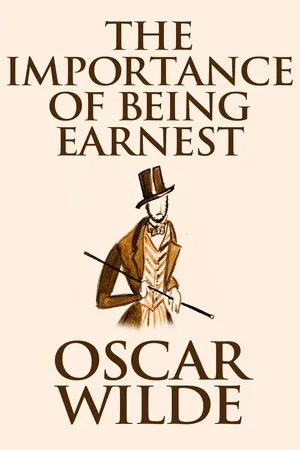
The Importance of Being Earnest is a farcical comedy in which the protagonists maintain fictional alter-egos to escape tiresome social obligations. The play makes light of the institution of marriage and more generally other serious Victorian customs. As a result, reviewers of the time praised the play's humor, while bemoaning its evident lack of social messages. Most agreed however that it was the high point of Wilde's artistic career to date. Its high farce and Wilde's dazzlingly witty dialogue have helped make The Importance of Being Earnest his most enduringly popular play.
- 112 pages
- English
- ePUB (mobile friendly)
- Available on iOS & Android
eBook - ePub
The Importance of Being Earnest
About this book
Information
Second Act
The Garden at the Manor House, Woolton.
The Garden at the Manor House, Woolton.
SCENE
Garden at the Manor House. A flight of grey stone steps leads up to the house. The garden, an old-fashioned one, full of roses. Time of year, July. Basket chairs, and a table covered with books, are set under a large yew tree.
[Miss Prism discovered seated at the table. Cecily is at the back watering flowers.]
Miss Prism. [Calling.] Cecily, Cecily! Surely such a utilitarian occupation as the watering of flowers is rather Moulton’s duty than yours? Especially at a moment when intellectual pleasures await you. Your German grammar is on the table. Pray open it at page fifteen. We will repeat yesterday’s lesson.
Cecily. [Coming over very slowly.] But I don’t like German. It isn’t at all a becoming language. I know perfectly well that I look quite plain after my German lesson.
Miss Prism. Child, you know how anxious your guardian is that you should improve yourself in every way. He laid particular stress on your German, as he was leaving for town yesterday. Indeed, he always lays stress on your German when he is leaving for town.
Cecily. Dear Uncle Jack is so very serious! Sometimes he is so serious that I think he cannot be quite well.
Miss Prism. [Drawing herself up.] Your guardian enjoys the best of health, and his gravity of demeanour is especially to be commended in one so comparatively young as he is. I know no one who has a higher sense of duty and responsibility.
Cecily. I suppose that is why he often looks a little bored when we three are together.
Miss Prism. Cecily! I am surprised at you. Mr. Worthing has many troubles in his life. Idle merriment and triviality would be out of place in his conversation. You must remember his constant anxiety about that unfortunate young man his brother.
Cecily. I wish Uncle Jack would allow that unfortunate young man, his brother, to come down here sometimes. We might have a good influence over him, Miss Prism. I am sure you certainly would. You know German, and geology, and things of that kind influence a man very much. [Cecily begins to write in her diary.]
Miss Prism. [Shaking her head.] I do not think that even I could produce any effect on a character that according to his own brother’s admission is irretrievably weak and vacillating. Indeed I am not sure that I would desire to reclaim him. I am not in favour of this modern mania for turning bad people into good people at a moment’s notice. As a man sows so let him reap. You must put away your diary, Cecily. I really don’t see why you should keep a diary at all.
Cecily. I keep a diary in order to enter the wonderful secrets of my life. If I didn’t write them down, I should probably forget all about them.
Miss Prism. Memory, my dear Cecily, is the diary that we all carry about with us.
Cecily. Yes, but it usually chronicles the things that have never happened, and couldn’t possibly have happened. I believe that Memory is responsible for nearly all the three-volume novels that Mudie sends us.
Miss Prism. Do not speak slightingly of the three-volume novel, Cecily. I wrote one myself in earlier days.
Cecily. Did you really, Miss Prism? How wonderfully clever you are! I hope it did not end happily? I don’t like novels that end happily. They depress me so much.
Miss Prism. The good ended happily, and the bad unhappily. That is what Fiction means.
Cecily. I suppose so. But it seems very unfair. And was your novel ever published?
Miss Prism. Alas! no. The manuscript unfortunately was abandoned. [Cecily starts.] I use the word in the sense of lost or mislaid. To your work, child, these speculations are profitless.
Cecily. [Smiling.] But I see dear Dr. Chasuble coming up through the garden.
Miss Prism. [Rising and advancing.] Dr. Chasuble! This is indeed a pleasure.
[Enter Canon Chasuble.]
Chasuble. And how are we this morning? Miss Prism, you are, I trust, well?
Cecily. Miss Prism has just been complaining of a slight headache. I think it would do her so much good to have a short stroll with you in the Park, Dr. Chasuble.
Miss Prism. Cecily, I have not mentioned anything about a headache.
Cecily. No, dear Miss Prism, I know that, but I felt instinctively that you had a headache. Indeed I was thinking about that, and not about my German lesson, when the Rector came in.
Chasuble. I hope, Cecily, you are not inattentive.
Cecily. Oh, I am afraid I am.
Chasuble. That is strange. Were I fortunate enough to be Miss Prism’s pupil, I would hang upon her lips. [Miss Prism glares.] I spoke metaphorically.—My metaphor was drawn from bees. Ahem! Mr. Worthing, I suppose, has not returned from town yet?
Miss Prism. We do not expect him till Monday afternoon.
Chasuble. Ah yes, he usually likes to spend his Sunday in London. He is not one of those whose sole aim is enjoyment, as, by all accounts, that unfortunate young man his brother seems to be. But I must not disturb Egeria and her pupil any longer.
Miss Prism. Egeria? My name is Lætitia, Doctor.
Chasuble. [Bowing.] A classical allusion merely, drawn from the Pagan authors. I shall see you both no doubt at Evensong?
Miss Prism. I think, dear Doctor, I will have a stroll with you. I find I have a headache after all, and a walk might do it good.
Chasuble. With pleasure, Miss Prism, with pleasure. We might go as far as the schools and back.
Miss Prism. That would be delightful. Cecily, you will read your Political Economy in my absence. The chapter on the Fall of the Rupee you may omit. It is somewhat too sensational. Even these metallic problems have their melodramatic side.
[Goes down the garden with Dr. Chasuble.]
Cecily. [Picks up books and throws them back on table.] Horrid Political Economy! Horrid Geography! Horrid, horrid German!
[Enter Merriman with a card on a salver.]
Merriman. Mr. Ernest Worthing has just driven over from the station. He has brought his luggage with him.
Cecily. [Takes the card and reads it.] “Mr. Ernest Worthing, B. 4, The Albany, W.” Uncle Jack’s brother! Did you tell him Mr. Worthing was in town?
Merriman. Yes, Miss. He seemed very much disappointed. I mentioned that you and Miss Prism were in the garden. He said he was anxious to speak to you privately for a moment.
Cecily. Ask Mr. Ernest Worthing to come here. I suppose you had better talk to the housekeeper about a room for him.
Merriman. Yes, Miss.
[Merriman goes off.]
Cecily. I have never met any really wicked person before. I feel rather frightened. I am so afraid he will look just like everyone else.
[Enter Algernon, very gay and debonnair.] He does!
Algernon. [Raising his hat.] You are my little cousin Cecily, I’m sure.
Cecily. You are under some strange mistake. I am not little. In fact, I believe I am more than usually tall for my age. [Algernon is rather taken aback.] But I am your cousin Cecily. You, I see from your card, are Uncle Jack’s brother, my cousin Ernest, my wicked cousin Ernest.
Algernon. Oh! I am not really wicked at all, cousin Cecily. You mustn’t think that I am wicked.
Cecily. If you are not, then you have certainly been deceiving us all in a very inexcusable manner. I hope you have not been leading a double life, pretending to be wicked and being really good all the time. That would be hypocrisy.
Algernon. [Looks at her in amazement.] Oh! Of course I have been rather reckless.
Cecily. I am glad to hear it.
Algernon. In fact, now you mention the subject, I have been very bad in my own small way.
Cecily. I don’t think you should be so proud of that, though I am sure it must have been very pleasant.
Algernon. It is much pleasanter being here with you.
Cecily. I can’t understand how you are here at all. Uncle Jack won’t be back till Monday afternoon.
Algernon. That is a great disappointment. I am obliged to go up by the first train on Monday morning. I have a business appointment that I am anxious . . . to miss?
Cecily. Couldn’t you miss it anywhere but in London?
Algernon. No: the appointment is in London.
Cecily. Well, I know, of course, how important it is not to keep a business engagement, if one wants to retain any sense of the beauty of life, but still I think you had better wait till Uncle Jack arrives. I know he wants to speak to you about your emigrating.
Algernon. About my what?
Cecily. Your emigrating. He has gone up to buy your outfit.
Algernon. I certainly wouldn’t let Jack buy my outfit. He has no taste in neckties at all.
Cecily. I don’t think you will require neckties. Uncle Jack is sending you to Australia.
Algernon. Australia! I’d sooner die.
Cecily. Well, he said at dinner on Wednesday night, that you would have to choose between this world, the next world, and Australia.
Algernon. Oh, well! The accounts I have received of Australia and the next world, are not particularly encouraging. This world is good enough for me, cousin Cecily.
Cecily. Yes, but are you good enough for it?
Algernon. I’m afraid I’m not that. That is why I want you to reform me. You might make that your mission, if you don’t mind, cousin Cecily.
Cecily. I’m afraid I’ve no time, this afternoon.
Algernon. Well, would you mind my reforming myself this afternoon?
Cecily. It is rather Quixotic of you. But I think you should try.
Algernon. I will. I feel better already.
Cecily. You are looking a little worse.
Algernon. That is because I am hungry.
Cecily. How thoughtless of me. I should have remembered that when one is going to lead an entirely new life, one requires regular and wholesome meals. Won’t you come in?
Algernon. Thank you. Might I have a buttonhole first? I never have any appetite unless I have a buttonhole first.
Cecily. A Marechal ...
Table of contents
- Title
- About Oscar Wilde
- The Persons in the Play
- The Scenes of the Play
- First Act: Algernon Moncrieff’s Flat in Half-Moon Street, W.
- Second Act: The Garden at the Manor House, Woolton.
- Third Act: Drawing-Room at the Manor House, Woolton. TIME: The Present.
Trusted by 375,005 students
Access to over 1.5 million titles for a fair monthly price.
Study more efficiently using our study tools.
Frequently asked questions
Yes, you can cancel anytime from the Subscription tab in your account settings on the Perlego website. Your subscription will stay active until the end of your current billing period. Learn how to cancel your subscription
No, books cannot be downloaded as external files, such as PDFs, for use outside of Perlego. However, you can download books within the Perlego app for offline reading on mobile or tablet. Learn how to download books offline
Perlego offers two plans: Essential and Complete
- Essential is ideal for learners and professionals who enjoy exploring a wide range of subjects. Access the Essential Library with 800,000+ trusted titles and best-sellers across business, personal growth, and the humanities. Includes unlimited reading time and Standard Read Aloud voice.
- Complete: Perfect for advanced learners and researchers needing full, unrestricted access. Unlock 1.5M+ books across hundreds of subjects, including academic and specialized titles. The Complete Plan also includes advanced features like Premium Read Aloud and Research Assistant.
We are an online textbook subscription service, where you can get access to an entire online library for less than the price of a single book per month. With over 1.5 million books across 990+ topics, we’ve got you covered! Learn about our mission
Look out for the read-aloud symbol on your next book to see if you can listen to it. The read-aloud tool reads text aloud for you, highlighting the text as it is being read. You can pause it, speed it up and slow it down. Learn more about Read Aloud
Yes! You can use the Perlego app on both iOS and Android devices to read anytime, anywhere — even offline. Perfect for commutes or when you’re on the go.
Please note we cannot support devices running on iOS 13 and Android 7 or earlier. Learn more about using the app
Please note we cannot support devices running on iOS 13 and Android 7 or earlier. Learn more about using the app
Yes, you can access The Importance of Being Earnest by Oscar Wilde in PDF and/or ePUB format, as well as other popular books in Literature & British Drama. We have over 1.5 million books available in our catalogue for you to explore.