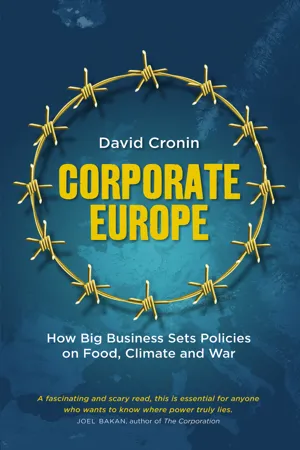
During the chaos of the eurozone crisis, few mainstream commentators have stopped to question the purpose of the European Union itself, and whose interests it serves. Corporate Europe goes beyond the divisions between nation-states, focusing instead on the division between the corporate elite and the peoples of Europe. David Cronin spent a year investigating the privileged access that big business enjoys in Brussels. In this book, he reveals how the EU's policies on health, climate change, armaments and food safety have been tailored to please an unaccountable elite. Making extensive use of previously unpublished documents, he explores how ideologically blinkered lobbyists have seized on the financial crisis of recent years to entrench the casino capitalism that caused the crisis in the first place. What emerges is a powerful exposé of how vested interests in the EU have manipulated opportunities to introduce ideologically-driven reforms.
- 216 pages
- English
- ePUB (mobile friendly)
- Available on iOS & Android
eBook - ePub
About this book
Information
1
Wrecking the welfare state

Sometime during the last two months of 2011, the mask slipped off the European project. Elected governments in both Greece and Italy were replaced with hastily assembled administrations. Voters were given no say in the matter.
Most of the attention was focused on Greece, where George Papandreou resigned as prime minister because he had the temerity to suggest that a referendum be called, asking if ordinary people concurred with the terms of a ‘bail-out’ imposed on the country. His effective dismissal by Angela Merkel and Nicolas Sarkozy shattered the myth that the EU was a club of sovereign nations.1 Perhaps the only mitigating factor was that the interim government in Athens wasn’t in office for too long.2 By contrast, the new regime in Rome stayed in office for a full year.
Mario Monti came to power in circumstances that resembled a coup. In the summer of 2011, Italy had a crushing national debt and found its banks under attack by speculators.3 Jean Claude-Trichet, then the outgoing president of the European Central Bank, and his incoming successor Mario Draghi pounced on this crisis. Writing to Silvio Berlusconi in August that year, the duo complained that the prime minister’s commitments to economic reform were ‘insufficient’. It was ‘essential’, they added, for Italy to undertake ‘large-scale privatisations’ and to make it easier for firms to sack workers. A series of other measures must be introduced by decree within less than two months, Berlusconi was told.4
Though Berlusconi succumbed to the ECB’s pressure and helped to bring in a package of cutbacks, he found his own position untenable. After many of his parliamentary allies deserted him, Berlusconi resigned in November 2011.5 Monti promptly replaced him. No election was called. Like the other members of his hand-picked new cabinet, Monti was not an elected politician.6
Monti appeared in some respects to be the polar opposite of Berlusconi. Whereas Berlusconi had a penchant for risqué jokes and became synonymous with ‘bunga bunga’ parties, Monti came across as inscrutable and dour. Monti is routinely described as a ‘technocrat’, implying that as a university professor, he was not motivated by the base concerns of a career parliamentarian. The description was misleading: Monti proved not only to be highly political, he was in some respects more dangerous than Berlusconi. Monti quickly resorted to taking action by emergency decree; this effectively meant that he was ordering that the retirement age be increased and expenditure on public services be slashed.7 As I hadn’t heard any convincing explanation for why he was issuing diktats, I requested one when I approached Monti as he was leaving a conference in Brussels a few months later.
‘Mr Monti, do you accept that you have no democratic mandate to introduce the reforms you are undertaking in Italy?’ I asked.
‘No, I do not,’ he replied.
‘What democratic mandate do you have?’ I persevered.
‘I have a huge majority in Parliament,’ he said.8
I tried to enquire how his ‘huge majority’ compensated for the fact that he had not been elected but Monti had already walked away, surrounded by bodyguards and a smartly-dressed entourage.
Taking a more softball approach than I had, journalists with Der Spiegel soon learned how Monti actually regarded parliaments as something of an irritant. ‘If governments let themselves be bound by the decisions of their parliaments without protecting their own freedom to act, a breakup of Europe would be a more probable outcome than integration,’ he told the German magazine.9
Having monitored his work intermittently for more than a decade, I am convinced that Monti has long been seeking a fundamental transformation of the European economy. Because this kind of transformation (or ‘integration’, as he prefers to call it) necessitates social upheaval, it is not hard to see why he wants to avoid the oversight and checks and balances that parliaments are supposed to provide. Before I ‘doorstepped’ him, I had listened to Monti give a keynote address to an audience invited by the employers group BusinessEurope. Monti used this platform to spurn ‘an old-fashioned Keynesian way of looking at the world’, stressing efforts must be made towards ‘budgetary consolidation’. He summarised his thinking as ‘structural reforms – yes; ephemeral deficit spending – no’.10 Didn’t Margaret Thatcher adopt a similar outlook with the guidance of her economic guru Keith Joseph?11Just as Thatcher had done, Monti was wielding a machete at the big government policies favoured by John Maynard Keynes. Monti was urging the destruction of the welfare state not just in Italy but throughout the EU.
Between 1999 and 2004, Monti was the EU’s commissioner for competition policy. He was best known during that period for blocking a merger between General Electric (GE) and Honeywell. Monti continued to spend much of his time in Brussels when his term as a commissioner expired. He was named chairman of Bruegel, an economic affairs ‘think-tank’.12 Ironically – or appropriately, depending on one’s perspective – this outfit’s activities have been partly financed by GE, as well as by Goldman Sachs, for whom Monti has worked as an adviser.13 In an article published by Bruegel in 2005, Monti gave a useful history lesson. It is wrong, he argued, to equate the concept of a ‘market economy’ solely with Anglo-Saxon capitalism. Monti praised the German government of the 1950s – particularly Ludwig Erhard, the economics minister – for imprinting on ‘the nascent European construction a solid market orientation’, with the help of France. Twenty-first century France and Germany ‘need quickly to reform and modernise their model, not repudiate it,’ he added.14
It is telling that Monti’s article was penned the year that Angela Merkel took over as chancellor in Germany. Ahead of her election, Merkel hired Paul Kirchhof as an economic adviser. An advocate of radical tax cuts, Kirchhof had been actively involved in the Initiative for a New Social Market Economy (INSM). Financed by trade associations representing the metal and electronics industries, the INSM was set up in 2005 to push for a weakening of the welfare state.15 Merkel’s scope for implementing the policies favoured by the INSM was limited in her first term in office. That was because she led a coalition with the Social Democrats, who were averse to Kirchhof’s main recommendations.16 Circumstances were to change dramatically after she was re-elected in 2009. Not only was Merkel able to form a government with the right-wing Free Democrats, the troubles besetting the eurozone helped her become the self-appointed empress of austerity. Largely at her behest, a number of European economies were remoulded to meet the requirements of the ‘social market’.
The term ‘social market’ is a misnomer. The prefix ‘social’ has been attached purely as a form of sugar-coating to make painful adjustments appear palatable. In reality, ‘social market’ is a synonym for neo-liberalism, an ideology which holds that the most important purpose of the state is to defend private property rights.17Genuine social policies aimed at reducing poverty and inequality are anathema to this way of thinking. The INSM’s vision of a social market is one where minimum wages are abolished and health insurance opened up to greater competition.18
To understand how the ‘social market’ involves a repackaging of old ideas, it is helpful to examine the report of a 2009 conference titled ‘60 Years of the Social Market Economy’. Held in Sankt-Augustin, a town near Bonn, the conference was hosted by the Konrad Adenauer Stiftung (KAS), a ‘foundation’ affiliated to Merkel’s Christian Democratic Union, and the European Business Circle, a group dominated by German entrepreneurs and academics. The report traces the first use of the phrase ‘social market economy’ to a 1946 paper by the economist and anthropologist Alfred-Müller Armack. While the authors of the 2009 report contend that the concept is based on ‘seemingly conflicting objectives, namely economic freedom and social security’, they admit that it is ‘a new variant of neo-liberalism’. What is particularly striking about the report is that it presented the economic crisis which erupted a year earlier as an opportunity to ‘renew’ the ‘principles and fundamental ideas’ behind the social market economy. Far from confining this debate to Germany, it urged that the concept be applied globally to ‘reinvigorate the philosophical and economic standing of liberalism in general’.19 Such thinking will be familiar to readers of Naomi Klein’s magnum opus The Shock Doctrine. Among the numerous examples of market fundamentalists exploiting emergency situations cited by Klein was how the highly influential economist Milton Friedman urged the privatisation of the school system in New Orleans soon after the city was devastated by a hurricane.20
AMBUSHING THE IRISH
Towards the end of November 2010, the shock doctrine came to Ireland. I happened to be home in Dublin at the time that details of an €85 billion ‘bail-out’ were announced. It felt grimly appropriate that the news coincided with heavy snow. As the capital was covered with sheets of ice, it was a major challenge to walk the streets without breaking a leg. Parts of the city felt deserted, almost ghostly.
The Irish people were not bailed out on that bitterly cold week; they were ambushed. Those who had little, if anything, to do with the excesses of the Celtic Tiger era were forced to suffer the most now that the speculative bubble had burst. Most of the €85 billion was to be borrowed from the European Union and the International Monetary Fund under conditions that amounted to blackmail.
Just three years earlier, the largest business deal of the boom was clinched. At 2 a.m. on a Saturday in June 2007, Anglo Irish Bank issued a draft for €1.165 billion to allow a property developer to buy a chain of hotels. When the paroxysms in the global economy started the following year, it soon became clear that Anglo had been throwing gargantuan sums of ‘other people’s money’ around like confetti. As Anglo’s problems worsened, the Dublin government tried to ‘rescue’ it. Some €22 billion were pumped into it by May 2010. But this wasn’t enough to cover its gambling debts and the bank’s management conceded that the ‘lion’s share’ of these billions wouldn’t be seen again. In the words of Simon Carswell, author of the book Anglo Republic, the bank turned into a ‘black hole for taxpayers’ cash’.21 The ‘bail-out’ prompted the Green Party to withdraw from a ruling coalition with the centre-right Fianna Fáil, leading to an election in 2011. Having been an active member of the Irish Greens in the 1990s, the party’s performance in government had been unpleasant for me to observe, albeit from a distance; principles once held as sacrosanct were abandoned purely on the grounds of expediency. The decision to leave that government was accompanied by the ultimate act of betrayal. Rather than resisting the manifestly unfair terms of the ‘bail-out’, the Greens’ leadership decided to facilitate its approval by the Oireachtas, Ireland’s parliament, ahead of polling day.22
Although this treachery was to tie the hands of the next government, the main opposition party Fine Gael (slightly more right-wing than Fianna Fáil) went to the hustings with a promise it would ‘burn the bondholders’ (another popular term for refusing to repay lenders was to make them have a ‘haircut’).23 The pledge was neatly summarised by Richard Bruton, then the party’s spokesman for enterprise: ‘We have to take the view that people who invested and invested unwisely have the consequences under capitalism of losing some or all of their investment.’24 Internal European Commission documents I have seen indicate that Ireland’s masters in Brussels were adamant that no bondholder would even by singed, regardless of how unwise his or her investments had been. A December 2010 ‘background note’ prepared for Olli Rehn, the Union’s economic and monetary affairs commissioner at the time, said that EU officials were already in contact with the leading opposition parties and believed that ‘a high degree of policy continuity should be possible even in the case of a change of government’. As well as stressing that ‘the main elements or goalposts of the [“bail-out”] programme should not be renegotiated’, the paper explicitly stated that ‘a possible involvement of banks’ senior bondholders (“haircut”) has been excluded and renegotiating this would run counter to the programme’s main objective – restore confidence in the Irish banking system’. The same paper then went on to give a snapshot of the ‘fiscal consolidation’ and ‘structural reform agenda’ that would be implemented as a condition for the loans being released; among the key ingredients would be wage cuts and ‘large reductions in welfare spending’. The country’s corporation tax – at 12.5 per cent one of the lowest in the eurozone – would be left ‘untouched’.25
The technical wording of the document does not eclipse its ideological bias. Other internal documents show that the Commission was perfectly aware that Ireland spent less on social welfare than many other EU countries. These papers nonetheless illustrated that the Commission preferred the slashing of payments on which people on the lower rungs of the social ladder depended to making bondholders pay their own casino bills now that their bets had gone belly-up. One such paper commented that Ireland’s ‘social safety net’ was ‘not very generous by EU standards’; an accompanying graph showed that in 2007, Ireland spent a little over 12.5 per cent of gross domestic product on social benefits. Germany, by contrast, spent 24.5 per cent that year, while the EU average was 19 per cent. While rising unemployment led to an increase in such spending over the next few years, Ireland’s proportionate rate of expenditure on social benefits (18 per cent) in 2009 remained considerably less than Germany’s (26.5 per cent) and the EU average (22 per cent).26
Even though EU officials had this very clear information at their disposal, they told Rehn that ‘foreseen cuts in social payments and public sector pay appear appropriate’. Some months before the ‘bail-out’ was put together, Rehn was advised to tell Brian Lenihan, then Ireland’s finance minister, that ‘the Irish authorities should pursue further reforms to the social security system as soon as possible’.27 The point was emphasised again later in 2010 when Rehn travelled to Dublin and met the politicians expected to comprise the next government. Rehn’s core message was: ‘The markets’ trust in Ireland’s ability to service and repay its sovereign debt is battered. Ireland needs to credibly convince markets of its commitment to fiscal discipline.’ Calls by trade union leaders for a modicum of flexibility were rebuffed on the grounds that ‘financial markets will simply not allow Ireland to kick the can further down the road’.28
Let’s pause for a second and reflect on what all this means. Unless I am mistaken, it means that an unelected bureaucrat flew from Brussels to dictate what path the next Irish government must take in order to please something called the ‘markets’. The understanding was that...
Table of contents
- Cover
- Title page
- Copyright page
- Contents
- Acknowledgements
- A short guide to the European Union
- List of acronyms
- Introduction
- 1. Wrecking the welfare state
- 2. Bombarded by bankers
- 3. War is good for business
- 4. How we live and diet
- 5. Smoke and mirrors
- 6. Cheating on climate
- 7. The malign legacy of Peter Mandelson
- Conclusion: Taking Europe back
- Notes
- Index
Trusted by 375,005 students
Access to over 1.5 million titles for a fair monthly price.
Study more efficiently using our study tools.
Frequently asked questions
Yes, you can cancel anytime from the Subscription tab in your account settings on the Perlego website. Your subscription will stay active until the end of your current billing period. Learn how to cancel your subscription
No, books cannot be downloaded as external files, such as PDFs, for use outside of Perlego. However, you can download books within the Perlego app for offline reading on mobile or tablet. Learn how to download books offline
Perlego offers two plans: Essential and Complete
- Essential is ideal for learners and professionals who enjoy exploring a wide range of subjects. Access the Essential Library with 800,000+ trusted titles and best-sellers across business, personal growth, and the humanities. Includes unlimited reading time and Standard Read Aloud voice.
- Complete: Perfect for advanced learners and researchers needing full, unrestricted access. Unlock 1.5M+ books across hundreds of subjects, including academic and specialized titles. The Complete Plan also includes advanced features like Premium Read Aloud and Research Assistant.
We are an online textbook subscription service, where you can get access to an entire online library for less than the price of a single book per month. With over 1.5 million books across 990+ topics, we’ve got you covered! Learn about our mission
Look out for the read-aloud symbol on your next book to see if you can listen to it. The read-aloud tool reads text aloud for you, highlighting the text as it is being read. You can pause it, speed it up and slow it down. Learn more about Read Aloud
Yes! You can use the Perlego app on both iOS and Android devices to read anytime, anywhere — even offline. Perfect for commutes or when you’re on the go.
Please note we cannot support devices running on iOS 13 and Android 7 or earlier. Learn more about using the app
Please note we cannot support devices running on iOS 13 and Android 7 or earlier. Learn more about using the app
Yes, you can access Corporate Europe by David Cronin in PDF and/or ePUB format, as well as other popular books in Economics & Economic Policy. We have over 1.5 million books available in our catalogue for you to explore.