As thousands of wives and children joined American servicemen stationed at overseas bases in the years following World War II, the military family represented a friendlier, more humane side of the United States' campaign for dominance in the Cold War. Wives in particular were encouraged to use their feminine influence to forge ties with residents of occupied and host nations. In this untold story of Cold War diplomacy, Donna Alvah describes how these “unofficial ambassadors” spread the United States’ perception of itself and its image of world order in the communities where husbands and fathers were stationed, cultivating relationships with both local people and other military families in private homes, churches, schools, women's clubs, shops, and other places.
Unofficial Ambassadors reminds us that, in addition to soldiers and world leaders, ordinary people make vital contributions to a nation's military engagements. Alvah broadens the scope of the history of the Cold War by analyzing how ideas about gender, family, race, and culture shaped the U.S. military presence abroad.
eBook - ePub
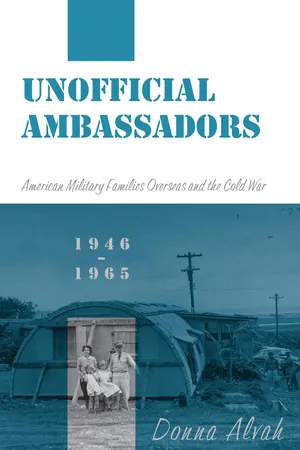
Unofficial Ambassadors
American Military Families Overseas and the Cold War, 1946-1965
- 291 pages
- English
- ePUB (mobile friendly)
- Available on iOS & Android
eBook - ePub
About this book
Information
1
Going Overseas
As World War II drew to a close first in Europe in May 1945, then in the Pacific in August, American women looked forward to the homecomings of husbands and fiancés. On the eve of the Allies’ official announcement of victory in Japan, Rosie McClain of Washington wrote to her husband Charles, a Navy man in the Pacific, that “The whole world is full of joy and expressing it in some way or another this evening. I know it’s the ending of great suffering and pain of war. Darling, I can’t celebrate remembering the one I know can’t come back [yet].… God willing, we will be together again. For all our lives, we can be together again.”1 The next day, Betty Maue of Pennsylvania wrote to her fiancé, Ario Pacelli, who was in Italy with the Army: “I pray you’re fine and that you have good news about coming home soon, too.”2
At the war’s end, Charles McClain, Ario Pacelli, and hundreds of thousands of other service personnel faced the possibility of many more months of overseas duty, far from family and home. In the United States, women complained of family separation and demanded the quick return of husbands and fiancés. “I sympathized with parents still waiting to see their sons, and with the wives and children longing to see their husbands and fathers again,” President Harry Truman recalled in his memoir, “[but] we had an obligation as a leading nation to build a firm foundation for the future peace of the world. The future of the country was as much at stake as it had been in the days of the war.”3
Although the armed forces demobilized millions of service personnel in the months following the war, the United States continued to maintain a substantial military strength abroad, especially in occupied Germany and Japan. But many servicemen stationed overseas after the war’s end were dispirited and preoccupied with going home. Some engaged in troublesome behavior that undermined military discipline and disrupted local communities. Days after Germany’s surrender, General Dwight Eisenhower privately expressed the certitude that the military would have to enable families to join personnel overseas. By late 1945, military officials who hoped to solve the problems of low morale and quell complaints from the home front about the hardships of family separation were making plans to send families to join servicemen at overseas bases wherever possible. Although the U.S. military allowed families to go overseas in 1946 chiefly to bolster servicemen’s morale, the military need to maintain a large overseas presence coincided with Americans’ social demands and cultural attitudes about the family. Thus, the establishment of American family life abroad in the early postwar era served military goals, as well as the needs of families and cultural ideals.
Postwar International Responsibilities
World War II, which had pulled in so many of the world’s nations, ended three months after the Allied victory in Europe. In August 1945, American bombers dropped atomic bombs in Japan, first in Hiroshima, then in Nagasaki. When the Allies declared victory in Japan on August 15, millions of Americans danced in the streets and anticipated the homecoming of military personnel.4 More than sixteen million Americans had served in the armed forces at some point between December 1941, when the United States officially entered the war after the bombing of Pearl Harbor, and late summer 1945, when Japan surrendered to the Allies.5 Seventy-three percent of service members had served overseas. Over 400,000 Americans died in the war; approximately 670,000 suffered nonmortal wounds.6
Other nations and peoples fared far worse. Combat, sieges, starvation, disease, aerial bombardments of civilian populations, and atrocities killed tens of millions of people. Thirty-five million soldiers and civilians died in Europe: approximately twenty million from the Soviet Union (one-sixth of its total population), 5.6 million Germans, three million Poles (not including Polish Jews), 1.6 million Yugoslavs, and 1.6 million other Europeans. The Nazis murdered nine million Jews, Russians, Poles, and others who were victims of their social and racial purity ideology. By May 1945, an estimated 40.5 million people, many of them Germans and Eastern Europeans, had been displaced by the war. Asian nations also suffered greatly. Chinese civilian and battle deaths numbered as many as fifteen million. The Japanese lost 2.7 million soldiers and noncombatants.7 When Emperor Hirohito asked the Japanese people to accept their nation’s surrender, nearly nine million were homeless and 6.5 million military personnel and civilians were stranded abroad in various locales.8 While the United States emerged from the world conflict a prosperous and powerful nation, unmarred by warfare within its borders, other nations faced years of repairing destroyed landscapes and economies.
Yet the end of the war did not release the United States from international conflict. Although the Soviet Union had proved a crucial ally whose enormous sacrifices helped secure victory, tensions between the U.S. and Soviet governments had undermined the wartime cooperation between the two nations. In February 1945, President Franklin Delano Roosevelt met in Yalta with Britain’s Prime Minister Winston Churchill, and Soviet leader Joseph Stalin, to discuss plans for the postwar world, including the structure of the United Nations, the occupation of Germany, and the matter of free elections in the Eastern European countries taken by the Soviets from the Germans. The question of democratic elections in Poland and other Eastern European nations, which Roosevelt and Churchill urged Stalin to allow, remained unresolved through the end of the war and became a raw nerve in international relations that contributed to the onset of the Cold War.9
Nor did the cessation of hostilities free the United States from international responsibilities. Since 1942, the United States had planned for the occupation of enemy nations.10 Upon achieving victory in Europe, the United States, Great Britain, France, and the Soviet Union divided Germany into occupation zones. At the Potsdam conference in July 1945, leaders of the four Allied powers discussed initial occupation goals: demilitarization, which included the removal of Germany’s industrial capacity to wage war; denazification, which entailed the eradication of Nazi ideology and the purging of Nazis and Nazi sympathizers from positions of authority; the establishment of democratic government; the trial of war criminals; and reparations to the occupying powers. Whereas the United States shared the occupation of Germany and Austria with its allies, it dominated the occupation of Japan, with nominal input from two international advisory boards. The demilitarization and democratization of Japan composed the core of occupation policy there.11 Early in the occupations American policymakers did not focus as much as they would later on the economic reconstruction of Germany and Japan. In the meantime, because these countries were not economically or materially self-sufficient, the United States imported food and other necessities to alleviate hunger and prevent disease.12
The United States took on other international responsibilities besides the occupations of the leading Axis powers. The U.S. and Soviet militaries also occupied Korea, which Japan had controlled for four decades. Soviet forces occupied northern Korea, while American armies occupied the south. The Allies intended the occupation to restore Korean government and rebuild the nation’s economy.13 U.S. military personnel also participated in the monumental task of sheltering and transporting millions of prisoners of war, displaced persons, refugees, and expellees in Europe and Asia.14
Americans who remained in the armed forces or were drafted after the war’s end worried about the prospect of several more months, perhaps even years, of staying overseas. In fact, no one could be sure exactly how long the occupations in Europe and Asia would last. At the Yalta meeting in February 1945, President Roosevelt said he believed that the American people would tolerate only a brief occupation of Germany, and estimated that public support for maintaining U.S. troops in Europe would last about two years after the defeat of Germany. Other occupation planners forecasted a longer stay in Germany, ranging from ten, fifteen, twenty-five, to even fifty years.15 In November 1945, a captain stationed in Germany wrote to Stars and Stripes to bemoan the lack of information about the length of the occupation: “We have nothing to look forward to except a continuance for an indefinite period of this daily, drudging and uninteresting existence. We are all becoming mentally troubled by the uncertainty.”16 This captain and other Americans serving abroad could not have known in late 1945 that the occupation of Germany would last several more years.17
As in the case of Germany, U.S. government and military leaders found it difficult to predict how long the occupation of Japan would last, or how many service personnel would be needed there. News reports on General Douglas MacArthur’s statements about reducing personnel in Japan in September 1945, and President Truman’s public and private reactions to MacArthur’s announcements, reveal the uncertainty of occupation planning so soon after the war. MacArthur, the Supreme Commander for the Allied Powers in Asia, announced to the press on September 17 that the occupation of Japan might require only 200,000 troops, rather than the 500,000 initially believed crucial.18 Truman later wrote in his memoir that MacArthur’s pronouncement, of which he first learned when questioned about it by reporters, caught him off guard. In his public response to MacArthur’s declaration, Truman assured Americans that there would be “no padding in our armed forces” and that personnel deemed unnecessary would be released “as fast as the services can get them out.” But the President also stated that “no one now can accurately forecast what our occupation needs are going to be,” and suggested that the size and composition of overseas forces would remain unsettled until the spring of 1946. Privately, MacArthur’s maverick declaration had upset Truman. The President considered it “embarrassing” as well as destabilizing of his administration’s attempt to balance demands for demobilization with military necessity. On September 18, Acting Secretary of State Dean Acheson tried to neutralize MacArthur’s announcement by stating that “[nobody] can see at this time the number of forces that will be necessary in Japan.”19
Families During and After the War
While government officials attempted to plan for occupation needs, estimate troop numbers, and carry out other international objectives, American families who had tired of the unpredictability of the war years were eager to establish a stable home life. Despite the domestic upheaval caused by the entry of millions (mostly men, but also women) into the armed forces between the fall of 1940, when President Roosevelt approved the Selective Service Act, and the end of the war, marriage and birth rates soared in this period. During the Great Depression of the previous decade, the marriage rate had fallen below that of the 1920s, the birth rate had declined, and the divorce rate had risen.20 In 1940, the year after the outbreak of World War II in Europe—which increased demand for American industrial production, and thus provided employment opportunities that had not existed during the depression—marriage rates began to rise dramatically. “Instead of deterring Americans from embarking on family life,” writes historian Elaine Tyler May, “the war may have sped up the process.”21 In 1941 and 1942, the number of marriages in the United States reached historic heights. The war also sparked the baby boom that continued into the early 1960s. The reinvigoration of American industry by war production, exemptions of married men and fathers from the draft, and the impending departure of servicemen to foreign stations fueled the historically unprecedented surge in marriage and birth rates.22
Although the war revitalized the creation of families, it also upset routine family life. In January 1942, the director of the Selective Service asked draft boards not to exempt married men without children from military duty. The next year, the Selective Service moved to induct fathers into the armed forces in order to meet predicted needs for personnel. Between October and December 1943, the percentage of fathers inducted into the services jumped from 6.8 to 26.5 percent; in April 1944, nearly fifty-three percent of draftees were fathers. As of June 1945, an estimated four million men in the armed forces were married.23
Wives employed a variety of strategies to cope with their husbands’ military duty. Some women accompanied their husbands to posts in the United States, making homes and finding jobs on or near military bases. Thelma Thurston Gorham reported that African-American couples in Fort Huachuca, Arizona lived in cramped quarters she described as “slum dwellings,” with no kitchens, where eleven soldiers and their spouses shared one shower and two sinks.24 Joining husbands on posts often proved impractical in the United States, and was impossible when the men departed for service in most foreign countries. Before 1941, the United States had established military sites (mostly naval bases) in Alaska, Hawaii, Cuba, Puerto Rico, the Virgin Islands, Guam, the Philippines, and Panama. During the war, the United States vastly bolstered its military presence around the globe, especially fortifying armed forces installations in Europe and the Pacific.25 Approximately three out of four military personnel served overseas during the war for an average period of sixteen months, many leaving spouses to manage households without them.26 The formation of so many new families during the war, employment opportunities in cities, and the War Production Board’s ban on nondefense construction precipitated a scarcity of affordable housing that prevented families from enjoying the domestic ideal of single-family dwellings. Some women and their children lived with relatives while husbands were away or shared houses with other families.27
The need to support themselves and their children placed many women in the role of primary breadwinner and financial manager for their families.28 Wives, children, and others classified as “dependents” of enlisted men were eligible to receive monetary allowances from the federal government, but these allowances did not cover all household expenses, especially in ind...
Table of contents
- Cover Page
- Title Page
- Copyright Page
- Dedication
- Contents
- Acknowledgments
- Introduction
- 1 Going Overseas
- 2 Unofficial Ambassadors
- 3 A U.S. Lady’s World
- 4 “Shoulder to Shoulder” with West Germans
- 5 “Dear Little Okinawa”
- 6 Young Ambassadors
- Conclusion
- Notes
- Bibliography
- Index
- About the Author
Trusted by 375,005 students
Access to over 1.5 million titles for a fair monthly price.
Study more efficiently using our study tools.
Frequently asked questions
Yes, you can cancel anytime from the Subscription tab in your account settings on the Perlego website. Your subscription will stay active until the end of your current billing period. Learn how to cancel your subscription
No, books cannot be downloaded as external files, such as PDFs, for use outside of Perlego. However, you can download books within the Perlego app for offline reading on mobile or tablet. Learn how to download books offline
Perlego offers two plans: Essential and Complete
- Essential is ideal for learners and professionals who enjoy exploring a wide range of subjects. Access the Essential Library with 800,000+ trusted titles and best-sellers across business, personal growth, and the humanities. Includes unlimited reading time and Standard Read Aloud voice.
- Complete: Perfect for advanced learners and researchers needing full, unrestricted access. Unlock 1.5M+ books across hundreds of subjects, including academic and specialized titles. The Complete Plan also includes advanced features like Premium Read Aloud and Research Assistant.
We are an online textbook subscription service, where you can get access to an entire online library for less than the price of a single book per month. With over 1.5 million books across 990+ topics, we’ve got you covered! Learn about our mission
Look out for the read-aloud symbol on your next book to see if you can listen to it. The read-aloud tool reads text aloud for you, highlighting the text as it is being read. You can pause it, speed it up and slow it down. Learn more about Read Aloud
Yes! You can use the Perlego app on both iOS and Android devices to read anytime, anywhere — even offline. Perfect for commutes or when you’re on the go.
Please note we cannot support devices running on iOS 13 and Android 7 or earlier. Learn more about using the app
Please note we cannot support devices running on iOS 13 and Android 7 or earlier. Learn more about using the app
Yes, you can access Unofficial Ambassadors by Donna Alvah in PDF and/or ePUB format, as well as other popular books in History & 20th Century History. We have over 1.5 million books available in our catalogue for you to explore.