- 238 pages
- English
- ePUB (mobile friendly)
- Available on iOS & Android
eBook - ePub
About this book
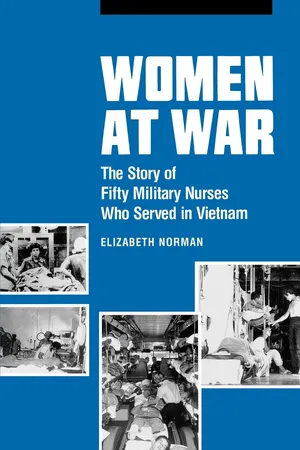
Norman tells the dramatic story of fifty women—members of the Army, Navy, and Air Force Nurse Corps—who went to war, working in military hospitals, aboard ships, and with air evacuation squadrons during the Vietnam War. Here, in a moving narrative, the women talk about why they went to war, the experiences they had while they were there, and how war affected them physically, emotionally, and spiritually.
Information
1
Volunteering for the Vietnam War
Why would a woman choose to go to war—especially the war in Vietnam? Men did not line up at the recruiting stations and women did not gather under the sign of the Red Cross. We remember men as draft resisters and women as draft counselors. And yet, as figures from the Department of Defense show, the great majority of those who served in Vietnam—men and women—volunteered.1 They did not shout about their choices. They went quietly. The fifty women in this book all volunteered for military service. Some joined the military to begin a career, some to get more training, some to pay for a nursing education. Thirty-four of the fifty volunteered to go to Vietnam. Only four of the others objected to being sent.
History and heredity made them go. Most nurses in the 1960s and early 1970s (the time of nurses’ involvement in the war) were white, working class and middle class Catholic and Protestant daughters whose fathers were veterans of World War II and whose grandfathers recalled the Great War. Some were inspired by heroes like the fictitious Cherry Ames, the young nurse who bravely served her country in World War II and whose exploits were told in a series of popular books published in the 1940s and 1950s.2 She was an inspiration, the female equivalent of John Wayne or Audie Murphy.
Going to war also was part of the adult American experience. There were war movies at Saturday matinees, large Memorial Day parades down Main Street, and a president who was a war hero. An army nurse who grew up in North Dakota remembered this patriotic atmosphere and had volunteered to go to Vietnam to show people, “A little town girl can serve her country and be a hero.”
There were strong feelings of loyalty to country among the nurses. They had a sense of pride and a sense of duty. These women knew they could not be drafted like their brothers and high school friends, but they felt an equal responsibility to serve. “How could I say, ‘Oh no, not me,’ when men my age were going?” recalled another army nurse, “I really felt, ‘How come not me?” The result of this enthusiasm was an excess of nurses volunteering for Vietnam duty. In 1965, for example, navy leaders planned to commission the first hospital ship for service in the waters off Vietnam. Twenty-nine nurses were to be part of the first crew. Navy administrators quickly had a list of 400 nurses who requested duty on the ship, out of a total of 1,874 active duty nurses in the entire navy.3
Early in their lives, young girls learned the responsibilities of caring for others. While boys were outdoors playing baseball, girls were indoors playing house. Girls learned to view themselves in relation to others, as mothers, sisters, and friends—not as individuals.
As they grew up, nursing became a logical career choice. The task of caring for others is the core of the profession. And the war was an opportunity to care for others who really needed it—men their own age who were far from home, orphaned children, and wounded civilians. This was the profession at its most basic. No big medical bureaucracy, no stringent rules, just an opportunity to fulfill the basic, traditional female roles; to care and to feel needed. One nurse summed up the thoughts of others when she said, “Politics had nothing to do with it. I was very naive. But, if our men were fighting and dying, someone ought to be there taking care of them. We had to be there as nurses.”
The antiwar movement, so prevalent on college campuses during the war, was missing from the hospital schools of nursing. During the 1960s, diploma schools—the term used to define hospital schools of nursing where the nurses received diplomas at the completion of three years of school—were the primary institutions for training nurses.4 A woman spent those three years living in a dormitory, usually on the hospital grounds, and working long shifts on the hospital wards. Her education involved classes in anatomy, nutrition, and other sciences, and hospital practice. At the end of the third year, she graduated and prepared to take the registered nurse licensing examination. It was a cloistered, carefully monitored world. There was little time for or interest in questioning government policy. Not one of the fifty nurses in this study mentioned trying to avoid duty in Vietnam because of moral or political motives.
Not every nurse, however, went to Vietnam because of patriotism or loyalty to others. Just as men have long done, some nurses realized the personal benefits of going to a war zone. Here were the reasons this group of nurses volunteered for wartime duty:
Protective parents were left behind—“My father tore up my application to the Peace Corps so I joined the navy,” said a woman who grew up in a strict Catholic household.
Another woman wanted to avoid a stifling future. “Everyone else in nursing school was going home to get married. I was not going to do that. I did not want to come home to Somerville, New Jersey, because I was afraid that in 35 years I would still be there.”
A former army nurse said wartime duty was a chance for an adventure—“On a whim, my friend and I put in our papers to go to Vietnam. That’s about all the thought I gave it!”
Going to Vietnam provided one nurse with a chance to travel to the exotic—“I always wanted to see the Orient and get out of Florida!”
Still another sensed work in an evacuation hospital would be a chance to test herself—“I wanted to see if I could do it. The patients on my ward who were recuperating from war wounds got my curiosity up. I also thought this is my generation’s war. There would not be another chance again.”
And for the career officer, the war was a chance to move up the military ladder—“I was due to go overseas for my next [military] tour and the best opportunity for promotion was in Vietnam.”
Regardless of the reason for volunteering, a few women gave deep thought into what the experience would really be like for them. It was a time in their lives when decisions were quick and consequences not pondered.
In 1956, the army instituted a Student Nurse Program to increase the number of nurses in uniform.5 This program paid for the final years of nursing education in return for service after graduation. Twenty of the fifty women interviewed were in this program. These nurses entered the military at age twenty or twenty-one and most planned to stay only long enough to pay off their debt. The army was a good beginning for a professional nursing career. A few realized they might receive orders for Vietnam, but for most of these women the war seemed an improbable place. Most volunteered to go, but some were very surprised when they opened the manila order envelope.
In an effort to offset their fears, a few women in this study used a “buddy system” to go to Vietnam. Five army and navy nurses said this system permitted two friends who volunteered for wartime duty to serve at the same medical facility in Vietnam. They thought the presence of a friend might help them adjust to the long and difficult working hours and to the world of bunkers, air raid sirens, jungle heat, and typhoons.
Four of the nurses interviewed who were in the student nurse program did not volunteer for duty in Vietnam and did not want to go. These nurses had assumed that their mandatory service would be in the United States, Germany, or Japan. Their reluctance to go to Vietnam was more the result of professional insecurity—one women graduated from college in June and landed in Vietnam in November—and a lack of interest in the military as a lifelong career than any moral or political objection to the war. In the end, all four nurses followed orders and reported to Vietnam.
Parents were used to sending their sons off to war but not their daughters. Fathers frequently shared a sense of duty and expressed pride at their girls’ decisions. At the same time, however, they worried about what would happen to their daughters’ morals. Many fathers had served in World War II. They held strongly to the stereotype that only women of low moral character went into the military.6
Most nurses did not need their parents’ permission to enter the military. They were at least twenty years old, considered adult and able to sign the necessary papers. Fathers worried about morality, but daughters wanted the military life and the war held sway. In the end one father, a career army officer, realizing the decision had been made, passed on an old military tradition to his daughter. “Do not,” he said, as she went out the door for basic training, “volunteer for anything.”
Mothers also could feel pride, but most nurses remember the tears and the upset that greeted their decisions. These mothers had guided their daughters through school and Girl Scouts and puberty. Their daughters had even chosen a good female profession. Going into the military and going to Vietnam did not fit the picture. There was too much that was unknown.
When the nurses volunteered for the war, the current feminist movement was just beginning. The concept of the “dependent daughter” who relied on her parents for emotional support and guidance was the norm.7 Parents were protective. The thought of their daughter going to a war zone was both unnerving and frightening. There were no guidelines, no rules, and no precedents for parents to follow. Once she was in Vietnam, there was no way to protect her from danger, strain, loneliness, and men. One nurse summed up a typical parental reaction: “My parents were very upset and they said they did not understand me. My older brother had not even been to Vietnam. And here I was, their only daughter, going off to war.”
Military leaders did not prepare nurses for Vietnam with the same rigor as for the men. Formal professional training took place in nursing school or at civilian and military hospitals. The amount of professional experience the nurses had before going to Vietnam varied greatly—from those with less than six months of work as a nurse to women with fifteen or twenty years of work experience in operating rooms, emergency rooms, and hospital units. Generally, the more professional nursing experience prior to Vietnam, the more confident the nurse.
Most older, experienced nurses were operating room nurses who were in great demand during the Tet Offensive of 1968. One woman, an experienced circulating and scrub nurse in the operating room, received twenty-four hours’ notice in February 1968 to report for duty in Vietnam. She received her orders on Friday and on Saturday was on an airplane heading for Da Nang, South Vietnam. There was little time to train nurses in the complex procedures used in operating rooms filled with traumatic war injuries from large scale military offensives. Experienced nurses relied on years of work in civilian and military hospitals to meet the demands of twenty-hour days around operating tables.
Nine women in this study had more than five years of professional experience when they went to Vietnam. They brought to the war a varied background particularly suited for wartime work. Two of them were veterans of the Korean War. When asked if there were differences between the Korean and Vietnam wars, one nurse said, “In Vietnam, there was no front, the war was all around us. We were always in danger of attack. And the casualties were worse. The helicopters would bring in severely wounded boys who would have died on the battlefield in another war. And the nurses took so much of it to heart.” Experience and maturity helped this group of nurses face the timeless as well as the unique aspects of Vietnam.
Another nurse had spent three years on the Project Hope hospital ship caring for people in South America and West Africa. The poverty and foreign culture in Saigon was not a shock to her. Rather, working in the Vietnam War as an air force flight nurse presented the challenge she wanted after her Third World experience.
Personal backgrounds helped prepare some young women for Vietnam service. The nurses who grew up on farms in the Midwest and in Pennsylvania were used to living without amenities. Sharing quarters in Quonset huts or tents or simple buildings on a military compound recalled the camping or farmhouse rooms of their rural childhood. Similarly, those women who grew up in military families and moved around the world as children felt they had the flexibility to adjust to the very different living situations in Vietnam.
One young woman was more prepared than others for the tragedy she would see in the war. She followed her military orders knowing there was more than adventure and professional challenge in wartime work. Her husband had died in combat two months before she left to serve in an army evacuation hospital. His death did not make her afraid to go to Vietnam. It sobered her. She knew this was a place where, she said, “one could get killed.”
Formal preparation varied between the services. The army offered an eight to ten week preparation course at Fort Sam Houston in Texas. The navy had no specific training program but required nurses to serve at least one two-year tour before going overseas. This minimum requirement insured that all nurses would have some professional experience and skills before working on the hospital ships or at naval hospitals in Vietnam. Air force nurses attended a standard two-month flight school where they received in-flight training. The first weeks in Vietnam were spent with an instructor who supervised them as they worked in different types of aircraft and prepared patients for evacuation flights.8
Endurance training or information about the health beliefs and practi...
Table of contents
- Cover
- Half title
- Title
- Copyright
- Dedication
- Contents
- Acknowledgments
- Introduction
- 1 Volunteering for the Vietnam War
- 2 Arriving in Vietnam
- 3 The Professional Strains and Moral Dilemmas of Nursing in Vietnam
- 4 The Rewards of Wartime Nursing in Vietnam
- 5 Personal Experiences in Vietnam
- 6 The Status of Female Military Nurses in Vietnam
- 7 Different Experiences in the Army, Navy, and Air Force Nurse Corps
- 8 Factors Associated with the Year the Nurse Served in Vietnam
- 9 Leaving Vietnam
- 10 Homecoming
- 11 The Years Since the War
- 12 Coming to Terms with the War: Post-Traumatic Stress Disorder
- 13 Lessons Learned from the War
- 14 Conclusions
- Appendix: Information on the Fifty Military Nurses
- Notes
- References
- Index
Trusted by 375,005 students
Access to over 1.5 million titles for a fair monthly price.
Study more efficiently using our study tools.
Frequently asked questions
Yes, you can cancel anytime from the Subscription tab in your account settings on the Perlego website. Your subscription will stay active until the end of your current billing period. Learn how to cancel your subscription
No, books cannot be downloaded as external files, such as PDFs, for use outside of Perlego. However, you can download books within the Perlego app for offline reading on mobile or tablet. Learn how to download books offline
Perlego offers two plans: Essential and Complete
- Essential is ideal for learners and professionals who enjoy exploring a wide range of subjects. Access the Essential Library with 800,000+ trusted titles and best-sellers across business, personal growth, and the humanities. Includes unlimited reading time and Standard Read Aloud voice.
- Complete: Perfect for advanced learners and researchers needing full, unrestricted access. Unlock 1.5M+ books across hundreds of subjects, including academic and specialized titles. The Complete Plan also includes advanced features like Premium Read Aloud and Research Assistant.
We are an online textbook subscription service, where you can get access to an entire online library for less than the price of a single book per month. With over 1.5 million books across 990+ topics, we’ve got you covered! Learn about our mission
Look out for the read-aloud symbol on your next book to see if you can listen to it. The read-aloud tool reads text aloud for you, highlighting the text as it is being read. You can pause it, speed it up and slow it down. Learn more about Read Aloud
Yes! You can use the Perlego app on both iOS and Android devices to read anytime, anywhere — even offline. Perfect for commutes or when you’re on the go.
Please note we cannot support devices running on iOS 13 and Android 7 or earlier. Learn more about using the app
Please note we cannot support devices running on iOS 13 and Android 7 or earlier. Learn more about using the app
Yes, you can access Women at War by Elizabeth Norman in PDF and/or ePUB format, as well as other popular books in Medicine & Nursing. We have over 1.5 million books available in our catalogue for you to explore.