Millions of laborers, from the Philippines to the Caribbean, performed the work of the United States empire. Forging a global economy connecting the tropics to the industrial center, workers harvested sugar, cleaned hotel rooms, provided sexual favors, and filled military ranks. Placing working men and women at the center of the long history of the U.S. empire, these essays offer new stories of empire that intersect with the “grand narratives” of diplomatic affairs at the national and international levels. Missile defense, Cold War showdowns, development politics, military combat, tourism, and banana economics share something in common—they all have labor histories.
This collection challenges historians to consider the labor that formed, worked, confronted, and rendered the U.S. empire visible. The U.S. empire is a project of global labor mobilization, coercive management, military presence, and forced cultural encounter. Together, the essays in this volume recognize the United States as a global imperial player whose systems of labor mobilization and migration stretched from Central America to West Africa to the United States itself.
Workers are also the key actors in this volume. Their stories are multi-vocal, as workers sometimes defied the U.S. empire’s rhetoric of civilization, peace, and stability and at other times navigated its networks or benefited from its profits. Their experiences reveal the gulf between the American ‘denial of empire’ and the lived practice of management, resource exploitation, and military exigency. When historians place labor and working people at the center, empire appears as a central dynamic of U.S. history.
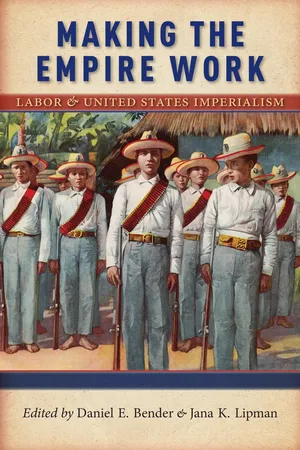
eBook - ePub
Making the Empire Work
Labor and United States Imperialism
- 384 pages
- English
- ePUB (mobile friendly)
- Available on iOS & Android
eBook - ePub
Making the Empire Work
Labor and United States Imperialism
About this book
Information
Part I
Solidarities and Resistance
1
The Wages of Empire
Capitalism, Expansionism, and Working-Class Formation
Julie Greene
In 1963, Edward Thompson focused our attention on the ways the working class made itself, framing class formation as an active and dynamic process; in 1973, Herbert Gutman demonstrated that the U.S. working class in effect made and remade itself as waves of immigrants, possessing a variety of cultural traditions and workplace strategies, entered the country between 1815 and 1919.1 Then, in 1990, David Roediger broadened our understanding by exploring how the crucible of whiteness made class formation possible. Building upon the writings of W.E.B. Du Bois, Roediger coined the phrase “wages of whiteness” to denote the psychological and emotional benefits some workers received from their whiteness, which compensated for the class oppression they experienced.2
This essay builds upon the insights of those and other scholars, asking how thinking more globally—and looking in particular at U.S. expansionism in the decades after the Civil War—might illuminate working-class history. To do so, we return as Roediger did to W.E.B. Du Bois. Du Bois’s masterful Black Reconstruction in America, 1860–1880 explored white racial identity, yet at its heart the book is concerned with global historical currents and particularly with the workings of imperialism. The end of the U.S. Civil War initiated a new engine of economic, political, and military expansionism. The result, as Du Bois saw it, was an emergent global slavery in which workers, especially those who were nonwhite, were enmeshed in serving the U.S. empire. Du Bois proclaimed: “Out of the exploitation of the dark proletariat comes the Surplus Value filched from human beasts which, in cultural lands, the Machine and harnessed Power veil and conceal.” The burst of imperialism that characterized the late nineteenth and early twentieth centuries, built as it was upon an aggressively expansionist industrial capitalism, had combined the problems of labor and race into one. Building upon Du Bois’s insights regarding imperialism, we might employ the concept of the “wages of empire” to reassess labor and working-class history in the decades from 1865 to 1920, thereby shifting our understanding of class formation to consider flows and dynamics that stretch beyond the territorial limits of the United States.3 My contention is that the U.S. imperial project always and everywhere involved the recruitment, managing, and disciplining of labor, and that historians of both U.S. labor and its empire might fruitfully focus more attention on those connections.
Imperial processes created new systems of mobility and ideology, they ingeniously organized labor in order to extract value and profit efficiently, and they generated hierarchies of difference as a way of organizing labor. In all their manifestations, imperial processes placed the control and regulation of labor at the very heart of the enterprise. Thus empire constituted a force that articulated and shaped class experience and formation as much as did, say, race or gender. To paraphrase Stuart Hall, empire served as a modality through which class was lived, experienced, organized, and struggled through. These processes shaped metropolitan workers as well as working men and women on the various sites of empire.4 Furthermore, while it is undeniable that imperial processes profoundly shaped racial identities, generating new racial hierarchies and racializations, their complex impact should not be reduced purely to race. New kinds of circulation and exchange, new patterns of demographic mobility, new notions of a people’s relationship to the world, new strategies of occupation and conquest, and more, changed the worlds of working men and women. A key effect of this hypermobile circulatory system was to make the very composition of the working classes much more fluid and quick to change, and to make racial and gender relations themselves more fluid and changeable. Speedy and continuous transformation is itself central to the period and to workers’ experiences during it. Furthermore, to speak of empire’s impact as consisting only in generating a racial consciousness that united white workers is to render invisible the many workers of color who toiled for U.S. empire.
Globalizing our understanding of U.S. labor and working-class history requires attention to the varied sites of empire and the gradated forms of sovereignty that emerged as the power of the U.S. spread halfway around the world, and most of the essays in this volume focus on those topics. It also necessitates exploration of empire’s impact on metropolitan workers and the society and politics of the metropole, and this essay focuses on that. It addresses four problems involved in the history of U.S. labor and empire: conceptualizing the links between expansionist capitalism and imperialism; continuities and ruptures in our periodization of U.S. empire; the role of white and African American U.S. soldiers who labored to build the infrastructure of capitalism, accumulate territory and resources, and occupy, colonialize, and kill; and finally, the impact of empire on metropolitan politics and notions of national identity.
Linkages of Imperialism and Capitalism
The United States in the late nineteenth and early twentieth centuries was a powerhouse of two processes tightly connected by a rapidly transforming capitalist economy: expansionism and industrialization. Its success in both endeavors was spectacular. United States capitalism was extremely innovative, relying heavily on technological advances, new labor management strategies and forms of discipline and, hugely important, its invention of the modern corporation. The U.S. was especially skilled, as Perry Anderson has written, at “disembedding the market as far as possible from ties of custom, tradition, or solidarity, whose very abstraction from them later proved . . . exportable and reproducible across the world, in a way that no other competitor could quite match.”5 The corporation as a legal personality emerged and blossomed earlier and more fully in the U.S. than anywhere else, and this occurred amid a concentration of capital unlike anything the world had seen. New technologies and new forms of labor discipline made capital accumulation highly efficient and this was in turn supported by rapid expansionism across the continent and then, increasingly, outward to international markets. In 1901, the British journalist Frederick Mackenzie wrote in The American Invaders that U.S. corporations now dominated in almost every new industry created within the previous 15 years. Thus well before the War of 1898 allowed the U.S.—having acquired an empire that stretched halfway around the world—to achieve new status as one of the “Great Powers,” U.S. corporations had been aggressively expanding internationally.6
This great strength of corporate, industrial capitalism gave U.S. empire building after 1898 a special flavor. An imperial ideology developed that cloaked the aggressive expansionism of the U.S. government and corporations in notions of technological and industrial know-how. With its victory over Spain, the U.S. thus benefitted from its economic power and domination of global markets to forge a complex and varied empire that continued to rely upon economic strategies and agro-industrial strength while adding formal colonialism, unincorporated territories, protectorates, repeated military interventions and occupations, and a strenuous insistence on “Open Door” market relations (though we note that the Open Door shut firmly when it came to many countries’ desire to enter U.S. markets). This required transforming, recalibrating, and rearticulating the role of the federal government and its laws in order to protect the property rights of U.S. corporations overseas and ensure efficient capital accumulation. United States rule became especially creative at gradated forms of sovereignty and disfranchisement in diverse sites like Samoa, Guam, Hawai‘i, Cuba, and Puerto Rico. Meanwhile, even as corporations continued to plumb the largest domestic market in the world, they pushed into Mexico, Central America, the Caribbean, and Asia.7
In short, U.S. imperialism and capitalism were profoundly intertwined, mutually supportive, and to some degree mutually constitutive. One could go back to Rosa Luxemburg or Vladimir Ilyich Lenin to track the evolving debates about the links between empire and capitalism. It is an old and continuing saw in Marxist theories of capitalism.8 However, earlier ideas about imperialism as the final stage of capitalism, or not, have been superseded by a focus on the ways the two make one another possible. Fernando Coronil articulates it this way: “Just as imperialism makes evident the political dimension of capitalism, capitalism makes visible the economic dimension of imperialism, revealing ‘states’ and ‘markets’ as dual facets of a unitary process.”9 Nonetheless, because states and corporations do not possess identical interests, the goals of the U.S. government often diverged from those of U.S. corporations. This requires nimble disentangling of the diverse strategies and tactics deployed by state and corporate actors. As bureaucrats and politicians like William Howard Taft or Charles Magoon circulated through their new empire, from the Philippines to Cuba to Panama, they worked not only to support the activities of U.S. corporations but also to generate and stabilize new forms of government and degrees of sovereignty that would benefit the American state.
Our understanding of U.S. empire at the turn of the twentieth century, in short, builds upon the work done over the last several decades by economic, labor, and business historians on the key dynamics and character of U.S. capitalism. Recent suggestions by journalists and some historians that the study of capitalism is a new phenomenon ignore the fact that generations of scholars have toiled to illuminate precisely these matters.10 Not the least of those scholars was Du Bois, for whom the interwoven character of imperialism and capitalism stood as a defining hallmark of the decades that followed the Civil War. The end of Reconstruction generated a new era in which labor exploitation and racism combined in the interest of capital and empire. Taking Du Bois’s observations to heart, we need not focus on defining what is or is not the American “empire,” but rather see U.S. economic, cultural, military, and colonial forms of domination as reciprocal. Much of the power of the U.S., indeed, came from the multifaceted character of its expansionist project. Ann Laura Stoler has argued for perceiving imperial processes as “macropolities whose technologies of rule thrive on the production of exceptions and their uneven and changing proliferation. Critical features of imperial formations include harboring and building on territorial ambiguity, redefining legal categories of belonging and quasi-membership, and shifting the geographic and demographic zones of partially suspended rights.”11 Focusing on the interconnections between empire building and capitalism clarifies the central role played by working people in the dreams of both state and corporate actors. The working man or woman was the instrument that made capital accumulation possible; recruiting, managing, and disciplining their bodies was the necessary goal of expansionists, regardless of whether this involved indigenous or imported labor. In this sense, the Slavic immigrants employed in factories, or the Chinese immigrants living in snow caves as they struggled to lay tracks across the Sierra Nevada, are just as relevant to our story as the labor of Jamaicans or Italians building the Panama Canal, or Filipinos building the infrastructure required by U.S. military officials on their islands. The railroads built by Chinese and Irish workers, for example, were needed not only to expand the marketing and distribution of domestic commodities. That infrastructure was itself central to the project of United States transcontinental expansionism.12
Continuities and Ruptures from Indian Wars to Overseas Expansion
Interrogating the role of expansionism in the remaking of the working class requires rethinking the relationship between the Indian wars of the postbellum period and the overseas expansionism of 1898 and beyond. This is crucial given the intertwined and reciprocal character of imperialism and capitalism. The notion that the War of 1898 marked a complete rupture with previous U.S. history has been surprisingly persistent, and corresponds to the old idea that expansionism across the North American continent was somehow foreordained, “Manifest Destiny.” This in turn relies upon archaic notions that Native American peoples do not deserve the status of foreign nations and so conquest of their territory somehow does not constitute imperialism. Walter Williams noted this as long ago as 1980 in “United States Indian Policy and the Debate over Philippine Annexation,” in which he pointed out also that imperialists like Theodore Roosevelt never failed to recognize the continuities between conquest of Native Americans in the nineteenth century and Filipinos in the early twentieth. Indeed, Roosevelt’s rhetorical campaign explicitly conflated the two, referring to the latter as “Apaches” or “Sioux.” Despite Williams’s influential article, and more recent, promising work by scholars like Brian DeLay and Pekka Hämäläinen, fully integrating continental expansionism and wars against indigenous peoples into our understanding of U.S. empire building remains a challenge. The final stages of those wars intersected with and shaped U.S. imperial ambitions across the Caribbean and Pacific Ocean. The physical and rhetorical labors involved in warfare against Plains Indians from 1866 to 1890—building and staffing of army forts, military campaigns, pacification, cr...
Table of contents
- Cover
- Title Page
- Copyright Page
- Contents
- Acknowledgments
- Introduction: Through the Looking Glass: U.S. Empire through the Lens of Labor History
- Part I. Solidarities and Resistance
- Part II. Intimacies in Colonial Spaces
- Part III. Migration and Mobilizing Labor for the Empire
- Part IV. Imperial Labor and Control in the Tropics
- About the Contributors
- Index
Trusted by 375,005 students
Access to over 1.5 million titles for a fair monthly price.
Study more efficiently using our study tools.
Frequently asked questions
Yes, you can cancel anytime from the Subscription tab in your account settings on the Perlego website. Your subscription will stay active until the end of your current billing period. Learn how to cancel your subscription
No, books cannot be downloaded as external files, such as PDFs, for use outside of Perlego. However, you can download books within the Perlego app for offline reading on mobile or tablet. Learn how to download books offline
Perlego offers two plans: Essential and Complete
- Essential is ideal for learners and professionals who enjoy exploring a wide range of subjects. Access the Essential Library with 800,000+ trusted titles and best-sellers across business, personal growth, and the humanities. Includes unlimited reading time and Standard Read Aloud voice.
- Complete: Perfect for advanced learners and researchers needing full, unrestricted access. Unlock 1.5M+ books across hundreds of subjects, including academic and specialized titles. The Complete Plan also includes advanced features like Premium Read Aloud and Research Assistant.
We are an online textbook subscription service, where you can get access to an entire online library for less than the price of a single book per month. With over 1.5 million books across 990+ topics, we’ve got you covered! Learn about our mission
Look out for the read-aloud symbol on your next book to see if you can listen to it. The read-aloud tool reads text aloud for you, highlighting the text as it is being read. You can pause it, speed it up and slow it down. Learn more about Read Aloud
Yes! You can use the Perlego app on both iOS and Android devices to read anytime, anywhere — even offline. Perfect for commutes or when you’re on the go.
Please note we cannot support devices running on iOS 13 and Android 7 or earlier. Learn more about using the app
Please note we cannot support devices running on iOS 13 and Android 7 or earlier. Learn more about using the app
Yes, you can access Making the Empire Work by Daniel E. Bender,Jana K. Lipman, Daniel E. Bender, Jana K. Lipman in PDF and/or ePUB format, as well as other popular books in Politics & International Relations & Labour & Employment Law. We have over 1.5 million books available in our catalogue for you to explore.