A Critical Introduction to Religion in
the Americas argues
that we cannot understand religion in the Americas without understanding its
marginalized communities. Despite frequently voiced doubts among religious
studies scholars, it makes the case that theology, and particularly liberation
theology, is still useful, but it must be reframed to attend to the ways in
which religion is actually experienced on the ground. That is, a liberation
theology that assumes a need to work on behalf of the poor can seem out of
touch with a population experiencing huge Pentecostal and Charismatic growth,
where the focus is not on inequality or social action but on individual
relationships with the divine.
By
drawing on a combination of historical and ethnographic sources, this volume provides
a basic introduction to the study of religion and theology in the Latino/a,
Black, and Latin American contexts, and then shows how theology can be reframed
to better speak to the concerns of both religious studies and the real people
the theologians' work is meant to represent. Informed by
the dialogue partners explored throughout the text, this volume presents a
hemispheric approach to discussing lived religious movements. While not
dismissive of liberation theologies, this approach is critical of their past
and offers challenges to their future as well as suggestions for preventing
their untimely demise. It is clear that the liberation theologies of tomorrow
cannot look like the liberation theologies of today.
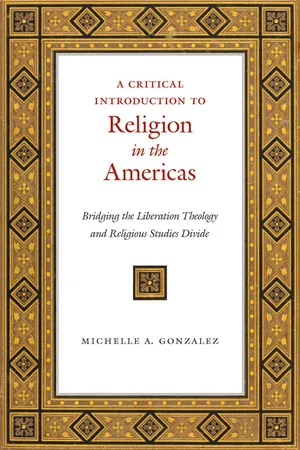
eBook - ePub
A Critical Introduction to Religion in the Americas
Bridging the Liberation Theology and Religious Studies Divide
- 208 pages
- English
- ePUB (mobile friendly)
- Available on iOS & Android
eBook - ePub
A Critical Introduction to Religion in the Americas
Bridging the Liberation Theology and Religious Studies Divide
About this book
Information
Topic
Theology & ReligionSubtopic
Christian Theology1
Latin American Liberation Theology
Latin American liberation theology, born in the late 1960s, argues that nonpersons, the poor and oppressed, must be the starting point and center of theological reflection. A theology that does not begin with the faith, life, and struggles of those from the underside of history is not a true Christian theology.1 Latin American liberation theology functions on three levels: the popular, the pastoral, and the academic.2 The first two give life to academic reflection: the spirituality and political praxis of grassroots Christian communities informs theoretical theological reflection. Grounded in the belief that economic and social justice are the center of Christianity’s mission, this Latin American theological movement has created a radical new ecclesial reality that centers on grassroots Christian communities and an innovative vision of the theological task. The Roman Catholic emphasis on the preferential option for the poor speaks to the global, institutional impact of this movement. However, in spite of the many publications, the pastoral life, and the pedagogy that center on this theology, rumblings have grown in the halls of the academy regarding the “death” and “failure” of liberation theology, even to the point of discussing postliberation theologies.
Academic liberation theology, admittedly, has become increasingly detached from the everyday lives of ecclesial Christians. In addition, the explosion of Pentecostalism in Central and South America and the Caribbean offers an alternative ecclesial model contrary to the Church of the poor celebrated by liberation theologians, which emphasizes political and social engagement. Nonetheless, the notion that the era of liberation theology is past and its effectiveness undermined is untrue. Such critiques emerge from a detached academy that is disconnected from the lives of grassroots communities within the Latin American Church. Proclamations of the death of liberation theologies in general are unfortunate as they lead to a disregard for oppressed peoples and to their increasing marginalization in the contemporary context. Just because for some observers Latin American liberation theology has “failed” to transform the nature of the theological task—although it has in fact radically transformed theological discourse—does not mean that we can forget the concrete lives and struggles of those who are at the center of this theological movement.
Ecclesial and Academic Roots
Before discussing the intellectual and social movements that fed the birth of Latin American liberation theology, it is important to contextualize it within the ecclesial milieu of Latin America. Our focus here is the contemporary era, Christianity in the twentieth and twenty-first centuries, with an emphasis on Christian movements that heavily involve the laity within Catholic circles and on the growth of Protestantism throughout the continent. Three elements that characterize Latin American Christianity frame the discussion: Catholic lay movements, base Christian communities, and the growth of movimientos evangélicos both in Roman Catholic and in Protestant circles.3 These movements reflect a grassroots approach to Latin American Christianity that emphasizes the everyday religion of Latin American Christians. Moreover, these three elements form bridge movements between institutional and what is often described as popular Catholicism. Popular Catholicism refers to the religious practices of the masses that are often, but not always, in tension with the institutional Roman Catholic Church. Local devotions to the saints and Mary, religious processions, and domestic religion are examples of popular Catholicism. Popular Catholicism is a subset within the category of popular religion.
Twenty-first century Christianity in Latin America inherited a legacy of colonial Catholicism that was linked to the oppressive regime of the Spanish empire and its conquest of the Americas. As a result of this history, once Latin American countries gained independence from Spain, the Church was faced with liberal governments that promoted staunch anticlericalism, and it was forced to align itself with conservative factions in the nineteenth and early twentieth centuries. Also of note is the historical lack of indigenous clergy within Latin American countries, where priests and women religious were predominantly foreign born. In addition, a shortage of priests throughout Latin America led to a population that was well schooled in popular Catholicism and religiosity yet was not thoroughly instructed in dogmatic theological teachings. A distinctive Latin American Catholicism emerged, composed of a mixture of indigenous and African religions with Catholic elements; the growth of this kind of Catholicism was due, in part, to the lack of a strong clerical presence. The nature of the Catholic Church’s presence as a dominant religious and political force, coupled with the absence of the ecclesial Church in the daily lives of many Latin Americans, also left fertile ground for the growth of Protestantism and the survival of indigenous and African religions.
Roman Catholic lay movements were born in Latin America in the early twentieth century. Their purpose was threefold: defense of Catholicism in the face of anti-Catholic governments, encouragement of Catholic culture, and promotion of social justice. Movements such as Catholic Action emerged from an apologetic Catholicism with an eye toward promoting Catholic social teachings. Catholic Action sought to promote lay leadership in the Church globally and was very active in Latin America. The intention was for lay people to influence the secular realm with Catholic values. Catholic Action utilized a “see-judge-act” methodology that encouraged adherents to describe the world around them, to assess that world in light of Catholic principles, and to respond with concrete action. Catholic Action was an essential dimension of twentieth-century Latin American Catholicism.
Another significant lay movement was the Cursillos de Cristiandad. The Cursillos began as exclusively male gatherings in order to encourage lay men to become more active in the Church. However, after much petitioning women were allowed to participate. Cursillos are gatherings of thirty to forty lay people, directed by a layperson and with a priest serving as spiritual advisor. They usually take the form of a three-day retreat that combines music, silence, and reflection. Underlying the cursillo movement was a desire to train a new lay leadership within local churches.
Base Christian Communities (BCCs) were yet another means of promoting such leadership. Perhaps no other dimension of the Latin American Church in the twentieth century is more well-known than these communities. The birth of BCCs may be traced to 1963, when North American priest Leo Mahon led a group of priests from Chicago to Panama City to run an adult ministry program. This became a focal point for BCCs, and hundreds of clergy, women religious, and laity came to explore and model this community effort. The “base” of Base Christian Communities refers to both the socioeconomic and internal structure of BCCs.4 BCCs are also referred to as CEBs (comunidades eclesiales de base). They are small religious groups typically consisting of friends and neighbors; most often they were initiated by members of the institutional Church (priests, lay leaders). BCCs combine religiosity, such as bible study and prayer, with community activism. Although many understand these communities as geared entirely toward leftist political activism, their theological and political bent varies significantly.5 They also vary dramatically in parish structure and the priest with which they coexist.
The key point is that BCCs are not distinct from the institutional Church but instead are a natural development within it that centers on lay participation and leadership.6 Part of the appeal and success of BCCs is that, because of their small size, these communities have a strong spirit of communitarianism and lack institutionalization. Institutionalization, in fact, would lead to the death of the communitarian spirit. “Church” is not limited to the institutionalized mass but occurs when a community gathers in discipleship to celebrate Jesus Christ. BCCs constitute the Church despite the absence of clergy and the Eucharistic within them. As theologian Leonardo Boff emphasizes, the historical weakness of the institutional church contributed in part to the establishment of BCCs. “It is not that this absence is not felt, is not painful. It is, rather, that these ministers do not exist in sufficient numbers. The historical situation does not cause the church to disappear. The church abides in the people of God as they continue to come together, convoked by the word and discipleship of Jesus Christ.”7 BCCs, however, are not in conflict or competition with the institutional church. The communitarian aspect of BCCs is instead a source of institutional renewal. The two, communitarian and institutional, must coexist together. Ultimately, liberation theologians argue, BCCs represent the true Church of the poor. “Thus, we are no longer speaking of the Church for the poor but rather a Church of and with the poor.”8 The grassroots nature of BCCs as the church of the masses reveals them as being constituted by and in solidarity with poor Latin Americans.
The contributions of BCCs are significant, albeit at times saturated with a romanticism and idealization that perhaps led to the downfall of the idea of BCCs in academic circles This idealization is seen both in the description of the base communities themselves and in the exaggeration of their numbers. Also, not all scholarship on BCCs paints the extensive and favorable picture given by most liberation theologians. Although early liberation theologians depicted BCCs in a utopian manner, social scientists have painted a different picture, recognizing that many BCCs had their origins in the institutional church and were sanctioned and encouraged by ecclesial leaders.9 In other words, BCCs were much more intimately linked to the institutional church than many liberation theologians implied. The widespread nature of BCCs has been contested, with some studies stating that both liberation theology and BCCs affected less than 5 percent of the Catholic population in Latin America. Their presence, success, and/or failure must be studied at the regional level, for their influence varies significantly depending on country and region.10 One movement, however, that is gaining widespread support throughout Latin America—and among Latino/as in the United States—is the evangélico movement.
Perhaps no other religious movement within Latin America has received more recent attention by academics than the growth of Pentecostal churches. Pentecostalism should be framed in light of the broader spread of evangelical Christianity throughout the region. Recent figures estimate that at least one in ten Latin Americans are evangelical, with 70–80 percent Pentecostal. In some countries the figures are even higher. The indigenous nature of Pentecostalism, with its Latin American pastors and leadership, is its greatest resource. In other words, unlike Catholicism, in which the clergy is often foreign born, Pentecostalism and other Protestant evangélico movements draw their leadership from the local population. Pentecostalism, neo-Pentecostalism, and Charismatic Catholicism, a movement within the Roman Catholic Church that shares many similarities with Pentecostalism, exploded globally in the second half of the twentieth century. The term evangélico is used in Latin America to loosely categorize all Protestants, although it is often used by scholars to describe the more theologically and socially conservative branches of Protestantism. Pentecostalism in Latin America often has a twofold structure: churches that have emerged with denominational ties to North American churches or indigenous churches that exist as independent entities.
Characteristics of evangélico belief include the authority of Scripture, the experience of personal salvation through Jesus Christ, and the importance of the missionary enterprise.11 It is too simplistic to assume that the growth of evangelicalism in Latin America is due to North American evangelization efforts and money. This assumption also downplays the religious ownership of evangelicalism by the poor. Most important, as previously suggested, the opportunities for native pastoral leadership became one of evangelical Protestantism’s greatest appeals. Unlike Catholic clergy, evangelical pastors are not required to pursue higher education, and thus ecclesial leadership much more accessible to the poor in Protestant denominations. Also, there are more possibilities at the local level because of the variety and number of evangelical churches. If one has a dispute with a pastor, one can go to or even start a new church.
Pentecostalism has emerged as an unlikely source of empowerment for women. This development is due in part to the manner in which Pentecostalism reconfigures the line between public and private life; it encourages men to become more active in the domestic sphere than they usually are. In contrast, liberationist Catholicism has tended to emphasize the public and the structural at the expense of oppressive paradigms within the domestic sphere.12 Evangelical movements within Christianity build on the importance of the personal and the domestic for religious life. One of Pentecostalism’s greatest appeals has been the manner in which it directly addresses the everyday struggles of families and communities especially in regard to social issues such as alcoholism and gambling.
Often when one thinks of movimientos evangélicos in Latin America, the assumption is that these movements are exclusively Protestant. However, the Catholic Charismatic Renewal movement (CCR) is the evangelical face of Catholicism. The CCR is the fastest growing movement in Latin American Catholicism; and Latin America is the region with the greatest increase in the CCR globally.13 The CCR was born in 1966 at Duquesne University in Pittsburgh. The movement spread to Latin America in the 1970s. CCR’s first members were predominantly middle class and included a large number of women. Three trends shaped the movement during the 1980s: growth among the popular classes, episcopal approval, and its primacy as a tool of evangelization. In the 1990s CCR became institutionalized. CCR not only is one of the largest and fastest growing movements in the Latin American Church but also is thriving in other parts of the global South. It has enormous appeal among the laity and has the approval of national episcopacies. Nevertheless, the movement has received scant academic attention, in part because of scholars’ heavy emphasis on liberation theology and BCCs. One of the factors that distinguishes the CCR is its missionary appeal and its use of media. Although ecclesial leaders were at first hesitant about accepting this strong lay movement, its heavy emphasis on ecclesial submission quickly earned the episcopacy’s approval.
Another feature that marks Charismatic Catholicism is its similarity to Pentecostalism, as seen in the shared emphasis on the Holy Spirit. “That both U.S. and Latin American Charismatics initially called themselves Pentecostal Catholics is revealing. Catholic Charismatics share the same ecstatic spirituality with Protestant Pentecostals. Like Pentecostals, Catholic Charismatics are pneumocentrists; that is, the Holy Spirit occupies center stage in believers’ religious practice.”14 This emphasis on the Holy Spirit distinguishes Charismatics from other Catholic groups. A belief in the gifts of the Spirit, such as faith healing and glossolalia; a certain degree of biblical fundamentalism; and asceticism are some of the characteristics Charismatics share with Pentecostals. Devotion to Mary and acquiescence to the Vatican, however, are distinguishing markers of the CCR in contrast to Pentecostalism. While seeing the CCR as a way of combating Protestantism, many clergy were concerned that its pneumocentrism would undermine ecclesial authority. The CCR is characterized by weekly prayer groups (grupos de oración) that can include as few as ten or as many as three hundred members. Lay leaders direct them, and priests do not often participate. A diversity of prayer forms can be found within Charismatic Catholicism, including hymns, glossolalia, and pneumatic praise.15 Unlike the clergy-led mass, therefore, lay Charismatic Catholics are em...
Table of contents
- Cover Page
- Title Page
- Copyright Page
- Contents
- Acknowledgments
- Introduction
- 1. Latin American Liberation Theology
- 2. Black Liberation Theology
- 3. Latino/a Theology: To Liberate or Not to Liberate?
- 4. African Diaspora Religion
- Conclusion
- Notes
- Bibliography
- Index
- About the Author
Trusted by 375,005 students
Access to over 1.5 million titles for a fair monthly price.
Study more efficiently using our study tools.
Frequently asked questions
Yes, you can cancel anytime from the Subscription tab in your account settings on the Perlego website. Your subscription will stay active until the end of your current billing period. Learn how to cancel your subscription
No, books cannot be downloaded as external files, such as PDFs, for use outside of Perlego. However, you can download books within the Perlego app for offline reading on mobile or tablet. Learn how to download books offline
Perlego offers two plans: Essential and Complete
- Essential is ideal for learners and professionals who enjoy exploring a wide range of subjects. Access the Essential Library with 800,000+ trusted titles and best-sellers across business, personal growth, and the humanities. Includes unlimited reading time and Standard Read Aloud voice.
- Complete: Perfect for advanced learners and researchers needing full, unrestricted access. Unlock 1.5M+ books across hundreds of subjects, including academic and specialized titles. The Complete Plan also includes advanced features like Premium Read Aloud and Research Assistant.
We are an online textbook subscription service, where you can get access to an entire online library for less than the price of a single book per month. With over 1.5 million books across 990+ topics, we’ve got you covered! Learn about our mission
Look out for the read-aloud symbol on your next book to see if you can listen to it. The read-aloud tool reads text aloud for you, highlighting the text as it is being read. You can pause it, speed it up and slow it down. Learn more about Read Aloud
Yes! You can use the Perlego app on both iOS and Android devices to read anytime, anywhere — even offline. Perfect for commutes or when you’re on the go.
Please note we cannot support devices running on iOS 13 and Android 7 or earlier. Learn more about using the app
Please note we cannot support devices running on iOS 13 and Android 7 or earlier. Learn more about using the app
Yes, you can access A Critical Introduction to Religion in the Americas by Michelle A. Gonzalez in PDF and/or ePUB format, as well as other popular books in Theology & Religion & Christian Theology. We have over 1.5 million books available in our catalogue for you to explore.