“Come to me, all you that labor and are heavy laden, and I will give you rest.”Mathew 11:28 (AKJV)
In the early 1990s, a grassroots coalition of churches in Baltimore, Maryland helped launch what would become a national movement. Joining forces with labor and low-wage worker organizations, they passed the first municipal living wage ordinance. Since then, over 144 municipalities and counties as well as numerous universities and local businesses in the United States have enacted such ordinances.
Although religious persons and organizations have been important both in the origins of the living wage movement and in its continuing success, they are often ignored or under analyzed. Drawing on participant observation in multiple cities, All You That Labor analyzes and evaluates the contributions of religious activists to the movement. The book explores the ways religious organizations do this work in concert with low-wage workers, the challenges religious activists face, and how people of faith might better nurture moral agency in relation to the political economy. Ultimately, C. Melissa Snarr provides clarity on how to continue to cultivate, renew, and expand religious resources dedicated to the moral agency of low-wage workers and their allies.
eBook - ePub
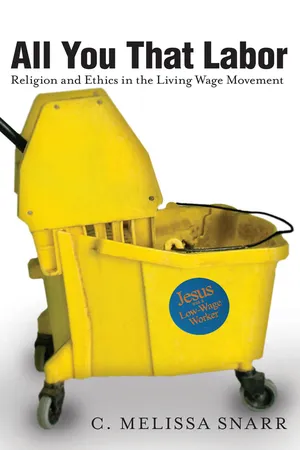
All You That Labor
Religion and Ethics in the Living Wage Movement
- 217 pages
- English
- ePUB (mobile friendly)
- Available on iOS & Android
eBook - ePub
About this book
Information
Topic
Teologia e religioneSubtopic
Etica e religione1
U.S. Poverties and Religious Resources
Movement Context
Oh Mary, don’t you weep, don’t you mourn
Oh Mary, don’t you weep, don’t you mourn
Pharaoh’s army got drowned
Oh Mary, don’t you weep.
Oh Mary, don’t you weep, don’t you mourn
Pharaoh’s army got drowned
Oh Mary, don’t you weep.
Oh Worker, don’t you weep, don’t you mourn
Oh Worker, don’t you weep, don’t you mourn
Pharaoh’s army got drowned
Oh Worker, don’t you weep.
Oh Worker, don’t you weep, don’t you mourn
Pharaoh’s army got drowned
Oh Worker, don’t you weep.
Oh Pharaoh, don’t you know what you do
Oh Pharaoh, don’t you know what you do
Pharaoh’s army got drowned.
Oh Mary, don’t you weep.
Oh Pharaoh, don’t you know what you do
Pharaoh’s army got drowned.
Oh Mary, don’t you weep.
Woe to the powerful, justice will prevail
Woe to the powerful, justice will prevail
Pharaoh’s army got drowned.
Oh Mary, don’t you weep.
Woe to the powerful, justice will prevail
Pharaoh’s army got drowned.
Oh Mary, don’t you weep.
Oh Council, won’t you pay a living wage
Oh Council, won’t you pay a living wage
Pharaoh’s army got drowned
Oh Mary, don’t you weep.
Oh Council, won’t you pay a living wage
Pharaoh’s army got drowned
Oh Mary, don’t you weep.
When I get to Heaven goin’ to put on my shoes
Run about glory and tell all the news
Pharaoh’s army got drowned
Oh Mary, don’t you weep.1
Run about glory and tell all the news
Pharaoh’s army got drowned
Oh Mary, don’t you weep.1
Through an African rhythm, an oppressor’s folly, and justice’s triumph, a new version of a familiar spiritual declares the presence of a growing social movement. This recent adaptation of “Oh Mary, Don’t You Weep,” while echoing old labor hymns, has several novel features that reflect the living wage movement.2
First, the activists singing these songs are on the lines of a burgeoning frontier in the labor struggle—municipal living wage ordinances. They are not just singing to factory bosses but to city councils and county commissioners, who, in an era of privatization, are contributing to lower wage work in America. Second, this song is found in Interfaith Worker Justice’s Rally Song Book, circa 2005, not the Little Red Song Book of the International Workers of the World (or the “Wobblies”) of 1904. Interfaith Worker Justice, founded in 1996, serves as an innovative movement halfway house for the support, coordination, and integration of religion and labor activism in the United States.3 Third, this song appears in a rally book that includes numerous African spirituals, Appalachian hymns, and Spanish folk songs. The compilation represents the diversity of contemporary work in the United States and labor and religious organization’s efforts to deal with these changes. Finally, a religious laywoman, Kim Bobo, the founder of Interfaith Worker Justice, composed the hymn’s new verses. She is just one of the hundreds of women of faith who play a primary role in leading this movement, a movement whose primary beneficiaries are most often women living in poverty.
Religious activism has been absent from much of social movement theorists’ analyses of the living wage movement. However, progressive religious coalitions are fundamental to the new labor activism rising in the United States. As the political scientist Richard Wood recognized in his analysis of faith-based community organizing, religious community organizing is “second in size only to the labor movement among drives for social justice among low-income Americans today.”4 At a time when the media and academia still focus regularly on the strength of the “religious right” at the federal level, the success of the living wage movement demonstrates the underrecognized power of progressive religious activists in cities around the nation.
The 1994 coalition of Baltimore churches provided the impetus for that city’s living wage ordinance. While often cited as the first living wage ordinance in the nation, Baltimore’s ordinance was not really the first. In 1988, the city of Des Moines, Iowa, set a minimum compensation package for its economic development projects, and Gary, Indiana, implemented a similar measure in 1991. But Baltimore’s ordinance was the first to be prompted by a grassroots campaign.5 Moreover, Baltimore activists articulated the failures of the minimum wage program and reintroduced the term “living wage” while developing a new successful model for building local economic political power.6 In Andy Merrifield’s assessment, these new living wage campaigns offered “progressives everywhere a new big idea at a time when we’re not supposed to need big ideas anymore: the working class is getting back on the offensive, reorganizing in the work-place, [and] seeking allies.”7 These campaigns breathed new life into the economic political agency of workers and their allies. As a result, they became stepping stones for other struggles as coalitions extended their power base to statewide minimum wage victories (Arizona), increases in the Earned Income Tax Credit (Boston), the election of third-party candidates to city councils and mayoral seats (Santa Monica), and to the increase in the federal minimum wage in 2007.8
While the specifics of living wage ordinances vary according to local contexts, the logic and strategy of municipal campaigns have not varied dramatically from the Baltimore model of developing religion, community, and labor coalitions to establish higher wage floors. Municipal living wage ordinances typically propose that those who work full time for a local government (and often those who work for businesses that have contracts with or receive subsidies/tax abatements from local government) should receive an hourly wage that lifts them out of poverty. Proponents generally calculate the appropriate wage level either by dividing the federal poverty threshold for a family of three or four by one or two full-time, full-year, wage earners or by using a more precise local needs assessment that enables families to provide for their basic needs from earned wages. The logic offered is straightforward: full-time work should ensure basic economic needs. Workers paid by the government (or supported by their contracts and/or subsidies) should not have to return to the government for basic economic assistance (such as food stamps); taxpayer money should not be used to create poverty-level jobs.
Strategically, numerous organizations have played important roles in developing the living wage movement nationally. ACORN and the New Party provided centralized information centers and trained personnel for numerous campaigns.9 Their websites and experienced personnel, such as Jen Kern and David Reynolds, have been a repository of organizing guides, sample ordinances, and campaign updates, all essential resources for establishing a consistent framework and strategy in the movement. Inspired by the Baltimore victory, ACORN’s Kern laboriously poured over state constitutions and documents from around the country in 1995 to determine other places where citizens could legally develop campaigns to raise the minimum wage above the federal level.10 In other words, were there any state regulations or court decisions that could block the development of ordinances or a ballot initiative to raise wages? With this list in hand, ACORN began by working for statewide minimum wage increases in Missouri (a successful campaign, but quite expensive), and citywide minimum wage increases in Houston and Denver (which were defeated). Eventually, ACORN returned to more limited, city government-focused ordinances, and local ACORN affiliates served as a direct partner in fourteen successful ordinance campaigns.11 Nationally, ACORN held three living wage conferences for those interested in running successful local campaigns. The IWJ founder and director Kim Bobo notes, “[ACORN] had provided much of the leadership for the living wage movement (thanks especially to Jen Kern [the director of the ACORN’s living wage resource center for ten years]).”12 While the national ACORN office provided important early training for the Atlanta coalition and shorter consultations with several other campaigns, local ACORN affiliates were not integral to the cities in my research, as many did not even have local affiliates in the area.13 Yet ACORN’s training expertise and national activity as an information clearinghouse assisted almost every campaign in the United States.
Independent and university economic think tanks also contributed to the success of the movement. In San Diego, the local Center for Policy Initiatives researched the economic feasibility of the living wage ordinance and testified regularly before the city council. In Atlanta and Nashville (as well as numerous other cities), the Political Economy Research Institute (PERI), based at the University of Massachusetts–Amherst and directed by the economist Robert Pollin, provided analyses and reports on the economic impact of specific municipal ordinances. These documents were often submitted directly to city councils to counter opposition arguments. In a more general manner, the Economic Policy Institute in Washington also provides crucial studies of the effects of ordinance implementation around the nation. The Brennan Center for Justice at New York University Law School, particularly Paul Sonn of the National Employment Project there, supplied key legal advice for the movement and helped write several wage ordinances and ballot measures.14 The Strategic Press Information Network (SPIN) and the Communications Consortium Media Center’s Fairness Initiative on Low Wage Work also provided consultations and organizing guides on movement messaging.15
Although part of the national infrastructure of the movement, none of these organizations directly organizes local living wage campaigns.
In contrast, the locals and central labor councils of various unions provided important infrastructure, funding, and organizing for numerous local campaigns.16 Although labor is not particularly powerful in Atlanta, Memphis, Nashville, or San Diego, each of these coalitions still received some funding (direct and in-kind contributions) from union networks, drew on union connections with key government officials, relied on union organizers to identify low-wage workers, and benefited from unions mobilizing turnout. When many of these coalitions formed, among their first phone calls were those to allies in the local labor movement for endorsement and advice. As an organizer in Nashville explained, “No one knows the political landscape better than [the head of the local AFL-CIO (American Federation of Labor-Congress of Industrial Organizations)] and [their lobbyist]. Their insight was vital.” Calls from these union leaders also arranged the first metro council-member sponsor of Nashville’s municipal living wage campaign.
Despite the fact that religious organizations are often less obvious in other campaigns than in Baltimore, they continue to shape the “new” living wage movement. Religious activists help influence the movement through their participation in local coalitions and national networks such as Interfaith Worker Justice (with their forty local affiliates and worker centers), the National Council of Churches’ Let Justice Roll campaign, various denominational social justice offices, and the four major interreligious faith-based community organizing networks (IAF, Pacific Institute for Community Organizing [PICO], Direct Action Research and Training [DART], and Gamaliel).17 As the political scientists Margaret Levi, David Olson, and Erich Steinman conclude, “Besides lending legitimacy and authority to living wage campaigns, church involvement provides significant contributions to organization building for campaigns.”18 Rabbi Lori Coskey, the executive director of San Diego’s ICWJ, states this clearly: “We were the face of the living wage here in San Diego. We turned out over half of the participants at every rally and testified for months before the council.” The 5–4 metro council vote could not have happened without them.
Municipal living wage ordinances are the backbone of the new living wage movement. Yet the movement encompasses a range of worker justice campaigns including various public policies, business practices, and organizing strategies. In addition to municipal living wage ordinances, these include cost-of-living increases, health care co-payments, paid vacation time, and workplace equity. For example, among the stated principles providing the “basis of [San Diego’s ICWJ’s] formation” is this:
People have a basic right to productive lives, including compensated employment. Part of compensated employment is the right to just and living wages and other benefits to sustain a life with dignity. Included in the benefits are adequate health care, security for old age or disability, unemployment compensation, healthful and safe working conditions, weekly and daily rest, family leave, periodic holidays for recreation and leisure, and reasonable security against abuse, harassment, and arbitrary dismissal.19
This principle correlates with the goal of the organization “to educate the community on the rights of workers to obtain just and living wages and other benefits that allow for a life with dignity.”20 As in San Diego, other cities’ lead organizations saw municipal living wage ordinances as only one dimension of their campaigns. They participated regularly in “living wage” organizing for universities and local businesses.
During Atlanta’s municipal living wage campaign, successful campaigns occurred concurrently at Agnes Scott College and Emory University. Campaigns at Belmont and Vanderbilt Universities in Nashville (where a wide-ranging ordinance had been withdrawn in 2000) nurtured a new municipal campaign with new organizers. In Memphis and San Diego, the success of the municipal campaign led to support for new university campaigns. Religious activists and organizations also participated in wage-related campaigns focused on local business concurrently with their municipal campaigns. In Nashville, this included aiding the mostly immigrant Metro taxi drivers to document their low pay (around $2.10 an hour) and organize for new contracts.
Moreover, living wage organizing is not just about wages; it also focuses on health care coverage, retirement benefits, vacation days, and var...
Table of contents
- Cover Page
- Title Page
- Copyright Page
- Dedication
- Contents
- Acknowledgments
- Abbreviations
- Introduction
- 1 U.S. Poverties and Religious Resources: Movement Context
- 2 Living Wages: Religious Ideology and Framing for Moral Agency
- 3 “I Was a Stranger and You Welcomed Me”: Bridge Building and Political Engagement in Racialized Economies
- 4 “Your Daughters Will Prophesy”: Women’s Labor in the Movement
- 5 “Where Two or Three Are Gathered”: Ritualizing Moral Agency
- 6 Conclusion: “Come, Walk with Us, the Journey is Long”
- Notes
- Bibliography
- Index
- About the Author
Trusted by 375,005 students
Access to over 1.5 million titles for a fair monthly price.
Study more efficiently using our study tools.
Frequently asked questions
Yes, you can cancel anytime from the Subscription tab in your account settings on the Perlego website. Your subscription will stay active until the end of your current billing period. Learn how to cancel your subscription
No, books cannot be downloaded as external files, such as PDFs, for use outside of Perlego. However, you can download books within the Perlego app for offline reading on mobile or tablet. Learn how to download books offline
Perlego offers two plans: Essential and Complete
- Essential is ideal for learners and professionals who enjoy exploring a wide range of subjects. Access the Essential Library with 800,000+ trusted titles and best-sellers across business, personal growth, and the humanities. Includes unlimited reading time and Standard Read Aloud voice.
- Complete: Perfect for advanced learners and researchers needing full, unrestricted access. Unlock 1.5M+ books across hundreds of subjects, including academic and specialized titles. The Complete Plan also includes advanced features like Premium Read Aloud and Research Assistant.
We are an online textbook subscription service, where you can get access to an entire online library for less than the price of a single book per month. With over 1.5 million books across 990+ topics, we’ve got you covered! Learn about our mission
Look out for the read-aloud symbol on your next book to see if you can listen to it. The read-aloud tool reads text aloud for you, highlighting the text as it is being read. You can pause it, speed it up and slow it down. Learn more about Read Aloud
Yes! You can use the Perlego app on both iOS and Android devices to read anytime, anywhere — even offline. Perfect for commutes or when you’re on the go.
Please note we cannot support devices running on iOS 13 and Android 7 or earlier. Learn more about using the app
Please note we cannot support devices running on iOS 13 and Android 7 or earlier. Learn more about using the app
Yes, you can access All You That Labor by C. Melissa Snarr,C. Melissa Snarr in PDF and/or ePUB format, as well as other popular books in Teologia e religione & Etica e religione. We have over 1.5 million books available in our catalogue for you to explore.