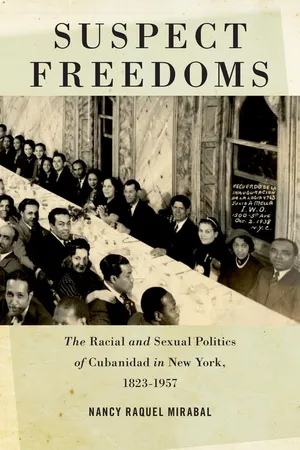
Beginning in the early nineteenth century, Cubans migrated to New York City to organize and protest against Spanish colonial rule. While revolutionary wars raged in Cuba, expatriates envisioned, dissected, and redefined meanings of independence and nationhood. An underlying element was the concept of Cubanidad, a shared sense of what it meant to be Cuban. Deeply influenced by discussions of slavery, freedom, masculinity, and United States imperialism, the question of what and who constituted "being Cuban" remained in flux and often, suspect.
The first book to explore Cuban racial and sexual politics in New York during the nineteenth and twentieth centuries, Suspect Freedoms chronicles the largely unexamined and often forgotten history of more than a hundred years of Cuban exile, migration, diaspora, and community formation. Nancy Raquel Mirabal delves into the rich cache of primary sources, archival documents, literary texts, club records, newspapers, photographs, and oral histories to write what Michel Rolph Trouillot has termed an "unthinkable history." Situating this pivotal era within larger theoretical discussions of potential, future, visibility, and belonging, Mirabal shows how these transformations complicated meanings of territoriality, gender, race, power, and labor. She argues that slavery, nation, and the fear that Cuba would become "another Haiti" were critical in the making of early diasporic Cubanidades, and documents how, by the late nineteenth and early twentieth centuries, Afro-Cubans were authors of their own experiences; organizing movements, publishing texts, and establishing important political, revolutionary, and social clubs. Meticulously documented and deftly crafted, Suspect Freedoms unravels a nuanced and vital history.
eBook - ePub
Suspect Freedoms
The Racial and Sexual Politics of Cubanidad in New York, 1823-1957
- 320 pages
- English
- ePUB (mobile friendly)
- Available on iOS & Android
eBook - ePub
Suspect Freedoms
The Racial and Sexual Politics of Cubanidad in New York, 1823-1957
About this book
Information
Contents
Acknowledgments
Introduction: Diasporic Histories and Archival Hauntings
1. Rhetorical Geographies: Annexation, Fear, and the Impossibility of Cuban Diasporic Whiteness, 1840–1868
2. “With Painful Interest”: The Ten Years’ War, Masculinity, and the Politics of Revolutionary Blackness, 1865–1898
3. In Darkest Anonymity: Labor, Revolution, and the Uneasy Visibility of Afro-Cubans in New York, 1880–1901
4. Orphan Politics: Race, Migration, and the Trouble with ‘New’ Colonialisms, 1898–1945
5. Monumental Desires and Defiant Tributes: Antonio Maceo and the Early History of El Club Cubano Inter-Americano, 1945–1957
Epilogue
Notes
Bibliography
Index
About the Author
Acknowledgments
I have been thinking about, researching, and writing this book for close to twenty years. It has taken many forms, but never a book, until now. I thank all of those who traversed these seemingly impractical and distracted roads with grace, kindness, and humor. I want to thank Earl Lewis and Robin D. G. Kelley for their encouragement and support. Their ability to envision this project as an integral part of a larger hemispheric and transnationalist history made all the difference. I am indebted to Ruth Behar, Elsa Barkley Brown, Eileen Boris, Lisa Brock, Sandra Cisneros, Arlene Dávila, Anani Dzinzeyo, Juan Flores, Donna Gabbacia, Farah Jasmine Griffin, Jennifer Guglielmo, Nancy Hewitt, Miriam Jiménez Román, Diana Lachatanere, Velora Lilly, Agnes Lugo-Ortiz, Diane Milioties, Premilla Nadasen, Suzanne Oboler, Annelise Orleck, Silvia Pedraza, Louis A. Pérez, Jr., Gerald E. Poyo, Barbara Ransby, Juana María Rodríguez, George Sánchez, Aldo Lauria Santiago, Rebecca Scott, and Vicky Ruiz, for publishing articles, offering invaluable advice, pointing out critical sources, writing (countless) letters, and teaching important lessons.
This book could not have been completed without the support of friends and colleagues who read drafts, offered suggestions, invited me to give talks, provided needed distractions, tolerated my attention to detail, and made the research and writing so much better. Thank you to Rosio Alvarez, Nancy Bercaw, Maylei Blackwell, Mary Pat Brady, Luz Calvo, Laureen Chew, Kathleen Coll, Eduardo Contreras, Raúl Coronado, Wei Ming Dariotis, María De Guzmán, Sergio De la Mora, Dawn Elissa Fischer, Aurelia Flores, Ester Hernández, Philip Jackson, Félix Kury, Carmen Lamas, Leslie Larson, Rodrigo Lazo, John Jota Leaños, Ricardo Lemvo, Katynka Martińez, Lourdes Martińez Echezábal, April Mayes, John McKiernan-González, Claudia Milian, Kristin Naca, Marcia Ochoa, Ariana Ochoa Camacho, Ricardo Ortiz, Naomi Quiñones, Isabelle Pelaud, Alaí Reyes-Santos, Roberto Rivera, Tamerra Roberts, Ana Patricia Rodríguez, Merida Rua, Catriona Rueda Esquibel, Tania Triana, Carla Trujillo, Diana Valle, Deborah Vargas, Carmen Whalen, and Nataly Zaragoza. Thank you to Karina Lisette Cespedes for being my Cuban co-conspirator, and to the incredibly generous Gema Guevara for reading chapters, providing critical feedback, sharing invaluable sources, and being brilliant in so many ways. Thank you to Juana María Rodríguez for inspiring me to be a better writer and thinker. I deeply appreciate your feedback and assistance over the years. I am so grateful to my sister-friend Andreana Clay for showing unlimited kindness, humor, and love. I also want to thank her and Joan Benoit for inviting me to be part of Otis’s life as one of his godmothers and many adoring tias.
Thank you to the participants of Tepoztlan for reading and critiquing my work at a pivotal juncture. I especially want to thank Jossianna Arroyo, David Sartorious, Yolanda Martínez-San Miguel, Robin Lauren Derby, Nicole Guidotti-Hernández, Lawrence LaFountain Stokes, and to Frank Andre Guridy who invited me to apply and opened a whole new world of collegial possibilities. From 2001 to 2003, I was awarded a Chancellor’s Post-doctoral Fellowship in the Ethnic Studies Department at the University of California, Berkeley. I want to thank José David Saldívar for serving as my faculty advisor, and to Laura Pérez and Norma Alarcón for kindly inviting me to be part of conferences, workshops, and writing groups. In 2003 I was awarded a Social Science Research Council International Migration Post-doctoral Fellowship funded by the Mellon Foundation. The fellowship funded research trips and provided the time necessary to rethink and redraft this project. In 2012 I was awarded the Scholar in Residence Fellowship at the Schomburg Center for Research in Black Culture, funded in part by the National Endowment for the Humanities. The fellowship was a turning point in my research, career, and life. And for that I am forever grateful. I am deeply thankful to Farah Jasmin Griffin, Steven Fullwood, Antony Toussant, and Mary Yearwood, as well as to the many librarians and archivists, for helping me locate precious documents, research materials, and photographic images. I am especially indebted to Diana Lachatenere whose belief in this research has been invaluable. I am so grateful for her insights, patience, brilliance, and friendship. I want to thank all of my colleagues who were part of the Scholar-in-Residence Fellowship for reading drafts and offering needed critiques. In particular, I want to thank Miriam Jiménez Román, David Goldberg, Marisa Reese Fuentes, Anthony Foy, Kevin Meehan, and Jim DeLongh for their smart and thoughtful suggestions on the manuscript, and to Naomi Bland and Jadele McPherson for assisting me when I needed it most. Many thanks to the staff at the Center for Puerto Rican Studies, who were extremely helpful in locating important documents and ensuring that I received resources in a timely manner. I especially want to thank Pedro Juan Hernández and Yosenex Orengo for their assistance. My deepest gratitude to Eduardo Contreras, Arlene Dávila, Zaire Dinzey-Flores, Juan Flores, Miriam Jiménez Román, Arnaldo Cruz-Malavé, John Arenare, Jadele McPherson, Jo-Ana Moreno, Yesenia Selier, Pamela Sporn, Pablo Foster, Premilla Nadasen, Pamela Calla, Wendy Susan Walters, and Dan Charnas for providing community and making me feel at home while in New York. It made all the difference.
I would never have been able to spend an academic year at the Schomburg Center without the efforts and generosity of my colleagues in the College of Ethnic Studies at San Francisco State University. Thank you to Teresa Carrillo, former chair of the Latina/Latino Studies Department, Laureen Chew, former Associate Dean, and Kenneth Monteiro, Dean of the College of Ethnic Studies, for your assistance and support.
In 2014 I accepted a position in the American Studies Department and US Latina/o Studies Program at the University of Maryland, College Park. I am so thankful to Nancy Struna, Psyche Williams-Forson, Julie Greene, and Ira Berlin for being so kind and helpful as I transitioned to the University of Maryland and Washington, DC. I would also like to thank my wonderful colleagues in the American Studies Department and US Latina/o Studies Program for being so welcoming. I am particularly grateful to Betsy Yuen and Julia John for their gracious assistance.
Mil gracias to Mercedes Rubio (la comadre), Nicholas Saunders, Nico, and Jackson for being my DC family and generously giving me a place to stay and write while my furniture traveled across country. I am so grateful to Kimberley L. Phillips and Daniel Bender, who as series editors believed in this project early on and welcomed me with open arms. Thank you to my editors at New York University Press (past and present), Eric Zinner, Deborah Gershenowitz, Clara Platter, Constance Grady, Amy Klopfenstein, and Alexia Traganas for their enthusiasm, expertise, and unlimited patience.
This book would not have been possible without Melba Alvarado. Her conviction that this book needed to be written and that I should be the one to do so made all the difference. I am deeply honored to have conducted oral histories and interviews, archived documents, and worked closely with her for more than twenty years to piece together a history that, in her words, “needed to be told.” In working with Alvarado I learned the value of being invested in community and part of what she called “something bigger.” She revealed a great deal to me, years of pain and struggle, but more importantly her tenacity, strength, humor, and love for her community. She is, and will always be, one of my greatest inspirations.
I am so thankful to the members of El Club Cubano Inter-Americano, in particular Jo-Ana Moreno, for inviting me to give a talk at the Cena Martiana, making sure that I got free tickets to La Fiesta del Mamoncillo, and for allowing me to assist her in organizing the 70th anniversary of El Club Cubano Inter-Americano at the Schomburg Center for Research in Black Culture. You have no idea how exciting this has been for me. Thank you to Lydia “Tata” Caraballosa, “my tia,” for allowing me to interview her and learn more about her experiences in New York during the 1940s, and for being such a loving and strong spirit. And to my other “tia,” Olga Marten, who for more than forty years lived in a rent-controlled apartment on 72nd Street and Broadway above the Ortiz Funeral Hom...
Table of contents
- Cover
- Title Page
- Copyright Page
- Dedication
- CONTENTS
Trusted by 375,005 students
Access to over 1.5 million titles for a fair monthly price.
Study more efficiently using our study tools.
Frequently asked questions
Yes, you can cancel anytime from the Subscription tab in your account settings on the Perlego website. Your subscription will stay active until the end of your current billing period. Learn how to cancel your subscription
No, books cannot be downloaded as external files, such as PDFs, for use outside of Perlego. However, you can download books within the Perlego app for offline reading on mobile or tablet. Learn how to download books offline
Perlego offers two plans: Essential and Complete
- Essential is ideal for learners and professionals who enjoy exploring a wide range of subjects. Access the Essential Library with 800,000+ trusted titles and best-sellers across business, personal growth, and the humanities. Includes unlimited reading time and Standard Read Aloud voice.
- Complete: Perfect for advanced learners and researchers needing full, unrestricted access. Unlock 1.5M+ books across hundreds of subjects, including academic and specialized titles. The Complete Plan also includes advanced features like Premium Read Aloud and Research Assistant.
We are an online textbook subscription service, where you can get access to an entire online library for less than the price of a single book per month. With over 1.5 million books across 990+ topics, we’ve got you covered! Learn about our mission
Look out for the read-aloud symbol on your next book to see if you can listen to it. The read-aloud tool reads text aloud for you, highlighting the text as it is being read. You can pause it, speed it up and slow it down. Learn more about Read Aloud
Yes! You can use the Perlego app on both iOS and Android devices to read anytime, anywhere — even offline. Perfect for commutes or when you’re on the go.
Please note we cannot support devices running on iOS 13 and Android 7 or earlier. Learn more about using the app
Please note we cannot support devices running on iOS 13 and Android 7 or earlier. Learn more about using the app
Yes, you can access Suspect Freedoms by Nancy Raquel Mirabal in PDF and/or ePUB format, as well as other popular books in History & Latin American & Caribbean History. We have over 1.5 million books available in our catalogue for you to explore.