Sir
Your name is down amongst the Black hearts in the Black Book and this is to advise you and the like of you, who are Parson Justasses, to make your wills
Ye have been the Blackguard Enemies of the People on all occasions, Ye have not yet done
as ye ought
- Swing
In our increasingly mechanized age, the Swing revolts are a timely record of the relationship between technological advance, labour and poverty. With the onset of the Industrial Revolution, capitalism swept from the cities into the countryside, and tensions mounted between agricultural workers and employers.
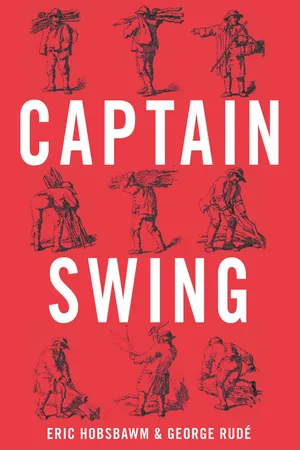
From 1830 on, a series of revolts, known as the "Swing" shook England to its core. Landowners wanting to make their land more profitable started to use machinery to harvest crops, causing widespread misery among rural communities. Captain Swing reveals the background to that upheaval, from its rise to its fall, and shines a light on the people who tried to change the world and save their livelihoods.
- 384 pages
- English
- ePUB (mobile friendly)
- Available on iOS & Android
eBook - ePub
Captain Swing
About this book
Information
PART 1
BEFORE SWING
I
AGRICULTURAL ENGLAND
Agricultural England in the 19th century presented a unique and amazing spectacle to the enquiring foreigner: it had no peasants. In practically all the countries from which visitors were at all likely to come to the United Kingdom, the bulk of the people who earned their living by tilling the soil consisted of families owning or occupying their own small plot of land, cultivating it substantially with the labour of their members, and indeed very often—perhaps mostly—still practising subsistence agriculture, even when they sold some of their produce in the market, supposing they had a surplus. (That peasant serfs in feudal societies were obliged to work also on their lord’s farms does not mean that on their own holdings they were not peasant farmers in the sense just described.) Such peasants still form the bulk of the population of the soil in some parts of the world and the bulk of the cultivators of the soil in many regions, including most of Europe. At the time of the first industrial revolution they were even more common. In 19th century Britain they were not entirely absent. They predominated in Ireland, and the thinly populated regions of Wales and the Scottish Highlands, perhaps in parts of Northern England such as the Pennine dales, and local concentrations could be found here and there in other parts. Yet in England these were already unimportant minorities. When 19th century politicians and pamphleteers spoke of the English “peasantry” they did not mean direct family cultivators, but agricultural wage-labourers.
In fact, the English agricultural population divided into three unequal segments. At the top stood a small number of landlords, who between them owned most of the land. The first attempt to discover how the land of Britain was owned (in 1871–73) revealed that about 1,200 persons owned a quarter of the United Kingdom and about 7,200 owned half, though it certainly underestimated the concentration of landed property. It could be argued that in England and Wales not more than 4,000 proprietors owned four-sevenths of the land, and that most of the rest of “landowners” probably consisted of small freeholders in towns and suburbs rather than of yeomen or small country gentlemen.1 This comparative handful of giant landlords rarely cultivated their estates themselves, except for the odd home farm or model holding. Essentially they rented them out to tenant-farmers who actually exploited them. In 1851, when the first nationally reliable figures were collected,2 there were about 225,000 farms in Britain, about half of them between 100 and 300 acres in size, and all of them averaging just over 110 acres. In other words, what passed for a small farm in England would certainly have counted as a giant farm beside the smallholdings of typical peasant economies.i Just over 300,000 people described themselves as “farmers and graziers”. These cultivated their farms essentially by employing the 1·5 million men and women who described themselves as agricultural labourers, shepherds, farm-servants, etc.
In other words, the typical English agriculturalist was a hired man, a rural proletarian. There is no doubt that beside him all manner of smallholders survived (but as often as not they might be small rural tradesmen, craftsmen, carters, etc., with a hay-field or market-garden, who did not regard themselves as farmers), and even some people who could be classified as peasants. However, socially speaking the marginal members of a rural lower-middle class were assimilated to the rest of the “lower orders”, and distinguished from the farmers.3 Of course, rural society consisted not only of those actually engaged in landownership or farming, but also of the numerous craftsmen, shopkeepers, carters, innkeepers, etc., who provided the services necessary to agriculture and village life, not to mention the less numerous professional men who provided those necessary to farmers and gentry; and of course the Church, which went with the Squire. Parishes in which more than three-quarters of the families were engaged in agriculture were not too common, even when there was no particular local industry or manufacture.ii Nor ought we to forget the various rural industries, either domestic and cottage manufactures (such as the straw-plaiting of Bedfordshire) or the small (mainly textile) nuclei still fairly widely spread through even the most agricultural counties, with some notable exceptions.iii

After Caird (reprinted in J. H. Clapham, Economic History of Modem Britain, I, The Early Railway Age, p. 147)

ENCLOSURE OF COMMON FIELD BY ACT
18TH–19TH CENTURIES
18TH–19TH CENTURIES
After E. C. K. Gonner, Common Land and Inclosure
Just when the English peasantry disappeared, and English farming came to be dominated by the triple division into landlords, tenant-farmers and hired labourers, has been a matter of argument for a long time. The most common opinion today is that this structure had come into existence in broad outline by the middle of the 18th century at the latest, i.e., before the start of the Industrial Revolution.4 The agrarian changes which accompanied the passage to industrialism (say, 1760 to 1850), did not turn a feudal countryside into a capitalist one, nor did they simply transform family subsistence cultivators or small market peasants into proletarians. Several centuries of English history had already done most of that. Nevertheless, it is evident that in the period of the Industrial Revolution profound changes were taking place in the British countryside. Every schoolchild is familiar with the parliamentary “Enclosures” which, between 1750 and 1850 turned well over 6 million acres, or something like one-quarter of the cultivated acreage from open field, common land, meadow or waste into private fields, thus incidentally creating the characteristic hedge-patterned landscape of much of the English countryside. Three-quarters of the 4,000 private Acts of Parliament which thus revolutionised English farming and landscape (especially in a great inverted triangle of country with its apex at Portland Bill and its corners in North Yorkshire and East Norfolk)5 were concentrated in the 1760s and 1770s, and again during the revolutionary and Napoleonic Wars (1793–1815). Between 1750 and 1840 the population of England and Wales multiplied by rather more than two. Yet it was estimated that in the 1830s home production of grain covered 98 per cent of British consumption, that is to say, that British cereal farming had not much less than doubled its outputiv—a very dramatic rise for so traditional a form of production as farming. It is inconceivable that such vast changes should not have had equally profound repercussions in rural society.
Before we try to assess these, let us see what industrialisation actually meant to the British agricultural producer. It meant in the first place, and mainly, a permanent boom in the demand for food for the growing towns, the rising numbers of the non-agricultural workers, and indeed the expanding population in general. (For reasons which do not concern us here, there was no real possibility of massive and regular imports of basic foods from outside the United Kingdom until past the middle of the 19th century.) The expansion of English farming in this period was essentially one of food production (including, of course, drink), and not significantly of the production of raw materials for industry. In the areas which lent themselves to tillage (as many hilly regions of the North and West, or heavy lands as yet incapable of effective drainage, did not), it was essentially the expansion of the production of bread of some or other cereal, which was still the staple food, the “staff of life”.v The great waves of enclosure were primarily for grain production (especially during the wars of 1793–1815 when the cereal fields crept farther up the hillsides and onto the moorlands than at any time between the late 13th century and the production drives of the Second World War). However, geography, the nearness of large towns with their miscellaneous demand for food, and even the crop-rotations recommended by the experts, ensured a good deal of mixed farming; and so did the defects of transport, which made it impossible to transport perishable products very far before the railway boom of the 1840s, and obliged the producers of meat to drive their livestock for long distances and then to fatten it up near the final market (e.g. in the Home Counties and parts of East Anglia).

Broadly speaking, demand kept pace with, or ran ahead of, supply for the whole of the period from the middle of the 18th century until the arrival of massive cheap overseas food imports in the third quarter of the 19th century. Yet the prices of farm produce, and with them the prosperity of agriculture, fluctuated very considerably. Leaving aside short-term fluctuations, such as those which drove prices sharply upwards in years of poor harvests, the most striking movement, as the following table of annual average wheat prices for England and Wales shows, was the very large rise during the revolutionary and Napoleonic wars, and the very substantial fall in the years which followed them. (See table overleaf.)
This table shows that wheat prices after the Napoleonic Wars were consistently higher in each five-year period than they had been before the wars; and indeed, except for four such periods,vi the lowest prices never fell below 50 shillings, which would have been considered extremely high prices before 1795. Yet landowners and farmers after 1815 measured their prosperity not against the remote pre-war years, but against the abnormal boom profits of 1795–1815, when the golden sovereigns had rolled in, when credit had been easy, when marginal land had been leased at inflationary rents, money borrowed in the confidence that prices would stay up, and luxury articles accumulated in the parlours of farmers who saw themselves as potential gentlemen, and on the backs of their wives and daughters who saw themselves even more passi...
Table of contents
- Cover
- About the Author
- Title Page
- Copyright
- Contents
- List of Illustrations
- Maps
- Preface
- Introduction
- Part I. Before Swing
- Part II. The Rising
- Part III. The Anatomy of Swing
- Part IV. Repression and Aftermath
- Appendix I. Distribution of Disturbances by Counties
- II. Summary of Repression
- III. Table of Incidents
- IV. The Problem of the Threshing Machine
- Select Bibliography
- Subject Index
- Index of Places
- Index of Names
Trusted by 375,005 students
Access to over 1.5 million titles for a fair monthly price.
Study more efficiently using our study tools.
Frequently asked questions
Yes, you can cancel anytime from the Subscription tab in your account settings on the Perlego website. Your subscription will stay active until the end of your current billing period. Learn how to cancel your subscription
No, books cannot be downloaded as external files, such as PDFs, for use outside of Perlego. However, you can download books within the Perlego app for offline reading on mobile or tablet. Learn how to download books offline
Perlego offers two plans: Essential and Complete
- Essential is ideal for learners and professionals who enjoy exploring a wide range of subjects. Access the Essential Library with 800,000+ trusted titles and best-sellers across business, personal growth, and the humanities. Includes unlimited reading time and Standard Read Aloud voice.
- Complete: Perfect for advanced learners and researchers needing full, unrestricted access. Unlock 1.5M+ books across hundreds of subjects, including academic and specialized titles. The Complete Plan also includes advanced features like Premium Read Aloud and Research Assistant.
We are an online textbook subscription service, where you can get access to an entire online library for less than the price of a single book per month. With over 1.5 million books across 990+ topics, we’ve got you covered! Learn about our mission
Look out for the read-aloud symbol on your next book to see if you can listen to it. The read-aloud tool reads text aloud for you, highlighting the text as it is being read. You can pause it, speed it up and slow it down. Learn more about Read Aloud
Yes! You can use the Perlego app on both iOS and Android devices to read anytime, anywhere — even offline. Perfect for commutes or when you’re on the go.
Please note we cannot support devices running on iOS 13 and Android 7 or earlier. Learn more about using the app
Please note we cannot support devices running on iOS 13 and Android 7 or earlier. Learn more about using the app
Yes, you can access Captain Swing by Eric Hobsbawm,George Rude,George Rudé in PDF and/or ePUB format, as well as other popular books in History & British History. We have over 1.5 million books available in our catalogue for you to explore.