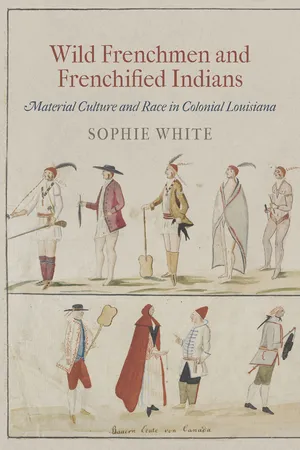
Based on a sweeping range of archival, visual, and material evidence, Wild Frenchmen and Frenchified Indians examines perceptions of Indians in French colonial Louisiana and demonstrates that material culture—especially dress—was central to the elaboration of discourses about race.
At the heart of France's seventeenth-century plans for colonizing New France was a formal policy—Frenchification. Intended to turn Indians into Catholic subjects of the king, it also carried with it the belief that Indians could become French through religion, language, and culture. This fluid and mutable conception of identity carried a risk: while Indians had the potential to become French, the French could themselves be transformed into Indians. French officials had effectively admitted defeat of their policy by the time Louisiana became a province of New France in 1682. But it was here, in Upper Louisiana, that proponents of French-Indian intermarriage finally claimed some success with Frenchification. For supporters, proof of the policy's success lay in the appearance and material possessions of Indian wives and daughters of Frenchmen.
Through a sophisticated interdisciplinary approach to the material sources, Wild Frenchmen and Frenchified Indians offers a distinctive and original reading of the contours and chronology of racialization in early America. While focused on Louisiana, the methodological model offered in this innovative book shows that dress can take center stage in the investigation of colonial societies—for the process of colonization was built on encounters mediated by appearance.
eBook - ePub
Wild Frenchmen and Frenchified Indians
Material Culture and Race in Colonial Louisiana
- 360 pages
- English
- ePUB (mobile friendly)
- Available on iOS & Android
eBook - ePub
About this book
Information
NOTES

Introduction
1. While the term métissage (like “race” and “gender”) is anachronistic, it is used here (in preference to the English “miscegenation” with its explicitly biological connotations) to convey the full range of sexual and marital unions and procreation.
2. Throughout, sauvage will be used in preference to the English “savage” to retain the original French definition of the word as meaning wild or untamed. Notwithstanding critiques of “identity” as too protean (Brubaker and Cooper, “Beyond “Identity” ” and Hodson, “Weird Science”), it is this very quality that provides the flexibility needed for my analysis.
3. Aubert, “ ‘The Blood of France’ ”; Belmessous, “Assimilation and Racialism.”
4. Havard and Vidal, Histoire de l’Amérique française.
5. Vidal, “Africains et Européens au pays des Illinois” and “Private and State Violence Against African Slaves in Lower Louisiana”; Ekberg, “Black Slavery in Illinois, 1720–1765” and “Black Slaves in the Illinois Country, 1721–1755”; also Heerman, “That “a’cursed Illinois venture.”
6. Aubert, “The Blood of France”; Belmessous, “Assimilation and Racialism”; Emily Clark, Masterless Mistresses; Dawdy, Building the Devil’s Empire; DuVal, The Native Ground; Jaenen, Friend and Foe; Hall, Africans in Colonial Louisiana; Ingersoll, Mammon and Manon in Early New Orleans; Spear, Race, Sex, and Social Order in Early New Orleans; Usner, Indians, Settlers, and Slaves in a Frontier Exchange Economy.
7. See, for example, Shoemaker, A Strange Likeness; Chaplin, Subject Matter; Kathleen M. Brown, “Native Americans and Early Modern Concepts of Race.”
8. Spear, “Colonial Intimacies” and “ ‘They Need Wives.’ ”
9. DuPlessis, “Cloth and the Emergence of the Atlantic Economy” and “Defining a French Atlantic Empire: some material culture evidence,” in Augeron and DuPlessis, Fleuves et colonies, 291–300; Dean L. Anderson, “Documentary and Archaeological Perspectives on European Trade Goods” and “The Flow of European Trade Goods into the Western Great Lakes Region, 1715–1760”; Dubé, “Les Biens publics,” which stresses the importance of textile imports and see in particular Table 6.1 p. 321; Breen, Marketplace of Revolution, 56
10. See, for example, Glassie, “Meaningful Things and Appropriate Myths.”
11. Key works include Buckridge, The Language of Dress; Castro, “Stripped”; DuPlessis, “Circulation des textiles et des valeurs dans la Nouvelle-France” and “Circulation et appropriation des mouchoirs chez les colons et aborigènes”; Foster, New Raiments of Self; Little, “ ‘Shoot That Rogue’ ”; Loren, The Archaeology of Clothing and Bodily Adornment in Colonial America; Mackie, “Cultural Cross-Dressing”; Ann Smart Martin, Buying into the World of Goods, esp. chap. 6; Maynard, Fashioned from Penury; Prude, “To Look upon the ‘Lower Sort’ ”; Shannon, “Dressing for Success on the Mohawk Frontier”; Tobin, Picturing Imperial Power; Ulrich, “Cloth, Clothing, and Early American Social History”; Waldstreicher, “Reading the Runaways”; White and White, Stylin’; Sophie White, “ ‘Wearing Three or Four Handkerchiefs.’ ”
12. See, for example, Castro, “Stripped”; and Haefeli and Sweeney, Captors and Captives, 145–63.
13. Caroline Weber, Queen of Fashion, 25–32. This was the custom throughout Europe; see, for example, Welch, “Art on the Edge,” 247–49.
14. Belmessous, “Assimilation and Racialism”; “Être français en Nouvelle-France”; and “D’un préjugé culturel à un préjugé racial”; Havard, “ ‘Les Forcer à devenir cytoyens’ ”; Jaenen, “The Frenchification and Evangelization of the Amerindians in the Seventeenth-Century New France,” Friend and Foe, and “Miscegenation in Eighteenth Century New France”; Melzer, “The Underside of France’s Civilizing Mission,” “The Magic of French Culture,” and “L’Histoire oubliée de la colonisation française.” On the expression “franciser” (to Frenchify), see Belmessous, “Assimilation and Racialism,” 323 n. 7.
15. Belmessous, “Être français.” On Frenchness and French national identity in this period, see Bell, “Recent Works on Early Modern French National Identity”; Sahlins, “Fictions of a Catholic France”; and the papers presented at the colloquium “Être et se penser Français: Nation, sentiment national et identités dans le monde atlantique français du XVIIe au XIXe siècle,” Centre d’Études Nord-Américaines, École des Hautes Études en Sciences Sociales, Paris, October 16–18, 2008.
16. Kupperman, “Presentment of Civility,” 193; see also Kupperman, “Fear of Hot Climates in the Anglo-American Colonial Experience” and Indians and English, 41–76.
17. Aubert, “ ‘The Blood of France.’ ”
18. Sala-Molins, Le Code Noir ou Le calvaire de Canaan, 108–9.
19. Rushforth, “ ‘A Little Flesh We Offer You’ ” and “Savage Bonds.”
20. My thanks to Guillaume Aubert for offering this nuance.
21. Aubert, “ ‘The Blood of France,’ ” 451.
22. On the repopulation of the Illinois tribes from the Ohio valley via the southern shores of Lake Michigan to the Upper Mississippi Valley, see Shackelford, “Navigating the Opportunities of New Worlds.” Shackelford argues that rather than being driven into the area by the threat of aggression from the Iroquois Confederacy (the orthodox explanation), Illinois Indians were in fact drawn by the possibilities for large-scale bison hunting consistent with their historic subsistence strategies. The precise genesis and meanings of the terms “Illinois” and “Illiniwek” have remained open to debate; for two opposing views see Sleeper-Smith, Indian Women and French Men, 173 n. 15; and Bilodeau, “Colonial Christianity and the Illinois Indians,” esp. 372 n. 12.
23. Margaret Kimball Brown, Cultural Transformations Among the Illinois; Bauxar, “History of the Illinois Area”; Callender, “Illinois”; also Bilodeau, “Colonial Christianity.”
24. Settlement patterns in the Illinois Country are discussed by Ekberg, French Roots in the Illinois Country; Lessard, Mathieu, and Gouger, “Peuplement colonisateur au pays des Illinois”; see also Briggs, “Le Pays des Illinois”; Belting, Kaskaskia Under the French Regime; Giraud, A History of French Louisiana, 1:340–47; Richard White, The Middle Ground. For a comparative study that does not treat the Illinois Country in isolation from its Anglo neighbors, see Hinderaker, Elusive Empires.
25. On variations in her name and on the phoneme “8,” see Ekberg, “Marie Rouensa-8canic8e and the Foundations of French Illinois...
Table of contents
- Cover
- Title
- Dedication
- Copyright
- Contents
- List of Illustrations
- Introduction
- I. Frenchification in the Illinois Country
- II. Frenchified Indians and Wild Frenchmen In New Orleans
- Epilogue: “True French”
- List of Abbreviations
- Notes
- Bibliography
- Index
- Acknowledgments
Trusted by 375,005 students
Access to over 1.5 million titles for a fair monthly price.
Study more efficiently using our study tools.
Frequently asked questions
Yes, you can cancel anytime from the Subscription tab in your account settings on the Perlego website. Your subscription will stay active until the end of your current billing period. Learn how to cancel your subscription
No, books cannot be downloaded as external files, such as PDFs, for use outside of Perlego. However, you can download books within the Perlego app for offline reading on mobile or tablet. Learn how to download books offline
Perlego offers two plans: Essential and Complete
- Essential is ideal for learners and professionals who enjoy exploring a wide range of subjects. Access the Essential Library with 800,000+ trusted titles and best-sellers across business, personal growth, and the humanities. Includes unlimited reading time and Standard Read Aloud voice.
- Complete: Perfect for advanced learners and researchers needing full, unrestricted access. Unlock 1.5M+ books across hundreds of subjects, including academic and specialized titles. The Complete Plan also includes advanced features like Premium Read Aloud and Research Assistant.
We are an online textbook subscription service, where you can get access to an entire online library for less than the price of a single book per month. With over 1.5 million books across 990+ topics, we’ve got you covered! Learn about our mission
Look out for the read-aloud symbol on your next book to see if you can listen to it. The read-aloud tool reads text aloud for you, highlighting the text as it is being read. You can pause it, speed it up and slow it down. Learn more about Read Aloud
Yes! You can use the Perlego app on both iOS and Android devices to read anytime, anywhere — even offline. Perfect for commutes or when you’re on the go.
Please note we cannot support devices running on iOS 13 and Android 7 or earlier. Learn more about using the app
Please note we cannot support devices running on iOS 13 and Android 7 or earlier. Learn more about using the app
Yes, you can access Wild Frenchmen and Frenchified Indians by Sophie White in PDF and/or ePUB format, as well as other popular books in History & Early American History. We have over 1.5 million books available in our catalogue for you to explore.