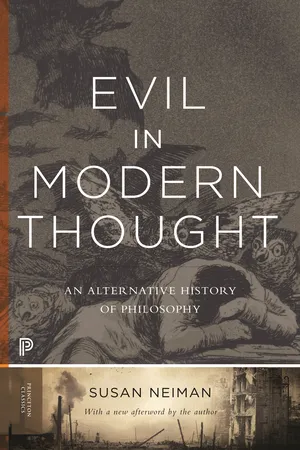
A compelling look at the problem of evil in modern thought, from the Inquisition to global terrorism
Evil threatens human reason, for it challenges our hope that the world makes sense. For eighteenth-century Europeans, the Lisbon earthquake was manifest evil. Today we view evil as a matter of human cruelty, and Auschwitz as its extreme incarnation. Examining our understanding of evil from the Inquisition to contemporary terrorism, Susan Neiman explores who we have become in the three centuries that separate us from the early Enlightenment. In the process, she rewrites the history of modern thought and points philosophy back to the questions that originally animated it.
Whether expressed in theological or secular terms, evil poses a problem about the world's intelligibility. It confronts philosophy with fundamental questions: Can there be meaning in a world where innocents suffer? Can belief in divine power or human progress survive a cataloging of evil? Is evil profound or banal? Neiman argues that these questions impelled modern philosophy. Traditional philosophers from Leibniz to Hegel sought to defend the Creator of a world containing evil. Inevitably, their efforts—combined with those of more literary figures like Pope, Voltaire, and the Marquis de Sade—eroded belief in God's benevolence, power, and relevance, until Nietzsche claimed He had been murdered. They also yielded the distinction between natural and moral evil that we now take for granted. Neiman turns to consider philosophy's response to the Holocaust as a final moral evil, concluding that two basic stances run through modern thought. One, from Rousseau to Arendt, insists that morality demands we make evil intelligible. The other, from Voltaire to Adorno, insists that morality demands that we don't.
Beautifully written and thoroughly engaging, this book tells the history of modern philosophy as an attempt to come to terms with evil. It reintroduces philosophy to anyone interested in questions of life and death, good and evil, suffering and sense. Featuring a substantial new afterword by Neiman that raises provocative questions about Hannah Arendt's take on Adolf Eichmann and the rationale behind the Hiroshima bombing, this Princeton Classics edition introduces a new generation of readers to this eloquent and thought-provoking meditation on good and evil, life and death, and suffering and sense.
- 392 pages
- English
- ePUB (mobile friendly)
- Available on iOS & Android
eBook - ePub
About this book
Information
Publisher
Princeton University PressYear
2015Print ISBN
9780691168500
9780691096087
eBook ISBN
9781400873661
Topic
PhilosophieSubtopic
Ethik & MoralphilosophieChapter One
FIRE FROM HEAVEN
Philosophy makes no secret of it. The confession of Prometheus: “In one word, I hate all the gods,” is its very own confession, its own sentence against all heavenly and earthly gods who refuse to recognize human self-consciousness as the supreme divinity—by the side of which none other shall be held.
—Marx, Dissertation
He may be the first Enlightenment hero. Alfonso X became king of Castile in 1252, and his reign was full of trouble from the start. He repudiated his wife, on the ground that she was barren, then sent to Denmark for another. By the time the princess of Denmark arrived in Spain, the queen was pregnant with the first of nine children she would bring into the world. Neither woman ever forgave Alfonso, though his brother, archbishop of Seville, gave up his seat to marry the Danish princess. The learning and eloquence that gave Alfonso a splendid reputation in other countries did not impress his Castilian contemporaries, who seemed to resent him. Though he was the first king of Castile who caused public acts to be written in the Spanish tongue, and commissioned a Spanish translation of the Bible, it didn’t lead to the flowering of local culture that translations into the vernacular produced in neighboring France. Rather, many later historians held the works he sponsored to be responsible for the ignorance and barbarity that they claimed spread over Spain. The children he had longed for turned out to be ingrates. One of them, Sancho, tired of waiting to inherit the throne and conspired with the king of Granada to overthrow his father. Alfonso’s death in 1284 put an end to the ensuing civil war but not to his misfortune, for his will was entirely ignored: the rebel Sancho remained on the throne, and his own heart, which he had ordered buried on Mount Calvary, was left to molder with his other remains in Seville.
Medieval and early modern thinkers viewed this saga as a confirmation of Providence. All Alfonso’s troubles were punishment for one nearly unspeakable sin, and hence were confirmation of God’s presence, justice, and even capacity for irony. For Sancho’s rebellion, in particular, was the fitting response to the rebellion his own father instigated against the Heavenly Father Himself. Alfonso’s revolt began as an act of scholarship. He sent to Toledo for learned Jews to instruct him in astronomy and commissioned one Rabbi Isaac Hazan to draw up astronomical tables, known thereafter as Tablas Alfonsinas, at considerable expense. After several years of intensive study, Alfonso remarked, “If I had been of God’s counsel at the Creation, many things would have been ordered better.”1
This little sentence, or some variation of it, expressed the essence of blasphemy for close to half a millennium. Bayle said no one was ignorant of Alfonso’s astronomical studies and their consequences, and was scrupulous in footnoting numerous variants of the story. In several of them, even the rebellion of his son wasn’t considered sufficient punishment. One who presumed to judge the heavens should be answered more directly, so a number of commentators had Alfonso or his family hit by lightning. A certain Rodericus Sanctius wrote that an angel appeared in a dream to convey a message from the celestial council warning Alfonso to repent.
But Alphonsus laughed, and repeated his blasphemy…. The Night following there were such horrible storms, accompanied with Thunder and Lightning, as if Heaven was falling. The Fire from Heaven burned, in Alphonsus’ chamber, the King and Queen’s Cloaths; then the Prince in Distress sent for the Hermit, confessed his Sins to him, cried, humbled himself, and retracted his Blasphemy. The more he wept, the more the Storm diminished, and at last quite ceased. (Bayle 2, 380)2
Bayle contested this account and other versions involving lightning. Such a wonderful accident, he argued, would be confirmed by more sources, particularly if it took place in Spain, whose inhabitants were always delighted to find evidence of miracles. Bayle wished to naturalize the story and may thereby be Alfonso’s first defender. The king, in Bayle’s account, committed prosaic sins: he neglected domestic political interests in favor of astronomical learning, preferring to “make a Noise” in foreign countries by cultivating his knowledge rather than attending to relations with his family and other subjects. Here we see ordinary, not criminal, narcissism. Though the former might render his subsequent downfall more comprehensible, Bayle still did not think he deserved it. On the contrary. Bayle devoted several footnotes to the infamous sentence and gave it a modern and more charitable reading. Alfonso’s belief that the heavens look remarkably disordered may be a comment not on God’s workmanship but on the defects of Ptolemaic astronomy, which were all too apparent by 1697. It all depends where the emphasis falls. Had Alfonso asserted “If I had been of God’s counsel at Creation …,” it would indeed sound like scandalous conceit. But, Bayle proposes, the claim could be read as follows: “If I had been of God’s counsel at Creation….” In that case the object of derision is not the Creator but the sorry medieval astronomers, whose ridiculous system did no honor to Him.
Whether or not we sympathize with such nascent deconstruction, we are likely to support Bayle, and to go several steps further. Alfonso’s remark will strike modern readers as so harmless that the wrath it provoked for centuries, much less the possible judgment of heaven, will be hard to understand. Even those who take patience and humility to be primary virtues can view Alfonso as manifesting them. He might, after all, have left the cosmic order to divine jurisdiction and devoted his attention to the business of earthly kings, like falconry and wenching. It would have been simpler, and brought simpler rewards: all Alfonso got for the years spent learning to calculate epicycles was the dubious blessing of posthumous notoriety. Since it wasn’t even good science, not even a glimpse of the truth crowned his efforts. His life, by all counts, looks a model of failure. Yet apart from the vanity that might afflict anyone, his motives were perfectly good ones. Alfonso sought to learn the secrets of the science that was viewed as the very highest so as better to understand and revere the Creation. And in uttering the remark that made him famous, there was no wish to blaspheme, just to point out the truth: an ordinary, hardworking Spanish king could design a better world than the one received wisdom ascribed to an omnipotent Creator.
His fate, therefore, will seem hardly more just than Job’s, whose story of endless suffering was also paradigmatic for writers concerned with the problem of evil. It is important to note that, like Alfonso’s misfortunes, Job’s were not viewed as unfair until a very late date. Sometime during the Enlightenment, commentators stopped looking for ways in which Job’s torments could be justified. According to Kant, who wrote a wonderful essay on the subject, they had previously done so in the hope that God would be eavesdropping. Having lost that hope, they had less motivation to try out variations on possible theodicies, which showed either that Job was secretly guilty of something after all, so that loss of all he had was justified punishment, or that he was being tried today to be rewarded the more surely tomorrow. Earlier writers identified with Job’s friends, the theodicy-makers who found justification. Later ones identified with Job, who found none. Tracing this development might be an interesting way of spending a lifetime, which wouldn’t be long enough to examine the vast literature the Book of Job inspired. But let us return to Alfonso, whose remark hardly reached the presumption of his biblical predecessor. Job did not go so far as to follow his wife’s suggestion that he curse God and die, but he did curse the day he was born, close enough to cursing Creation itself. Alfonso only suggested that it could be improved.
I will argue that Alfonso was less harmless than we think. Medieval observers were not entirely mistaken in reading his wish to advise God as the first step in a process that led to something they could not have imagined: not only the nineteenth century’s wish to displace God but Nietzsche’s announcement that the deed had been done and was no longer even shocking. Let’s begin by considering the functions Alfonso performed in the Enlightenment.
GOD’S ADVOCATES: LEIBNIZ AND POPE
Leibniz wrote that everyone condemns Alfonso’s opinion that the world could be better.3 He joined in the general condemnation and wondered why, despite it, the world of philosophers and theologians contained so many latter-day Alfonsos. For anyone who thinks God could have made the world better and chose not to do so thinks that God is not as good as He could be. Leibniz put the point gently. His Theodicy is one long response to the work of Bayle, who minced fewer words. History, said Bayle, is the history of the crimes and misfortunes of the human race. A God who could have created a world that contained fewer crimes and misfortunes, and chose not to do so, seems nothing but a giant criminal Himself.
Leibniz invented the word theodicy to describe the defense of God in categories taken from legal discourse. Before we examine his defense, let us look at the attack that provoked it. Bayle’s work will be examined on its own terms in chapter 2. Here I wish simply to mark what was exceptional in the charges he laid at God’s door. God had been on trial since the Book of Job, at the latest, and if the framers of that text pressed any point with clarity, it’s that He had it coming. For we, the readers, can see that things are even worse than Job suspects. He begs for understanding. Suppose he had known that the death of his ten children was the result of a bet God made with Satan, like two thuggish schoolboys contesting for power? One who undertakes to try the righteous in such ways will be called to account sooner or later Himself. Job, who cannot read the prologue to his story, might be satisfied by God’s mere appearance as a witness, but later ages would demand more in the way of defense. As the crimes He was charged with looked graver and graver, and He seemed unwilling even to appear to address the accusations, modern writers felt bound to condemn him, in absentia, to something like death.
Bayle argued that Christianity made the problem worse. Before Bayle it was easier to view Christianity as a sensible solution to the problem of evil. As one believer put it, “Job is the question, and Jesus is the answer.” The details of the solution are as various as the differences in Christian doctrine, but the statement marks the belief in messianic redemption, and the hope for eternal life, at the core of any Christian view. God Himself, in those views, took on as cruel a set of punishments as any human ever suffered. Indeed, they were made all the crueler by the fact of his utter innocence. His miraculous resurrection, which would make the agony on the cross seem a fleeting nightmare, is a prototype of that open to anyone who chooses to believe in the miracle.
Belief in miracles, for Bayle, was not a problem. He regarded the world as generally mysterious. One more break in a rather incomprehensible natural order would pose no great difficulty (Bayle 1, 194). The problem lies, rather, in the internal structure of the Christian solution itself. The torments of the damned, even without the doctrine of predestination, are the block on which reason stumbles. For however bad a sin may be, it has to be finite. An infinite amount of hellfire is therefore simply unjust.4 To imagine a God who judges many of the forms of life He created to be sinful, then tortures us eternally for our brief participation in them, is hardly to imagine a solution to the problem of evil. Positing a God who may permit infinite and eternal suffering is of little help in stilling doubt about a God who clearly permits finite and temporal suffering.
Matters were far worse for those who accept the doctrine of predestination. Though neither Bayle nor Leibniz did so, both took it very seriously. Manichaean heresies viewed the world as ruled by good and evil principles forever engaged in conflict. Bayle thought Manichaeism would be far more prevalent had it developed in an age that took predestination as seriously as did his own. Anyone who believes that our worldviews have become less heartening over time should recall the basic elements of that doctrine. According to Calvinism, the number of those who will be eternally damned is much larger than the number of those who will be eventually saved. Who shall be redeemed is decided by God at, or before, the moment of birth. Any action you perform may reflect your prospects of burning forever, but nothing you can do will affect them. Sade himself made an effort, but was unable to invent something worse, and no modern tyrant even tried. Death is a mercy here entirely lacking. Torture without limit falls on unbaptized babies, noble princes, and brutal gangsters alike—and its author is the Creator we are bound to revere.
The doctrine is the logic of omnipotence gone mad. Is the Creator all-powerful? But of course. Then He can do what He wants? Just the meaning of power. Can He break all the laws? Well, He made them. Laws of reason? We should judge Him? Laws of justice? Ditto, likewise. Any justice? If He chooses. Every step is unexceptionable, till we are led to a system choked with evil so inscrutable that we turn to modern worldviews for relief. Sheer randomness will be a respite.
It is just the randomness of guilt and punishment, along with the presence of good as well as evil, that creates philosophical problems. For even Bayle knew that life contains something besides vice and pain. The fact that we sometimes meet up with virtue and happiness is just what’s confusing. If all of humankind were wicked and miserable, we could conclude it to be the creation of a wicked and miserable deity, who created in his own image and for his own perverse pleasure. If the justice of such a world weren’t obviously apparent, it would be hard to find anyone who might care. But this is not the world we live in. Bayle says it’s the mixture of happiness and suffering, wickedness and virtue, that leads us to reflection and makes Manichaeism seem the most reasonable of views. The picture of a world ruled by good and evil principles locked in perpetual struggle preserves belief in God’s benevolence. Far from being the Author of sin and misery, God is always attempting to prevent it. He is simply hindered by the strength of His opponent. If this view makes God into a large and long-living parent, well-meaning but bounded, it does less violence to our intuitions than do other options. It may be hard to acknowledge God’s limits, but it’s less frightening than denying His goodwill. Manichaeism may not explain experience, but it certainly seems to reflect it, by underlining the bewildering alternation between good and evil that structures human life. Alfonso would have been unlikely to mutter if the natural world presented nothing but flawed machinery. It is just the presence of some matchless order, along with the existence of other parts without rhyme and reason, that caused his complaint. Some experience of understanding creates expectations of more. To be sure, the belief in such order long preceded modern science. Kant thought it was manifest in the change of the seasons. The fact that delicate flowers are preserved through winter storms should suffice to convince any skeptic that the world was designed by an awesome Creator. And if the coming of spring may seem more of a miracle in East Prussia than in the south of Spain, it’s an event that can evoke wonder anywhere.
Ordinary wonder at the world’s bits of order makes ordinary experience fractured. Discontinuity between understanding and blind groping, decency and horror, frames the texture of our lives. Thus, Bayle concludes, Manichaeism is the most reasonable response to experience. Let us take his conclusion at face value. Reason’s response to experience is a demand for Manichaeism. Faith’s response is affirmation of Christianity. In 1697, even in the progressive Holland where Bayle was writing, it is not hard to guess which of the two will be condemned.
No wonder Bayle was happy to take up Alfonso’s defense. For the king’s mild-mannered suggestion put a foot in the door. Alfonso stood for any claim that human reason contains in itself more sense and order than the world it faces. Bayle’s belief in the general incomprehensibility of all things used Alfonso as champion. Leibniz had to rebut him in the effort to show the world to be in principle transparent. So he took up Alfonso thirteen years later. Bayle had argued that reason, and all the evidence of experience, leave God condemned. Any attempt to retain faith will not only lack rational foundation; it must positively defy it.
The Theodicy thus set out to prove the conformity of faith with reason, though for later readers like Voltaire it served to prove the absurdity of faith in reason. Leibniz undertook to defend a Creator accused of unparalleled crime. His defense rests on two points. The first is that the accused could not have done otherwise. Like any other agent, He was constrained by the possibilities available to Him. The other line of defense invokes the claim that all the Creator’s actions in fact happen for the best. One part of the defense is an inquiry into the grounds of the accused’s actions, while the other concerns the true nature of their consequences in the world. It is there that Leibniz’s claims look not only prior to experience but positively immune to it. For he makes quite clear that any fact, however awful, is compatible with the claim that this world is the best of all possible ones. Leibniz’s assertion is no claim about the goodness of this world; it simply tells us that any other world would have been worse. Those who want to reject it will be told that they don’t know enough to do so, and this is surely true. The statement is just as impossible to disprove as it is to confirm. Take Leibniz’s attempt to speculate about how the balance of good and evil might cohere. It’s possible, he says, that all crimes and misfortunes are concentrated on this planet. In that case, it would be the lot of human beings to bear the burden of the universe, while inhabitants of other planets are much more blessed and happy than we are. This is possible, of course, but it’s no less possible that the denizens of other galaxies exceed us in wickedness and misery. That didn’t deter Leibniz from trying the same sort of speculation on the hardest of theological claims for his account, the claim that the number of the damned is greater than the number of the saved. Perhaps, he considers, there is incomparably more good in the glory of all the saved, few as they are in number, than there is evil in the misery of the damned.—Perhaps there is. On the face of it, one possibility is just as likely as any other. In the latter case, it is hard to know how to state the alternatives coherently. In the realm of sheer possibility, not much is excluded.
Leibniz’s defense of God’s justice depends on his division of all our misery into metaphysical, natural, and moral evil. It’s this division, together with his assumption of a causal link between them, that will strike us as sorely in need of defense. For Leibniz, metaphysical evil is the degeneration inherent in the limits of the substance(s) of which the world is made. Natural evil is the pain and suffering we experience in it. Moral evil is the crime for which natural evil is...
Table of contents
- Cover Page
- Title Page
- Copyright Page
- Dedication Page
- Contents
- Acknowledgments
- Introduction
- Chapter One: Fire from Heaven
- Chapter Two: Condemning the Architect
- Chapter Three: Ends of an Illusion
- Chapter Four: Homeless
- Afterword
- Notes
- Bibliography
- Index
Trusted by 375,005 students
Access to over 1.5 million titles for a fair monthly price.
Study more efficiently using our study tools.
Frequently asked questions
Yes, you can cancel anytime from the Subscription tab in your account settings on the Perlego website. Your subscription will stay active until the end of your current billing period. Learn how to cancel your subscription
No, books cannot be downloaded as external files, such as PDFs, for use outside of Perlego. However, you can download books within the Perlego app for offline reading on mobile or tablet. Learn how to download books offline
Perlego offers two plans: Essential and Complete
- Essential is ideal for learners and professionals who enjoy exploring a wide range of subjects. Access the Essential Library with 800,000+ trusted titles and best-sellers across business, personal growth, and the humanities. Includes unlimited reading time and Standard Read Aloud voice.
- Complete: Perfect for advanced learners and researchers needing full, unrestricted access. Unlock 1.5M+ books across hundreds of subjects, including academic and specialized titles. The Complete Plan also includes advanced features like Premium Read Aloud and Research Assistant.
We are an online textbook subscription service, where you can get access to an entire online library for less than the price of a single book per month. With over 1.5 million books across 990+ topics, we’ve got you covered! Learn about our mission
Look out for the read-aloud symbol on your next book to see if you can listen to it. The read-aloud tool reads text aloud for you, highlighting the text as it is being read. You can pause it, speed it up and slow it down. Learn more about Read Aloud
Yes! You can use the Perlego app on both iOS and Android devices to read anytime, anywhere — even offline. Perfect for commutes or when you’re on the go.
Please note we cannot support devices running on iOS 13 and Android 7 or earlier. Learn more about using the app
Please note we cannot support devices running on iOS 13 and Android 7 or earlier. Learn more about using the app
Yes, you can access Evil in Modern Thought by Susan Neiman in PDF and/or ePUB format, as well as other popular books in Philosophie & Ethik & Moralphilosophie. We have over 1.5 million books available in our catalogue for you to explore.