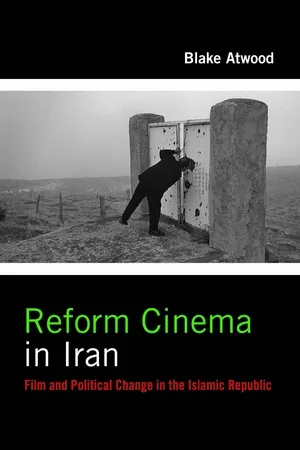
It is nearly impossible to separate contemporary Iranian cinema from the Islamic revolution that transformed film production in the country in the late 1970s. As the aims of the revolution shifted and hardened once Khomeini took power and as an eight-year war with Iraq dragged on, Iranian filmmakers confronted new restrictions. In the 1990s, however, the Reformist Movement, led by Mohammad Khatami, and the film industry, developed an unlikely partnership that moved audiences away from revolutionary ideas and toward a discourse of reform. In Reform Cinema in Iran, Blake Atwood examines how new industrial and aesthetic practices created a distinct cultural and political style in Iranian film between 1989 and 2007.
Atwood analyzes a range of popular, art, and documentary films. He provides new readings of internationally recognized films such as Abbas Kiarostami's Taste of Cherry (1997) and Mohsen Makhmalbaf's Time for Love (1990), as well as those by Rakhshan Bani, Masud Kiami, and other key Iranian directors. At the same time, he also considers how filmmakers and the film industry were affected by larger political and religious trends that took shape during Mohammad Khatami's presidency (1997-2005). Atwood analyzes political speeches, religious sermons, and newspaper editorials and pays close attention to technological developments, particularly the rise of video, to determine their role in democratizing filmmaking and realizing the goals of political reform. He concludes with a look at the legacy of reform cinema, including films produced under Mahmoud Ahmadinejad, whose neoconservative discourse rejected the policies of reform that preceded him.
- English
- ePUB (mobile friendly)
- Available on iOS & Android
eBook - ePub
About this book
Information
Subtopic
Film & VideoTable of contents
- Cover
- Series Page
- Title Page
- Copyright
- Contents
- A Note on Transliteration
- Acknowledgments
- Introduction: Revolutionary Cinema and the Logic of Reform
- 1. When Love Entered Cinema: Mysticism and the Emerging Poetics of Reform
- 2. Screening Reform: Campaign Movies, Documentaries, and Urban Tehran
- 3. Video Democracies: Or, The Death of the Filmmaker
- 4. Who Killed the Tough Guy? Continuity and Rupture in the Filmfārsi Tradition
- 5. Film Archives and Online Videos: The Search for Reform in Post-Khatami Iran
- Conclusion: Iran’s Cinema Museum and Political Unrest
- Notes
- Bibliography
- Filmography
- Index
- Series List
Trusted by 375,005 students
Access to over 1.5 million titles for a fair monthly price.
Study more efficiently using our study tools.
Frequently asked questions
Yes, you can cancel anytime from the Subscription tab in your account settings on the Perlego website. Your subscription will stay active until the end of your current billing period. Learn how to cancel your subscription
No, books cannot be downloaded as external files, such as PDFs, for use outside of Perlego. However, you can download books within the Perlego app for offline reading on mobile or tablet. Learn how to download books offline
Perlego offers two plans: Essential and Complete
- Essential is ideal for learners and professionals who enjoy exploring a wide range of subjects. Access the Essential Library with 800,000+ trusted titles and best-sellers across business, personal growth, and the humanities. Includes unlimited reading time and Standard Read Aloud voice.
- Complete: Perfect for advanced learners and researchers needing full, unrestricted access. Unlock 1.5M+ books across hundreds of subjects, including academic and specialized titles. The Complete Plan also includes advanced features like Premium Read Aloud and Research Assistant.
We are an online textbook subscription service, where you can get access to an entire online library for less than the price of a single book per month. With over 1.5 million books across 990+ topics, we’ve got you covered! Learn about our mission
Look out for the read-aloud symbol on your next book to see if you can listen to it. The read-aloud tool reads text aloud for you, highlighting the text as it is being read. You can pause it, speed it up and slow it down. Learn more about Read Aloud
Yes! You can use the Perlego app on both iOS and Android devices to read anytime, anywhere — even offline. Perfect for commutes or when you’re on the go.
Please note we cannot support devices running on iOS 13 and Android 7 or earlier. Learn more about using the app
Please note we cannot support devices running on iOS 13 and Android 7 or earlier. Learn more about using the app
Yes, you can access Reform Cinema in Iran by Blake Atwood in PDF and/or ePUB format, as well as other popular books in Media & Performing Arts & Film & Video. We have over 1.5 million books available in our catalogue for you to explore.