Shorlisted for the BAFTSS 2020 Award for Best Monograph
Despite his films being subjected to censorship and denigration in his native China, Jia Zhangke has become the country's leading independent film director internationally. Seen as one of world cinema's foremost auteurs, he has played a crucial role in documenting and reflecting upon China's era of intense transformations
since the 1990s.
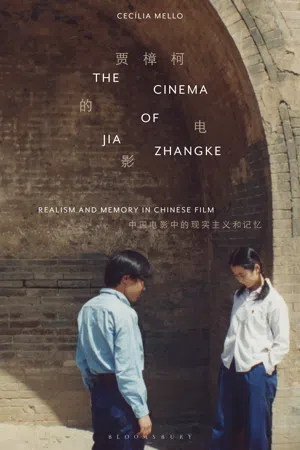
Cecília Mello provides in-depth analysis of Jia's unique body of work, from his early films Xiao Wu and Platform, to experimental quasi-documentary 24 City and the audacious Mountains May Depart. Mello suggests that Jia's particular expression of the realist mode is shaped by the aesthetics of other Chinese artistic traditions, allowing Jia to unearth memories both personal and collective, still lingering within the ever-changing landscapes of contemporary China. Mello's groundbreaking study opens
a door into Chinese cinema and culture, addressing the nature of the so-called 'impure' cinematographic art and the complex representation of China through the ages.
Foreword by Walter Salles
- 320 pages
- English
- ePUB (mobile friendly)
- Available on iOS & Android
eBook - ePub
About this book
Information
1
Introduction: Jia Zhangke, realism, impurity and memory
China is developing rapidly. Everything happens fast. For us, the key is to hold tight to our camera, hold tight to our power.
Jia Zhangke (2009b: 133)
This book offers an analysis of the work of China’s leading independent film director, Jia Zhangke, from the point of view of its at once realist and intermedial impulse. Born in 1970 in Fenyang, Shanxi province, located in the north of China, Jia started making films in the 1990s as a student in Beijing. At first, he was largely seen as the main representative of the so-called sixth generation of Chinese film-makers, whose films signalled a move towards realism in their incorporation of contemporary issues and in their depiction of the urban landscapes of the country. Now, he has long outgrown this label of convenience to become one of world cinema’s most original and important directors. Thus far, he has made twenty-seven films, including features and shorts, documentaries and fiction,1 and has garnered a reputation both nationally and abroad, where he has been lauded with awards at prestigious film festivals such as Venice and Cannes. As well as a film-maker, Jia has been displaying what can be described as a polymathic nature: he is a film producer,2 occasional actor,3 initiator of a film festival,4 lecturer in film and art at the Central Academy of Fine Arts in Beijing and the founding partner of four different film companies.5 He owns a restaurant and a cultural centre;6 he has published books and screenplays, some of which have been translated into French and English; he has currently over 16 million followers on Weibo, having become a sort of pundit despite the persistent tension between him and the Chinese censorship officials, now eased judging by his recent role as one of the many new deputies to the National People’s Congress in 2018.7 Not surprisingly, he has also been the face of publicity campaigns for Johnnie Walker, Moleskine and other labels, and has featured on a number of popular magazines in his country, including in-flight and in-train ones.8 Finally, he has been the subject of four documentaries,9 one made for Chinese television and the other three by international film-makers, most notably Walter Salles, who in 2014 shot an affective portrait of his Chinese colleague, whom he considers to be this generation’s most important world film director.
The centrality and importance of Jia Zhangke’s work in today’s cinematographic landscape seem to corroborate the polycentric definition of world cinema proposed by Lúcia Nagib in her essay ‘Towards a Positive Definition of World Cinema’ (2006). Drawing on Stam and Shohat’s foundational Unthinking Eurocentrism (1994), Nagib refuted the binary division between centre (Hollywood) and periphery (the rest of the world) and proposed instead a polycentric, democratic and inclusive approach to the study of world cinema. According to Nagib, this polycentrism is characterized by peaks of creation in different countries around the world, which normally appear during periods of crisis and transition. Today, this view seems in tune with the current political and economic scenario in which new powers emerge in different points of the planet, thus leading to a polycentric global configuration. By taking these observations into account, it would be fair to say that Jia Zhangke’s work represents a peak of creation within this polycentric ‘atlas of world cinema’ (Andrew 2006), emerging from China and responding to a new reality through an original aesthetics. In fact, one could argue that the originality of his aesthetic contribution corroborates the idea that cinema’s greatest innovators tend to thrive in periods of cultural and historical transition, when a new conjuncture calls for the articulation of a new language – or new languages – better suited to address and respond to a new reality (Mello 2006). Such innovations are also quite often the fruit of a combination of technological advances, aesthetic originality and a political will.
Jia Zhangke’s oeuvre shares a similarity with previous and current innovations in film production across the globe in that it is concerned with cinema’s relationship with reality, springing first and foremost from a realist impulse. Cinematographic realism is, of course, a malleable concept, frequently fragmented into smaller categories or subspecies (Andrew 1995: 198), and often defined in relation to a particular period and a particular place (Bazin 1958: 156). It is nonetheless possible to speak of certain common currencies in realist cinema, both in terms of subject matter and its modes of production, which relate to the type of realism observed in Jia’s cinema. Raymond Williams’s defining characteristics of realism, for instance, were a focus on contemporary and secular action and, most importantly, ‘a conscious movement towards social extension’ (1977: 63). In cinema, this means that realist turns often seek to articulate hitherto hidden or repressed facets of reality, operating under a revelatory principle. In his turn, André Bazin (1958; 2002), who has given the most enduring contribution to this debate, identified realist modes of production such as the technique of deep focus and the long take, grounded on the ontological foundations of cinematographic art, as well as location shooting with natural light and the use of semi- or non-professional actors, as central to cinematographic realism’s revelatory principle. These remain to this day associated with realist experiences in the cinema, albeit in their myriad forms and functions.
The films of Jia Zhangke share an affinity with these characteristics and he could, of his own accord, be called a Bazinian film-maker (Frodon 2008: 76–7; Li Lei-wei 2008: 78; Osnos 2009). As a student of film theory at the Beijing Film Academy (BFA) in the early to mid-1990s, Jia had the opportunity to read fresh translations of some of the most important works in film theory that had only been made available in China in the 1980s.10 Bazin’s view of cinema as the art of reality had a particular impact on him, and he became a diligent follower of Bazin’s canon, with an early preference for De Sica and Bresson (Frodon and Salles 2014). Likewise, Jia’s emphasis on contemporary Chinese social and economic issues such as migrant workers, criminality, pollution, unemployment, violence and prostitution also firmly place him within the realm of realist film-making, one that he claims derives from his own background growing up in the backwater town of Fenyang in Shanxi province (Jia 2009b: 45–6). It is no surprise, therefore, to identify in Jia’s work traces of post-war Italian neorealist practices, alive in his desire to establish a direct approach with the real in all its materiality, ambiguity, contingency and mystery. His is a cinema mindful and respectful of the existential link between reality and its image, between sign and object. Dudley Andrew has called it a ‘cinema of discovery’ (2010: 60), and recently Jia himself claimed likewise in an interview to Chinese film magazine Contemporary Cinema, stressing how for him film-making is indeed about ‘discovery/发现’ (Yang and Jia 2015: 38).
If Jia’s biography seems to lend him his realist credentials, his cinema can also be located within the tendency of a ‘return of the real’ in contemporary cinema, which saw, from the mid-1990s onwards, the waning of irony and intertextuality and a reconnection between the moving image and objective reality, leading to new definitions of realism (Nagib and Mello 2009). It is interesting to note that this adherence to realism coincided with the introduction and subsequent prevalence of digital technology in film production, which facilitated the creation of real-like images with no referent in the physical world (Hansen 1997). This brought into question Bazin’s ‘ontology of the photographic image’ (1958) or its translation into Peirce’s semiotic terms ‘indexicality’ (Wollen [1969] 1998) as the basis for cinematographic realism. While some were quick to announce the loss of the indexical properties of the cinematographic image, it is crucial to notice that digital technology has more often than not enabled a closer contact between cinema and reality by facilitating the shooting in real locations and with real characters and practically without artificial light. It has also allowed for the expansion and resignification of the use of techniques normally associated with realism such as the Bazinian long take, championed by film-makers around the globe such as Tsai Ming-liang, Carlos Reygadas, Gus Van Sant, Apichatpong Weerasethakul, Pedro Costa, Alexander Sokurov and Béla Tarr (Nagib and Mello 2009; de Luca 2014). Jia Zhangke’s cinema is a good example of the use of digital technology, starting with In Public (公共场所 Gong gong chang suo, 2001) and most notably Unknown Pleasures (任逍遥 Ren xiao yao, 2002), as a means to achieve a type of Bazinian aesthetic realism connected to prolonged observation, the use of the long take as well as the shooting in real locations with semi- or non-professional actors. Technology, therefore, acted in the first instance to reinforce this realist impulse,11 for, as Dudley Andrew observes, his idea of cinema ‘does not rise or fall with technology. A cinema of discovery and revelation can employ any sort of camera’ (2010: 60).
An itinerant impulse: Jia’s cinematic geography
From the mid-1990s onwards, starting with analogue video cameras, moving briefly to 16 mm and 35 mm celluloid film and finally embracing the digital, Jia’s cinema has been discovering and revealing, first and foremost, the real urban landscapes of contemporary China. This means being confronted with an unstable environment, ever-changing since the start of Deng Xiaoping’s Era of Reforms (改革开放 gaige kaifang) in December 1978, which led China into a market economy, completely revolutionizing the country’s social tapestry and not least its geography. Under Deng, following the harsh years of the Cultural Revolution (1966–76), China had begun to steadily improve its relations with the outside world and to open up its economy to foreign investment. Internally, it decollectivized agriculture, gradually privatized its industry and allowed for the appearance of private businesses. These were dramatic economic reforms whose effects were felt with intensity in the urban spaces of the country, as Zhang Zhen points out:
In the 1990s Chinese cities both large and small have seen tremendous changes in both infrastructural and social dimensions. Vernacular housing compounds, neighbourhoods and old communities of commerce and culture have been torn down to give way to expressways, subway stations, corporate buildings, and shopping malls – all in the wake of a ruthlessly advancing market economy and the incursion of global capitalism. (2007a: 3)
It is therefore within a dramatically shifting panorama that Jia Zhangke articulates his original aesthetic, moved by a desire to register and to preserve – through cinema’s unique recording ability – an ephemeral space. As Jia has acknowledged in several interviews in the past decade (see, e.g., M. Berry 2009; Fiant 2009; Jia 2009b; Mello 2014c), he is conscious of how memory is a spatial as much as a temporal phenomenon, and of how a disappearing space implies the loss of memory. From this, he derives an urgency to film these spaces and these memories, felt to be always on the cusp of disappearance. At the same time, he cultivates a seemingly contradictory slowness in observation, almost as an act of resistance in the face of the speed of transformations, which he regards as a ‘form of violenc...
Table of contents
- Cover
- Halftitle Page
- Dedication Page
- Series Page
- Author Bio
- Title Page
- Contents
- Figures
- 2022 Preface
- Foreword
- Acknowledgements
- Note on transliteration
- 1 Introduction: Jia Zhangke, realism, impurity and memory
- 2 The walls of China: Between ephemerality and permanence
- 3 Pingyao’s city walls: On-location filming and the weight of history
- 4 Pop music’s sonic memories
- 5 Landscape painting, Chinese philosophy and the aesthetic innovation of Still Life
- 6 Opera, wuxia and China’s imagined civilization
- 7 Painterly still lifes and photographic poses
- 8 Garden heterotopias and the memory of space
- 9 I Wish I Knew’s cinephilic journeys (an afterword on intertextuality)
- Appendix I Filmography
- Appendix II Songography
- Notes
- Bibliography
- Index
- Copyright Page
Trusted by 375,005 students
Access to over 1.5 million titles for a fair monthly price.
Study more efficiently using our study tools.
Frequently asked questions
Yes, you can cancel anytime from the Subscription tab in your account settings on the Perlego website. Your subscription will stay active until the end of your current billing period. Learn how to cancel your subscription
No, books cannot be downloaded as external files, such as PDFs, for use outside of Perlego. However, you can download books within the Perlego app for offline reading on mobile or tablet. Learn how to download books offline
Perlego offers two plans: Essential and Complete
- Essential is ideal for learners and professionals who enjoy exploring a wide range of subjects. Access the Essential Library with 800,000+ trusted titles and best-sellers across business, personal growth, and the humanities. Includes unlimited reading time and Standard Read Aloud voice.
- Complete: Perfect for advanced learners and researchers needing full, unrestricted access. Unlock 1.5M+ books across hundreds of subjects, including academic and specialized titles. The Complete Plan also includes advanced features like Premium Read Aloud and Research Assistant.
We are an online textbook subscription service, where you can get access to an entire online library for less than the price of a single book per month. With over 1.5 million books across 990+ topics, we’ve got you covered! Learn about our mission
Look out for the read-aloud symbol on your next book to see if you can listen to it. The read-aloud tool reads text aloud for you, highlighting the text as it is being read. You can pause it, speed it up and slow it down. Learn more about Read Aloud
Yes! You can use the Perlego app on both iOS and Android devices to read anytime, anywhere — even offline. Perfect for commutes or when you’re on the go.
Please note we cannot support devices running on iOS 13 and Android 7 or earlier. Learn more about using the app
Please note we cannot support devices running on iOS 13 and Android 7 or earlier. Learn more about using the app
Yes, you can access The Cinema of Jia Zhangke by Cecília Mello in PDF and/or ePUB format, as well as other popular books in Media & Performing Arts & Film & Video. We have over 1.5 million books available in our catalogue for you to explore.