From the mid-fifteenth century to the close of the nineteenth, it is estimated that more than 12 million people from Africa were forced onto slave ships and transported to the Americas; at least 11 million survived the journey. Even after Britain banned the importation of African slaves in its colonies in 1807, and the u.s. followed suit in 1808, more than 3 million Africans made the terrible transit across the Atlantic. Slavery itself was not finally ended until Brazilian emancipation in 1888.
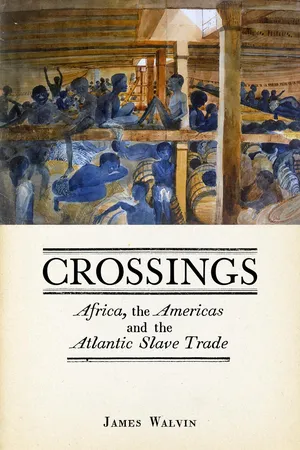
Crossings explores the broad sweep of slavery across the Atlantic world, revealing the extraordinary efforts to end it as well as the remarkable degree to which slavery and the slave trade managed to survive, even to the present day. In the most authoritative history of the entire slave trade to date, James Walvin returns the emphasis of the story to its origins in Africa. It was here that the trade originated, here that the terrible ordeal of slaves began, and here that the scars remain today. Journeying across the ocean, Crossings also explores the history of Portugese, French and British colonies, as well as its development in the usa, and shows how Brazilian slavery was central to the development of the slave trade itself: that country tested techniques and methods for trading and slavery that were successfully exported to the Caribbean and the rest of the Americas in the following centuries.
This book examines some vital unanswered questions, such as how did a system which the Western world had come to regard with distaste manage to survive for so long? And why were the British – so fundamental in developing and perfecting the slave trade – so prominent in its eradication? This groundbreaking study makes use of major new developments in research, rendering them available to a broad readership for the first time and offering a new understanding of one of the most important, and tragic, episodes in world history.
To read James Walvin's blog post Why Won't Slavery Go Away please click here.
- English
- ePUB (mobile friendly)
- Available on iOS & Android
eBook - ePub
About this book
Information
References
Introduction
1 For a criticism of the idea of Atlantic history, see J. H. Elliott, History in the Making (London and New Haven, CT, 2012), pp. 203–08.
1 Africa and Africans
1 For the details of Jacques Francis, see Gustav Ungerer, The Mediterranean Apprenticeship of British Slavery (Madrid, 2008); ‘Recovering a Black African’s Voice in an English Lawsuit’, Medieval and Renaissance Drama in England, 17 (2005).
2 Natalie Zemon Davis, Trickster Travels: In Search of Leo Africanus, A Sixteenth-century Muslim between Two Worlds (London, 2007), p. 4.
3 Philip Curtin, The Image of Africa (Madison, WI, 1964), pp. 10–11.
4 G. V. Scammell, The First Imperial Age: European Overseas Expansion, c. 1400–1715 (London, 1992), pp. 54–6.
5 J. H. Parry, The Discovery of the Sea (London, 1974), pp. 24–6.
6 Ibid., chap. 6.
7 Ibid., p. 42.
8 E.G.R. Taylor, The Haven-finding Art: A History of Navigation from Odysseus to Captain Cook (London, 1956), pp. 156–61; C. R. Boxer, The Portuguese Seaborne Empire (London, 1969), pp. 27–8.
9 David E. Waters, The Art of Navigation in England in Elizabethan and Early Stuart Times (London, 1958), pp. 11–15.
10 J. H. Parry, The European Reconnaissance (New York, 1968), pp. 323–7.
11 Boxer, The Portuguese Seaborne Empire, pp. 27–8.
12 Peter Russell, Prince Henry ‘The Navigator’: A Life (New Haven, CT, 2001), p. 297.
13 My italics. The Journal of a Slave Trader (John Newton, 1750–1754), ed. Bernard Martin and Mark Spurrell (London, 1962), 13, 16 and 19 October 1750, pp. 10–11.
14 Hugh Thomas, The Slave Trade: The History of the Atlantic Slave Trade, 1440–1870 (London, 1997), pp. 64–7.
15 Boxer, The Portuguese Seaborne Empire, pp. 20–23.
16 Annemarie Jordan, ‘Images of Empire: Slaves in the Lisbon Household and Court of Catherine of Austria’, in Black Africans in Renaissance Europe, ed. T. F. Earle and K.J.P. Lowe (Cambridge, 2005), chap. 7.
17 See ‘Northern Africa in a Wider World’, in Philip Curtin, Steven Feierman, Leonard Thompson and Jan Vansina, African History (Harlow, 1978), chap. 2.
18 John Iliffe, Africans: The History of a Continent (Cambridge, 1995), p. 42.
19 Fernand Braudel, The Mediterranean and the Mediterranean World in the Age of Philip 11 (Berkeley, CA and London, 1992), vol. I, pp. 466–8.
20 Ibid., p. 469.
21 David Abulafia, The Discovery of Mankind: Atlantic Encounters in the Age of Columbus (New Haven, CT, 2008), pp. 65–8.
22 Boxer, The Portuguese Seaborne Empire, p. 24.
23 Elizabeth Donnan, Documents Illustrative of the History of the Slave Trade to America (Washington, DC, 1965), vol. I: 1441–1700, p. 3.
24 Donnan, Documents Illustrative, p. 32, n. 26.
25 James Walvin, Atlas of Slavery (London, 2006), p. 23.
26 Curtin et al., African History, p. 108.
27 John Reader, Africa: A Biography of a Continent (London, 1998), p. 284.
28 Iliffe, Africans, pp. 129–30.
29 Sidney Mintz, Sweetness and Power: The Place of Sugar in Modern History (London, 1985).
30 Robert Harmes, The Diligent: A Voyage through the Worlds of the Slave Trade (Oxford, 2002), p. 286.
31 Walvin, Atlas of Slavery, chap. 6; David Eltis and David Richardson, Atlas of the Transatlantic Slave Trade (New H...
Table of contents
- Front Cover
- Half Title
- Title Page
- Copyright
- Contents
- Introduction
- ONE Africa and Africans
- TWO Slave Trading on the Coast
- THREE Slave Ships, Cargoes and Sailors
- FOUR The Sea
- FIVE Mutinies and Revolts
- SIX Landfall
- SEVEN Resistance
- EIGHT Chasing the Slave Ships: Abolition and After
- NINE The Durable Institution: Slavery after Abolition
- TEN Then and Now: Slavery and the Modern World
- REFERENCES
- ACKNOWLEDGEMENTS
- PHOTO ACKNOWLEDGEMENTS
- INDEX
Trusted by 375,005 students
Access to over 1.5 million titles for a fair monthly price.
Study more efficiently using our study tools.
Frequently asked questions
Yes, you can cancel anytime from the Subscription tab in your account settings on the Perlego website. Your subscription will stay active until the end of your current billing period. Learn how to cancel your subscription
No, books cannot be downloaded as external files, such as PDFs, for use outside of Perlego. However, you can download books within the Perlego app for offline reading on mobile or tablet. Learn how to download books offline
Perlego offers two plans: Essential and Complete
- Essential is ideal for learners and professionals who enjoy exploring a wide range of subjects. Access the Essential Library with 800,000+ trusted titles and best-sellers across business, personal growth, and the humanities. Includes unlimited reading time and Standard Read Aloud voice.
- Complete: Perfect for advanced learners and researchers needing full, unrestricted access. Unlock 1.5M+ books across hundreds of subjects, including academic and specialized titles. The Complete Plan also includes advanced features like Premium Read Aloud and Research Assistant.
We are an online textbook subscription service, where you can get access to an entire online library for less than the price of a single book per month. With over 1.5 million books across 990+ topics, we’ve got you covered! Learn about our mission
Look out for the read-aloud symbol on your next book to see if you can listen to it. The read-aloud tool reads text aloud for you, highlighting the text as it is being read. You can pause it, speed it up and slow it down. Learn more about Read Aloud
Yes! You can use the Perlego app on both iOS and Android devices to read anytime, anywhere — even offline. Perfect for commutes or when you’re on the go.
Please note we cannot support devices running on iOS 13 and Android 7 or earlier. Learn more about using the app
Please note we cannot support devices running on iOS 13 and Android 7 or earlier. Learn more about using the app
Yes, you can access Crossings by James Walvin,Walvin, James in PDF and/or ePUB format, as well as other popular books in Social Sciences & African History. We have over 1.5 million books available in our catalogue for you to explore.