
- 196 pages
- English
- ePUB (mobile friendly)
- Available on iOS & Android
eBook - ePub
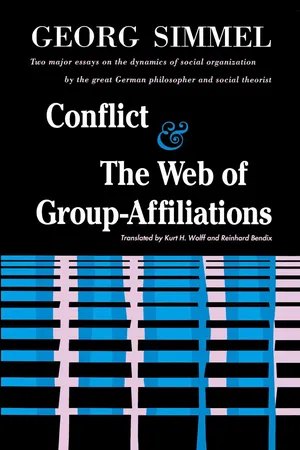
Conflict And The Web Of Group Affiliations
About this book
Two major essays on the dynamics of social organization by the great German philosopher and social theorist Georg Simmel.
Frequently asked questions
Yes, you can cancel anytime from the Subscription tab in your account settings on the Perlego website. Your subscription will stay active until the end of your current billing period. Learn how to cancel your subscription.
At the moment all of our mobile-responsive ePub books are available to download via the app. Most of our PDFs are also available to download and we're working on making the final remaining ones downloadable now. Learn more here.
Perlego offers two plans: Essential and Complete
- Essential is ideal for learners and professionals who enjoy exploring a wide range of subjects. Access the Essential Library with 800,000+ trusted titles and best-sellers across business, personal growth, and the humanities. Includes unlimited reading time and Standard Read Aloud voice.
- Complete: Perfect for advanced learners and researchers needing full, unrestricted access. Unlock 1.4M+ books across hundreds of subjects, including academic and specialized titles. The Complete Plan also includes advanced features like Premium Read Aloud and Research Assistant.
We are an online textbook subscription service, where you can get access to an entire online library for less than the price of a single book per month. With over 1 million books across 1000+ topics, weâve got you covered! Learn more here.
Look out for the read-aloud symbol on your next book to see if you can listen to it. The read-aloud tool reads text aloud for you, highlighting the text as it is being read. You can pause it, speed it up and slow it down. Learn more here.
Yes! You can use the Perlego app on both iOS or Android devices to read anytime, anywhere â even offline. Perfect for commutes or when youâre on the go.
Please note we cannot support devices running on iOS 13 and Android 7 or earlier. Learn more about using the app.
Yes, you can access Conflict And The Web Of Group Affiliations by George Simmel in PDF and/or ePUB format, as well as other popular books in Business & Marketing. We have over one million books available in our catalogue for you to explore.
Information
Conflict1
TRANSLATED BY KURT H. WOLFF
1 The title of this essay is Der Streit. âStreitâ is usually translated as âquarrel,â but has a broader meaning for Simmel; hence âconflictâ seems better. The essay is Chapter 4 of Soziologie (1908); it is translated from the third edition of this work (1923; pp. 186-255). All sub-headings are supplied, as are passages in brackets. An earlier translation of a considerably different original by Albion W. Small (âThe Sociology of Conflict,â The American Journal of Sociology, Vol. IX, 1904), has been examined, but is not the basis of the present rendition. For a fuller bibliographical reference to Smallâs translation, see The Sociology of Georg Simmel, transl., ed., and with an introd. by Kurt H. Wolff (Glencoe, Illinois: The Free Press, 1950), p. lviii.âTr.
Chapter One
The Sociological Nature of Conflict
CONFLICT AS SOCIATION
THE SOCIOLOGICAL SIGNIFICANCE of conflict (Kampf) has in principle never been disputed. Conflict is admitted to cause or modify interest groups, unifications, organizations. On the other hand, it may sound paradoxical in the common view if one asks whether irrespective of any phenomena that result from conflict or that accompany it, it itself is a form of sociation.2 At first glance, this sounds like a rhetorical question. If every interaction among men is a sociation, conflictâafter all one of the most vivid interactions, which, furthermore, cannot possibly be carried on by one individual aloneâmust certainly be considered as sociation. And in fact, dissociating factorâhate, envy, need, desireâare the causes of conflict; it breaks out because of them. Conflict is thus designed to resolve divergent dualisms; it is a way of achieving some kind of unity, even if it be through the annihilation of one of the conflicting parties. This is roughly parallel to the fact that it is the most violent symptom of a disease which represent the effort of the organism to free itself of disturbances and damages caused by them.
But this phenomenon means much more than the trivial âsi vis pacem para bellumâ [if you want peace, prepare for war]; it is something quite general, of which this maxim only describes a special case. Conflict itself resolves the tension between contrasts. The fact that it aims at peace is only one, an especially obvious, expression of its nature: the synthesis of elements that work both against and for one another. This nature appears more clearly when it is realized that both forms of relationâthe antithetical and the convergentâare fundamentally distinguished from the mere indifference of two or more individuals or groups. Whether it implies the rejection or the termination of sociation, indifference is purely negative. In contrast to such pure negativity, conflict contains something positive. Its positive and negative aspects, however, are integrated; they can be separated conceptually, but not empirically.
THE SOCIOLOGICAL RELEVANCE OF CONFLICT
SOCIAL PHENOMENA appear in a new light when seen from the angle of this sociologically positive character of conflict. It is at once evident then that if the relations among men (rather than what the individual is to himself and in his relations to objects) constitute the subject matter of a special science, sociology, then the traditional topics of that science cover only a subdivision of it: it is more comprehensive and is truly defined by a principle. At one time it appeared as if there were only two consistent subject matters of the science of man: the individual unit and the unit of individuals (society); any third seemed logically excluded. In this conception, conflict itselfâirrespective of its contributions to these immediate social unitsâfound no place for study. It was a phenomenon of its own, and its subsumption under the concept of unity would have been arbitrary as well as useless, since conflict meant the negation of unity.
A more comprehensive classification of the science of the relations of men should distinguish, it would appear, those relations which constitute a unit, that is, social relations in the strict sense, from those which counteract unity.3 It must be realized, however, that both relations can usually be found in every historically real situation. The individual does not attain the unity of his personality exclusively by an exhaustive harmonization, according to logical, objective, religious, or ethical norms, of the contents of his personality. On the contrary, contradiction and conflict not only precede this unity but are operative in it at every moment of its existence. Just so, there probably exists no social unit in which convergent and divergent currents among its members are not inseparably interwoven. An absolutely centripetal and harmonious group, a pure âunificationâ (âV ereinigungâ), not only is empirically unreal, it could show no real life process. The society of saints which Dante sees in the Rose of Paradise may be like such a group, but it is without any change and development; whereas the holy assembly of Church Fathers in Raphaelâs Disputa shows if not actual conflict, at least a considerable differentiation of moods and directions of thought, whence flow all the vitality and the really organic structure of that group. Just as the universe needs âlove and hate,â that is, attractive and repulsive forces, in order to have any form at all, so society, too, in order to attain a determinate shape, needs some quantitative ratio of harmony and disharmony, of association and competition, of favorable and unfavorable tendencies. But these discords are by no means mere sociological liabilities or negative instances. Definite, actual society does not result only from other social forces which are positive, and only to the extent that the negative factors do not hinder them. This common conception is quite superficial: society, as we know it, is the result of both categories of interaction, which thus both manifest themselves as wolly positive.4
UNITY AND DISCORD
THERE IS a misunderstanding according to which one of these two kinds of interaction tears down what the other builds up, and what is eventually left standing is the result of the subtraction of the two (while in reality it must rather be designated as the result of their addition). This misunderstanding probably derives from the twofold meaning of the concept of unity. We designate as âunityâ the consensus and concord of interacting individuals, as against their discords, separations, and disharmonies. But we also call âunityâ the total group-synthesis of persons, energies, and forms, that is, the ultimate wholeness of that group, a wholeness which covers both strictly-speaking unitary relations and dualistic relations. We thus account for the group phenomenon which we feel to be âunitaryâ in terms of functional components considered specifically unitary; and in so doing, we disregard the other, larger meaning of the term.
This imprecision is increased by the corresponding two-fold meaning of âdiscordâ or âopposition.â Since discord unfolds its negative, destructive character between particular individuals, we naĂŻvely conclude that it must have the same effect on the total group. In reality, however, something which is negative and damaging between individuals if it is considered in isolation and as aiming in a particular direction, does not necessarily have the same effect within the total relationship of these individuals. For, a very different picture emerges when we view the conflict in conjunction with other interactions not affected by it. The negative and dualistic elements play an entirely positive role in this more comprehensive picture, despite the destruction they may work on particular relations. All this is very obvious in the competition of individuals within an economic unit.
CONFLICT AS AN INTEGRATIVE FORCE IN THE GROUP
HERE, among the more complex cases, there are two opposite types. First, we have small groups, such as the marital couple, which nevertheless involve an unlimited number of vital relations among their members. A certain amount of discord, inner divergence and outer controversy, is organically tied up with the very elements that ultimately hold the group together; it cannot be separated from the unity of the sociological structure. This is true not only in cases of evident marital failure but also in marriages characterized by a modus vivendi which is bearable or at least borne. Such marriages are not âlessâ marriages by the amount of conflict they contain; rather, out of so many elements, among which there is that inseparable quantity of conflict, they have developed into the definite and characteristic units which they are. Secondly, the positive and integrating role of antagonism is shown in structures which stand out by the sharpness and carefully preserved purity of their social divisions and gradations. Thus, the Hindu social system rests not only on the hierarchy, but also directly on the mutual repulsion, of the castes. Hostilities not only prevent boundaries within the group from gradually disappearing, so that these hostilities are often consciously cultivated to guarantee existing conditions. Beyond this, they also are of direct sociological fertility: often they provide classes and individuals with reciprocal positions which they would not find, or not find in the same way, if the causes of hostility were not accompanied by the feeling and the expression of hostilityâeven if the same objective causes of hostility were in operation.
The disappearance of repulsive (and, considered in isolation, destructive) energies does by no means always result in a richer and fuller social life (as the disappearance of liabilities results in larger property) but in as different and unrealizable a phenomenon as if the group were deprived of the forces of cooperation, affection, mutual aid, and harmony of interest. This is not only true for competition generally, which determines the form of the group, the reciprocal positions of its participants, and the distances between them, and which does so purely as a formal matrix of tensions, quite irrespective of its objective results. It is true also where the group is based on the attitudes of its members. For instance, the opposition of a member to an associate is no purely negative social factor, if only because such opposition is often the only means for making life with actually unbearable people at least possible. If we did not even have the power and the right to rebel against tyranny, arbitrariness, moodiness, tactlessness, we could not bear to have any relation to people from whose characters we thus suffer. We would feel pushed to take desperate stepsâand these, indeed, would end the relation but do not, perhaps, constitute âconflict.â Not only because of the fact (though it is not essential here) that oppression usually increases if it is suffered calmly and without protest, but also because opposition gives us inner satisfaction, distraction, relief, just as do humility and patience under different psychological conditions. Our opposition makes us feel that we are not completely victims of the circumstances. It allows us to prove our strength consciously and only thus gives vitality and reciprocity to conditions from which, without such corrective, we would withdraw at any cost.
Opposition achieves this aim even where it has no noticeable success, where it does not become manifest but remains purely covert. Yet while it has hardly any practical effect, it may yet achieve an inner balance (sometimes even on the part of both partners to the relation), may exert a quieting influence, produce a feeling of virtual power, and thus save relationships whose continuation often puzzles the observer. In such cases, opposition is an element in the relation itself; it is intrinsically interwoven with the other reasons for the relationâs existence. It is not only a means for preserving the relation but one of the concrete functions which actually constitute it. Where relations are purely external and at the same time of little practical significance, this function can be satisfied by conflict in its latent form, that is, by aversion and feelings of mutual alienness and repulsion which upon more intimate contact, no matter how occasioned, immediately change into positive hatred and fight.
Without such aversion, we could not imagine what form modern urban life, which every day brings everybody in contact with innumerable others, might possibly take. The whole inner organization of urban interaction is based on an extremely complex hierarchy of sympathies, indifferences, and aversions of both the most short-lived and the most enduring kind. And in this complex, the sphere of indifference is relatively limited. For, our psychological activity responds to almost every impression that comes from another person with a certain determinate feeling. The subconscious, fleeting, changeful nature of this feeling only seems to reduce it to indifference. Actually, such indifference would be as unnatural to us as the vague character of innumerable contradictory stimuli would be unbearable. We are protected against both of these typical dangers of the city by antipathy, which is the preparatory phase of concrete antagonism and which engenders the distances and aversions without which we could not lead the urban life at all. The extent and combination of antipathy, the rhythm of its appearance and disappearance, the forms in which it is satisfied, all these, along with the more literally unifying elements, produce the metropolitan form of life in its irresolvable totality; and what at first glance appears in it as dissociation, actually is one of its elementary forms of sociation.
HOMOGENEITY AND HETEROGENEITY IN SOCIAL RELATIONS
RELATIONS OF CONFLICT do not by themselves produce a social structure, but only in cooperation with unifying forces. Only both together constitute the group as a concrete, living unit. In this respect, conflict thus is hardly different from any other form of relation which sociology abstracts out of the complexity of actual life. Neither love nor the division of labor, neither the common attitude of two toward a third nor friendship, neither party affiliation nor superordination of subordination is likely by itself alone to produce or permanently sustain an actual group. Where this seems so nevertheless, the process which is given one name actually contains several distinguishable forms of relation. Human nature does not allow the individual to be tied to another by one thread alone, even though scientific analysis is not satisfied until it has determined the specific cohesive power of elementary units.
Yet perhaps this whole analytic activity is purely subjective in a higher and seemingly inverse sense of the word: perhaps the ties between individuals are indeed often quite homogeneous, but our mind cannot grasp their homogeneity. The very relations that are rich and live on many different contents are apt to make us most aware of this mysterious homogeneity; and what we have to do is to represent it as the co-efficiency of several cohesive forces which restrict and modify one another, resulting in the picture which objective reality attains by a much simpler and much more consistent route. Yet we cannot follow it with our mind even though we would.
Processes within the individual are, after all, of the same kind. At every moment they are so complex and contain such a multitude of variegated and contradictory oscillations that to designate them by any one of our psychological concepts is always imperfect and actually misleading. For, the moments of the individual life, too, are never connected by only one thread-this is the picture analytic thought constructs of the unity of the soul, which is inaccessible to it. Probably much of what we are forced to represent to ourselves as mixed feelings, as composites of many drives, as the competition of opposite sensations, is entirely self-consistent. But the calculating intellect often lacks a paradigm for this unity and thus must construe it as the result of several elements. When we are attracted and at the same time repelled by things; when nobler and baser character traits seem mixed in a given action; when our feeling for a particular person is composed of respect and friendship or of fatherly, motherly, and erotic impulses, or of ethical and aesthetic valuationsâthen certainly these phenomena in themselves, as real psychological processes, are often homogeneous. Only we cannot designate them directly. For this reason, by means of various analogies, antecedent motives, external consequences, we make them into a concert of several psychological elements.
If this is correct, then apparently complex relations between several individuals, too, must actually often be unitary. For instance, the distance which characterizes the relation between two associated individuals may appear to us as the result of an affection, which ought to bring about much greater closeness between them, and of a repulsion, which ought to drive them completely apart; and in as much as the two feelings restrict one another, the outcome is the distance we observe. But this may be entirely erroneous. The inner disposition of the relation itself may be those particular distances; basically the relation, so to speak, has a certain temperature which does not emerge as the balance of two temperatures, one higher, the other lower. We often interpret the quantity of superiority and suggestion which exists between two persons as produced by the strength of one of them, which is at the same time diminished by a certain weakness. While such strength and weakness may in fact exist, their separateness often does not become manifest in the actually existing relation. On the contrary, the relation may be determined by the total nature of its elements, and we analyze its immediate character into those two factors only by hindsight.
Erotic relations offer the most frequent illustrations. How often do they not strike us as woven together of love and respect, or disrespect; of love and the felt harmony of the individuals and, at the same time, their consciousness of supplementing each other through opposite traits; of love and an urge to dominate or the need for dependence. But what the observer or the participant himself thus divides into two intermingling trends may in reality be only one. In the relation as it actually exists, the total personality of the one acts on that of the other. The reality of the relation does not depend on the reflection that if it did not exist, its participants would at least inspire each other with respect or sympathy (or their contraries). Any number of times we designate such relations as mixed feelings or mixed relations, because we construe the effects the qualities of one individual would have upon the other if these qualities exerted their influence in isolationâwhich is precisely what they do not do in the relation as it exists. Aside from all this, the âmixtureâ of feelings and relations, even where we are fully entitled to speak of it, always remains a problematic expression. It uses a dubious symbolism to transfer a process which is represented spatially into the very different realm of psychological conditions.
This, then, probably is often the situation in respect to the so-called mixture of converging and diverging currents within a group. That is, the structure may be sui generis, its motivation and form being wholly self-consistent, and only in order to be able to describe and understand it, do we put it together, post factum, out of two tendencies, one monistic, the other antagonistic. Or else, these two do in fact exist, but only, as it were, before the relation itself originated. In the relation itself, they have fused into an organic unity in which neither makes itself felt with its own, isolated power.
This fact should not lead us to overlook the numerous cases in which contradictory tendencies really co-exist in separation and can thus be recognized at any moment in the over-all situation. As a special form of historical development, relations sometimes show at an early stage undifferentiated unity of convergent and divergent forces which separate only later with full distinctness. At courts in Central Europe we find, up to the thirteenth century, permanent bodies of noblemen who constitute a kind of council to the prince and live as his guests; but at the same time, almost like an estate, they represent nobility and must guard its interests even against the prince. The interests in common with those of the king (whose administration these nobles often serve) and the oppositional vigilance of their own rights as an estate exist in these councils not only separately side by side but in intimate fusion; and it is most likely that the position was felt as self-consistent, no matter how incompatible its elements appear to us now. In the England of that period, the baronial parliament is hardly yet distinguished from an enlarged royal council. Loyalty and critical or partisan opposition are still contained in germ-like unity. In general, as long as the problem is the crystallization of institutions whose task it is to solve the increasingly complex and intricate problem of the equilibrium within the group, it often is not clear whether the cooperation of forces for the benefit of the whole takes the form of opposition, competition, and criticism, or of ex...
Table of contents
- Cover Page
- Title Page
- Contents
- Foreword
- Conflict
- The Web of Group-Affiliations