- 272 pages
- English
- ePUB (mobile friendly)
- Available on iOS & Android
eBook - ePub
About this book
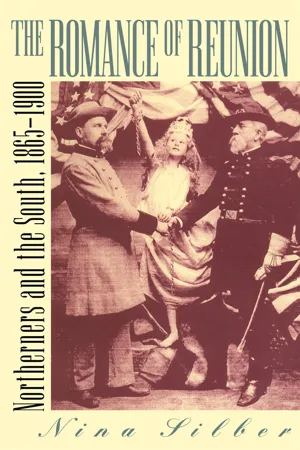
The reconciliation of North and South following the Civil War depended as much on cultural imagination as on the politics of Reconstruction. Drawing on a wide range of sources, Nina Silber documents the transformation from hostile sectionalism to sentimental reunion rhetoric. Northern culture created a notion of reconciliation that romanticized and feminized southern society. In tourist accounts, novels, minstrel shows, and popular magazines, northerners contributed to a mythic and nostalgic picture of the South that served to counter their anxieties regarding the breakdown of class and gender roles in Gilded Age America. Indeed, for many Yankees, the ultimate symbol of the reunion process, and one that served to reinforce Victorian values as well as northern hegemony, was the marriage of a northern man and a southern woman. Southern men also were represented as affirming traditional gender roles. As northern men wrestled with their nation's increasingly global and aggressive foreign policy, the military virtues extolled in Confederate legend became more admired than reviled. By the 1890s, concludes Silber, northern whites had accepted not only a newly resplendent image of Dixie but also a sentimentalized view of postwar reunion.
Trusted by 375,005 students
Access to over 1.5 million titles for a fair monthly price.
Study more efficiently using our study tools.
Information
1 INTEMPERATE MEN, SPITEFUL WOMEN, AND JEFFERSON DAVIS
NORTHERN VIEWS OF THE DEFEATED SOUTH
In the early morning hours of April 10, 1865, George Templeton Strong, a meticulous diarist of the mid-nineteenth century, was sleeping soundly in his comfortable Manhattan home. But, as Strong soon discovered, this was not to be a morning for sleeping late. The prominent New York lawyer’s repose was interrupted by “a series of vehement pulls at the front door bell” when a friend came by “to announce the surrender and that the rebel army of the Peninsula, Antietam, Fredericksburg, Chancellorsville, the Wilderness, Spotsylvania Court House, and other battles, has ceased to exist.” In a prophetic, but somewhat overly optimistic, afterthought, Strong reflected on the previous day’s events at Appomattox, observing that “it can bother and perplex none but historians henceforth forever.”1
The news of Robert E. Lee’s surrender to Ulysses S. Grant shattered the sleep of countless residents of the northern states on that morning of April 10. Charlotte Holbrooke, another New Yorker, was visiting family in Washington, D.C., when word of the Union victory arrived. “The first thing we heard of Lee’s surrender,” she wrote in a letter to her father, “was just before daylight yesterday when we were waked up by the thunder of the cannon just behind the house. We knew in a minute [what] the news was and rejoiced accordingly.”2
Throughout the North on April 10, 1865, and for the next few days thereafter, millions shared Strong’s and Holbrooke’s optimistic rejoicing. While some of the Confederate armies continued to do battle after Appomattox, Lee’s defeat occasioned one of the most joyous and enthusiastic celebrations many Americans had ever experienced. An estimated 100,000 people paraded through the streets of Chicago in celebration of the Union victory, and in cities and villages throughout the North there were festive processions, musical offerings, impromptu speech-making, and candlelight illuminations.3
Perhaps nowhere was the excitement more keenly felt than amongst the Union soldiers in the South. Edward Hamilton, the chaplain of the 7th Regiment of the New Jersey Volunteers found himself on the road to Lynchburg when word of the surrender arrived. “There was a scene of wild confusion & delight,” Hamilton recalled. “The men fired off their pieces with blank cartridges. Hats were thrown into the air. A battery kept firing a long salute.” As another soldier recalled, the scene at Appomattox itself was wildly euphoric and prompted a joint celebration of the blue and the gray. “It was hard to tell which side cheered the loudest, Rebs or Yanks. We were soon all mixed up, shaking hands, giving the johnnies grub & coffee & getting tobacco. It seemed more like meeting of dear old friends after long absence than of men ready to kill or be killed a few hours previously.”4
Apparently, as this account suggested, the joy of the surrender encouraged some northerners, stay-at-homes as well as soldiers, to view their former enemies with a spirit of fraternity and goodwill. “It is natural,” commented the Boston Post, “that this final success should … beget expressions of true magnanimity and forgiveness toward the people of the rebellious states, which, three or six months ago, would have been thought impossible. It is but a token of that solid and lasting reunion which we have always insisted was so easy of accomplishment, if proposed in the right spirit.” Certainly some of the first proponents of reunion were those who had never been ardent supporters of the war in the first place, northern Democrats and “Copperheads” who objected to the Republican party’s war policy. Yet even the most strident Unionists voiced sentiments of sympathy and forgiveness in the aftermath of Appomattox. In their eyes, a proper attitude toward the Union victory would reveal the righteousness of their cause and the purity of their devotion. As many explained it, nothing short of heartfelt generosity could be expected of a God-fearing and liberty-loving people. “We should be unworthy of (that) liberty entrusted to our care,” declared the North’s most famous clergyman, Henry Ward Beecher, “if, on such a day as this, we sullied our hearts by feelings of aimless vengeance.”5
Northerners used this moment of the surrender to draw conclusions about the war’s meaning and to elaborate on the lessons which they hoped Americans would draw from the experience. For men like Beecher, the lesson was of righteousness and forgiveness. For northern workers, Appomattox offered an occasion to reflect on the dignity of human toil, to urge that the Union struggle for free labor be extended to all who worked. Hence the question of the hour was not reunion or forgiveness, but the commitment to free labor for all—black and white, northern and southern. Boston’s labor newspaper, while rejoicing at the news of Lee’s surrender, also introduced a note of caution. “It is in vain that all this struggle has been experienced, if human rights and human brotherhood are not henceforth better recognized than ever before.”6
In a few quarters, a decidedly antireunion posture was adopted. Northern newspapers which leaned toward a Radical Republican position preferred to prolong the spirit of animosity, choosing this time to remind their readers of the traitorous deeds of the Confederacy. Others expressed their outrage at the slightest gesture of conciliation, believing that this would only give ammunition to a class of still unrepentant rebels. Indiana Radical Republican George Julian strongly objected to Beecher’s tone of forgiveness, suspecting that few could feel truly benevolent at this moment. “This fake magnanimity,” Julian reflected, “is to be our ruin after all. … The rebel officers in Richmond are strutting round the streets in full uniform looking as impudent as may be.”7
Julian’s remarks pointed to the depth of bitterness and anger that, for many, would not disappear simply with the cessation of the military conflict. Doubts surfaced in the early days after Appomattox regarding the Confederate leadership’s willingness to accept defeat. Nonetheless, the actual conclusion of the war prompted many to adopt a hopeful outlook toward the future and the improved economic and political relations that would follow. Hence, while many were still unwilling to trust the rebels, they were glad that the Union leaders had decisively gained the upper hand and could choose to set a tone of forgiveness. George Templeton Strong, like many others, had initially been apprehensive about Grant’s liberal terms of surrender with Lee and his men. Later, however, he approved of the Union leader’s decision to send the Confederate soldiers home, as they “will be a fountain of cold water on whatever pugnacity and chivalry may yet survive” in their own communities.8
Any bold expressions of reconciliation or more subtle subsiding of bitterness were shattered on the night of April 14. With the news of Appomattox only five days old, northerners awoke on April 15 to the news of President Lincoln’s assassination and the attempted assassination of Secretary of State William Seward. Reeling from the heights of joy to the depths of grief, they struggled to comprehend this first assassination of an American president. Those who lived far from any sources of communication learned of the joyful and the sorrowful all at once. Elizabeth Botume, a northerner living in Beaufort, South Carolina, and teaching school to freed slaves, gave her version of this onslaught of events. “The news of this surrender,” she recalled, “and the disbanding of Lee’s army, and the breaking up of the Confederacy, came with that of the death of President Lincoln. But the joy of the final victory was swallowed up in the grief of this last disaster.” This sudden upheaval inspired many to see a divinely orchestrated plan at work. The assassination confirmed deeply held religious sensibilities and an apocalyptic vision of the Civil War. Northern writer Rebecca Harding Davis believed that during this final month of the war “God was dealing with us as with his chosen people of old—by such great visible judgements that we almost heard his voice and saw his arm.” And others, like Davis, relied on their religious faith to comprehend the chaos of the war’s concluding moments. “The wisdom of Heaven,” explained the Boston Post, “is certainly in it all. We cannot see it now, but faith will reveal it to us as we advance.”9
Despite an abiding trust in God, many experienced this sudden change of circumstances with a sense of panic and uncertainty. Charlotte Holbrooke, still in Washington during the assassination and its aftermath, wrote to her brother two days after Lincoln’s death, describing how people gathered spontaneously to stay posted on the news, “for we did not know but that the entire government was to be attacked.” And Rachel Cormany, a resident of Chambersburg, Pennsylvania, recorded in her diary a similar sense of horror and anxiety. “What does it all mean,” she wrote on the day after the assassination. “Is anarchy and destruction coming upon us?”10
Behind the panic of northerners like Holbrooke and Cormany lay a terrifying suspicion that perhaps the Confederates were not prepared to surrender after all. Secretary of War Stanton, indicating his belief in a Confederate conspiracy behind Booth’s assault, merely voiced the apprehensions of many in the northern states. Northern resentment of haughty Confederate leaders and the “chivalric” southern aristocracy burst forth wildly and uncontrollably as newspapers, politicians, and other speakers sought to suppress even the dimmest expressions of mercy. The clergy struck an early chord against harmonious reconciliation between the sections. “What shall we say of the hellish power that aimed the blow?” proclaimed Reverend William Studley of Boston in his Easter Sunday sermon, two days after Lincoln’s assassination. “We thought we had already seen the depths of barbarism and savagery of which the slave-power is capable.” Sidney George Fisher, a scion of Philadelphia society, succinctly captured the altered emotions of April 15. “The national exultation at the prospects of peace & union,” he noted, “has been suddenly converted into alarm & grief.”11
The North concentrated its postassassination venom on the leaders of the Confederacy, the same men who had supposedly orchestrated the “slave power conspiracy” of the prewar years and who had foisted the secession movement on the rest of the South. Despite the fact that four years of war had shown that numerous white southerners had a more than superficial commitment to the Confederacy, many northerners emerged from the war clinging to the belief that the real enemies were not the common people of the South, not the average soldiers, but primarily the slaveholding leadership. Even after the assassination, various soldiers and civilians began to show an inclination to look upon the “misguided” Confederate soldiers with some sympathy and forgiveness. Very few, however, were willing to extend any consideration to the leaders, believing them most responsible for fomenting war and for keeping the mass of southerners in ignorance. The white southern masses may have joined in the rebellion, but, as many northerners saw it, they were partially excused out of their own blindness and stupidity, which had been cultivated over years of living under a tyrannical, slaveholding aristocracy. According to Harper’s Weekly, “The Southern people, who had grown up in ignorance and prejudice, the extent of which we can hardly comprehend, and who have been deluded into the active support of so enormous a conspiracy, have been deluded because their minds were prepared for delusion.” Now, in this final ignominious act, the southern leaders once again received the blame. “It is generally believed,” wrote Union soldier Charles Lynch, “there was a conspiracy among the leaders of the rebellion to murder Mr. Lincoln, so the cry is that the leaders must be punished.” The New York Tribune, while not convinced that Confederate leaders had actually plotted to kill the president, believed they must nonetheless assume the blame for having encouraged “a violence and bitterness of speech” among “the ignorant Southern rank and file.”12
This diatribe against the Confederate leadership signified more than just a political judgment; it also continued the northern free labor critique of southern slaveholders. In the heated ideological ferment of the prewar years, southerners had claimed superiority in military maneuvers, in economic productivity, in political leadership, and in refined civilization over the crass materialism of the North. As most northerners became convinced of the merits of the free labor system, however, they saw the southern system as one mired in indolence and idleness. In living off the enslaved labor of others, the southern aristocracy proved itself deficient and thereby incapable of honest and genuine leadership. In the pre–Civil War years one Wisconsin resident had described the southern ruling class as “a set of cowards, full of gasconade, and bad liquor, brought up to abuse negroes and despise the north, too lazy to work.” Such a class, many had concluded, had proven to be the economic, political, and social antithesis of everything the North represented.13
But, as historian Michael Adams has observed, there was also a flip side to this notion of free labor superiority. Many Yankees became convinced, especially in light of the early Confederate victories, that southern planters possessed a martial acumen which northerners lacked. Removed from the Yankee world of capital and commerce, southern men seemed to be closer to a world of violence and military valor, where knightly fortitude mattered more than money. Northerners, Adams notes, became psychologically terrorized by the image of the masterful southern soldier, an image which incapacitated them in many Civil War battles.14
The final defeat of these seemingly unstoppable warriors allowed the Yankees to make some much-needed psychological readjustments and to proclaim again their superiority in matters of war, leadership, and culture. With victory now secure, many northerners referred ironically to the southern “chivalry” as a class that had merely been posing at being cultured and refined. Indeed, to a people who viewed honest sentiments as the hallmark of true middle-class respectability, nothing could be more damning than the charge of hypocrisy and ostentation that was flung at the South’s aristocracy. “The pomp and pride of Southern chivalry,” claimed one Union soldier in New Orleans in the post-Appomattox days, “has no Charms for me.” Others sought to expose this “chivalry” as lazy, idle, and generally useless. According to many northerners, it was these pretenders—to both economic and political leadership—who now must suffer the consequences for having led the rebellion and, in an immediate sense, for murdering the nation’s beloved leader.15
At the heart of this attack on the “chivalry” was an attitude not only about labor and about hypocrisy, but also about gender. Firmly imbued with Victorian notions of gender behavior, and a commitment to firm demarcations between male and female “spheres,” middle-class northerners were quick to point out the ways in which southerners deviated from accepted norms. They evaluated southern men as weak and undisciplined parodies of manhood and southern women as aggressive creatures who stepped way beyond the bounds of appropriate femininity. Ultimately, their gendered analysis of the postwar South reflected a broader assessment of the power relations between the two sections in the new, reunified society. Yankees spoke of the need for a northern model of manliness, and perhaps for northern men themselves, to restore order to the defeated South. In short, they constructed a gendered view of postwar Dixie that very much fit with their concerns about subduing the South under northern political and economic authority.
On one level, northerners simply used their victory to declare that the manlier men had won the contest. Those of the middle and upper classes, especially, often focused their attack on the manhood of the southern leaders, chiding the “chivalry” for their dissipate ways and suggesting that southern masculinity lacked the restraint which was one hallmark of northern manliness. For the past several years, northerners had recoiled against the southern “bullies” and “braggarts” who had loudly proclaimed their superiority over northern manhood and the ease with which they would whip the Yankees. Now, in their victory, northern men could turn the tables, confirming not only their moral righteousness and superior civilization, but also their manhood. George Templeton Strong, for example, noted the stories that circulated through the North in June 1865 concerning the Confederates’ military ineptitude. According to one account, “The braggarts of South Carolina were the slowest fighters, and are the most abjectly whipped rebels in all Rebeldom. They did nothing but whine … as Sherman’s column marched over their plantations.” Whitelaw Reid, a northern journalist who toured the South in 1865 and 1866, also pictured the Confederates as less than adequate soldiers, concerned primarily with social pretensions, “with feasting, and dancing, and love making, with music improvised from the ball room.” Reid claimed that these light-headed socialites had “dashed int...
Table of contents
- Front Cover
- Title Page
- Copyright Page
- Dedication
- Contents
- Illustrations
- Acknowledgments
- Introduction
- Chapter 1. Intemperate Men, Spiteful Women, and Jefferson Davis: Northern Views of the Defeated South
- Chapter 2. A Reconstruction of the Heart: Reunion and Sentimentality during Southern Reconstruction
- Chapter 3. Sick Yankees in Paradise: Northern Tourism in the Reconstructed South
- Chapter 4. The Culture of Conciliation: A Moral Alternative in the Gilded Age
- Chapter 5. Minstrels and Mountaineers: The Whitewashed Road to Reunion
- Chapter 6. New Patriotism and New Men in the New South
- Notes
- Select Bibliography
- Index
- Back Cover
Frequently asked questions
Yes, you can cancel anytime from the Subscription tab in your account settings on the Perlego website. Your subscription will stay active until the end of your current billing period. Learn how to cancel your subscription
No, books cannot be downloaded as external files, such as PDFs, for use outside of Perlego. However, you can download books within the Perlego app for offline reading on mobile or tablet. Learn how to download books offline
Perlego offers two plans: Essential and Complete
- Essential is ideal for learners and professionals who enjoy exploring a wide range of subjects. Access the Essential Library with 800,000+ trusted titles and best-sellers across business, personal growth, and the humanities. Includes unlimited reading time and Standard Read Aloud voice.
- Complete: Perfect for advanced learners and researchers needing full, unrestricted access. Unlock 1.5M+ books across hundreds of subjects, including academic and specialized titles. The Complete Plan also includes advanced features like Premium Read Aloud and Research Assistant.
We are an online textbook subscription service, where you can get access to an entire online library for less than the price of a single book per month. With over 1.5 million books across 990+ topics, we’ve got you covered! Learn about our mission
Look out for the read-aloud symbol on your next book to see if you can listen to it. The read-aloud tool reads text aloud for you, highlighting the text as it is being read. You can pause it, speed it up and slow it down. Learn more about Read Aloud
Yes! You can use the Perlego app on both iOS and Android devices to read anytime, anywhere — even offline. Perfect for commutes or when you’re on the go.
Please note we cannot support devices running on iOS 13 and Android 7 or earlier. Learn more about using the app
Please note we cannot support devices running on iOS 13 and Android 7 or earlier. Learn more about using the app
Yes, you can access The Romance of Reunion by Nina Silber in PDF and/or ePUB format, as well as other popular books in History & North American History. We have over 1.5 million books available in our catalogue for you to explore.