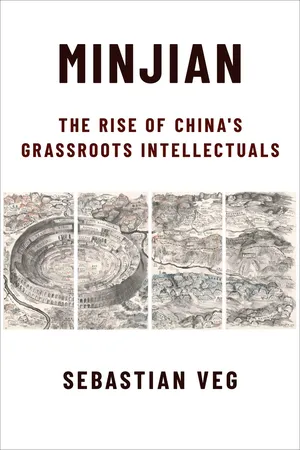
Who are the new Chinese intellectuals? In the wake of the crackdown on the 1989 democracy movement and the rapid marketization of the 1990s, a novel type of grassroots intellectual emerged. Instead of harking back to the traditional role of the literati or pronouncing on democracy and modernity like 1980s public intellectuals, they derive legitimacy from their work with the vulnerable and the marginalized, often proclaiming their independence with a heavy dose of anti-elitist rhetoric. They are proudly minjian—unofficial, unaffiliated, and among the people.
In this book, Sebastian Veg explores the rise of minjian intellectuals and how they have profoundly transformed China's public culture. An intellectual history of contemporary China, Minjian documents how, amid deep structural shifts, grassroots thinker-activists began to work outside academia or policy institutions in an embryonic public sphere. Veg explores the work of amateur historians who question official accounts, independent documentarians who let ordinary people speak for themselves, and grassroots lawyers and NGO workers who spread practical knowledge. Their interventions are specific rather than universal, with a focus on concrete problems among disenfranchised populations such as victims of Maoism, migrant workers and others without residence permits, and petitioners. Drawing on careful analysis of public texts by grassroots intellectuals and the networks and publics among which they circulate, Minjian is a groundbreaking transdisciplinary exploration of crucial trends developing under the surface of contemporary Chinese society.
- English
- ePUB (mobile friendly)
- Available on iOS & Android
eBook - ePub
About this book
Information
Topic
GeschichteSubtopic
Geschichte des 21. JahrhundertsCHAPTER 1
Grassroots Intellectuals
Theoretical and Historical Perspectives
Some preliminary considerations are in order to clarify how historians and social scientists have conceptualized the category of intellectuals.1 The object of the present study is situated at the intersection of two sets of discussions. On the one hand, there is an ongoing dichotomy between a humanities approach (intellectual history, literature, philosophy), focused on the classical ideal of the intellectual as moral critic, and a social science approach, which conceptualizes intellectuals as a social category. On the other hand, there is a large body of literature about the specificities of Chinese intellectuals, related to China’s classical examination system and political institutionalization of knowledge and moral authority. By focusing on grassroots intellectuals, the present study aims to displace some of these lines, questioning both Chinese specificities and the elite nature of intellectual pursuits.
INTELLECTUALS: NORMATIVE IDEALS AND SOCIAL PRACTICES
Definitions of the intellectual vary widely.2 They can usefully be divided between normative (moralist) and sociological (realist) definitions—that is, between definitions of intellectuals as critics (exercising a moral responsibility to serve universal values) and definitions of intellectuals as experts (people working more broadly with knowledge or “symbolic producers,” as in Pierre Bourdieu’s definition). This distinction is often accompanied by a methodological divide between a traditional history-of-ideas approach based on (politically critical) texts and a sociological-critical approach that highlights intellectuals’ (generally dominant) position within class and social relations.
In an insightful study, Lloyd Kramer, an intellectual historian of Europe, argues for a definition that brings together both aspects, highlighting intellectuals’ entwinement with the production of knowledge as well as their critical role in society. He contrasts Michel Foucault’s expert and Jürgen Habermas’s critic as the two faces of the Enlightenment, exemplified in the historical figures Jeremy Bentham and Heinrich Heine. Drawing on Habermas’s Structural Transformation of the Public Sphere (1962), Kramer notes that intellectuals came into being during the Enlightenment as a “community of critical debaters whose work shaped a new sphere for politics as well as a new literary culture” and as “independent critical thinkers who evaluated art, literature, theatre, and political theory with rational judgment that defied the authority of kings and churchmen alike.”3 By contrast, in Kramer’s reading of Foucault’s work Discipline and Punish (1975), Enlightenment intellectuals play the role of producers of knowledge used to institute “new forms of social control and surveillance in asylums, prisons, clinics, schools and armies—all of which relied on new forms of knowledge in the emerging ‘sciences of man.’ ” Kramer defines Foucault’s view of the Enlightenment by the accessibility of social space to the surveillance of experts: “the Enlightenment that produced new definitions of madness, criminality, and knowledge also produced a new class of persons: the sovereign intellectual expert of modernity.”4 Although the new intellectuals as experts thus take up the role of sustaining power through surveillance, Kramer emphasizes that Foucault’s own analysis remains an expression of the rational-critical role of the Enlightenment intellectual.5
Many twentieth-century contributions to a theory of intellectuals follow a similar divide: whereas philosophers and intellectual historians highlight the distinct nature of intellectual activity, social science approaches underscore intellectuals’ role in the social hierarchy. Little attention has been paid to intellectuals situated outside the elite. Antonio Gramsci distinguishes between “traditional” intellectuals, who define themselves as disinterested defenders of universal rationality (“autonomous and independent of the dominant social group”), and “organic intellectuals,” who speak for the interest of a (usually dominant) class. Under the veneer of universalist discourse, Gramsci understands all intellectuals as intrinsically organic: “The intellectuals are the dominant group’s ‘deputies’ exercising the subaltern functions of social hegemony and political government.”6 These functions are organized on two levels: manufacturing “spontaneous consent” in society and sustaining the state apparatus of coercive power. Gramsci therefore believes that the working class should create organic intellectuals of its own, which opens a possibility for intellectuals to emerge from the grassroots, although they may not be autonomous.
Bourdieu in some ways continues the Gramscian vein in “demystifying” the universalist pretensions of intellectuals. In a short interview that sums up the main paradoxes in his conceptualization, Bourdieu argues that “artists and writers, and more generally intellectuals, are a dominated fraction of the dominant class. They are dominant in so far as they hold the power and privileges conferred by the possession of cultural capital … but writers and artists are dominated in their relations with those who hold political and economic power.” This dominated status of art, literature, and academia (Bourdieu’s three main categories of intellectual pursuits) is structural in that “fields of cultural production occupy a dominated position in the field of power.” Hence, intellectuals’ positions are ambiguous: “Despite their revolt against those they call the ‘bourgeois,’ they remain loyal to the bourgeois order.” Bourdieu defines intellectuals as “cultural producers [who] hold a specific power, the properly symbolic power of showing things and making people believe in them.” The intellectual can put this power in the service of the dominant class as an expert or in the service of the dominated as a “free, critical thinker, the intellectual who uses his or her specific capital, won by virtue of autonomy and guaranteed by the very autonomy of the field, to intervene in the field of politics, following the model of Zola or Sartre.”7 In the first case, the assertion of autonomy should be understood as a sign of distinction, a means in the pursuit of symbolic capital, whereas in the latter case the autonomy gained by the writer or the critical sociologist in his or her own field (Noam Chomsky as a linguist, Émile Zola as a writer, Bourdieu as a sociologist) can provide them with the means of contesting the “monopoly of the legitimate representation of the social world.”8 Bourdieu’s theory therefore defines a spectrum of positions according to a varying degree of autonomy. Ideally (at one extreme of the spectrum of possibilities), as Bourdieu argues in a late text, the intellectual “can exist and survive as such if (and only if) he is invested with a specific authority, conferred by an autonomous intellectual world (that is independent from religious, political, economic power), whose specific laws he respects, and if (and only if) he engages this specific authority in political struggles.… [I]t is by increasing their autonomy … that intellectuals can increase the efficiency of a political action whose ends and means are grounded in the specific logic of fields of cultural production.”9 In this configuration, universal competence can be restored, at least at the most autonomous end of the spectrum: “an intellectual, to put it very simply, is a writer, an artist or an academic who, using the authority acquired in his or her own field, goes beyond his or her field and exercises a symbolic action of political nature.”10 Characteristically, for Bourdieu, it is social prestige rather than knowledge that grounds the intellectual’s claim to public speech (a view that, in the perspective of intellectual history, may pay insufficient attention to what intellectuals actually say and write).
In the final analysis, Bourdieu remains entrenched in a binary schema: “But, and this is true also of the so-called ‘organic intellectuals’ of revolutionary movements, alliances founded on the homology of position (dominant–dominated = dominated) are always more uncertain, more fragile, than solidarities based on an identity of position and thereby, of condition and habitus.”11 Objective conditions will therefore prevail, and the social status of the intellectual will ultimately decisively shape (if not entirely determine) his or her political position. Like Gramsci, Bourdieu “unmasks” the ties of the intellectual to his or her position in the social hierarchy; unlike him, he does not seem to envisage a possibility for organic intellectuals to appear outside of the institutions of symbolic legitimation controlled by the bourgeoisie. In this sense, one could argue that Bourdieu remains convinced of the intellectual’s elite status.
Foucault’s earlier critique (formulated in 1976 in his essay “The Political Function of the Intellectual”), which Bourdieu partially but not entirely acknowledges, is in some ways more radical than Gramsci’s. Foucault sees the working class (and its organic intellectuals) as simply the last incarnation of an illusory claim to universality: “For a long time, the so-called ‘left-wing’ intellectual has spoken out and has seen recognized his right to speak out as the master of truth and justice. One listened to him, or he wanted to be listened to, as the representative of universality.… [J]ust as the proletariat, by virtue of its historical position, is the carrier of universality (albeit an immediate carrier, hardly reflexive or conscious of itself), the intellectual, through his moral, theoretical and political choices, claims to be the carrier of this universality, but in its conscious and elaborated form.”12
In a text written only a few years after Discipline and Punish, Foucault defines a new figure of the intellectual; his critique of the universal intellectual is in some ways more radical than Bourdieu’s: autonomy in a specific field is not simply a stepping stone to prop up a universal discourse; rather, specific knowledge, with the constraints it implies, becomes the intellectual’s contribution to social critique. In a significant break with previous characterizations of the prophetic, universal, or “total” intellectual, Foucault takes stock of the modern figure of the specific expert (as opposed to the Enlightenment intellectual), whose genesis is described in Discipline and Punish, but crucially endows it with a critical function. Since World War II, Foucault argues, intellectuals have taken to working in “specific points”: public housing, hospitals, asylums, laboratories, universities, family or gender relations. Here, they are confronted with “specific, non-universal” problems, different from those of the proletariat or the masses but deriving from “real, material, quotidian struggles” that bring them closer to the “masses.” Whereas the epitome of the (universal) intellectual was previously the writer (derived, in Foucault’s view, from the gentry lawyer, the man of justice), now “transversal links appear between fields of knowledge, from one point of politicization to another: judges and psychiatrists, doctors and social workers, laboratory workers and sociologists” work together, and the university becomes a point of interchange or intersection.13
The specific intellectual as expert is always in danger of being marginalized, cut off from the masses; however, “it would be dangerous to disqualify his specific relationship with local knowledge, under the pretext that these are questions for specialists that do not interest the masses (which is doubly wrong: the...
Table of contents
- Cover
- Series Statement
- Title Page
- Copyright
- Contents
- Acknowledgments
- Introduction
- 1. Grassroots Intellectuals: Theoretical and Historical Perspectives
- 2. Wang Xiaobo and the Silent Majority: Redefining the Role of Intellectuals After Tiananmen
- 3. Minjian Historians of the Mao Era: Commemorating, Documenting, Debating
- 4. Investigating and Transforming Society from the Margins: The Rise and Fall of Independent Cinema
- 5. Professionals at the Grassroots: Rights Lawyers, Academics, and Petitioners
- 6. Journalists, Bloggers, and a New Public Culture
- Conclusion
- Appendix: Minibiographies of Thirty Minjian Intellectuals
- Notes
- Index
Trusted by 375,005 students
Access to over 1.5 million titles for a fair monthly price.
Study more efficiently using our study tools.
Frequently asked questions
Yes, you can cancel anytime from the Subscription tab in your account settings on the Perlego website. Your subscription will stay active until the end of your current billing period. Learn how to cancel your subscription
No, books cannot be downloaded as external files, such as PDFs, for use outside of Perlego. However, you can download books within the Perlego app for offline reading on mobile or tablet. Learn how to download books offline
Perlego offers two plans: Essential and Complete
- Essential is ideal for learners and professionals who enjoy exploring a wide range of subjects. Access the Essential Library with 800,000+ trusted titles and best-sellers across business, personal growth, and the humanities. Includes unlimited reading time and Standard Read Aloud voice.
- Complete: Perfect for advanced learners and researchers needing full, unrestricted access. Unlock 1.5M+ books across hundreds of subjects, including academic and specialized titles. The Complete Plan also includes advanced features like Premium Read Aloud and Research Assistant.
We are an online textbook subscription service, where you can get access to an entire online library for less than the price of a single book per month. With over 1.5 million books across 990+ topics, we’ve got you covered! Learn about our mission
Look out for the read-aloud symbol on your next book to see if you can listen to it. The read-aloud tool reads text aloud for you, highlighting the text as it is being read. You can pause it, speed it up and slow it down. Learn more about Read Aloud
Yes! You can use the Perlego app on both iOS and Android devices to read anytime, anywhere — even offline. Perfect for commutes or when you’re on the go.
Please note we cannot support devices running on iOS 13 and Android 7 or earlier. Learn more about using the app
Please note we cannot support devices running on iOS 13 and Android 7 or earlier. Learn more about using the app
Yes, you can access Minjian by Sebastian Veg in PDF and/or ePUB format, as well as other popular books in Geschichte & Geschichte des 21. Jahrhunderts. We have over 1.5 million books available in our catalogue for you to explore.