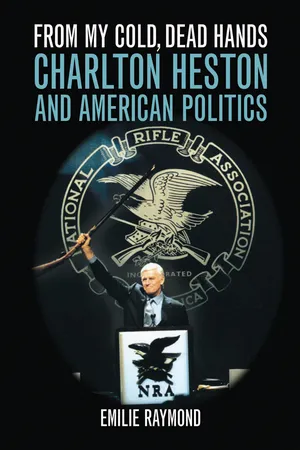
Charlton Heston is perhaps most famous for his portrayal of Moses in Cecil B. DeMille's epic The Ten Commandments and for his Academy Award–winning performance in the 1959 classic Ben-Hur. Throughout his long career, Heston used his cinematic status as a powerful moral force to effect social and political change. Author Emilie Raymond examines Heston's role as a crusader for individual rights and his evolution into a major American political figure with a pivotal role in the conservative movement. Heston's political activities were as varied as they were time consuming. He worked with the Kennedy, Johnson, Nixon, Reagan, and first Bush administrations. He marched in support of black civil rights, served as the president of the Screen Actors Guild, and helped shape policy for the National Endowment for the Arts before taking on his most high-profile position—president of the National Rifle Association. Over the course of his career, Heston became disillusioned with the Democrats; he formally registered with the Republican Party in the 1980s, arguing that the decision was in keeping with his longtime advocacy of individual rights. From My Cold, Dead Hands is far more than a biography—it is a chronicle of the resurgence of American conservative thought and, in particular, the birth of neoconservatism. Heston's brand of neoconservatism differed from that of the exclusively intellectual wing, and he came to represent a previously ignored segment of neoconservatives operating on the basis of more common, emotionally oriented concerns. The neocons brought new life to the GOP, and Raymond convincingly argues that Heston revitalized conservatism in general: his image of morality, individualism, and masculinity lent the conservative movement credibility with a larger public. He effectively campaigned for conservative candidates and causes, using his popularity and image to fuel and legitimize his political activities. Heston's high degree of political engagement not only paved the way for many of today's Hollywood activists but also helped popularize many of the beliefs of the neoconservative movement. A balanced look at Heston and his offscreen work, From My Cold, Dead Hands explains how this charismatic man of conviction propelled his personal beliefs into the political mainstream of America.
- 416 pages
- English
- ePUB (mobile friendly)
- Available on iOS & Android
eBook - ePub
About this book
Information
CHAPTER ONE
SUPERSTAR
CHARLTON HESTON WAS BORN ON OCTOBER 4, 1923, TO RUSS AND LILLA Carter. His first home was a small, white-framed structure on Michigan’s Russel Lake. This, according to the actor, was “a fine place to be a boy in.”1 His simple surroundings did not lack comfort, for his family home enjoyed running water, central heating, and electricity. One of eleven pupils, three of whom were his cousins, he was educated in a one-room schoolhouse in the nearby town of St. Helen. Frequently on his own, the young Heston spent much of his time hiking the Michigan woods, hunting and fishing and using his imagination to develop solitary games. White-tailed deer, partridge, duck, rabbit, and other wild game roamed the surrounding forest, which was also blessed with ample streams for fishing. This vast expanse of nature gave Heston plenty of room to act out his creative imaginings. He often fancied himself as Kit Carson, rifle in hand, tramping throughout the woods to hunt for elk to feed starving settlers stranded in a blizzard in Donner Pass. Twenty-two miles separated Heston from the nearest movie theater, so to attend a show was a rare and “incredible event.”2
Lilla Carter bore two more children, but Heston remained a loner because of the age difference that separated him from his siblings. His sister, Lilla, was born when Heston was six years old and his brother, Alan, when he was ten. His parents’ divorce disrupted young Charlton’s tranquil life, and he had to leave his beloved Michigan woods when Lilla briefly moved her children to Georgia to live with her sister. Eventually, she returned to Michigan and married a man by the name of Chester, or “Chet,” Heston. Although Chet did not adopt Lilla’s children, he cared for them as his own; Heston would see his natural father only one more time in the next ten years. This distance made it easy for Heston to take his stepfather’s name. He later explained that, at the time, he was embarrassed and guilt ridden over his parent’s divorce and, thus, “couldn’t bear having a different name from my stepfather.” Indeed, Heston’s own daughter claims that the divorce “scarred him terribly,” and the actor went so far as to say that his parents’ divorce was more traumatic than his later service in World War II because he did not understand why it happened and blamed himself. Chet did his best to help Heston and his new family cope. Looking for financial opportunities in the midst of the Great Depression, he moved the family to Wilmette, Illinois, a suburb north of Chicago, where he found a job at the Bell and Gossett steel plant. Chet Heston’s resourcefulness allowed the new family to survive the economic difficulties of the day without having to go on welfare. This is an achievement that his stepson found particularly striking. Heston later wrote about his stepfather: “I admire Chet Heston more for his desperate odyssey that summer than for anything else I know about him; he never quit.”3
Heston attended New Trier High School in Wilmette, reputedly one of the best public schools in America. He was, however, unhappy in his new surroundings. Six feet, two inches tall by the age of sixteen, Heston described himself as having been a “skinny hick from the woods” when he first arrived in the affluent suburb of Chicago. His awkward physique, solitary upbringing, and extreme shyness did not lend to making new friends easily. Not knowing the basics of city living or socializing did not help matters. The single task of crossing the street in city traffic intimidated him. He also did not know how to drive a car or ride a bike, and he had no team sports background or dating experience. “On top of all this,” he wrote, “I was a nerd before the word had even been invented—shy, skinny, short, pimply, and ill-dressed.” A rapid growth spurt at age fifteen intensified his awkward image; his clothes barely accommodated his growing frame. By this time, Heston already possessed an independent streak by nature, and his new school accentuated this inclination. He attested: “Kids are the most conventional people in the world. It is more important than anything else for them to conform, and I was a kind of oddball. I was driven into being independent. I was very, very unhappy.”4
Alienated from the social scene, Heston slowly acclimated to his new life through New Trier’s extracurricular activities, including the football, tennis, rifle, and drama teams. During his junior and senior years, he focused more intently on drama and dropped his other clubs. Heston had discovered his love for acting and for the master playwright William Shakespeare. “What acting offered me was the chance to be many other people. In those days, I wasn’t satisfied being me,” he confessed. “You see, I always thought of myself as inadequate. Kids of divorced parents always feel that way—that, on some subconscious level, they’re responsible. It comes from self-loathing. I suppose a lot of that has to do with my Scottish, Calvinistic background, instilled in me by my grandparents, that somehow you’re responsible for what happens to you.” Acting eventually proved to be his lifeblood, not just a way to cope with his guilt and shame. Trying to gain as much experience as possible, Heston also acted with local amateurs in the Winnetka Community Theater and made plans to attend Northwestern University. The school boasted one of the best theater departments in the country, but he could not afford the tuition. When he graduated from high school in 1941, the community theater offered to pay the $300 tuition, which assisted the aspiring actor greatly, although he still had to take various jobs, including a stint as an elevator operator, to support himself and to repay his benefactors.5
Heston’s success did not inspire him to shed his shy demeanor. His confidence had grown onstage but not with people, and his solitary inclination still prevailed to the point that he did not even attend the senior dance held at his high school after graduation. “I can’t imagine why I hadn’t sorted out a solution to the Senior Ball. Like going to it for God’s sake,” he wrote in his autobiography. He made a brief appearance and then snuck out the side door to the shores of Lake Michigan. Not wanting to admit to his parents that he had skipped the dance, he filled the next three hours “wandering slowly south to Wilmette, feeling disgustingly sorry for myself.”6 As he matured physically and his confidence grew at college, Heston had no more of these types of painful experiences, but his loner instinct as well as a certain degree of shyness would remain permanent features of his adult personality.
Heston’s experience at Northwestern established the framework for his future. His demanding acting teacher, Alvina Krause, did not coddle her students. As Heston remembered, Krause “wasn’t interested in teaching self-esteem,” and it was through her that Heston acquired the thick skin needed for the acting business. Another Northwestern student, David Bradley, persuaded Heston to star in his independent film Peer Gynt (1941). Although the film never surfaced beyond the borders of the local art scene, it gave Heston a taste of being in front of the camera. Most important, it was at college that Heston met the love of his life, Lydia Clarke. Immediately taken with the young law student, Heston secretly touched her chestnut hair when he sat behind her in theater practice class. Clarke’s feelings were not, to say the least, mutual. She confided to one journalist that, when she first met Heston, “I thought he was arrogant and conceited, and supremely self-confident.” Not until the two performed together in Harley Granville Barker’s one-act play The Madras House (1910) did Heston convince the object of his crush to join him for coffee. “We had a very stimulating conversation and that was it,” Clarke remembered. “I was insanely in love with him.” Heston wooed Clarke with Shakespearean sonnets and also convinced her to drop law and study acting full-time. However, she did not fall completely under his spell. Having decided long before that she preferred a career to matrimony, she refused Heston’s marriage proposals for a full two years.7
The entrance of the United States into World War II interrupted Heston’s plans to finish school and Lydia’s intention to remain single. Heston got his first taste of government service when he enlisted in the army air corps in 1943. During basic training and several months at various stateside air bases, Heston repeatedly begged Clarke to marry him, but she continued to refuse, insisting on at least finishing her studies first. Undaunted, Heston doggedly persisted. Finally, in a surprise telegram, Clarke relented, stating: “Have decided to accept your proposal. Love, Lydia.”8 Clarke joined Heston in Greensboro, North Carolina, in March 1944 for a private wedding ceremony, but the new Mrs. Heston returned to Chicago shortly thereafter for school. The newlyweds reunited briefly in Detroit when Heston was stationed in the city. At this time, Heston also reunited with his father, Russ Carter, after fortuitously seeing his name in the Detroit phone book. At his bride’s urging, Heston called his father, to learn that Carter had remarried and started a new family. (Heston has remained in contact with his father’s new family ever since.) Shortly thereafter, the air corps shipped Heston to Alaska, where he served as a sergeant in the Eleventh Air Force. Heston, along with the vast majority of Americans, was relieved when President Harry S. Truman deployed the newly developed atomic bomb on Japan, thus obviating the need for a land invasion of the home islands and preventing the thousands of U.S. casualties that would, undoubtedly, have resulted.
At war’s end, the newlyweds had big dreams of success. Amid postwar inflation, they moved from Chicago to New York City in order to expand their acting opportunities. They found an apartment in Hell’s Kitchen on Manhattan’s East Side, and, between the two of them, they managed to eke out a living, with Lydia initially being their sole means of support. Acting jobs were difficult to find. Both took modeling jobs. Heston drove an ambulance at one point and even posed for a series of art classes, wearing only a gray velour jockstrap that Lydia had sewn for him. Fortune called in 1947 when the Asheville Community Theater offered the couple a six-month position as the theater’s codirectors. They enjoyed the tranquil setting and were proud of their productions. The theater, pleased with the Hestons’ management, offered them a permanent arrangement at a higher salary. Although this offer was tempting, the couple decided to give Broadway one more go. The community theater did not satisfy Heston’s needs as an actor. He loved theater, but the amateur players did not take their parts as seriously as he or his wife did. To the locals, the plays were a welcome distraction from their workaday lives. Heston needed a different environment. He explained: “I wanted the arena . . . sweat, sand, and blood, where it really counts. To take the test, and give your best . . . and then somehow be better.” In August 1947, he and Lydia moved back to New York City, and Heston bet his wife a new hat that he would find work within two months. Lydia won her prize faster than they expected. The very day they returned, Heston earned a position in the highly respected McClintic-Cornell Company on Broadway, and, soon thereafter, Lydia received several lucrative offers as well.9
Heston and Lydia both obtained substantial roles, in Antony and Cleopatra and Sidney Kingsley’s Detective Story, respectively. Heston, however, owed his big break to the advent of live television. In 1947, only 2 percent of American households boasted a television set, with most televisions concentrated in New York City. This new and relatively primitive technology required shows to be broadcast live, and television producers had not yet developed substantial programming that would attract a regular audience. Stations unexpectedly found that audience with the 1947 World Series, featuring the New York Yankees and the Brooklyn Dodgers. This historic matchup propelled the status of television to that of the nation’s fastest-growing entertainment medium. By 1956, 70 percent of American households owned a television set, and the two major networks, the Columbia Broadcasting System (CBS) and the National Broadcasting Company (NBC), competed to establish hit shows and maintain a loyal audience. Although the networks attracted millions of viewers, they could not draw big-name talent to star in their programs. As Heston remembered: “Most Hollywood actors considered television sort of tacky. Serious actors didn’t do that kind of thing; nor directors, God knows.”10 NBC concentrated on variety shows starring Milton Berle and Ed Sullivan, while CBS pursued a more prestigious angle by converting its radio drama Studio One to the small screen. Live television proved fortuitous for a number of young actors, including Anne Bancroft, Jack Lemmon, Yul Brynner, and Walter Matthau, all of whom, under the direction of Worthington Miner, performed live Shakespearean drama. Because of his experience at McClintic-Cornell, Studio One considered Heston worthy, and Miner hired him as Cinna in Julius Caesar, which aired for the first time in the spring of 1949. Thereafter, Heston starred in a number of Studio One productions, including The Taming of the Shrew and Macbeth. It was in Macbeth, during which an Irish wolfhound played Macbeth’s alter ego, that the legendary “starmaker” Hal Wallis first got a glimpse of Heston.
Hal Wallis had arrived in Hollywood in 1920 and quickly established himself as one of the film community’s power brokers, maintaining a considerable degree of independence as a producer for Warner Brothers Studios, where he made between forty and sixty features a year. Contemptuous of the “perfumed melodramas” typical of other studios, Wallis made movies that were witty, modern, and tough, including Dark Victory (Edmund Goulding, 1939), The Maltese Falcon (John Huston, 1941), and Casablanca (Michael Curtiz, 1942). Despite these successes, Wallis chafed under the studio system, which maintained direct control over its employees. By the 1950s, he had moved to Paramount Pictures with a contract that allowed him more independence. His new studio gave Wallis and his partner, Joseph Hazen, profit participation, a producer’s fee, and, most important, complete autonomy in film production. Freed from the old studio system, Wallis experimented with more modern approaches when signing talent. For example, he signed Kirk Douglas to a contract that required the actor to do one picture per year for five years but that also allowed him to accept other roles from other producers. “Those were the days when everyone was dying to be under contract because it was safe, it was guaranteed income,” explained Douglas. “But to me it was like slavery.” Indeed, each studio was its own entity, controlling production, distribution, and exhibition as well as its “players.” While Heston conceded that studios did ensure that actors were well-fed and secure in their contracts, like Douglas he disliked the way the talent was loaned back and forth “like property” and the lack of freedom actors had in choosing their own roles.11
By the time Wallis discovered Heston, the producer had all but abandoned the standard contract of the traditional studio system. He signed actors to an agreement for a certain number of pictures, as customary, but, when actors were not working for him, Wallis was, as with Douglas, willing to allow them to undertake other projects, something the old studios forbade. Wallis’s flexible contract was probably the only kind that the independent Heston would have accepted. Fortunately, Heston was just the type of actor for which Wallis had been scouting. Having already discovered Burt Lancaster and Douglas with his new agency, Wallis was on the prowl for more actors with their type of rough masculinity. As Wallis wrote in his memoirs: “Like Kirk and Burt, Chuck was exactly the type of heman I was looking for. He was tall, rangy, bony. . . .” Furthermore, he could act. After viewing Heston on Studio One, Wallis called him in for an interview and hired him “on the spot.” Genuinely impressed with Heston and aware that Warner had already offered him a contract, Wallis did not waste any time. Warner, indeed, had pursued Heston, but he was not interested in their antiquated way of doing business. He felt apprehensive about giving up his “modest reputation” on the stage and on television for the movies, especially since Hollywood producers had yet to allow their actors to appear on television. Now someone would. Knowing that the old studio system was dying a slow death, Wallis, Heston later recalled, “gave me what no one else had gotten up to that point: an independent contract with the right to do plays and television. It horrified the industry.” Wallis signed Heston for five films and, having resolved the contract, also helped him tackle his next problem—his outdated attire. “Chuck arrived [for the interview] wearing a zoot suit. We took him out and bought him a wardrobe,” he chuckled.12
Although he would, ultimately, find Hollywood distasteful, Heston had transformed from a “backward hick” into a sophisticated Shakespearean, suitably garbed for the glamorous Los Angeles scene. Already put off by the schmoozing bar scenes, on one of his first nights out in Hollywood he found that a passerby had tossed a l...
Table of contents
- Cover
- Half title
- Title
- Copyright
- Dedication
- Contents
- Acknowledgments
- Introduction
- Chapter One: Superstar
- Chapter Two: Cold War Liberal
- Chapter Three: Union Leader
- Chapter Four: Arts Patron
- Chapter Five: Democrat for Republicans
- Chapter Six: Republican Ideologue
- Chapter Seven: Gun Guru
- Chapter Eight: Cultural Cannon
- Conclusion
- Notes
- Select Bibliography
- Index
Trusted by 375,005 students
Access to over 1.5 million titles for a fair monthly price.
Study more efficiently using our study tools.
Frequently asked questions
Yes, you can cancel anytime from the Subscription tab in your account settings on the Perlego website. Your subscription will stay active until the end of your current billing period. Learn how to cancel your subscription
No, books cannot be downloaded as external files, such as PDFs, for use outside of Perlego. However, you can download books within the Perlego app for offline reading on mobile or tablet. Learn how to download books offline
Perlego offers two plans: Essential and Complete
- Essential is ideal for learners and professionals who enjoy exploring a wide range of subjects. Access the Essential Library with 800,000+ trusted titles and best-sellers across business, personal growth, and the humanities. Includes unlimited reading time and Standard Read Aloud voice.
- Complete: Perfect for advanced learners and researchers needing full, unrestricted access. Unlock 1.5M+ books across hundreds of subjects, including academic and specialized titles. The Complete Plan also includes advanced features like Premium Read Aloud and Research Assistant.
We are an online textbook subscription service, where you can get access to an entire online library for less than the price of a single book per month. With over 1.5 million books across 990+ topics, we’ve got you covered! Learn about our mission
Look out for the read-aloud symbol on your next book to see if you can listen to it. The read-aloud tool reads text aloud for you, highlighting the text as it is being read. You can pause it, speed it up and slow it down. Learn more about Read Aloud
Yes! You can use the Perlego app on both iOS and Android devices to read anytime, anywhere — even offline. Perfect for commutes or when you’re on the go.
Please note we cannot support devices running on iOS 13 and Android 7 or earlier. Learn more about using the app
Please note we cannot support devices running on iOS 13 and Android 7 or earlier. Learn more about using the app
Yes, you can access From My Cold, Dead Hands by Emilie Raymond in PDF and/or ePUB format, as well as other popular books in Politics & International Relations & Political Biographies. We have over 1.5 million books available in our catalogue for you to explore.