
- 528 pages
- English
- ePUB (mobile friendly)
- Available on iOS & Android
eBook - ePub
About this book
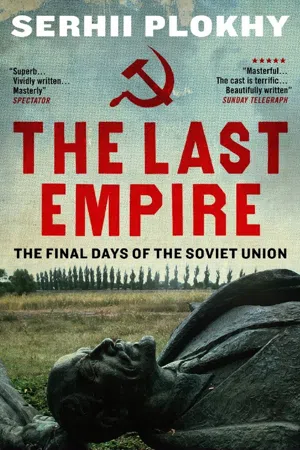
World-renowned historian Serhii Plokhy presents a profoundly original, page-turning account of the Soviet Union’s collapse
BY THE AUTHOR OF CHERNOBYL: HISTORY OF A TRAGEDY, WINNER OF THE BAILLIE GIFFORD PRIZE 2018
WINNER OF THE PUSHKIN HOUSE RUSSIAN BOOK PRIZE 2015
On Christmas Day 1991 Mikhail Gorbachev resigned as president of the Soviet Union. By the next day the USSR was officially no more and the USA had emerged as the world’s sole superpower. Award-winning historian Serhii Plokhy presents a page-turning account of the preceding five months of drama, filled with failed coups d’état and political intrigue.
Honing in on this previously disregarded but crucial period and using recently declassified documents and original interviews with key participants, he shatters the established myths of 1991 and presents a bold new interpretation of the Soviet Union’s final months. Plokhy argues that contrary to the triumphalist Western narrative, George H. W. Bush desperately wanted to preserve the Soviet Union and keep Gorbachev in power, and that it was Ukraine and not the US that played the key role in the collapse of the Soviet Union. The consequences of those five months and the myth-making that has since surrounded them are still being felt in Crimea, Russia, the US, and Europe today.
With its spellbinding narrative and strikingly fresh perspective, The Last Empire is the essential account of one of the most important watershed periods in world history, and is indispensable reading for anyone seeking to make sense of international politics today.
***
‘Fascinating and readable… Beautifully written.’ SUNDAY TELEGRAPH, &&★&&★&&★&&★&&★
‘Written like a good thriller, The Last Empire recounts how chance events and quirky personalities led within a few months in 1991 to the disintegration of the empire built and maintained by generations.’ GUARDIAN
‘Wonderfully well-written… bracing and timely… well worth reading.’ THE TIMES
Frequently asked questions
Yes, you can cancel anytime from the Subscription tab in your account settings on the Perlego website. Your subscription will stay active until the end of your current billing period. Learn how to cancel your subscription.
No, books cannot be downloaded as external files, such as PDFs, for use outside of Perlego. However, you can download books within the Perlego app for offline reading on mobile or tablet. Learn more here.
Perlego offers two plans: Essential and Complete
- Essential is ideal for learners and professionals who enjoy exploring a wide range of subjects. Access the Essential Library with 800,000+ trusted titles and best-sellers across business, personal growth, and the humanities. Includes unlimited reading time and Standard Read Aloud voice.
- Complete: Perfect for advanced learners and researchers needing full, unrestricted access. Unlock 1.4M+ books across hundreds of subjects, including academic and specialized titles. The Complete Plan also includes advanced features like Premium Read Aloud and Research Assistant.
We are an online textbook subscription service, where you can get access to an entire online library for less than the price of a single book per month. With over 1 million books across 1000+ topics, we’ve got you covered! Learn more here.
Look out for the read-aloud symbol on your next book to see if you can listen to it. The read-aloud tool reads text aloud for you, highlighting the text as it is being read. You can pause it, speed it up and slow it down. Learn more here.
Yes! You can use the Perlego app on both iOS or Android devices to read anytime, anywhere — even offline. Perfect for commutes or when you’re on the go.
Please note we cannot support devices running on iOS 13 and Android 7 or earlier. Learn more about using the app.
Yes, you can access The Last Empire by Serhii Plokhy in PDF and/or ePUB format, as well as other popular books in History & 20th Century History. We have over one million books available in our catalogue for you to explore.
Information
Notes
INTRODUCTION
1. George H. W. Bush, “Address to the Nation on the Commonwealth of Independent States,” December 25, 1991, George Bush Presidential Library and Museum, Archives (hereafter Bush Presidential Library), Public Papers, http://bushlibrary.tamu.edu/research/public_papers.php?id=3791&year=1991&month=12; George H. W. Bush, “State of the Union Address,” January 28, 1992. C-SPAN http://www.c-spanvideo.org/program/23999-1
2. “Statement on the Resignation of Mikhail Gorbachev as President of the Soviet Union,” December 25, 1991, Bush Presidential Library, Public Papers, http://bushlibrary.tamu.edu/research/public_papers.php?id=3790&year=1991&month=12.
3. Apart from Bush’s own pronouncements, see Brent Scowcroft’s comments in George Bush and Brent Scowcroft, A World Transformed (New York, 1998), 563–564, and Robert M. Gates in his From the Shadows: The Ultimate Insider’s Story of Five Presidents and How They Won the Cold War (New York, 1996), 552–575.
4. Ellen Schrecker, “Cold War Triumphalism and the Real Cold War,” in Ellen Schrecker, ed., Cold War Triumphalism: The Misuse of History After the Fall of Communism (New York, 2006), 1–26; Bruce Cumings, “Time of Illusion: Post–Cold War Visions of the World,” in Ellen Schrecker, ed., Cold War Triumphalism, 71–102; “Tainy mira s Annoi Chapman, no. 79. Gibel’ imperii,” YouTube video posted by ChannelProXima, February 13, 2013, www.youtube.com/watch?v=T1zr8Fr1Nbs; “Sekretnyi stsenarii razvala SSSR i Rossii v planakh TsRU,” YouTube video posted by AndreyFLKZ, January 31, 2013, www.youtube.com/watch?v=PfeiGv6IkQc.
5. On the Soviet Union as a multinational state, see Richard Pipes, The Formation of the Soviet Union: Communism and Nationalism, 1917–23 (Cambridge, MA, 1997); Terry Martin, The Affirmative Action Empire: Nations and Nationalism in the Soviet Union, 1923–1939 (Ithaca, NY, 2001); Francine Hirsch, Empire of Nations: Ethnographic Knowledge and the Making of the Soviet Union (Ithaca, NY, 2005).
6. For the interpretation of the Soviet collapse as the fall of an empire and the role of political nationalism in that process, see Roman Szporluk, Russia, Ukraine, and the Breakup of the Soviet Union (Stanford, CA, 2000); Dominic Lieven, Empire: The Russian Empire and Its Rivals (New Haven, CT, 2002), ch. 9; Mark R. Beissinger, Nationalist Mobilization and the Collapse of the Soviet State (Cambridge, 2002), 4; Jane Burbank and Frederick Cooper, Empires in World History: Power and Politics of Difference (Princeton, NJ, 2010), ch. 13.
7. David Remnick, the author of the Pulitzer Prize–winning Lenin’s Tomb: The Last Days of the Soviet Empire (New York, 1994), devotes only two and a half pages to that important concluding chapter of Cold War history; Michael Dobbs, the author of the widely acclaimed Down with Big Brother: The Fall of the Soviet Empire (New York, 1997), six pages; Stephen Kotkin in his thought-provoking Armageddon Averted: The Soviet Collapse, 1970–2000 (Oxford, 2001), five pages.
8. Kotkin, Armageddon Averted, introduction and ch. 4; Stephen Kotkin, Uncivil Society: 1989 and the Implosion of the Communist Establishment (New York, 2009), preface; David A. Lake, “The Rise, Fall, and Future of the Russian Empire: A Theoretical Interpretation,” in Karen Dawisha and Bruce Parrott, eds., The End of Empire? The Transformation of the USSR in Comparative Perspective (Armonk, NY, 1997), 30–62; Timothy J. Colton, Yeltsin: A Life (New York, 2008), chs. 8 and 9.
CHAPTER 1
1. David Reynolds, Summits: Six Meetings That Shaped the Twentieth Century (New York, 2007), 1–102.
2. “U.S.-Soviet Relations and the Moscow Summit,” July 26, 1991, C-SPAN, www.c-spanvideo.org/program/19799-1; Treaty Between the United States of America and the Union of Soviet Socialist Republics on the Reduction and Limitation of Strategic Offensive Arms, July 31, 1991. US Department of State, http://www.state.gov/www/global/arms/starthtm/start/start1.html.
3. John Lewis Gaddis, The Cold War: A New History (New York, 2006); Henry Kissinger, Diplomacy (New York, 1996), 423–732; Vladislav M. Zubok, A Failed Empire: The Soviet Union in the Cold War from Stalin to Gorbachev (Chapel Hill, NC, 2007), 1–226.
4. Scott Shane, “Cold War’s Riskiest Moment,” Baltimore Sun, August 31, 2003.
5. “Atomic War Film Spurs Nationwide Discussion,” New York Times, November 22, 1983; Ronald Reagan, An American Life (New York, 1990), 585–586; Beth A. Fisher, The Reagan Reversal: Foreign Policy and the End of the Cold War (Columbia, MO, 2000); Ronald Reagan, “Address to the Nation and Other Countries on United States–Soviet Relations, January 16, 1984,” http://www.reagan.utexas.edu/archives/speeches/1984/11684a.html.
6. Barbara Bush, A Memoir (New York, 1994); George Bush, All the Best, George Bush: My Life in Letters and Other Writings (New York, 2000); Webster Griffin Tarpley and Anton Chaitkin, George Bush: An Unauthorized Biography (Joshua Tree, CA, 2004).
7. “Remarks at the Arrival Ceremony in Moscow, July 30, 1991” and “Remarks by President Gorbachev and President Bush at the Signing Ceremony for the Strategic Arms Reduction Talks Treaty in Moscow, July 31, 1991,” Bush Presidential Library, Public Papers, http://bushlibrary.tamu.edu/research/public_papers.php?id=3256&year=1991&month=7.
8. Michael R. Beschloss and Strobe Talbott, At the Highest Levels: The Inside Story of the End of the Cold War (Boston, 1993), 411; George Bush and Brent Scowcroft, A World Transformed (New York, 1998), 510–511.
9. “Mikhail Sergeevich Gorbachev,” Trip of President Bush to Moscow and Kiev, July 30–August 1, 1991, Bush Presidential Library, Presidential Records, Office of the First Lady, Scheduling, Ann Brock Series: Moscow Summit, Monday 7/29/91 to Thursday 8/1/91—Moscow and Kiev, no. 4.
10. Archie Brown, The Gorbachev Factor (Oxford, 1997); Andrei Grachev, Gorbachev’s Gamble: Soviet Foreign Policy and the End of the Cold War (Cambridge, 2008); Raymond L. Garthoff, The Great Transition: American-Soviet Relations and the End of the Cold War (Washington, D.C., 1994); Don Oberdorfer, From the End of the Cold War to a New Era: The United States and the Soviet Union, 1983–1991 (Baltimore, 1998).
11. Walter Goodman, “Summit Image: Hardly a Mikhail and George Show,” New York Times, August 1, 1991; Gene Gibbons, “Pre Advance Pool Report, Moscow Summit, July 29–August 1, 1991, July 25, 1991,” Bush Presidential Library, Presidential Records, White House Office of Me...
Table of contents
- Cover
- Praise for The Last Empire
- About the Author
- Title
- Copyright
- Dedication
- Contents
- “Empire Strikes Back:” A Foreword to the Paperback Edition
- Maps
- Introduction
- I. THE LAST SUMMIT
- II. THE TANKS OF AUGUST
- III. A COUNTERCOUP
- IV. SOVIET DISUNION
- V. VOX POPULI
- VI. FAREWELL TO THE EMPIRE
- Epilogue
- Acknowledgments
- Image Section
- Notes