- discuss the technique itself, background, nuances when it comes to looking at glassy materials, interpretation of results, case studies, and recent and near-future innovations
- Fill a widening gap in modern techniques for glass characterization
- Provide much needed updates on the multiple essential characterization techniques
- English
- ePUB (mobile friendly)
- Available on iOS & Android
eBook - ePub
Modern Glass Characterization
About this book
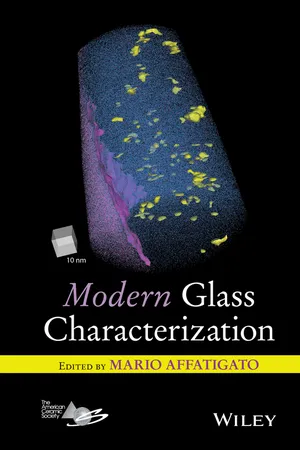
The book consists of a series of edited chapters, each written by an expert in the field and focusing on a particular characterization technique as applied to glass. The book covers a variety of techniques ranging from the very common (like Raman and FTIR) to the most recent (and less well known) ones, like SEM for structural analysis and photoelastic measurements. The level of the chapters make it suitable for researchers and for graduate students about to start their research work. It will also:
Information
Publisher
Wiley-American Ceramic SocietyYear
2015Print ISBN
9781118230862
Edition
1eBook ISBN
9781119051879
1
DENSITY, THERMAL PROPERTIES, AND THE GLASS TRANSITION TEMPERATURE OF GLASSES
Steve Feller
Physics Department, Coe College, Cedar Rapids, IA, USA
Part I: Introduction to Physical Properties and Their Uses
Any computer-generated or spectroscopic determination of the atomic structure of glass is tempered by the necessity that the resulting structural model be consonant with physical property measurements. As a result the basic physical properties play a key role in the acceptance of any model of atomic arrangements. In this chapter, two of the most fundamental properties are examined: density (ρ) and thermal properties with a focus on the glass transition temperature (Tg). How these measurements are made and interpreted will be discussed. Also, some comparisons between the resulting properties and models of glass structure are given.
First, however, a note of caution is provided. It is not possible to go from direct measurements of the physical properties to a unique model of atomic arrangement. This multiplicity of paths is an example of an ill-posed problem. What can be done is to use experimental property data to provide a consistency check on models. That is significant.
Density is perhaps the single-most fundamental and important measure of a glass. Its value is needed in manifold experimental techniques such as neutron, electron, and x-ray scattering. It is also an essential value in molecular dynamics simulations. In addition, density stands on its own as an intrinsic property capable of casting light on various ranges of order within glasses [1].
Furthermore, density can be used to extract a variety of useful volumes including the molar volume, the volume per mole glass former, and for a given model of atomic structure, the volumes of the individual atomic-level structural units themselves. Another useful parameter directly derived from density is the dimensionless packing fraction, the ratio of filled space to total volume within a glass [2]. Additionally, as these property data have become available from a wide variety of glass systems over extende...
Table of contents
- Cover
- Title page
- Copyright
- PREFACE
- LIST OF CONTRIBUTORS
- 1 DENSITY, THERMAL PROPERTIES, AND THE GLASS TRANSITION TEMPERATURE OF GLASSES
- 2 INFRARED SPECTROSCOPY OF GLASSES
- 3 RAMAN SPECTROSCOPY OF GLASSES
- 4 BRILLOUIN LIGHT SCATTERING
- 5 NEUTRON DIFFRACTION TECHNIQUES FOR STRUCTURAL STUDIES OF GLASSES
- 6 X-RAY DIFFRACTION FROM GLASS
- 7 XAFS SPECTROSCOPY AND GLASS STRUCTURE
- 8 NUCLEAR MAGNETIC RESONANCE SPECTROSCOPY OF GLASSES
- 9 ADVANCED DIPOLAR SOLID STATE NMR SPECTROSCOPY OF GLASSES
- 10 ATOM PROBE TOMOGRAPHY OF GLASSES
- INDEX
- EULA
Trusted by 375,005 students
Access to over 1.5 million titles for a fair monthly price.
Study more efficiently using our study tools.
Frequently asked questions
Yes, you can cancel anytime from the Subscription tab in your account settings on the Perlego website. Your subscription will stay active until the end of your current billing period. Learn how to cancel your subscription
No, books cannot be downloaded as external files, such as PDFs, for use outside of Perlego. However, you can download books within the Perlego app for offline reading on mobile or tablet. Learn how to download books offline
Perlego offers two plans: Essential and Complete
- Essential is ideal for learners and professionals who enjoy exploring a wide range of subjects. Access the Essential Library with 800,000+ trusted titles and best-sellers across business, personal growth, and the humanities. Includes unlimited reading time and Standard Read Aloud voice.
- Complete: Perfect for advanced learners and researchers needing full, unrestricted access. Unlock 1.5M+ books across hundreds of subjects, including academic and specialized titles. The Complete Plan also includes advanced features like Premium Read Aloud and Research Assistant.
We are an online textbook subscription service, where you can get access to an entire online library for less than the price of a single book per month. With over 1.5 million books across 990+ topics, we’ve got you covered! Learn about our mission
Look out for the read-aloud symbol on your next book to see if you can listen to it. The read-aloud tool reads text aloud for you, highlighting the text as it is being read. You can pause it, speed it up and slow it down. Learn more about Read Aloud
Yes! You can use the Perlego app on both iOS and Android devices to read anytime, anywhere — even offline. Perfect for commutes or when you’re on the go.
Please note we cannot support devices running on iOS 13 and Android 7 or earlier. Learn more about using the app
Please note we cannot support devices running on iOS 13 and Android 7 or earlier. Learn more about using the app
Yes, you can access Modern Glass Characterization by Mario Affatigato in PDF and/or ePUB format, as well as other popular books in Technology & Engineering & Materials Science. We have over 1.5 million books available in our catalogue for you to explore.