Discover our e-book series on Environmental Monitoring and Protection, published in partnership with The Open University!
Find out more about the series editors, the titles in the series and their focus on water, noise, air and waste, and The Open University courses in Environmental Management.
Visit www.wiley.com/go/ouebookseries
eBook - ePub
Air Quality Management
- English
- ePUB (mobile friendly)
- Available on iOS & Android
eBook - ePub
Air Quality Management
About this book
Designed to accompany the new Open University course in Environmental Monitoring and Protection, this is one of four new titles which will equip the reader with the tools to undertake Environmental Impact Assessments (EIAs). Used in planning, decision-making and management, EIAs review both the theoretical principles and environmental considerations of engineering and environmental projects to help steer fundamental legislation in the right direction. Air Quality Management begins with an introduction to the atmosphere around us and the units of concentration. It then discusses the importance of meteorology and the part it plays in air quality, before detailing the main types of air pollutants, their sources, and their effects on humans and their environments. Further chapters discuss measurement technologies and systems, as well as a selection of control and elimination methods. Finally, the book details methods of modelling atmospheric dispersion.
Information
Section 1: Air basics
1.1 Introduction
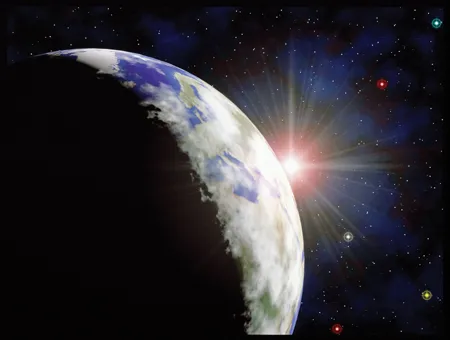
Without the layer of air that surrounds our planet, neither we nor any of the other forms of life that have evolved on Earth could exist. The general term for this layer of air is ‘atmosphere’, a word derived from the Greek atmos (vapour) and sphaira (ball or sphere). Of all the subsystems within the environmental system, the atmosphere has a number of unique characteristics. It is continuous around the Earth (Figure 1), but compared with the size of the Earth, the atmosphere is a thin shell (Figure 2). The part of the atmosphere we know best and live in – the troposphere – is an even thinner shell, only around 12 kilometres (7.5 miles) thick.
© Roger Harris/Science Photo Library
Figure 1 The Earth and its atmosphere from space

© Julian Baum/Science Photo Library
Figure 2 Space Shuttle photograph of the Earth: the thin atmosphere is lit by the setting Sun
If the Earth were the size of an apple, the atmosphere would have the thickness of the apple peel, yet this thin film of gases fulfils many essential functions. It is in the troposphere that all weather occurs; it is only here that life exists. Wind systems and rainfall patterns result from the differential heating by solar energy of the Earth’s surface and, subsequently, the atmosphere. Such weather manifestations are visible from space.
This text introduces the components of the atmosphere, and how meteorological conditions influence air quality. It then goes on to consider the main sources of air pollution. The adverse effects of air pollutants on both human beings and the environment are detailed, together with methods of measuring air pollutants. Methods of preventing or minimising air pollution are then outlined. Finally, air pollution modelling is introduced: this allows prediction of air quality and the impact of air pollutants, and can also be used to determine the effectiveness of any control measures that are implemented.
1.2 Clean air – a basic human need
Have you ever thought about how much air you need to breathe each day? We take the air for granted, but think how long you can go without food or water compared to how long you can hold your breath. The basic biological air requirements for a person weighing around 68 kg are summarised in Table 1.
Table 1 Air requirements for human activity at typical ground-level pressure (100 kPa)
| Activity | l min−1 | l hour−1 |
|---|---|---|
| Resting | 7.4 | 444 |
| Doing light work | 28 | 1680 |
| Doing heavy work | 43 | 2580 |
Based on this information, if we take a working day to comprise 7 hours of heavy work, 7 hours of light work and 10 hours of rest, we need 34 260 litres or 34.26 m3 of air per day. Taking the density of air as 1.29 kg m−3, the mass of air required comes to 44.20 kg. In comparison, we eat no more than about 1.5 kg of food each day, so our air requirement is nearly 30 times our food requirement. Similarly, we probably drink no more than about 2.5 kg of water each day. This indicates why air quality is so important; any contamination needs to be much lower in air than in food and water if we are to ensure that our total intake of potentially harmful substances does not put our health at risk. We cannot choose the air we breathe.
In our modern, technological society, we also need air to burn fuels for heating and for transport. Look at the boiler in Figure 3. To burn 0.8 litres of oil per minute it needs 8.5 m3 of air per minute. A large boiler in a power station needs considerably more air.
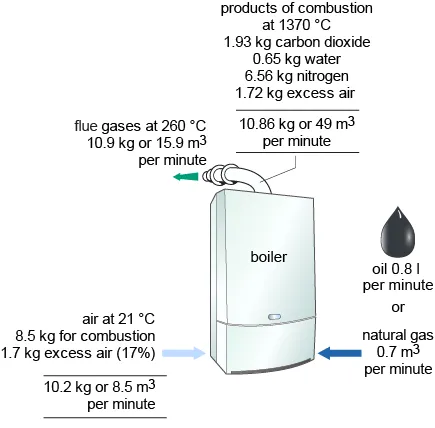
Figure 3 Fuel and air requirements for a typical central heating and hot water boiler
Determination of the stoichiometric (theoretical) air/fuel ratio for the complete combustion of petrol
Modern petrols are blends of hydrocarbons and additives, but we can represent an average formulation in terms of a single component, octane (C8H18). A balanced chemical equation for the combustion of this fuel is:
C8H18 + 12.5 O2 → 8CO2 + 9H2O
The mass of one mole of octane is given by:
(8 × 12) + (18 × 1) = 114 g
The chemical equation tells us that 12.5 moles of molecular oxygen are required for complete combustion of each mole of octane. The mass of this oxygen is given by:
12.5 × 16 × 2 = 400 g
Since the percentage by mass of oxygen in air is approximately 23.15 (you can confirm this for yourself later using the values in Table 2), the mass of air required for complete combustion of one mole of octane is given by:
(400/23.15) × 100 = 1728 g
So the stoichiometric air/fuel ratio is:
air/fuel = 1728/114 = 15.16
Therefore, each mass unit of petrol needs just over 15 mass units of air. Think of how many cars are on the roads. If each kilogram of fuel requires 15 kg of air for combustion in the engine, you should be able to work out how much air you need for your car each day. The car exhaust also contaminates the air we breathe. You can see that the air is an indispensable resource, which we contaminate by using it.
SAQ 1
Suggest some ways that we as individuals contribute to air pollution.
This text will examine some aspects of air quality, look at how the air behaves, and consider how we can minimise our impact on what may be regarded as our most precious resource.
1.3 What is air pollution?
The United Kingdom is where the industrial revolution began, bringing with it a legacy of damage to the natural environment and public health. Resources such as water, coal and minerals were exploited, and by the middle of the nineteenth century the air and water were choked with industrial emissions (Figure 4). Indeed, the image of a prospering industry was of smoking chimneys.
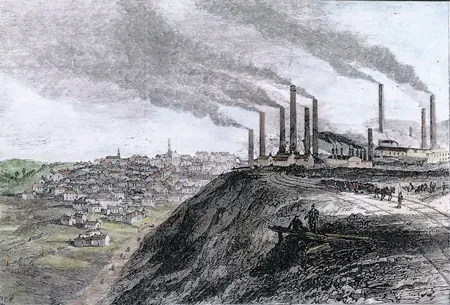
Figure 4 Factory chimneys at Dowlais, South Wales, 1875
The first measures to protect the environment can also be traced back to this period. The air is obviously an important part of the environment to protect – it is essential for the survival of all higher forms of life on the planet. While seemingly vast, the atmosphere accounts for only about 1% of the diameter of the Earth. It is also continuous and so may be contaminated by activities perhaps hundreds or even thousands of miles away. We usually refer to this contamination as air...
Table of contents
- Section 1: Air basics
- Section 2: Meteorology and air pollutants
- Section 3: Environmental monitoring
- Section 4: Air pollution control techniques
- Section 5: Atmospheric dispersion modelling
- Glossary
- References
- Acknowledgements
Trusted by 375,005 students
Access to over 1.5 million titles for a fair monthly price.
Study more efficiently using our study tools.
Frequently asked questions
Yes, you can cancel anytime from the Subscription tab in your account settings on the Perlego website. Your subscription will stay active until the end of your current billing period. Learn how to cancel your subscription
No, books cannot be downloaded as external files, such as PDFs, for use outside of Perlego. However, you can download books within the Perlego app for offline reading on mobile or tablet. Learn how to download books offline
Perlego offers two plans: Essential and Complete
- Essential is ideal for learners and professionals who enjoy exploring a wide range of subjects. Access the Essential Library with 800,000+ trusted titles and best-sellers across business, personal growth, and the humanities. Includes unlimited reading time and Standard Read Aloud voice.
- Complete: Perfect for advanced learners and researchers needing full, unrestricted access. Unlock 1.5M+ books across hundreds of subjects, including academic and specialized titles. The Complete Plan also includes advanced features like Premium Read Aloud and Research Assistant.
We are an online textbook subscription service, where you can get access to an entire online library for less than the price of a single book per month. With over 1.5 million books across 990+ topics, we’ve got you covered! Learn about our mission
Look out for the read-aloud symbol on your next book to see if you can listen to it. The read-aloud tool reads text aloud for you, highlighting the text as it is being read. You can pause it, speed it up and slow it down. Learn more about Read Aloud
Yes! You can use the Perlego app on both iOS and Android devices to read anytime, anywhere — even offline. Perfect for commutes or when you’re on the go.
Please note we cannot support devices running on iOS 13 and Android 7 or earlier. Learn more about using the app
Please note we cannot support devices running on iOS 13 and Android 7 or earlier. Learn more about using the app
Yes, you can access Air Quality Management by Suresh T. Nesaratnam, Shahram Taherzadeh, Suresh T. Nesaratnam,Shahram Taherzadeh in PDF and/or ePUB format, as well as other popular books in Technology & Engineering & Environmental Management. We have over 1.5 million books available in our catalogue for you to explore.