The 10 Principles of Food Industry Sustainability
eBook - ePub

The 10 Principles of Food Industry Sustainability

  1. English
  2. ePUB (mobile friendly)
  3. Available on iOS & Android
eBook - ePub

The 10 Principles of Food Industry Sustainability

About this book

Although the food industry is beginning to make headway with its sustainability initiatives, substantially more progress is needed in order to feed the world's growing population sustainably. The challenge is that the topic of sustainability can seem overwhelming and there is limited information that is specific to the food industry.

Written by an experienced food industry professional with years of experience in sustainability, The 10 Principles of Food Industry Sustainability inspires and informs the progress required to nourish the population, revitalize natural resources, enhance economic development, and close resource loops. The book makes this complex topic approachable and actionable by identifying the most pressing sustainability priorities across the entire food supply chain and showing, with tools and examples, how producers, processors, packers, distributors, marketers and retailers all play a role in advancing improvement. The book begins with an overview of the Principles of sustainability in the food industry: what they are and why they matter. Subsequent chapters focus on each of the Ten Principles in detail: how they relate to the food industry, their global relevance (including their environmental, health, and social impacts), and the best practices to achieve the potential of meaningful and positive progress that the Principles offer. Specific examples from industry are presented in order to provide scalable solutions and bring the concepts to life, along with top resources for further exploration.

The Principles, practices, and potential of sustainability in the food industry covered in this book are designed to be motivating and to offer a much-needed and clear way forward towards a sustainable food supply.
Frequently asked questions

Yes, you can cancel anytime from the Subscription tab in your account settings on the Perlego website. Your subscription will stay active until the end of your current billing period. Learn how to cancel your subscription.
No, books cannot be downloaded as external files, such as PDFs, for use outside of Perlego. However, you can download books within the Perlego app for offline reading on mobile or tablet. Learn more here.
Perlego offers two plans: Essential and Complete
  • Essential is ideal for learners and professionals who enjoy exploring a wide range of subjects. Access the Essential Library with 800,000+ trusted titles and best-sellers across business, personal growth, and the humanities. Includes unlimited reading time and Standard Read Aloud voice.
  • Complete: Perfect for advanced learners and researchers needing full, unrestricted access. Unlock 1.4M+ books across hundreds of subjects, including academic and specialized titles. The Complete Plan also includes advanced features like Premium Read Aloud and Research Assistant.
Both plans are available with monthly, semester, or annual billing cycles.
We are an online textbook subscription service, where you can get access to an entire online library for less than the price of a single book per month. With over 1 million books across 1000+ topics, we’ve got you covered! Learn more here.
Look out for the read-aloud symbol on your next book to see if you can listen to it. The read-aloud tool reads text aloud for you, highlighting the text as it is being read. You can pause it, speed it up and slow it down. Learn more here.
Yes! You can use the Perlego app on both iOS or Android devices to read anytime, anywhere — even offline. Perfect for commutes or when you’re on the go.
Please note we cannot support devices running on iOS 13 and Android 7 or earlier. Learn more about using the app.
Yes, you can access The 10 Principles of Food Industry Sustainability by Cheryl J. Baldwin in PDF and/or ePUB format, as well as other popular books in Technology & Engineering & Food Science. We have over one million books available in our catalogue for you to explore.

1
Introduction to the Principles

1.1 The 10 principles of food industry sustainability

  1. Safe and highly nutritious food is accessible and affordable to promote and support a healthy population.
  2. Agricultural production beneficially contributes to the environment while efficiently using natural resources and maintaining a healthy climate, land, water, and biodiversity.
  3. Use of animals, fish, and seafood in the food supply optimizes their well-being and adds to environmental health.
  4. Producer equity and rural economy and development are strengthened with fair and responsible production and sourcing.
  5. Safe and suitable working conditions are provided to support employees across the supply chain.
  6. Food and ingredient processing generates resources and requires minimal additional inputs and outputs.
  7. Packaging effectively protects food and supports the environment without damage and waste.
  8. Food and ingredient waste and loss are prevented across the supply chain and what cannot be avoided is put to a positive use.
  9. Food and ingredients are efficiently delivered across the supply chain and to the consumer.
  10. The supply chain and consumers advance sustainable business and food consumption.

1.2 Principles–practices–potential

Our food system has the potential to produce renewable energy, replenish freshwater and other natural resources, provide an effective means of developing economic capacity, and remove waste through closing resource loops while nourishing the population. Are we achieving this potential? No, we fall short. In fact, we are not able to feed our population and yet cause astounding environmental and social damage.
The Principles of Food Industry Sustainability provide guidance on what to focus on across the supply chain to meet the needs of the population while not contributing to destruction of the environment or society. This book explains these principles through examples of how the supply chain has adopted them and what approaches are working, best practices. In many cases the efforts are moving past reducing detrimental impact and toward the goal of having meaningful and positive effects.

1.3 What is sustainability in the food industry?

The world’s population depends on the food industry to produce, process, and deliver safe and nutritious food every day of the year. The demands on the food industry from farm to fork continue to increase. The global population is expected to increase from the current 7 billion to nearly 10 billion by 2050, thereby increasing food needs more than 60% (Consultative Group on International Agricultural Research [CGIAR] 2014). Most of the growth will be in developing countries where improvements in standards of living are rapidly shifting the diet from grains, beans, and other legumes to more animal protein. This will increase the demand for meat and poultry about 35% by 2015 (Pew 2008).
Yet, the food system is already contributing to widespread environmental damage and compromised health and livelihoods of our global population. The amount of energy used to produce, process, package, store, and transport food is seven and a half times the amount of energy the food actually provides in return (Heller & Keoleian 2000). The food supply is thereby a significant factor in climate change, water use and pollution, and the reduction of fish stocks in the oceans; at the same time 33% of adults in the United States are obese and over 12% of the world’s population is malnourished.
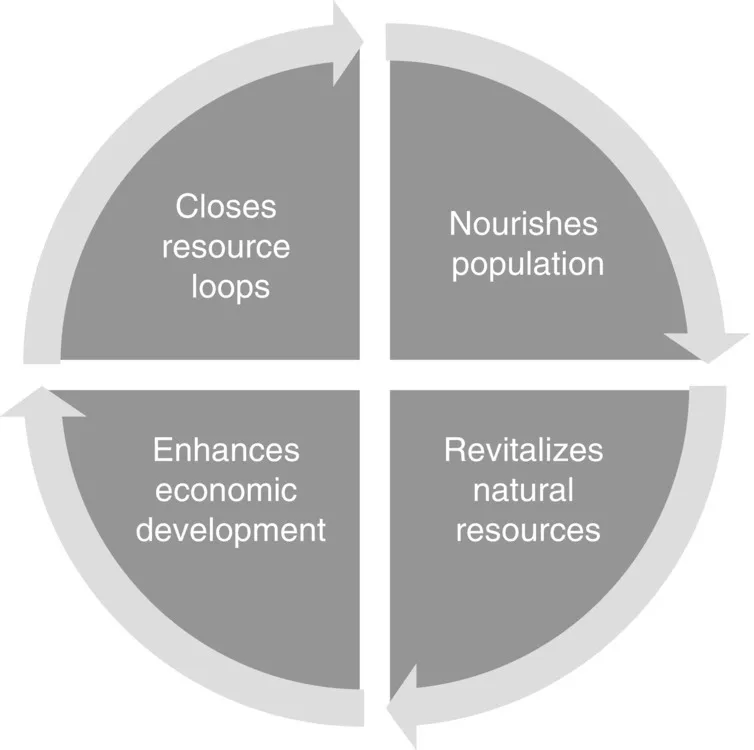
The goal of sustainability in the food industry is to produce and consume food in a way that supports the well-being of generations. The current system clearly falls short and, with the growing demands for food as the population surges, there is the need and the opportunity for the food industry to balance the market needs for food with its environmental and social requirements. The ten principles given in this book provide a framework in which to address these requirements to move toward sustainability in the food industry. Together they aim for a food system that nourishes the population, revitalizes natural resources, enhances economic development, and closes resources loops (see Figure 1.1).
c1-fig-0001
Figure 1.1 Aim for a sustainable food system.

1.4 The destructive course of the food system

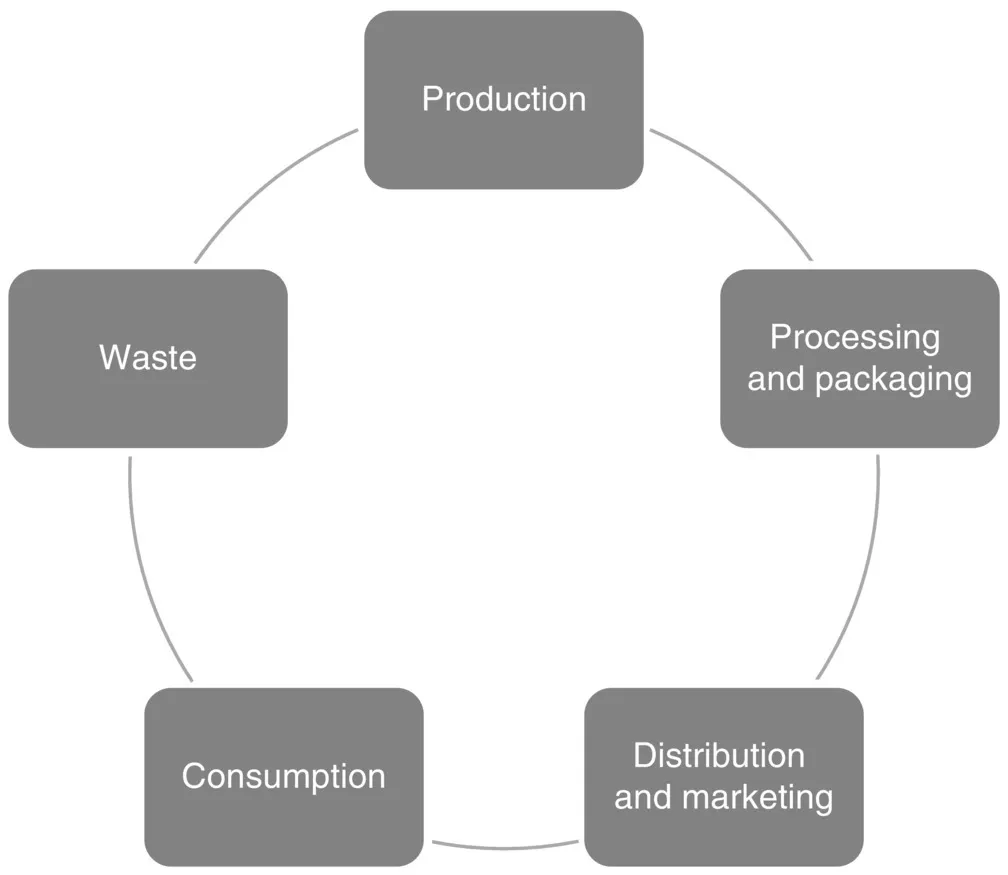
The many activities that go into the global food system can be divided into five major parts: agricultural production, processing and packaging, distribution and marketing, consumption, and waste (see Figure 1.2). Each stage of the food life cycle has unique interactions with the environment and society, causing problems that can be reduced or avoided. This book does not go into the details of these issues but provides a concise summary of the importance and relevance of addressing these concerns. The chapters that follow describe how the supply chain is moving away from the course of destruction toward a system of sustainability that has the potential to thrive economically and benefit both the environment and society.
c1-fig-0002
Figure 1.2 Food life cycle.
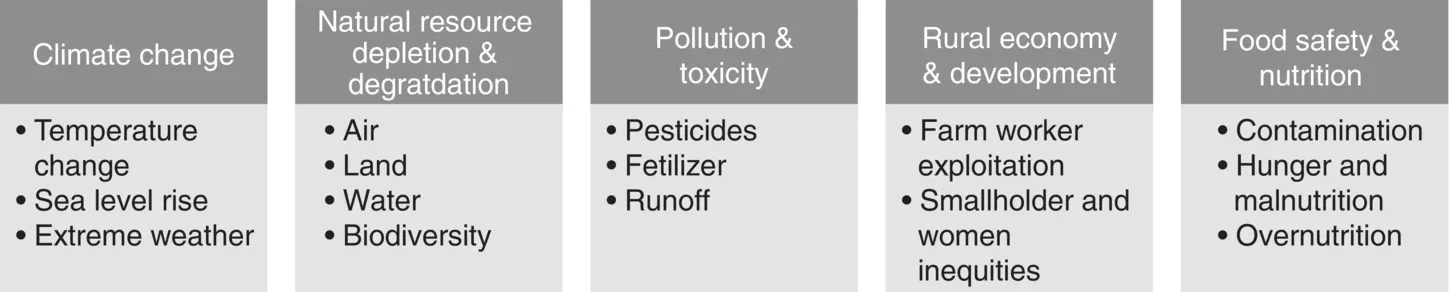
The primary environmental and social issues of the current food system are closely related to each other and often influence each other. These include climate change, natural resource depletion and degradation, pollution and toxicity, rural economy and development, and food safety and nutrition (see Figure 1.3). These issues are not theoretical but are creating real challenges that businesses are facing today. One example of a supply chain disruption attributed to climate change was the unusually prolonged drought in Russia over the summer of 2010. By early August, more than one-fifth of Russia’s wheat crop had been destroyed and the government banned all grain exports, contributing to wheat price futures reaching their highest point in nearly two years. General Mills was one of many food manufacturers that faced significant price pressure as a result and announced price increases of between 4 and 5% in September 2010 (Reed & Willis).
c1-fig-0003
Figure 1.3 Global environmental and social challenges with the food system.

1.4.1 Climate change

Climate change is the shifting of global temperatures owing to various factors. A leading cause is the accumulation of heat-trapping gases in the atmosphere, called greenhouse gases (GHGs), including carbon dioxide, methane, nitrous oxide, and others. GHGs trap the sun’s heat in the earth’s atmosphere rather than allowing it to escape out to space. The accumulation and increase of GHGs has led to warmer atmospheric temperatures.
The food supply contributes significantly to climate change by being responsible for about 10 to 30% of global GHGs (U.S. Environmental Protection Agency [EPA] 2010a; and Bellarby et al. 2008). GHGs include the carbon dioxide emitted from electricity production and fuel use, methane from landfills and the production of an increasing number of livestock animals, nitrous oxide from excessive fertilizer use, and other kinds of emissions. Carbon dioxide is the most prevalent GHG; however, methane and nitrous oxide are significantly more potent than carbon dioxide at warming the climate (see Table 1.1). Table 1.2 factors in this difference in global warming potential (by putting all GHGs into equivalent terms) ...

Table of contents

  1. Cover
  2. Title page
  3. Copyright page
  4. Acknowledgments
  5. 1 Introduction to the Principles
  6. 2 Agriculture and the Environment
  7. 3 Welfare and Environmental Considerations in Production and Harvesting of Animals, Fish, and Seafood
  8. 4 Processing
  9. 5 Packaging
  10. 6 Distribution and Channels
  11. 7 Food Waste
  12. 8 Nutrition, Security, and Equity
  13. 9 Sustainable Food Consumption and the Potential of the Principles
  14. Index
  15. End User License Agreement