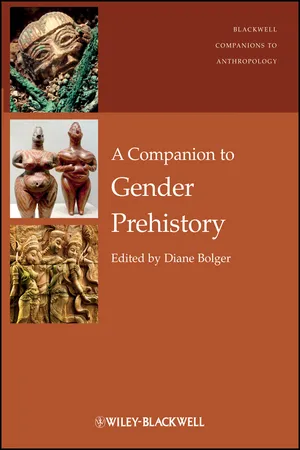
- Provides the most up-to-date, comprehensive coverage of gender archaeology, with an exclusive focus on prehistory
- Offers critical overviews of developments in the archaeology of gender over the last 30 years, as well as assessments of current trends and prospects for future research
- Focuses on recent Third Wave approaches to the study of gender in early human societies, challenging heterosexist biases, and investigating the interfaces between gender and status, age, cognition, social memory, performativity, the body, and sexuality
- Features numerous regional and thematic topics authored by established specialists in the field, with incisive coverage of gender research in prehistoric and protohistoric cultures of Africa, Asia, Europe, the Americas and the Pacific
- English
- ePUB (mobile friendly)
- Available on iOS & Android
eBook - ePub
A Companion to Gender Prehistory
About this book
An authoritative guide on gender prehistory for researchers, instructors and students in anthropology, archaeology, and gender studies
Information
PART I Thematic Perspectives in Gender Prehistory
SECTION 1
Current Themes and Debates
CHAPTER 1 Engendering Human Evolution
Prior to the 1960s there was little discussion about social life in prehistoric times, much less an examination of women’s roles. Up to this point the cultural ideals of the 1950s prevailed in the wider society and were unquestioned within anthropology: women as stay-at-home moms with men bringing home the bacon, a sexual division of labor, and the nuclear family were all regarded as “natural” and part of an ancient pattern. During the 1960s advances in several areas of research revolutionized our understanding of human origins. This evidence and a growing social awareness of women’s roles influenced anthropologists to reconsider the evolution of human behavior and where women fit into the picture. Hence, the 1960s and 1970s gave rise to an altered view of human evolution that focused on female primates, women cross-culturally, and women’s roles in the evolutionary past.
The 1970s saw a scientific as well as popular flowering of articles and books about women that shifted the default setting away from men. “Woman the Gatherer” became the counter to “Man the Hunter” and identified women as central in anthropological theory. The discussion of gender continued and expanded in several fields during the 1980s and 1990s through research, conferences, and publications. At the same time, counter forces challenged, undermined, and ignored evidence that gave balance to women’s roles. Darwin’s ideas on sexual selection resurfaced with female choice of mates although he, along with later researchers, maintained an emphasis on male dominance. Sexual selection and male-male competition became centerpieces for the then new field of sociobiology, which narrowed evolution to “reproductive strategies.”
Sometime in the 1990s, “feminism” developed into a pejorative term, especially among women scientists, and researchers in their publications shied away from mentioning gender and connecting women to any interpretations of activities during human evolution. References to gender diminished so that the behavior of ancient hominids became “genderless,” and ultimately retained males in the central position.
As we go forward, a wealth of research emerging in the twenty-first century and a life history framework hold renewed potential for incorporating gender into evolutionary reconstructions. An appreciation of the history and limitations of the fossil and archaeological records can help steer clear of androcentrism and untenable assumptions about the past. Recognition of the complexity of human and nonhuman primate societies is replacing one-dimensional explanations of past societies. Membership then and now consists of all ages, both sexes, and more than two generations. When human biology goes beyond reproductive function and addresses the intersections with sociality and cultural practices, a less simplistic and more balanced approach to gender and human evolution becomes possible.
HISTORICAL BACKGROUND: EVIDENCE FOR RECONSTRUCTING THE PAST
The human lineage originated about 5–6 million years ago and diversified into many species that represented different stages of anatomical and behavioral development through time. As other species died out, Homo sapiens came to dominate during the last 50,000 years. In the 1960s, however, studies of human evolution focused on the origin and early fossil species belonging to the australopithecines. Several lines of evidence contributed to these evolutionary issues and questions and became part of the support for reconstructing gender roles in the past.
Molecular data and primate field research
The application of molecular data to questions about human origins extended into anthropology through the comparative study of proteins and amino acids in different species. Sarich and Wilson (1967) demonstrated unequivocally that the African apes, chimpanzees, and gorillas are most closely related to humans. These data provided an unexpected time frame, namely, that the three lineages (gorillas, chimpanzees, and humans) are so closely related that their separation occurred as recently as 5 million years ago, which contradicted the view accepted at the time about human origins of a separation 15 million years ago.
These molecular data added significance to discoveries from field studies on the natural history of African and Asian monkeys and apes. The highly popularized research of Jane Goodall (1968) initiated in 1960 documented the lives of chimpanzees, particularly the matriarch Flo and her offspring. A detailed film record brought to public attention chimpanzee mother–infant interactions, skills in tool using and making, gestures and social communication, and the ability to catch and eat monkeys. These and other behaviors seemed to narrow the gap between apes and humans and highlighted the social centrality of females.
Ethnographic evidence
Hunter-gatherer societies have been of particular interest for prehistory because a nomadic foraging way of life persisted throughout evolution until about 15,000 years ago, like yesterday in evolutionary time (Thomas 1959; Marshall 1976). During the 1960s, research by Richard Lee on the Kalahari Bushmen, the !Kung San, elaborated the reality of women’s lives through detailed documentation of work effort and energy output in collecting and sharing many types of plants, in walking long distances while carrying infants and food items, and in using tools to acquire food (Lee 1968a, 1968b, 1979). He also showed that women fashion, transport, and use digging sticks with a fire-hardened point, along with a stone for sharpening it. This all-purpose tool is effective for unearthing underground roots and tubers hidden from view and deeply buried. Finding and extracting them requires knowledge, skill, and strength. Women as active problem solvers, who shared food and contributed to the social fabric of the group, provided a model for reconstructing women’s multiple roles in the ancient past.
Record of the past
Until the 1960s the only evidence for an early stage in human evolution consisted of fossil bones from South African caves of unknown age. When Louis and Mary Leakey announced their exciting discoveries from Olduvai Gorge in Tanzania, they captivated the anthropological world. They uncovered associations of animal bones, stone tools, and the remains of hominids in contexts of ancient lake and river margins. Breakthroughs in radiometric dating methods verified the time depth of almost 2 million years – a time frame that doubled the previous estimates of the extent of human evolution (Morell 1995).
These eastern African discoveries of known age lent support to the antiquity of the cave findings in South Africa first discovered in 1925 by Raymond Dart, with later findings by Robert Broom and John Robinson from the 1930s to 1950s. At that time there was no geological method that could establish the age of these cave deposits. Furthermore, there was little agreement on how the animal and hominid bones had accumulated in South African caves, initially maintained by Dart to be the result of human hunting activities. C. K. (Bob) Brain undertook the challenge and demonstrated that the bones were due to carnivore activity and that the hominids, rather than the animals, were often the victims (Brain 1970, 1981).
During the 1970s a wealth of fossils, including footprints preserved in volcanic ash in Tanzania, extended the evidence of human evolution to more than 3.5 million years. In Ethiopia a partial skeleton of the famous fossil dubbed “Lucy” raised questions about sexual dimorphism in this species of australopithecines. In Kenya numerous fossils representing more than one species were excavated along with stone tools and animal bones. According to their pelvic morphology, these early hominids were bipedal, but they had chimpanzee-size brains one third the size of Homo sapiens, as well as large and well worn molar teeth.
Evolutionary theory
In the realm of evolutionary theory, Darwin’s Descent of Man and Selection in Relation to Sex (1871) gained renewed interest in anthropology from Bernard Campbell’s edited volume Sexual Selection and the Descent of Man 1871–1971 (1972). After publishing his ideas about evolution by natural selection to explain the appearance of new species, Darwin shifted his attention to variation within a species and formulated the concept of sexual selection. Mating behavior, he surmised, is a mechanism that shapes female and male differences within a species and consists of two components leading to sexual dimorphism: male–male competition and female choice. Reproductive success is at the center of the concept, and though Darwin primarily highlighted males, female choice presented a new framework for field primatologists and evolutionary theorists. Robert Trivers (1972) connected mate choice with parental investment, the notion that the sex investing the most in its offspring likewise invests more heavily in the choice of mates. Because female primates put more time and energy than males into reproductive effort, sexual selection points to female primates as the principal choosers.
These lines of evidence, singly and in combination, gave a clearer picture of the when and where of human origins, and at the same time provided a basis for challenging traditional views about gender and the evolution of human behavior.
MAN THE HUNTER AND WOMAN THE GATHERER
Research on the evolution of social behavior was initiated during the late 1950s by anthropologist Sherwood Washburn, first in a paper with Virginia Avis (1958), and later in a conference on social life (1961). A joint paper with his student Irven DeVore (Washburn and DeVore 1961) contrasted baboon life with that of pre-agricultural humans to highlight the behavioral gap and the uniqueness of human social life. For the first time, a specific species, savanna baboons, was used for comparison with early hominids, another savanna species.
Early human evolution came to be summed up in the “Hunting hypothesis,” which was based on the premise that, like the baboon, our ape ancestors were strict vegetarians and that meat was the “new” component of the diet. As part of this dietary shift, a configuration of behaviors emerged in which men acquired meat through hunting and shared it with their pair-bonded mates and nuclear families back at the home base. Thus men assumed the primary role in foraging, food sharing, tool using, and tool making. Furthermore, male aggression, bonding, and warfare, along with the nuclear family and the sexual division of labor, came to be explained as “natural” outcomes of evolution (e.g., Tiger 1969).
When Richard Lee returned from his research on the Kalahari hunter-gatherers, he and Irven DeVore organized a conference in 1966, later published as Man the Hunter (1968). A paper in this volume by Sherwood Washburn and Chet Lancaster (1968) on the evolution of hunting helped seal “Man the hunter” as an icon in human evolution. Ironically, Lee’s introduction to the volume pointed up the bias in the material record of women’s activities. In an archaeological context, he noted that important organic objects, such as women’s digging sticks and skin bags (karosses), leave no trace whereas stone tools and animal bones, traditionally associated with male activities, do. Consequently, one important component of women’s activities is no longer visible. Additionally, Lee (1968a, 1968b) found that women contributed a majority of the family’s daily calories through gathering and sharing activities. But these points did little to offset the emphasis on hunting in that volume or in the wider context.
Richard Lee’s fieldwork, however, sparked interest in taking a deeper look at the role of women in evolution. Picking up on the active dimensions of women’s lives as portrayed by Lee, Sally Linton’s landmark paper, “Woman the Gatherer: Male Bias in Anthropology,” presented at the 1970 annual meetings in San Diego of the American Anthropological Association, offered a counter to the mainline hunting thesis. Initially circulated on blue-ink dittoed paper, it was subsequently published in 1971 (and again in 1975 under Sally Slocum). Soon the phrase “Woman the gatherer” caught on as a counter to “Man the hunter” and drew attention to women by narrowing, and in a way stereotyping, economic roles for both genders.
Confronting issues about hunting and gathering from the comparative perspective of diet, Harding and Teleki (1980:3) challenged the idea that hunting and eating meat were new in human evolution. They reviewed historical reasons for the preoccupation with hunting: glacial periods in Europe projected back in time; tools as weapons (Darwin); and meat-eating of early hominid hunters (the broken bones in South African caves). Research papers in the volume provided “hard data that have been lacking” from primate field studies and from cultural studies on several populations of hunter-gatherers. Although not directly focused on gender, the data presented challenged the assumption of a vegetarian ancestor that needed meat in order to become human, although the idea about diet and the primacy of meat persists to the present time.
EXPANDING WOMEN’S ROLES
During the 1960s and 1970s research in Africa provided new data for formulating an alternative: field studies of African apes; ethnographies of the Kalahari hunter-gatherer way of life; discoveries of fossil and archeological sites from South Africa; Tanzania’s Olduvai Gorge; Kenya’s Koobi Fora, and later, the Hadar region of Ethiopia; developments in methodologies for dating volcanic geological deposits (potassium argon) that extended human origins back in time to nearly 4 million years ago; new excavation methods applied to archaeological sites that established context of bone and stone assemblages; and comparative anatomy and molecular data to establish evolutionary relationships – all provided a rich context.
Within this context Nancy Tanner and I began to develop new hypotheses about the similarities between a chimpanzee-like ape ancestor and early humans, and about differences that arose in the divergence of the two lineages and the transformation of early humans some 3 to 5 million years ago. Interpreting this early stage of human evolution, we incorporated discoveries of chimpanzee behavior, fossil hominids that were bipedal with small brains, and ethnographies documenting human activities. Combining social anthropology and its “people focus” with an evolutionary framework integrated socio-cultural and physical anthropology. Rather than an exclusive focus on human differences, we emphasized continuity between chimpanzee and human biology and behavior, and at the same time proposed new patterns that might have emerged in the transition from ape ancestors to early hominids.
Our approach was as important as the data we gained from different lines of evidence. Washburn (1951) emphasized the use of all the available evidence from both fossils and living species as a basis for testing hypotheses. To understand the transition to a human way of life in eastern Africa, he argued it was necessary to take into account the social behavior of primates and hunter-gatherers (Washburn and Avis 1958; Washburn and Lancaster 1968). Our conclusions differed from Washburn’s. He later insisted to me that he had always acknowledged the importance of gathering, but emphasized hunting as the fundamental new element in human evolution. We agreed to disagree.
Drawing on available research, Nancy and I used the molecular discovery of a recent ape–human divergence to support our choice of chimpanzee behavior to represent the transitional population of apes, rather than using baboon, carnivore, or a grab-bag of behaviors from several species that were proposed at the time. The fossil record is limited because behavior does not fossilize; consequently, we relied on observations of behavior in present-day societies. Chimpanzees are omnivores, not strictly vegetarians as is often assumed, use tools, share food, and carry offspring for several years. Similarly, women in foraging societies are omnivorous, adept tool users, carry their young, and are part of social networks. We concluded that these attributes were selected for in early hominid females. As the first hominids moved into the savanna environment away from the forests some 4–5 million years ago, innovations involving tools for gatheri...
Table of contents
- Cover
- Series page
- Title page
- Copyright page
- Dedication
- List of Illustrations
- List of Tables
- Notes on Contributors
- Acknowledgments
- Introduction: Gender Prehistory – The Story So Far
- PART I: Thematic Perspectives in Gender Prehistory
- PART II: Regional Perspectives in Gender Prehistory
- Index
Trusted by 375,005 students
Access to over 1.5 million titles for a fair monthly price.
Study more efficiently using our study tools.
Frequently asked questions
Yes, you can cancel anytime from the Subscription tab in your account settings on the Perlego website. Your subscription will stay active until the end of your current billing period. Learn how to cancel your subscription
No, books cannot be downloaded as external files, such as PDFs, for use outside of Perlego. However, you can download books within the Perlego app for offline reading on mobile or tablet. Learn how to download books offline
Perlego offers two plans: Essential and Complete
- Essential is ideal for learners and professionals who enjoy exploring a wide range of subjects. Access the Essential Library with 800,000+ trusted titles and best-sellers across business, personal growth, and the humanities. Includes unlimited reading time and Standard Read Aloud voice.
- Complete: Perfect for advanced learners and researchers needing full, unrestricted access. Unlock 1.5M+ books across hundreds of subjects, including academic and specialized titles. The Complete Plan also includes advanced features like Premium Read Aloud and Research Assistant.
We are an online textbook subscription service, where you can get access to an entire online library for less than the price of a single book per month. With over 1.5 million books across 990+ topics, we’ve got you covered! Learn about our mission
Look out for the read-aloud symbol on your next book to see if you can listen to it. The read-aloud tool reads text aloud for you, highlighting the text as it is being read. You can pause it, speed it up and slow it down. Learn more about Read Aloud
Yes! You can use the Perlego app on both iOS and Android devices to read anytime, anywhere — even offline. Perfect for commutes or when you’re on the go.
Please note we cannot support devices running on iOS 13 and Android 7 or earlier. Learn more about using the app
Please note we cannot support devices running on iOS 13 and Android 7 or earlier. Learn more about using the app
Yes, you can access A Companion to Gender Prehistory by Diane Bolger in PDF and/or ePUB format, as well as other popular books in Social Sciences & Archaeology. We have over 1.5 million books available in our catalogue for you to explore.