- English
- ePUB (mobile friendly)
- Available on iOS & Android
eBook - ePub
About this book
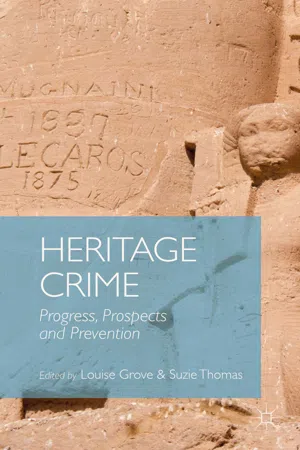
Bringing together leading academics and practitioners from across the globe, this unique collection explores the emerging field of heritage crime studies. Moving beyond the traditional focus on illicit antiquities, the volume identifies the diversity of crimes that affect heritage and outlines various approaches to prevention.
Information
Topic
ArteSubtopic
Arte generale1
Introduction
Suzie Thomas and Louise Grove
What is ‘heritage crime’?
‘Heritage crime’ as a term has begun to appear more and more in both academic and policy documents. In England, the non-governmental organization responsible for the management and promotion of the historic environment, English Heritage, has even taken on the issue of heritage crime as a key aspect within its strategy moving forward (English Heritage, 2013, p. 15). More broadly, such globally pertinent issues as the international trafficking of cultural objects, especially those looted from archaeological sites and monuments, have long attracted the attention of academics, heritage managers, lawyers, journalists and participants in the art market alike (see for example Coggins, 1969 for an early archaeological discussion of the issue; Ede, 1998, for a dealer’s perspective, and Silver, 2009, for a journalistic investigation). The challenges connected to the curtailing of the theft and illegal export of cultural material, not only that of an archaeological origin, continue to be an important area of research for many and the conflation of heritage crime in general with illicit trade was suggested in a recent publication produced in partnership between Norwegian and Polish agencies (Ramskjaer et al., 2011). However, other crimes also have a significant impact on cultural heritage, as defined here.
As this volume demonstrates, a vast range of criminal activity, from theft and vandalism, to contraventions of planning and development regulations by corporations and others, as well as the destructive impact of the search for saleable artefacts, can and does have an impact on cultural heritage and the historic environment. Recognizing this, there is a growing movement to categorize certain crimes as heritage crime. Outlining their research parameters for a survey of ‘cultural heritage crime’ in the Nordic nations, Korsell et al. (2006, p. 7) explained that, for them, the term:
. . . includes theft of cultural objects from preservers, such as museums and churches, and from dealers, such as antique shops and auction houses. Cultural heritage crime also includes illegal movement/export of protected cultural objects that even though they are legally acquired, may not be taken out of the country without a permit. The illegal import of these objects from other countries also constitutes a cultural heritage crime. The looting of ancient monuments and shipwrecks is also included.
English Heritage defines heritage crime even more broadly (although in an English context) ‘as any offence which harms the value of England’s heritage assets’ (Coombes et al., 2012, p. 7). This term reflects more closely our philosophy here, since we recognize that more offences than just those connected to theft, import and export negatively impact on heritage.
Defining heritage
In order to understand better the components of heritage crime, we can briefly think about how both ‘heritage’ and ‘crime’ are separately understood. Scholars of heritage studies have offered what can often be rather holistic interpretations of what constitutes heritage. This is a complex term, with nuanced meanings beyond its physical aspects. One of the seminal writers on the concept of heritage, Lowenthal (1998, p. x), has discussed at length how heritage can be regarded, exploited, claimed and criticized, and above all how it differs from history:
In fact, heritage is not history at all; while it borrows from and enlivens historical study, heritage is not an inquiry into the past but a celebration of it, not an effort to know what actually happened but a profession of faith in a past tailored to present-day purposes.
Gegner and Ziino (2012, pp. 1–2) have also noted that:
It is not simply the case that there are two or more sides to any story, but that heritage itself has a history: a history surrounding the creation of significant sites and practices; a history of management and continuous reworking of meanings into the present.
These definitions, which acknowledge the intangible and fluid facets of heritage, are useful for understanding why heritage, or the notion of it at least, is important to different people at different times. A wide range of things and concepts may be construed as heritage, whether a physical monument, cultural or natural landscape, object, language, or even a way of life. The damage or destruction of heritage therefore causes harm beyond the immediate physical loss, due to the meanings and values which may be attached to it and the access to collective memory and commemoration that may be lost alongside it. It is not for nothing that the Cultural Revolution of China targeted Tibetan documentary heritage (Lloyd, 2007, p. 56), or that Mostar Bridge and other iconic heritage sites were destroyed in the conflicts of the former Yugoslavia in the 1990s (Coward, 2006).
Yet heritage, as well as giving clear foundations to the identity and sense of place felt by people at individual, local, national and regional levels, also requires a degree of formalization in its management and definition. This can assist in a legal sense – if an asset is designated to have heritage importance and special protection in law, then acts causing damage to the asset can, at least theoretically, be prosecuted.
The United Nations Educational, Scientific and Cultural Organization (UNESCO), with various international conventions affecting cultural heritage, has offered a definition of cultural heritage as part of the Convention Concerning the Protection of the World Cultural and Natural Heritage 1972 (UNESCO, 1972, Article 1) which divides it into different categories:
monuments: architectural works, works of monumental sculpture and painting, elements or structures of an archaeological nature, inscriptions, cave dwellings and combinations of features, which are of outstanding universal value from the point of view of history, art or science;
groups of buildings: groups of separate or connected buildings which, because of their architecture, their homogeneity or their place in the landscape, are of outstanding universal value from the point of view of history, art or science;
sites: works of man or the combined works of nature and of man, and areas including archaeological sites which are of outstanding universal value from the historical, aesthetic, ethnological or anthropological points of view.
In another of the UNESCO conventions, the Convention on the Means of Prohibiting and Preventing the Illicit Import, Export and Transfer of Ownership of Cultural Property 1970, ‘cultural property’, heritage in a more portable (and tradable) form, is also suggested to fall into several categories. Crucially, the convention also acknowledges that ultimately the types of cultural property, or objects, that are to be subject to legal protection, in this case from unauthorized import or export, ‘is specifically designated by each State as being of importance’ (UNESCO, 1970, Article 1). This suggests, as is borne out by the examples in this book, that while there are some more or less universally accepted and understood means of defining and designating heritage, much falls to national legislations to recognize heritage within their own jurisdictions. This in turn, depending on national laws and restrictions, impacts what can be considered as crime.
Adding ‘crime’ to ‘heritage’
Crime, in the present context, is more straightforward than heritage to define. Perhaps one of the most simplistic, but nonetheless on the mark definitions of crime is that it is ‘an act of law violation’ (Burt and Simons, 2013, p. 1326) and this is the definition which leads our authors in this volume. This is different from activities that may be perceived in some quarters as detrimental to heritage, but which are not in themselves crimes. This may include drastic changes to heritage sites sanctioned by government authorities, or treasure-hunting activities in jurisdictions where these are not prohibited. No matter how some people may feel about these practices, they are not criminal in their nature and, while worrisome in their own way, fall outside the scope of this book. As has been noted elsewhere, the range and frequency of crimes can vary ‘dramatically across countries, states, cities, and . . . neighborhoods’ (Ludwig and Kling, 2007, p. 491, sic.). This is certainly the case within this volume, where it becomes apparent that crimes such as metal thefts have grown internationally – nonetheless leading to noticeable increases in specific types of heritage crime such as theft of lead from churches in specific countries such as England (Price, Sidebottom and Tilley, Chapter 8). Similarly, countries such as Peru, with a rich and, significantly, financially desirable, range of material culture to be found on its territory, continue to experience looting of archaeological sites. This is exacerbated by socio-economic and cultural factors (Tantaleán, Chapter 5). Environmental (and to a certain extent corporate) crimes specific to a particular type of environment can have a direct effect on the archaeological heritage, which while registered (and thus protected) may not always be noticeable to offenders, and hence not a specific target of the offence (such as forestry-related crimes, see Laulumaa, Chapter 4) – these are the ‘incidental heritage crimes’ discussed by Grove and Pease (Chapter 7).
It is clear therefore that heritage and crime are both diverse terms and to differing extents are affected by national convention and legislature. This can mean that an activity affecting heritage that is under certain conditions legal in one country can become illegal by simply moving the activity to another jurisdiction. Taking this diversity at national and regional levels into account, as well as understanding that categories of heritage can vary and be distinct to specific places and cultures, we would offer our own definition of heritage crime to be any activity that is prohibited by law that causes loss of, damage to, or other harm to places, monuments or objects considered to be heritage.
The need for a dedicated publication
In 2011, the editors of this volume were part of an interdisciplinary team on a project funded by English Heritage. The project advertised was to capture data on the extent of crimes affecting heritage assets in England. Thomas’s experience as a Heritage Studies researcher undertaking a doctorate that investigated metal detecting in the UK, and Grove’s background as a criminologist with a particular specialism in crime prevention, meant that they had specific knowledge and skill sets to contribute to the project. During and after the production of the final report (see Coombes et al., 2012), it became apparent that even crimes that at first glance did not seem to be specifically heritage-related (such as graffiti and other vandalism; see Shelbourn, Chapter 11 for discussion of a notorious case in England), were nonetheless significantly impacting on the heritage around us. We found that our experience in the UK was mirrored in what colleagues in other countries were discussing, showing that activities such as the disregard of planning regulations (e.g. Wennberg, Chapter 9) were also causing irreversible damage to heritage sites, from historic buildings to underground archaeology. Similarly, it was clear that discussions over developing policy to deal with threats to heritage from criminal activity were taking place across the globe (e.g. Vollgraaff, Chapter 10).
With these thoughts in mind, and upon discovering a relative dearth of scholarly literature on heritage and crime in its most holistic sense, it became apparent that there was a need for a forum in which to discuss and present the various examples of types of crime from a range of perspectives. Therefore, this edited volume comes at a time that, we feel, is appropriate for capturing the various developments and initiatives concerning crimes against heritage. We have endeavoured to invite contributions that provide a truly global context, with contributors from a range of different countries and continents. The contributors themselves also come from diverse but relevant disciplines, including policing, heritage management, law, archaeology and criminology.
The crimes affecting cultural heritage range from some of the more well-known issues such as the looting and trafficking of material from archaeological sites or museum collections (e.g. in Musteaţă, Chapter 5; Benson and Fouché, Chapter 2) through to emerging problems such as lead theft from churches (Price, Sidebottom and Tilley, Chapter 8). The socio-cultural difficulties behind discouraging heritage crime activities are also explored (e.g. Tantaleán, Chapter 3), as are the legal frameworks with which authorities try to respond (e.g. Vollgraaff, Chapter 10; Shelbourn, Chapter 11).
Organization of the book
The book is divided thematically, with the first section focusing on case studies highlighting heritage crime in different parts of the world and the second section on how we look to tackle and prevent heritage crime. This division is of course notional in many respects, since all of the chapters include a focus on a particular region, and the second section, while focusing more on ways of tackling heritage crime, inevitably draws upon regional and national examples and laws. Therefore thematic overlaps exist throughout.
In Section I, ‘Heritage Crime Around the World’, authors working in diverse geographical settings present what are almost situation reports of their respective regions of interest. Benson and Fouché (Chapter 2), with specialisms in policing and criminology respectively, represent the only contributors in this section not from cultural heritage or archaeological backgrounds. They present insights specifically into understanding museum thefts in South Africa. In Chapter 3, Tantaleán provides an overview of the treatment of, and threats to, archaeological heritage in Peru. Discussing also the history of changing legislation’s effects and social attitudes towards archaeological heritage, Tantaleán shows that, while looting remains a problem (and a problem noted at length elsewhere, e.g. Alva, 2001), other threats – such as the rapid expansion of settlements supported by ineffectual laws – also cause considerable damage. Contravention of forestry regulations in Finland is covered by Laulumaa in Chapter 4, where he notes that the difficulty in bringing a prosecution against activity that destroys archaeological heritage means that success is virtually unheard of, despite Finland, on paper at least, app...
Table of contents
- Cover
- Title Page
- Copyright
- Contents
- List of Figures and Tables
- Foreword
- Notes on Contributors
- 1. Introduction
- Section I: Heritage Crime around the World
- Section II: Tackling Heritage Crime
- Index
Trusted by 375,005 students
Access to over 1.5 million titles for a fair monthly price.
Study more efficiently using our study tools.
Frequently asked questions
Yes, you can cancel anytime from the Subscription tab in your account settings on the Perlego website. Your subscription will stay active until the end of your current billing period. Learn how to cancel your subscription
No, books cannot be downloaded as external files, such as PDFs, for use outside of Perlego. However, you can download books within the Perlego app for offline reading on mobile or tablet. Learn how to download books offline
Perlego offers two plans: Essential and Complete
- Essential is ideal for learners and professionals who enjoy exploring a wide range of subjects. Access the Essential Library with 800,000+ trusted titles and best-sellers across business, personal growth, and the humanities. Includes unlimited reading time and Standard Read Aloud voice.
- Complete: Perfect for advanced learners and researchers needing full, unrestricted access. Unlock 1.5M+ books across hundreds of subjects, including academic and specialized titles. The Complete Plan also includes advanced features like Premium Read Aloud and Research Assistant.
We are an online textbook subscription service, where you can get access to an entire online library for less than the price of a single book per month. With over 1.5 million books across 990+ topics, we’ve got you covered! Learn about our mission
Look out for the read-aloud symbol on your next book to see if you can listen to it. The read-aloud tool reads text aloud for you, highlighting the text as it is being read. You can pause it, speed it up and slow it down. Learn more about Read Aloud
Yes! You can use the Perlego app on both iOS and Android devices to read anytime, anywhere — even offline. Perfect for commutes or when you’re on the go.
Please note we cannot support devices running on iOS 13 and Android 7 or earlier. Learn more about using the app
Please note we cannot support devices running on iOS 13 and Android 7 or earlier. Learn more about using the app
Yes, you can access Heritage Crime by Louise Grove,Suzie Thomas in PDF and/or ePUB format, as well as other popular books in Arte & Arte generale. We have over 1.5 million books available in our catalogue for you to explore.