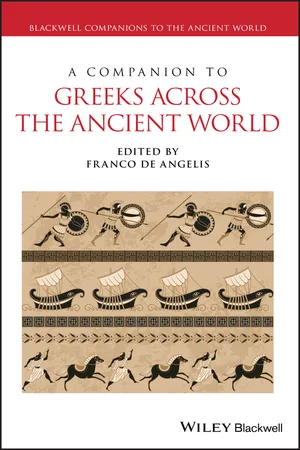
A Companion to Greeks Across the Ancient World
eBook - ePub

A Companion to Greeks Across the Ancient World

  1. English
  2. ePUB (mobile friendly)
  3. Available on iOS & Android
eBook - ePub

A Companion to Greeks Across the Ancient World

About this book

An innovative, up-to-date treatment of ancient Greek mobility and migration from 1000 BCE to 30 BCE

A Companion to Greeks Across the Ancient World explores the mobility and migration of Greeks who left their homelands in the ten centuries between the Early Iron Age and the Hellenistic period. While most academic literature centers on the Greeks of the Aegean basin area, this unique volume provides a systematic examination of the history of the other half of the ancient Greek world. Contributions from leading scholars and historians discuss where migrants settled, their new communities, and their connections and interactions with both Aegean Greeks and non-Greeks.

Divided into three parts, the book first covers ancient and modern approaches and the study of the ancient Greeks outside their homelands, including various intellectual, national, and linguistic traditions. Regional case studies form the core of the text, taking a microhistory approach to examine Greeks in the Near Eastern Empires, Greek-Celtic interactions in Central Europe, Greek-established states in Central Asia, and many others throughout Europe, Africa, and Asia. The closing section of the text discusses wider themes such as the relations between the Greek homeland and the edges of Greek civilization. Reflecting contemporary research and fresh perspectives on ancient Greek culture contact, this volume: 

  • Discusses the development and intersection of mobility, migration, and diaspora studies
  • Examines the various forms of ancient Greek mobility and their outcomes
  • Highlights contributions to cultural development in the Greek and non-Greek world
  • Examines wider themes and the various forms of ancient Greek mobility and their outcomes
  • Includes an overview of ancient terminology and concepts, modern translations, numerous maps, and full references

A Companion to Greeks Across the Ancient World is a valuable resource for students, instructors, and researchers of Classical antiquity, as well as non-specialists with interest in ancient Greek mobilities, migrations, and diasporas.

Frequently asked questions

Yes, you can cancel anytime from the Subscription tab in your account settings on the Perlego website. Your subscription will stay active until the end of your current billing period. Learn how to cancel your subscription.
No, books cannot be downloaded as external files, such as PDFs, for use outside of Perlego. However, you can download books within the Perlego app for offline reading on mobile or tablet. Learn more here.
Perlego offers two plans: Essential and Complete
  • Essential is ideal for learners and professionals who enjoy exploring a wide range of subjects. Access the Essential Library with 800,000+ trusted titles and best-sellers across business, personal growth, and the humanities. Includes unlimited reading time and Standard Read Aloud voice.
  • Complete: Perfect for advanced learners and researchers needing full, unrestricted access. Unlock 1.4M+ books across hundreds of subjects, including academic and specialized titles. The Complete Plan also includes advanced features like Premium Read Aloud and Research Assistant.
Both plans are available with monthly, semester, or annual billing cycles.
We are an online textbook subscription service, where you can get access to an entire online library for less than the price of a single book per month. With over 1 million books across 1000+ topics, we’ve got you covered! Learn more here.
Look out for the read-aloud symbol on your next book to see if you can listen to it. The read-aloud tool reads text aloud for you, highlighting the text as it is being read. You can pause it, speed it up and slow it down. Learn more here.
Yes! You can use the Perlego app on both iOS or Android devices to read anytime, anywhere — even offline. Perfect for commutes or when you’re on the go.
Please note we cannot support devices running on iOS 13 and Android 7 or earlier. Learn more about using the app.
Yes, you can access A Companion to Greeks Across the Ancient World by Franco De Angelis in PDF and/or ePUB format, as well as other popular books in History & Greek Ancient History. We have over one million books available in our catalogue for you to explore.

Information

PART I
APPROACHES, ANCIENT AND MODERN

CHAPTER ONE
Mobility in the Ancient Greek World: Diversity of Causes, Variety of Vocabularies1

Michela Costanzi
Since the beginning of the 1990s, the question of mobility has been at the center of a renewed reflection in historical studies, especially within the ancient period. The past two decades saw a transition from a very marginal vision of this phenomenon2 to a new approach which, first off, frames the Mediterranean as the site, since the Archaic period, of all kinds of migration, individual and collective (Gras 1995; Stazio 2000; cf. Moatti 2012, 40), and then imposes a vision of this fluid space as the scene for traffic, exchange, and diverse and complex movements.3
The work of Claudia Moatti has only confirmed the importance of mobility which, beyond just pushing people to move with objects in tow, also takes on precise forms, and has political, social, economic, and cultural consequences (Moatti 2004, 2007; Moatti and Kaiser 2007, 2009; Moatti, Kaiser, and Pébarthe 2009). Tracing the historiography of the concept of mobility, she remarks that since we cannot doubt that mobility lies at the heart of ancient as well as modern and contemporary societies, then this concept alone encompasses a large variety of movements and displacements. It also underlines how “behind a unifying [modern] vocabulary lies a great diversity of realities,” which range from mass movements (for which we most often use the term migration, referring interchangeably to colonization, exodus, or flight, etc.) to individual mobility (called generally or imprecisely foreigner, who could just as easily be an alien, nomad, or guest, etc.). Moatti denounces the uniformity of this modern lexicon, which reduces the complexity of these experiences and relations, and argues for “the necessity to start from the ancient vocabulary.”4 But were the ancient Greeks really aware of different types of movement, conveyed in a specific and precise vocabulary? Or is their vocabulary reductive and unvarying from the start?
This study presents a few examples to identify different forms of mobility and their causes, and to analyze the terms used in ancient sources. One should not expect an exhaustive glossary here. The examples, which come from literary and epigraphic sources of the Archaic to Hellenistic periods, illustrate a sampling of the terms used by ancient authors.5 Among the many categories of mobility, I will endeavor to go deeper into some of the most significant ones, so as to identify a specific lexicon. I will at times study certain problems raised by the vocabulary of modern authors on this subject.

Categories of Mobility

From the Archaic to the Hellenistic periods, the sources clearly show that the Greeks were in constant movement for numerous reasons. Modern thinkers interpret this with great variety: for some, mobility is a condition of everyday life, just as much in times of peace as war;6 for others, the practice of traveling, though not foreign to the ancients, was nevertheless not as common as now, for political and social reasons (hostility, wars) and practical reasons (distance, the precariousness of routes, and modes of transport), implying a different concept and command of space (Marasco 1978, 15–29). The reality is that, despite difficulties, the majority of ancient Greeks traveled incessantly, pushed by all sorts of motives and without the aid of our modern modes of transport.
As Thucydides (1.2.1–2) relates, “in ancient times” the Greeks were already emigrating and leaving their homes with ease:
It appears, for example, that the country now called Hellas had no settled population in ancient times; instead there was a series of migrations (μεταναστάσεις), as the various tribes, being under the constant pressure of invaders who were stronger than they were, were always prepared to abandon (ἀπολείποντες) their own territory. There was no commerce…. the use they made of their land was limited to the production of necessities; they had no surplus left over for capital, and no regular system of agriculture…. they showed no reluctance in moving from their homes (οὐ χαλεπῶς ἀπανίσταντο), and therefore built no cities of any size or strength…
(trans. Warner 1954).
The primary agent of mobility during the Archaic period is certainly colonization, which is to say the foundation of cities outside of Greek territory, more or less autonomous and independent of the metropolis. In the Classical period, colonies were founded as part of the constitution of the Athenian Empire, different from the cleruchies established during that same time. In the Hellenistic period, Alexander founded colonies throughout his eastern expedition, all bearing his name, as well as some other less important establishments. Thereafter, Hellenistic kings often resorted to the metonymy of ancient cities as they transformed and adapted to the new Greek presence.
Moreover, commerce drove Greeks to the extreme borders of the Mediterranean, touching the coastlines to the east and west, from which they moved inland. The more they traveled, the greater their reputation, and the further they went. Sanctuaries generated remarkable mobility as well. Private visits included Greek individuals consulting oracles at sanctuaries for personal or healing reasons. Public visits involved the political life of the city and the flow of its official representatives, oikistai, theoroi, ambassadors, and emissaries. Sanctuaries were equally a meeting place for athletes and artists. For education, Greek students and teachers were drawn to and from the great centers of Hellenic culture, like Athens or Alexandria in Egypt.
While the above forms of mobility are done freely, others by contrast involve constraint and violence: ostracisms, exiles, migrations of populations, and marriages across borders and cultures. Hence all Greeks moved about, and not just those among the elite. This list of the categories of mobility is incomplete, and in turn these categories can only be unevenly developed. By organizing them into two groups – mass mobility and personal mobility – I am forced to choose certain categories which seem particularly significant to highlight their causes and reasons for their associated vocabulary. I will leave aside mobility linked to colonization, which has already received ample commentary.7 Nevertheless, concerning Archaic colonization I cannot avoid the debate sparked by modern language.

Mass Mobility

Greeks left home (in general, the colonial expedition and the settlement itself were indifferently called apoikia, “away from home”) for many reasons,8 and settled themselves all along the perimeter of the Mediterranean and the Black Sea. These newly founded cities multiplied, reproducing cities of t...

Table of contents

  1. Cover
  2. Table of Contents
  3. Maps
  4. Illustrations and Tables
  5. Abbreviations
  6. Notes on Contributors
  7. Acknowledgments
  8. Introduction
  9. PART I: APPROACHES, ANCIENT AND MODERN
  10. PART II: REGIONAL CASE STUDIES
  11. PART III: THEMES
  12. Index
  13. End User License Agreement