Biological Sciences

Biotic and Abiotic Factors
Biotic factors refer to living components of an ecosystem, such as plants, animals, and microorganisms, that directly influence the environment. Abiotic factors, on the other hand, are non-living components like temperature, water, sunlight, and soil that also impact the ecosystem. Both biotic and abiotic factors play crucial roles in shaping the structure and function of ecosystems.
Written by Perlego with AI-assistance
Related key terms
1 of 5


11 Key excerpts on "Biotic and Abiotic Factors"

- Vierah Hulley(Author)
- 2023(Publication Date)
- Delve Publishing(Publisher)
Key Aspects of Environmental Planning: Public Policy and Practice 14 1.5. ABIOTIC COMPONENTS OF THE ENVIRONMENT Abiotic components are nonliving chemical and physical components of the environment that have an effect on the operation of living species and the ecosystem. They are also known as abiotic variables. Both the abiotic components themselves and the actions that they give rise to are necessary for life. They have an effect on a very wide variety of species that are found in a variety of environments, and this includes creatures that live in the ocean and on land. The human race is capable of either generating or influencing abiotic aspects of the surrounding environment (Sugumaran et al., 2004). Fertilizers, for example, have the potential to affect the surrounding habitat of a snail, whereas the GHGs created by humans have the potential to change the pH levels of marine ecosystems (Figure 1.9). Figure 1.9. Abiotic factors of the environment. Source: https:// d20khd7ddkh5ls.cloudfront.net/ ecology_abiotic_factors.jpg. Abiotic factors are conditions and resources that are not alive and that have an effect on the development, maintenance, and reproduction of living organisms. Materials are substances or resources found in the environment that are necessary for the survival of one species but are used up by other species or are unavailable to those species. The constituents of a material deteriorate as a result of chemical or physical processes like hydrolysis, for example. Abiotic components are all of the non-living components that make up an ecosystem, such as the weather and the availability of water and air. When it comes to determining where an organism lives and how The Environment 15 successfully it does so in its environment, these are the most important factors (Singleton, 2002). Even though a number of the components are reliant on one another, it is still feasible for a single component to function as a limiting factor.
- Hassan A.H. Ibrahim, Mostafa M. El-Sheekh, Hassan A.H. Ibrahim, Mostafa M. El-Sheekh(Authors)
- 2000(Publication Date)
- Bentham Science Publishers(Publisher)
The biotic (living) factors consist of organisms and their products and wastes. The abiotic (nonliving) component of the environment includes both physical and chemical factors. Any change in surrounding conditions directly or indirectly would change the existing habitat and create new conditions that in turn change the community structure of the living organisms (biotic factors) and consequently change the way they react with the abiotic factors. In marine environments, the relationship between biotic and abiotic components of the environment and the other surrounding environments is greatly controlling the life within the system (Fig. 1). For example; the deep-sea habitat, which is the deepest region of marine habitat (i.e., 700 m - several miles) is a harsh region with almost no sunlight, and hence no photosynthesis occurs. Therefore, several factors and processes are controlling organisms’ dwelling in the deep-sea environment; including non-living attributes, such as temperature, current, pressure, oxygen, and carbon dioxide exchange, and interaction with biotic factors and or processes responsible for life in deep-sea habitat, involving food abundance, competitors, and predators [ 28 ]. The aquatic biomes include the ocean, lakes, rivers, streams, and ponds. Any body of water that harbors life is an aquatic biome. Aquatic biomes have specific features and characterizations (abiotic components) that affect the way living things, which the biome also hosts - can flourish. Both phytoplankton and zooplankton components include members of the “microbial loop” of microscopic organisms that have been discovered recently to serve very important functions in energy flow and nutrient cycling [ 63 ]. Also, the ocean can be categorized by referring to all of the ocean’s open water as the pelagic realm (or zone) while the benthic realm (or zone) extends along the ocean bottom from the shoreline to the deepest parts of the ocean floor (Fig. 1) eBook - PDF
Agroecology
The Ecology of Sustainable Food Systems, Third Edition
- Stephen R. Gliessman(Author)
- 2014(Publication Date)
- CRC Press(Publisher)
131 11 Abiotic factors of the environment such as light, temperature, and mineral nutrients are not the only constituents of the environment that impact crop plants. Just as important are biotic factors—that is, living organisms and the conditions created and modified by them. An insect herbivore such as a locust, for example, can have an enormous impact on a crop plant, as can a neighboring plant that harbors nitrogen-fixing bacteria in its root nodules or conserves the soil moisture by shading the soil surface. In Chapter 8, we discussed organisms in the environ-ment (soil biota) that might affect crop plants. We did not, however, treat these soil organisms as biotic factors; instead we considered them among the multiple aspects of the soil that combine to make soil a separate factor of the environ-ment. Here in this chapter, we lay the groundwork for treat-ing these living organisms as biotic factors in their own right (although the primary focus will be on plants as biotic factors). In agroecosystems, the farmer is in a sense the organism with the greatest impact on the environment in which crops are grown. The farmer alters and adjusts conditions of the physical as well as the biological environment to meet the needs of the crop or crops. To do so sustainably, the farmer must have an understanding of the biotic interactions of the agroecosystem—how each member of the community impacts the agricultural environment and alters conditions for its neighbors. To conceptualize biotic factors in ecological terms, we must enter an area of overlap between autecology and syn-ecology. Even though we begin from the perspective of the individual organism confronting an environment made up of various factors, we must deal with interactions between organisms when the factors we are concerned with are biotic.
- Kiran Abasaheb More(Author)
- 2023(Publication Date)
- Delve Publishing(Publisher)
ECOLOGY 1 CONTENTS 1.1: Introduction ........................................................................................ 2 1.2: Biotic Factors in an Ecosystem ............................................................ 5 1.3: Abiotic Factors in an Ecosystem .......................................................... 7 1.4: Types of Ecology ................................................................................. 9 1.5: Importance of Ecology ...................................................................... 20 CHAPTER Ecological Studies in Environmental Science: New Insights and Perspectives 2 1.1: INTRODUCTION Ecology is a branch of biology that examines the relationships that exist between living things and the environments in which they live. The field of research known as biophysics investigates the relationships that exist between living things and the physical world around them. In this particular biophysical environment, it is possible to identify both biotic and abiotic components. The study of how organisms interact with their respective environments is known as ecology. Ernst Haeckel, a physicist from Germany, is credited with first using the word in 1866. It is possible to trace its roots back to the Greek language. Oikos is the term that is used for “home” in Greek, whereas logos is the word that is used for “school.” In a biophysical environment, everything is related to everything else and impacts everything else in some way. In the natural world, there are many different kinds of systems, and these systems all interact with one another to form ecosystems. As a consequence of this, the ecosystem may be thought of as a location. Figure 1.1: Ecology: the example is for CO2 analysis. Source: Public Domain, https://commons.wikimedia.org/w/index. php?curid=2109652 When all of the species in a region collaborate, they have the potential to create an environment that is not just consistent but also favorable to the existence of life. eBook - PDF
- Andrew S. Pullin(Author)
- 2002(Publication Date)
- Cambridge University Press(Publisher)
The ecosystem concept An ecosystem is a community of living organisms together with the phys-ical processes that occur within an environment. All organisms are faced with environmental variables to cope with. These are usually divided into abiotic factors, including the broad climate and geology as well as specific factors such as temperature, water (rainfall and humidity), light, salinity, pressure and soil and water chemistry (pH and mineral content), and biotic factors, which are interactions with other organ-isms, including competition, predation, parasitism and symbiosis. Thus there are abiotic (non-living) and biotic (living) components of an ecosys-tem, all potentially interacting to form a functioning unit, distinguish-able, although not isolated, from other ecosystems. The concept of the ecosystem is central to our understanding of the natural world. Ecological studies have shown how energy flows through ecosystems, from the capture of light energy by plants and conversion to the chemi-cal energy in sugars, to its passage through successive trophic levels and constant escape back into the environment (Fig. 2.1). Equally, we have learnt how nutrients and water are cycled from the atmosphere to the soil, through plants, animals, decomposers and back again; the intrica-cies of food webs and the interdependence of species in coevolved mutu-alisms (the evolution of relationships between species because of the benefit to both, e.g. pollinators and flowering plants); and how our eco-systems are shaped by the challenges of the abiotic environment. The study of the spatial distribution of species and habitats has led to the classification of the environments or ecosystem types we have on our planet in terms of the flora and fauna that prevail in them. This is most developed for terrestrial environments, but applies to aquatic ones as well. In this chapter we briefly review major world ecosystems. eBook - PDF
- Khushboo Chaudhary, Pankaj Kumar Saraswat, Aniruddh Kumar Pareek(Authors)
- 2023(Publication Date)
- Delve Publishing(Publisher)
Population Stabilization: Human birth rates have stabilized in most industrialized countries. Health: The incidence of life-threatening diseases has been reduced in most countries. Habitat Conservation: Deforestation has slowed & habitat protection has improved in some areas. Renewable Energy: Progress is being made in the transition to renewable energy sources. Freedom: Democracy is spreading around the world allowing local people to govern themselves. International Cooperation: helps solve global environmental problems An environmental management system brings together the people, policies, plans, review mechanisms, and procedures used to manage environmental issues at a facility or in an organization. Biotic factors are all of the living or once living things in an environment. Abiotic factors are all of the nonliving things in an environment. The interactions among living organisms such as plants and animals are called biotic factors, which may cause marked effects upon vegetation. The effects may be direct and indirect and modify the environment. The plants mostly live together in a community and influence one another. Similarly, animals in association with plants also affect plant life in one or several ways. The different interactions among them can be classified into the following two types they are positive interaction and negative interaction. Positive Interactions When one or both the participating species are benefited, it is positive interaction examples Mutualism and Commensalism. a. Mutualism: It is an interaction between two species of organisms in which both are benefitted from the obligate association. The following are common examples of mutualism. Environment- Environmental Management ond Control of Pollution... 127 Nitrogen fixation Rhizobium (Bacterium) forms nodules in the roots of leguminous plants and lives symbiotically. eBook - PDF
Ecology
Principles and Applications
- J. L. Chapman, M. J. Reiss(Authors)
- 1998(Publication Date)
- Cambridge University Press(Publisher)
Whether or not an organism can survive at all stages of its life in a particular environment is therefore of considerable importance in determining the distribution within habitats and the overall global range of individual species. Figure 9.2 summarises the complex interactions between the abiotic and biotic environments of an organism. Investigations of the components of the environ- ment and the responses of organisms play a crucial part in ecological study as they add to our under- standing of both the distribution of species and the structure of communities. 9.2 The physical environment 9.2.1 The composition of the physical environment The physical or abiotic environment experienced by an organism depends on several factors: geology (rock and soil types); topography (landscape); world location (latitudinal light and temperature varia- tions); climate and weather; and catastrophes (fire, earthquakes etc.). Some of these factors such as the geology and topography of an area are relatively sta- ble; they may be different at different places, but at any one site they will remain constant for periods of time much longer than the life of the organisms living there. Other factors, such as atmospheric con- ditions including humidity, wind speed, temperature and sunlight, will be very variable at one locality from one day or year to the next. Such abiotic factors will also change throughout the day and night, so that an organism, however short its life span, will have to live through changes in the environment. 9.2.2 Geology and soil The different rock types which form the geology of an area are the product of many long and complicated processes. These include the effects of the movements of whole continents by a process called plate tecton- ics (see Section 18.2), igneous activity such as volcanos, the accumulation of sediments and erosion of rocks. Figure 9.3 shows how complex the pattern produced by these processes can be. eBook - PDF
Ecotoxicology
A Comprehensive Treatment
- Michael C. Newman, William H. Clements(Authors)
- 2007(Publication Date)
- CRC Press(Publisher)
21 Biotic and Abiotic Factors That Regulate Communities 21.1 CHARACTERIZING COMMUNITY STRUCTURE AND ORGANIZATION The organization of a community results from the outcome of interspecific competition for the available resources, and is expressed both in the relative abundance and the spatial distribution of constituent species. (Hairston 1959) Despite recent advances, both in the acquisition of data and in its analysis, I doubt that any multispecies community is sufficiently well understood for us to make confident predictions about its response to particular disturbances, especially those caused by man. (May 1984) As with most scientific endeavors, the field of ecology is concerned with identifying patterns in the natural world and then explaining the underlying processes responsible for these patterns. Com-munity ecologists specifically focus on characterizing variation in the numbers and types of species found at different locations and understanding the role of biotic and abiotic processes responsible for these differences (Bellwood and Hughes 2001). Changes in species diversity across broad environ-mental gradients or between habitats have occupied the interest of community ecologists for several decades. Variation in the distribution and abundance of species may be a result of broad geographical patterns (e.g., “Why are there so many species in the tropics compared to temperate regions?”) or small-scale, local phenomena (e.g., “Why is community composition different between headwater streams and mid-order streams?”). An appreciation of factors that determine natural spatial and temporal variation in community composition is essential for ecotoxicologists. In order to charac-terize community responses to contaminants and other anthropogenic disturbances, we must first understand the influence of natural spatiotemporal variation on species diversity and composition.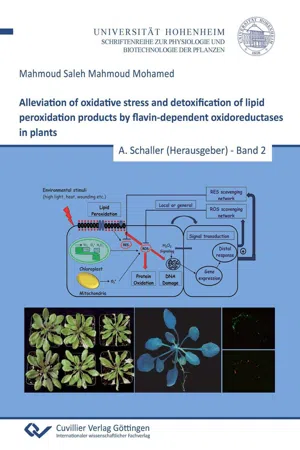
- (Author)
- 2013(Publication Date)
- Cuvillier Verlag(Publisher)
Introduction 1 1. Introduction One of the most important challenges higher plants are facing throughout their lives is to cope with a wide range of environmental stresses. Environmental factors can be of abiotic and/or biotic nature. Abiotic factors such as excessive light, drought, salinity and extreme temperatures are the major environmental factors that limit plant productivity, due to the series of negative morphological, physiological and molecular changes they inflict on the development of plants. Biotic factors include the physical damages caused by insects or herbivores, and diseases that develop from pathogenic bacteria and fungi (Lamb and Dixon, 1997; Bolwell and Wojtaszek, 1997). Combination of several stress factors is the normality for a plant and is referred to as multiple stress (Mittler, 2006; Newton et al., 2011). Plants are resident in place and have limited ability to escape environmental stresses. Therefore, it is essential for them to generate various types of successful resistance responses, which often partly overlap (Mullineaux et al., 2000; Valcu et al., 2009; Huang et al., 2011). Most plant species, due to continuous evolution and/or targeted selection, have developed to some extent the ability to adapt to those unfavourable stresses. The response to natural stress involves a complicated signal transduction network that is activated by sensing the stimuli, and is characterized by the synthesis of stress-related proteins and signaling molecules such as hormones and reactive oxygen species (ROS), and finally the transcriptional activation of specific stress-responsive genes to counteract the stress (see for review Xiong et al., 2002; Suzuki et al., 2012). These signals substantially induce the expression of sets of specific defense genes that lead to the organization of the overall defense reaction. eBook - PDF
- David A. Wright, Pamela Welbourn(Authors)
- 2002(Publication Date)
- Cambridge University Press(Publisher)
Therefore, in making comparisons between dif-ferent data relating to the same toxic agent, it is important to have as much infor-mation as possible on the taxonomic relationship between exposed organisms, their developmental state, the exposure conditions, and the form in which the toxic agent is presented to the biota. Usually, toxic chemicals appear in the environment as complex mixtures wherein the toxicity of one or more chemicals is affected by others in the mixture. As studies of the toxicological action of different chemicals have progressed, it has become possible to draw some inferences concerning the way specific groups of Biotic factors affecting toxicity 219 chemicals are likely to interact. These investigations have also provided a large body of information on the relationship between certain structural properties of chemicals and the way they behave toxicologically. Toxicologists have used these structure activity relationships or quantitative structure-activity relationships to make assumptions about the likely toxicity of chemicals based on properties such as size, polarity, lipid solubility and the presence of certain functional groups. Such information has proven useful in the registration and regulation of chemicals for which there may be little or no specific toxicological data. This chapter discusses some of the principal Biotic and Abiotic Factors affecting the toxicity of chemicals and other agents either by altering their availability to the organism or by affecting their mode of toxic action. 5.2 Biotic factors affecting toxicity 5.2.1 Taxonomic group Toxicity testing is designed to be protective. In selecting organisms from a broad range of ecosystems, our intent is to define the boundaries of damage to these ecosystems caused by man’s activities. In doing so, we need to determine the maximum acceptable concentration for toxicants of concern. eBook - PDF
- Stéphane Jacquemoud, Susan Ustin(Authors)
- 2019(Publication Date)
- Cambridge University Press(Publisher)
7 Variations Due to Leaf Abiotic and Biotic Factors The term “stress” was defined by Jackson (1986) as any disturbance that adversely influences plant growth. Various types of stress can be caused by abiotic (water deficit, nutrient deficiency, salinity, heavy metal, herbicide, air pollution, etc.) and biotic (bacteria, fungi, viruses, insects, etc.) factors. They may induce changes in leaf anatomy, chemistry, and physiology, which will result in changes in leaf optical properties (e.g., Carter, 1993). The challenge of remote sensing is to detect and diagnose stress as early as possible, before symptoms appear. Several approaches have been implemented with varying degrees of success. The main problem is that symptoms of stress caused by one factor are often confused with those caused by another factor. And when stress is caused by more than one factor, spectroscopic data may not provide enough information to identify these factors. 7.1 Abiotic Factors 7.1.1 Edaphic Factors: Mineral Nutrients The difference between rich, fertile soil, and poor, infertile soil is essentially the mineral composition. To grow, plants need about 13 mineral nutrients in an available and balanced form: macronutrients (nitrogen, phosphorus, potassium, calcium, magnesium, and sulfur) and micronutrients (iron, copper, manganese, zinc, boron, molybdenum, and chlorine) that are essential but needed in small amounts. Some macronutrients may interact in the soil with micronutrients or bind with potentially toxic elements making them unavailable to plants. Greenhouse and field studies have shown that a deficiency or an excess in some of these minerals in the soil or other growing medium may cause visual symptoms that can be detected by studying changes in optical properties (Table 7.1). Once exposed, plants often have difficulty recovering. Such symptoms may be a powerful diagnostic tool for evaluating the nutrient status of plants (Taiz and Zeiger, 2010, http://5e.plantphys.net/).
Index pages curate the most relevant extracts from our library of academic textbooks. They’ve been created using an in-house natural language model (NLM), each adding context and meaning to key research topics.

