Biological Sciences

Bioweapons
Bioweapons are biological agents or toxins that are used to cause harm to humans, animals, or plants as part of a deliberate attack. These weapons can include bacteria, viruses, fungi, or other microorganisms, and can be used in warfare or terrorism. Bioweapons pose a significant threat to public health and global security, and efforts to prevent their development and use are a critical focus of international security efforts.
Written by Perlego with AI-assistance
Related key terms
1 of 5
10 Key excerpts on "Bioweapons"
- Mark A. Prelas, Michael Peck(Authors)
- 2005(Publication Date)
- Routledge(Publisher)
157 4 Characteristics of Biological Weapons 4.1 BIOLOGICAL AGENTS Biological agents are defined as living organisms or toxins derived from biological organisms that can adversely affect people, ani-mals, plants, and strategic materials (e.g., an agent that might attack rubber or gasket materials). 1 Throughout history, the bal-ance between infectious disease and humankind has been tenuous. Disease has killed more humans than war. World War II was the first major conflict where more combatants died from directly inflicted wounds rather than from disease or infection. One of humankind’s greatest achievements during the 20th century was medical science advancements that shifted the delicate balance between microbe and man in favor of humankind. Our understand-ing of the microbe has led to significant discoveries in antibiotics, vaccines, and treatments. These discoveries also have a direct impact on the use of microbes in warfare. As discussed in Chapter 2, 20th-century science has successfully transformed certain bio-logical agents into weapons of mass destruction (WMDs). The world pharmaceutical market is enormous, representing estimated total sales of more than $500 billion in 2004. The indus-try growth rate tops 8%, with the bulk of the sales in North America (Figure 4.1). With the growing economies of China and India, there are also promising prospects for future growth in Asia. With the growth of the pharmaceutical industry, there is also a large amount of equipment and expertise widely distributed around the world. Much of this technology is transferable to destructive pur-poses. The proliferation of biotechnology was inevitable. For the 158 Prelas and Peck most part, this type of proliferation is for the benefit of humankind. However, the knowledge can be misused for the production of weapons of mass destruction. It is for this reason that the authors view Bioweapons as the greatest proliferation risk for the devel-opment of weapons of mass destruction. No longer available |Learn more
- (Author)
- 2014(Publication Date)
- University Publications(Publisher)
________________________ WORLD TECHNOLOGIES ________________________ Chapter 1 Biological Warfare Biological warfare (BW) — also known as germ warfare — is the deliberate use of disease-causing biological agents such as bacteria, viruses, fungi, or biological toxins, to kill or incapacitate humans, animals or plants as an act of war. Biological weapons (often termed bio-weapons or bio-agents) are living organisms or replicating entities (viruses) that reproduce or replicate within their host victims. Entomological (insect) warfare is also considered a type of BW. Biological weapons may be employed in various ways to gain a strategic or tactical advantage over an adversary, either by threat or by actual deployment. Like some of the chemical weapons, biological weapons may also be useful as area denial weapons. These agents may be lethal or non-lethal, and may be targeted against a single individual, a group of people, or even an entire population. They may be developed, acquired, stockpiled or deployed by nation states or by non-national groups. In the latter case, or if a nation-state uses it clandestinely, it may also be considered bioterrorism. There is an overlap between biological warfare and chemical warfare, as the use of toxins produced by living organisms is considered under the provisions of both the Biological Weapons Convention and the Chemical Weapons Convention. Toxins and Psychochemical weapons are often referred to as midspectrum agents . Unlike Bioweapons, these midspectrum agents do not reproduce in their host and are typically characterized by shorter incubation periods. Overview Offensive biological warfare, including mass production, stockpiling and use of biological weapons, was outlawed by the 1972 Biological Weapons Convention (BWC). eBook - PDF
- Gary Ackerman, Jeremy Tamsett, Gary Ackerman, Jeremy Tamsett(Authors)
- 2009(Publication Date)
- CRC Press(Publisher)
It will then examine the threat of jihad-ist terrorism vis-à-vis biological weapons in the context of capabilities and the minimum requirements for success. In addition, the chapter examines pathways to acquisition to pro-cure biological weapons as well as known attempts by jihadists to embark down these pathways. UNDERSTANDING BIOLOGICAL AND TOXIN WEAPONS Biological weapons (BW) are produced from pathogenic microorganisms or toxic sub-stances of biological origin, formulated in such a way that they are capable of disabling and/or killing people, crops, and livestock, and combined with an apparatus/method used to deliver the biological harm to the target population. Biological agents are the microorganisms and toxins that cause disease and could be used for manufacturing bio-logical weapons. The biological agents that have been associated with weapons develop-ment can be divided into five key groups: bacteria, viruses, rickettsia, fungi, and toxins (bacteria, viruses, and toxins are the most well-known types of BW agents). Table 6.1 identifies some of the more well-known agents that have been associated with biological weapons development. The difficulty in detecting biological terrorist attacks is that symptoms of illness do not appear immediately, as would occur in a chemical, nuclear, or conventional weapon attack. Because most biological weapons consist of living organisms, symptoms will occur only after an incubation period that may last days to weeks. 2 Many times, the ini-tial symptoms could appear as a common cold or influenza and might be mistaken for a normal outbreak of infectious disease. Until large numbers of individuals report illness, the attack could go undetected. This is especially likely to be the case during annual cold and flu season. If the agent used can translate as a communicable disease, the infec-tion could spread rapidly across a large population before health preventative measures eBook - PDF
- Jim A. Davis, Barry R. Schneider, Jim A. Davis, Barry R. Schneider(Authors)
- 2004(Publication Date)
- Praeger(Publisher)
50 A biological weapon consists of both the biological agent and its means of delivery. Growing microbes is easier than weaponizing or disseminating them. As Larry Johnson, former deputy director of the State Department's Office of Counter-Terrorism, said, "producing these weapons requires in- frastructure and expertise more sophisticated than a lab coat and a garage." 51 However, terrorists may attempt to recruit former biological weapons re- searchers to obtain information on weaponization techniques. Well-funded terrorist organizations might be able to buy the Russian scientists they need. A small subset of terrorist groups is likely to possess the technical know-how needed to carry out an effective biological attack. 52 Unless they are able to buy knowledge or microbe cultures from large programs, such as the former Soviet BW program, it is unlikely, though not impossible, that small terror- ist units would have access to or produce genetically engineered biologicals. GENETIC ENGINEERING, BIOTERRORISM, AND BIOWARFARE Revolutions in Medicine and Military Affairs The techniques of genetic engineering began to be developed in the 1970s. 53 In the 1980s, genetic engineering was already a global multibillion- dollar industry. 54 In the last decade of the twentieth century, the knowledge of molecular biology increased exponentially. The recent revolution in mo- lecular biology may have incidentally unleashed a new threat to mankind in the form of genetically engineered pathogens, which could be used to de- velop many new offensive biological weapons. The same biotechnology that has promised to save lives by treatment of many human diseases also has a dark side that could be misused for the development of deadly Bioweapons. The future of this "black biology" is the subject of the remainder of this chapter. The revolution in molecular biology and biotechnology can be considered as a potential Revolution in Military Affairs (RMA). No longer available |Learn more
Terrorism and WMDs
Awareness and Response, Second Edition
- John Pichtel(Author)
- 2016(Publication Date)
- CRC Press(Publisher)
103 4 Biological Agents You will be well advised to infect the Indians with sheets upon which smallpox patients have been lying, or by any other means which may serve to exterminate this accursed race. Jeffery Amherst, 1717–1797 For the life of me, I cannot understand why the terrorists have not attacked our food supply, because it is so easy to do. Tommy Thompson, 2004 INTRODUCTION Biological warfare has been known, and applied to great effect, for millennia. In recent years, however, with enhanced knowledge of microbiology, culturing techniques, and means of dissemination, the threat has become acute. Bioweapons have been used by ter-rorists, and several nations are known to be manufacturing tactical biological weapons. Therefore, awareness of this potential threat by first responders, medical care providers, public health agencies, elected officials, and ultimately the general public, including how to identify such weapons and to respond appropriately, is essential. CATEGORIES OF BIOTERRORISM AGENTS Given the events of the past two decades, it is essential that the U.S. public health sys-tem and primary healthcare providers be prepared to address a wide range of biological agents, including pathogens that rarely occur in the United States. Even before the bioter-ror attacks of 2001 in which anthrax spores were deliberately released in the U.S. postal 104 TERRORISM AND WMDs system, public health officials expressed concerned regarding the potential for such an event. In 1999, the U.S. Centers for Disease Control and Prevention (CDC), one of the key units of the Department of Health and Human Services, devised a classification scheme for major biological agents that terrorists could use to harm civilians (please see the lists of categories of CDC biological agents and examples of CDC category A, B, and C agents). eBook - PDF
Biosecurity and Bioterrorism
Containing and Preventing Biological Threats
- Jeffrey Ryan, Jan Glarum(Authors)
- 2011(Publication Date)
- Butterworth-Heinemann(Publisher)
Biological agents are no exception to this rule. As such, biowarfare (biological warfare) has a historical aspect to it that must be considered here, for advances in the use of biological agents over the last century are one of the main reasons why bioterrorism exists today. When President Richard M. Nixon said, in November 1969, that “Mankind already holds in its hands too many of the seeds of its own destruction,” he was signing an Executive Order putting an end to the United States offensive capabilities for waging biowarfare. Arguably, this statement foretold the potential doom we might all face when then state-of-the-art technologies became commonplace techniques in laboratories all over the world today. Accordingly, this chapter derives its name from the preceding quote and should serve to remind the reader that the seeds we sowed so long ago have now sprouted. The question remains: How shall they be reaped? The Reality versus the Potential Bioterrorism is the intentional use of microorganisms or toxins derived from living organisms to cause death or disease in humans or the animals and plants on which we depend. Biosecurity and biodefense programs exist largely because of the potential devastation that could result from a large-scale act of bioterrorism. Civilian biodefense funding (CBF) reached an all time high following the anthrax attacks of 2001. Conversely, the reality of the situation is that these well-intended programs cost taxpayers billions of dollars annually. Rapid detection biothreat pathogen tools are available to assist responders with on-site identification of a suspicious substance. In addition, biosecurity and biodefense are “big business” in the private sector. Security measures to protect agriculture and certain vulnerable industries from acts of bioterrorism and natural biological threats are also in place. Two detailed reports published in the journal Biosecurity and Bioterrorism (Schuler, 2005) show that U.S.
- Gupta, Anil K.(Authors)
- 2018(Publication Date)
- Daya Publishing House(Publisher)
Biological weapons could be just as destructive as chemical and nuclear weapons, but they are all the more frightening because they strike silently , invisibly , and may not even be discovered until long after the attack, giving the attackers plenty of time to flee far from the scene. Bioterrorism can range from putting waste matter into food in a small-town restaurant to the aerosolized release (dispersing an agent in a particulate form) of a contagious virus over a large city , or even the spreading of plant or animal diseases in farming areas to disrupt the nation’s food supply. The perpetrator can be anyone from a disgruntled employee to a hostile foreign nation or transnational terrorist group. The type of biological agent used, the means of dissemination, and the effectiveness of the response, as well as unpredictable variables such as rainfall and wind, will determine how many people are affected over how wide an area, and how severe their symptoms are. Theoretically , the number of potential biological agents is almost limitless, but certain agents naturally have a combination of properties (such as hardiness, transmissibility and virulence) that make them most effectiv e as This ebook is exclusively for this university only. Cannot be resold/distributed. w eapons. Several of these have been developed and tested for use as biological weapons, and these are the ones considered most likely to be used in a terrorist attack (Chandler and Landrigan, 2004). Biological vs. Chemical and Nuclear Weapons Figure 4.1: Symbols: Nuclear, biological and chemical weapons. The differences between nuclear or chemical attacks and biological attacks can be compared to the difference between air strikes and sabotage missions. While both are methods of attack, they are based on different technologies, unfold differently and have vastly different effects. eBook - PDF
Terrorism and Counter-Terrorism
Ethics and Liberal Democracy
- Seumas Miller(Author)
- 2009(Publication Date)
- Wiley-Blackwell(Publisher)
More generally, it is a dilemma for the individual communities for whose benefit or, indeed, to whose poten-tial detriment the research is being conducted, and for the national 186 Bioterrorism and the Dual-Use Dilemma governments who bear the moral and legal responsibility of ensuring that the security of their citizens is provided for. Finally, in the context of an increasingly interdependent set of nation-states – the so-called ‘global com-munity’ – the dual-use dilemma has become a dilemma for international bodies such as the United Nations. The Biological Weapons Convention Given the general threat to public health posed by transmissible pathogens, and given that biological agents can be used as WMDs in the hands of state actors, terrorist groups and criminal organizations, there is an imperative strictly to regulate the development, production, stockpiling, weaponization and use of pathogens. At the international level, a key instrument in this regard is the Biological Weapons Convention (BWC). 3 The general aim to which the BWC is directed is, ‘for the sake of all mankind, to exclude completely the possibility of bacteriological (biological) agents and toxins being used as weapons. Convinced that such use would be repugnant to the conscience of mankind and that no effort should be spared to minimize this risk.’ In accordance with Article I of the BWC, Each State Party to this Convention undertakes never in any circumstances to develop, produce, stockpile or otherwise acquire or retain: 1 Microbial or other biological agents, or toxins whatever their origin or method of production, of types and in quantities that have no justification for prophylactic, protective or other peaceful purposes; 2 Weapons, equipment or means of delivery designed to use such agents or toxins for hostile purposes or in armed conflict.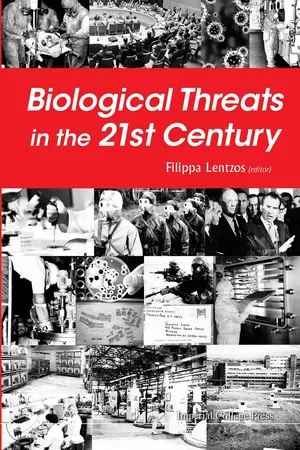 eBook - ePub
Biological Threats In The 21st Century: The Politics, People, Science And Historical Roots
The Politics, People, Science and Historical Roots
- Filippa Lentzos(Author)
- 2016(Publication Date)
- ICP(Publisher)
Determining who might misuse research is further complicated by the sparse empirical data available to assess the likelihood that Bioweapons will threaten national security. Thankfully, there have been only a handful of historical examples of bioterrorism or biowarfare, although multiple nations and terrorist organizations have developed the capability to varying degrees. Intelligence about Bioweapons programs and intent to use them has been difficult to acquire; miscalculations include type 1 errors (Iraq was thought to have a BW program during the lead up to the Second Gulf War, at which time it did not) and type 2 errors (the former Soviet Union was not thought to have a BW program but, in fact, employed tens of thousands of weapons scientists). Given the paucity of other data, judgments about the Bioweapons threat rest largely on expert opinions. Understanding how experts in national security, biosecurity and biosafety perceive the Bioweapons threat is therefore important for assessing the threat, and for assessing the potential for misuse of legitimate research.To assess collective judgments about the Bioweapons threat, colleagues and I carried out a Delphi method study that surveyed 59 U.S. experts in biosecurity, from the U.S. government, academia, nongovernmental sector, and industry organizations.11 We asked participants to estimate the percentage likelihood of a large-scale biological weapons attack occurring within the next ten years in any country. We defined a large-scale attack conservatively, as resulting in more than 100 ill people. There was a wide diversity of opinions. Participants’ answers ranged from one to 100 percent likelihood, with a mean of 57 percent. In general, those trained as biological scientists perceived a lower likelihood of Bioweapons use than other participants, although that was certainly not true in every case.Participants were also asked about the likelihood of different types of state and non-state actors to be the perpetrator of a biological weapons attack within the next 10 years. Although participants held a wide range of opinions, overt state Bioweapons use was considered to be less likely than covert use by a state or use by a non-state group. An overt attack by a state actor was rated significantly less likely than even the next lowest rated actor: criminal groups. Religious extremists were judged to be the most likely group to perpetrate an attack — significantly more likely than a covert attack by a state actor or any other attack by a state, but not significantly more likely than a right-wing violent non-state actor, or a disgruntled or mentally ill individual. eBook - PDF
Pathogens for War
Biological Weapons, Canadian Life Scientists, and North American Biodefence
- Donald H. Avery(Author)
- 2017(Publication Date)
- University of Toronto Press(Publisher)
They were particularly interested in this latter trial since it involved the testing of viral agents such as Venezulan equine encephalitis (VEE), and vaccinia, used as a stimulant for the much-feared variola virus (smallpox). On the policy side, the Defence Research Board monitored ongo-ing debates in the United Kingdom about the relative importance of biological and nuclear weapons. There were several stages in this competition. Until October 1952, when the UK exploded its first atomic bomb, supporters of the Bioweapons option could successfully argue that BW was crucial for the country’s national security, particu-larly since the Air Ministry was actively promoting the development of a 1,000-lb BW cluster bomb. As a result, MRD Porton received consid-erable financial support to expand its laboratory facilities, hire new scientific staff, and make plans for the mass production of bulk patho-gens in a large-scale pilot plant. On the other hand, there was abun-dant evidence that Britain’s military hierarchy regarded Bioweapons as a rather dubious stopgap measure, until the country acquired a nuclear deterrent. As one report to the British Chief of Staff pointed out, “lest over-optimistic results should be expected from [BW] retali-ation on a massive scale, it should be borne in mind that the large-scale use of biological warfare from the air as a weapon of war has not been tried.” 114 Although Porton’s BW operation continued to function after 1952, it was completely eclipsed by the rapidly expanding American program, which, as David Henderson noted, “had become very offensive minded … [and] the Services had gained complete con-trol of BW matters.” 115 78 Pathogens for War Medical Internationalism and Civil Defence Canada and the World Health Organization In their attempts to prevent biological warfare, Canadian scientists also worked closely with the newly created World Health Organization.
Index pages curate the most relevant extracts from our library of academic textbooks. They’ve been created using an in-house natural language model (NLM), each adding context and meaning to key research topics.

